Select Other Languages French.
Two recent books shed light on the events leading to October 7, 2023, and its aftermath, notably by doing what politicians refuse to do: take history seriously.
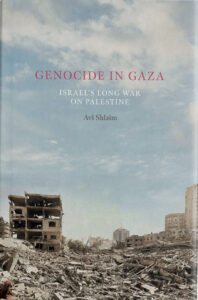
Genocide in Gaza: Israel’s Long War on Palestine by Avi Shlaim
Irish Pages Press 2025
ISBN 9781739090227
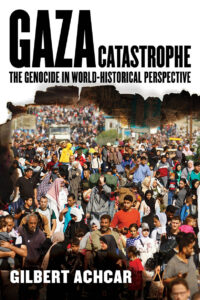
The Gaza Catastrophe: The Genocide in World-Historical Perspective by Gilbert Achcar
University of California Press and Saqi Books 2025
ISBN 9780520423558
In the immediate aftermath of the Hamas-led attacks in southern Israel on October 7, 2023, world leaders rushed to offer Israel their unconditional support for whatever steps it might deem necessary to “bring Hamas to an end” and ensure Israel’s security. By Israel’s assessment, these “necessary steps” included genocide and the forced starvation of the Palestinian people; tactics viewed as simply part of the calculus, a price to be paid. US President Joe Biden explosively declared that the Hamas attack was “as consequential as the Holocaust.” In the UK, Labour leader and future Prime Minister Keir Starmer affirmed that Israel has the right to cut off water and power to Gaza’s besieged population.
Most striking in politicians’ statements of unconditional support for Israel’s genocide was the complete historical ignorance that characterized them. One instance of Hamas-led violence was presented as if it had occurred in a vacuum and the state of Israel had not been waging war on Palestinians since its founding in 1948. Such erasure of history has been a frequent strategy in efforts to suppress those who tell the story of the Gaza genocide, and it has serious consequences not only for the present but for the future of peace in the region.
While western politicians silence those who insist on seeing the genocide in its full historical context, scholars have been documenting Israel’s long-standing strategies for torpedoing diplomatic negotiations for decades. Two scholars in particular, British Israeli historian Avi Shlaim, who was born in Iraq, and political theorist Gilbert Achcar, born in Senegal and raised in Lebanon, have published books gathering their writings from the past few decades on the subject of Israel and Palestine. These writings shed significant light on the events leading up to October 7, 2023, and its longterm aftermath, not least because they do what politicians refuse to do: take history seriously.
Both Shlaim and Achcar work in the field of international relations. Achcar does so with a broad theoretical interest in geopolitics and a focus on the Gaza genocide’s impact on the international world system. Shlaim’s work is grounded in archival research and the comparison of Israel’s changing yet consistent strategies over time. His latest collection of writings demonstrates that he has had the integrity to change his mind over the years when the archive presented him with evidence that Israel was not a partner for peace. In an essay on Operation Cast Lead (2008-9), Shlaim writes “as someone who served loyally in the Israeli army in the mid-1960s and who has never questioned the legitimacy of the state of Israel within its pre-1967 borders.” Yet by the epilogue, Israel’s actions are described as “state terrorism.” Shlaim and Achcar’s differing yet complementary methodologies give us a rich set of empirical and theoretical tools for challenging the media’s and politicians’ tendency to erase the long history of what Rashid Khalidi has called Israel’s Hundred Years War on Palestine.
The context they give helps us see the bigger picture and ask crucial questions about the decades of failed negotiations and wars of attrition that led to the Hamas attack. Achcar makes the case for understanding the Gaza genocide in a broader temporal context through a provocative analogy. “Imagine,” he writes, “a Native American who, having intended to set a few houses on fire in a nearby white settler colony, inadvertently sets off the gigantic blast of a huge buildup of explosive material, purposely amassed with the intention of inflicting death and mayhem on the native reservation to which the arsonist belongs.” As this analogy with the Native American genocide suggests, there is a long history behind these Hamas attacks that served as a pretext for this most concentrated chapter in Palestine’s ongoing Nakba. Achcar’s example provokes us to ask why were the reservations there in the first place, in the very same villages from which the people of Gaza and their ancestors had been expelled during the initial Nakba of 1948? And what made the reservationists so certain that they would be safe on occupied lands?
Diplomacy as War by Other Means
The need to take history seriously is underscored in Shlaim’s essay on Benjamin Netanyahu’s political formation, one of the three chapters written specifically for this volume (the other two are “Israel’s Road to Genocide,” written with Jamie Stern-Weiner, and “Green Light to Genocide: Joe Biden and Israel’s War in Gaza”). Netanyahu’s father Benzion Netanyahu was a well-known historian of Spanish Jewry; he was also an advisor to Ze’ev Jabotinsky, the founder of Revisionist Zionism, and author of one of this movement’s most influential texts, “On the Iron Wall (We and the Arabs).” This direct lineage, leading from the founders of Zionism to the current Israeli Prime Minister, is part of the context needed to understand what Achcar calls, in a direct reference to the Nakba, the “Gaza catastrophe.”
In her foreword to Genocide in Gaza, Francesca Albanese, UN Special Rapporteur on the occupied Palestinian territories, also emphasizes the temporal dimension that is so often erased from discussions of the Gaza genocide. “Properly understood,” Albanese writes, “genocide is a process, not an act, and it takes place in stages.” Shlaim concludes his 2023 report for the International Court of Justice, which comprises the longest chapter in his collection, by insisting that “the current Israeli Apartheid regime can only be properly understood in the context of Zionist settler-colonialism.”
Viewing the development of this apartheid regime through a historical lens reveals how the Israeli maneuvers to frustrate current diplomatic efforts to end the genocide in Gaza, both under Biden and Trump, repeat strategies that Israel has tested under previous United States presidencies, with similarly bad outcomes for peace. Israel has mastered the technique of using diplomacy as an “extension of war by other means,” to quote Shlaim’s characterization of Ehud Barak. In Shlaim’s account, Israeli leaders have consistently feared Arab moderation, inasmuch as it poses a “threat to their expansionist plans.” Hence, the strategy has always been to portray the Arab other as hostile to peace and closed to negotiations, even while sabotaging diplomacy at every stage.
For all that has distinguished some Israeli leaders from others and made some look more like partners for peace, Shlaim effectively shows that all Israeli prime ministers have been committed to the idea of a Greater Israel and have never set aside this territorial ambition, not even when they agreed to negotiate. In light of this pattern, the famous joke of Israeli diplomat Abba Eban that “Arabs never miss an opportunity to miss an opportunity for peace” appears part of a propaganda strategy rather than an accurate description of reality. The record shows that it is not the Arabs who miss opportunities for peace, but the Israelis who fabricate myths of Palestinian intransigence to conceal and justify their military aims. As Achcar demonstrates, this myth continues to structure western moral hierarchies today, in relation to Gaza and beyond.
Zionism, Shlaim argues, has always been about more than simply creating a Jewish state in Palestine; as a historical movement, it has aimed to extend the borders of that state as far as possible as a means of “reducing the number of Arabs within its borders.” In other words, the genocide that we have seen unfolding in Gaza over the past two years is a logical outcome of Zionism’s earliest ambitions.
Once the Zionist movement decided to create a Jewish state in Palestine, its leaders still had to refine the strategies by which they would change the facts on the ground. Among the most effective of these strategies has been the refusal — sometimes polite and conciliatory in form, other times loaded with flamboyant rhetoric — to declare Israel’s boundaries. Shlaim makes this point with reference to Israel’s response to UN Resolution 242, passed amid the 1967 war, and adds that Israel’s boundaries remain undeclared to this day. Edward Said made the same point in 2000, when he described Israel as “the only state in the world with no officially declared borders.”
A state that consistently sabotages peace negotiations, violates ceasefires, and refuses to commit to a clear plan for peace should not be taken seriously as an international actor. And yet Israel continues to be treated with deference by the most powerful members of the international community, above all the United States. Shlaim comes as close as any scholar can to helping us understand the peculiar power that Israel has been able to exercise by positioning itself as conciliatory in the international arena, while actively annexing Palestinian territory.
Achcar focuses more intensively on the flaws in Hamas’s strategy that have also contributed to Gaza’s ongoing catastrophe. Pointing to the undisputed military superiority of Israel, he notes that “the only rational strategy” for a resistance movement faced with such an enemy is “to wage the struggle on the terrain upon which it holds no superiority but is rather in a position of moral inferiority.” For Achcar, this terrain is exemplified in the “mass nonviolent struggle against the occupier, best epitomized by the First Intifada that peaked in 1988.”
In criticizing the decisions of Hamas, Achcar doesn’t fully address the extent to which the Israeli crackdown on Palestinian protest has become exponentially more brutal over the past four decades. In 1988, the Israeli state had less experience with cracking down on the Palestine movement. Palestinians bravely tried to recreate the conditions of the First Intifada but the repression that followed from events such as the Great March of Return in 2018, in which thousands were killed and maimed, demonstrates that the conditions needed for a nonviolent popular uprising cannot be manufactured at will.
Both Shlaim and Achcar are scathing in their critiques of the United Nations as a failed peacemaker. Shlaim notes that the United Nations’ flawed decision-making is a byproduct of the colonialist mindset of earlier eras, dating back to the League of Nations, which endorsed the Balfour Declaration and incorporated it into the British Mandate for Palestine in 1922. Shlaim also acknowledges that the UN partition resolution of 1947 “made war between Arabs and Jews inevitable.”
For his part, Achcar underscores the blindness and hypocrisy that led a majority of the United Nations General Assembly in 1949 to endorse a resolution claiming that “Israel is a peace-loving State which accepts the obligations contained in the Charter and is able and willing to carry out those obligations.” This endorsement could not have been further from the truth, and its falsehood should have been evident in the aftermath of the Nakba. In short, Shlaim reconstructs the failure of the international community to deliver justice to Palestinians from the perspective of Israel’s domestic politics, while Achcar situates this failure within the crisis of the post-1945 world order. For both writers, Gaza is a turning point, and one from which there is no return.
A Second Oslo?
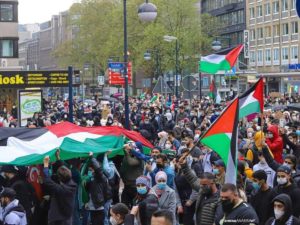
Notwithstanding a mass popular movement, with millions marching on the streets of capitals from London to Paris to Berlin, the states funding this genocide have invested more energy in suppressing the Palestinian struggle for freedom than in supporting it. Two-state solutions continue to be promoted in the abstract to distract from what Israel’s demographic changes have wrought on the ground, which have made such solutions impossible to implement.
The current ceasefire negotiations, which many in Gaza have described as another iteration of genocide, have at least ushered in a period that is less openly violent than the campaign of wanton destruction and bombing that destroyed Gaza’s infrastructure. Yet while the pace of Israel’s genocidal campaign has slowed, it has not ceased. The negotiations currently underway risk becoming a second Oslo: widely hailed as a diplomatic breakthrough, yet producing a stalemate without progress, or something worse. In terms of Achcar’s critique, this may be yet another attempt to manage catastrophe without addressing its causes.
Even when the Trump administration speaks vaguely of a “Palestinian technocratic government” that will govern Gaza, the conditions for peace across Palestine are entirely absent. The expansion of settlements continues apace in the West Bank, and Gaza’s borders are shrinking as Israel’s buffer zone expands. The asymmetry of power is stark, and the past two years of destruction have not changed that calculus.
The lessons of history are sobering, but they can give hope. No people has allowed themselves to be subjugated forever. From Ireland to Algeria, long liberation struggles have resulted in their people’s freedom. As Achcar argues, the more absolute the military asymmetry between Israel and Palestine becomes, the more the struggle is displaced onto the ethical and political terrain, where Israel’s position is objectively weaker. Israel has lost — and continues to lose — in the court of public opinion.
Gaza in the Present
For all the importance of their respective authors’ contributions to our understanding of Israel’s long war on Palestine, both Shlaim’s and Achcar’s latest volumes suffer from structural flaws: published in a state of emergency, in the middle of a genocide, these older texts show the effects of being unrevised. Shlaim notes that none of his essays have been revised for this book, which leads to significant repetition. In the case of Achcar, by his own framing, his book was published in the exigency of the moment, and therefore could never fully offer a “world-historical” overview of the genocide; its observations are too fragmented to generate a synthetic account. Both books are rich in their potential applications, but the work of interpretation in relation to the present is largely left to the reader.
In terms of its actual focus, Shlaim’s book is less about the last two years of genocide in Gaza than about the longer history of Israel’s diplomatic maneuverings. It could certainly be argued that the genocide that is occurring in Gaza has transpired over the long durée, from the Nakba to the present. This is implied by Albanese, but there is no analytical synthesis to make it the book’s explicit point of view. Indeed, the book does not have a single argument; it is more of a chronicle documenting an important scholar’s changing analysis over time, but without an overall point that can easily be distilled. The book’s arguments, such as they are, are more at the level of individual chapters than the book as a whole.
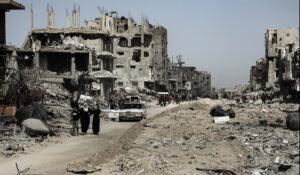
As for Achcar’s book, more of the texts are rooted in the past two years, but there is a similar sense that it is not quite ready to perform a historical reflection on our present moment. Both books might best be described as dispatches, collections of essays situated in a different place and time, juxtaposed to the horrors of the present. They are fragments shored against Gaza’s ruins. While the blood is still flowing, while Gaza remains under siege and children have starved or have frozen to death because Israel won’t allow in essential lifesaving supplies, it is too early to expect coherent arguments that span the length of entire books.
Such limitations are signs of the times and of the state of emergency in which we live. 2025 saw a wave of books that proposed to teach us what to make of a world “after Gaza.” The first of these was Peter Beinart’s Being Jewish After the Destruction of Gaza, published in January. It was followed the next month by Pankaj Mishra’s The World After Gaza: A Short History. Towards the end of 2025, Hamid Dabashi’s After Savagery: Gaza, Genocide, and the Illusion of Western Civilization added to this trend, albeit while acknowledging Gaza’s exclusion from the interpretive lens. None of these books are centrally about Gaza, yet they all frame the Gaza genocide as a fait accompli, as if the world has now moved on and we can apply a purely retrospective lens, rather than holding ourselves to account in the present. It may seem unfair to judge books by the prepositions in their titles, but in my view using “after” in relation to Gaza while a genocide is ongoing causes genuine harm. There is no “after” in relation to Gaza. Much has been destroyed, but the people of Gaza continue to struggle for freedom and justice as well as simply to survive. We are not yet in a moment that we can adequately historicize.
To their credit, Shlaim and Achcar avoid the pitfalls of Beinart, Mishra, and Dabashi by relying mostly on their previously published work, in which they carefully analyzed Israel’s preceding military campaigns. They also avoid a temporal framework that positions Gaza’s annihilation exclusively in the past, as if it were a distant process for which the final chapter has been written. While both books avoid the flaws of the “after Gaza” framework — and in so doing bring a greater degree of seriousness and accountability to the discussion — they do not go beyond that and offer a fully fleshed out alternative to our present paralysis. They remain confined within a historical horizon, hesitating to step outside their comfort zones.
Yet, carefully read, both books do give us the tools, not only to make sense of the past, but to act in the present. They provide irrefutable evidence that Israel’s current violations of international law date back to its very beginnings as a state, as does the criminal complicity of the international community. They demonstrate the futility and mendacity of peace negotiations, in which one side has always been more interested in acquiring land than in peace. They expose the limits of the international institutions that were founded with the mandate of securing basic rights for all peoples, yet which, in practice, reinforce global inequalities.
In showing us what we cannot trust and what we cannot expect from the hollowed out and morally vacuous institutions that prop up the international order, Shlaim and Achcar also lead us to look elsewhere: towards grassroots protest, popular mobilization, and civil disobedience. While increasingly dangerous for those who engage in them, these tactics have been effective, particularly in the court of public opinion.
None of us fully know what the Gaza genocide has wrought at the level of international politics. Nor do we know what the future holds, or how or when Palestinians will achieve their freedom. While the future is uncertain, our obligations are clear. We can hasten the achievement of this freedom by implementing the demands of the BDS campaign, by refusing complicity with occupation, and by speaking out against genocide. The task is not interpretation “after Gaza,” but responsibility and accountability during the ongoing Gaza genocide.
















































![Fady Joudah’s <em>[…]</em> Dares Us to Listen to Palestinian Words—and Silences](https://themarkaz.org/wp-content/uploads/2024/03/SAMAH-SHIHADI-DAIR-AL-QASSI-charcoal-on-paper-100x60-cm-2023-courtesy-Tabari-Artspace.jpg.webp)