



A Palestinian father during the war on Gaza makes an impossible choice.
Within minutes, everyone became aware of 12-year-old Mahmoud’s screams as he was struck with shrapnel in the head.
“God is great! God is great!” shouted Abu Salma.
Abu Nassar quickly picked up his son and rushed him to the shelter’s medical center. The father desperately tried to stop the bleeding, but with no success. Upon arrival, he found the emergency room bustling with the sounds of the moaning wounded, the snores of the patients, and the wails of the grieving. He realized it was only equipped with the most basic services, which were far from adequate for the situation at hand. And so, Abu Nassar laid his son on the floor and went in search of anything to stop the bleeding. After returning with useless bandages, Abu Nassar ripped off his own shirt to tie around his son’s wound. At this point, he surmised the futility of his actions; his son was suffering from internal hemorrhaging.
Abu Salma watched the entire scene unfold before him. He attempted to assist Abu Nassar at the same time trying to calm families and children until Abu Nassar’s words rendered him immobile with shock.
“The boy is suffering from internal bleeding and requires immediate hospital care. You see the situation we’re facing. Let’s save whoever else can be saved.”
“What do you mean?” asked a bewildered Abu Salma.
“I mean, we step outside and help with treatable injuries. My son is dying. I hope that at least his soul will be at peace if I help save those that I can.”
Abu Salma couldn’t believe what he had just heard. Was it possible for a father to abandon his son for his countrymen?
Abu Nassar covered his son’s face and proceeded with his mission. Questions crowded his mind as he attended to the wounds of men, women, and children. What did Gazans do to warrant all this pain? Whose fault was it that the children only knew the color red from roses and clothes for Eid? Why were their bodies drenched in blood?
After some time, Abu Nassar returned to where his son lay peacefully on the floor. The boy was drawing the final breaths of his short-lived existence in a country that made life uncertain and death a viable certainty.
If only the shelling would stop for a while, to allow their terror of the populace to subside, then there would be time to grieve and weep. For now, Abu Nassar had no time for tears. Death still threatened the four lives of his family who were depending on him. He had to believe there was a way to survive.
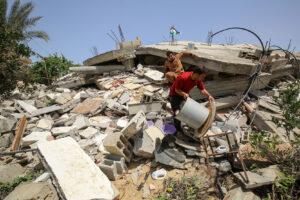
Abu Salma thought that sheltering at a UNRWA school guaranteed safety, that any danger would have, at least, been signaled by a siren. However, the shells gradually approached until they inevitably landed, unannounced, in the schoolyard. I’m unable to comprehend how we, as humans, can be reduced to mere body parts. It’s perplexing how our bodies fail us and break into fragments that fly through the air. It’s deeply upsetting to come across a detached hand and attempt to locate its owner afterwards. If this war ever ends, how will a child return to the same school where his mother or brother died? Will he be able to run in the schoolyard, or will the memories of those deaths cling to his every step, dragging him down?
When there was a brief pause in the shelling, Abu Nassar hurried to Abu Salma and urged him to leave the school and head south.
“I agree, but what are you going to do about your son?”
Abu Nassar looked around. The casualties were overwhelming. Bruised and broken bodies, strewn everywhere, had no recourse for escape other than succumbing to death. The survivors were loading the corpses onto carts for burial in mass graves on empty plots of land that had been donated by their owners for this purpose. Without uttering a single word, Abu Nassar lifted his son and, still maintaining his silence, laid him into one of the carts.
“What are you doing?” Abu Salma said.
“Yalla. To the south,” said Abu Nassar. “When your beloved has no grave, you will see them in every green plant that sprouts from the ground. You will imagine that all the clouds must be raining just for them.”
And so, Abu Nassar left his son among the dead on the cart and departed. He carried with him the enduring memory of his son, for whom he would unleash a flood of pent-up tears once the war was over.


“Today’s sun won’t bring harm. The plants in the pots will arrange themselves for a gentle visitor. It will be bright enough to help mothers to dry their laundry quickly, and cool enough for the children to play all day. Today’s sun will not be harsh on anyone.” RIP Fatima Hassouna