Aida Šehović on the 30th Anniversary of the Srebrenica Genocide

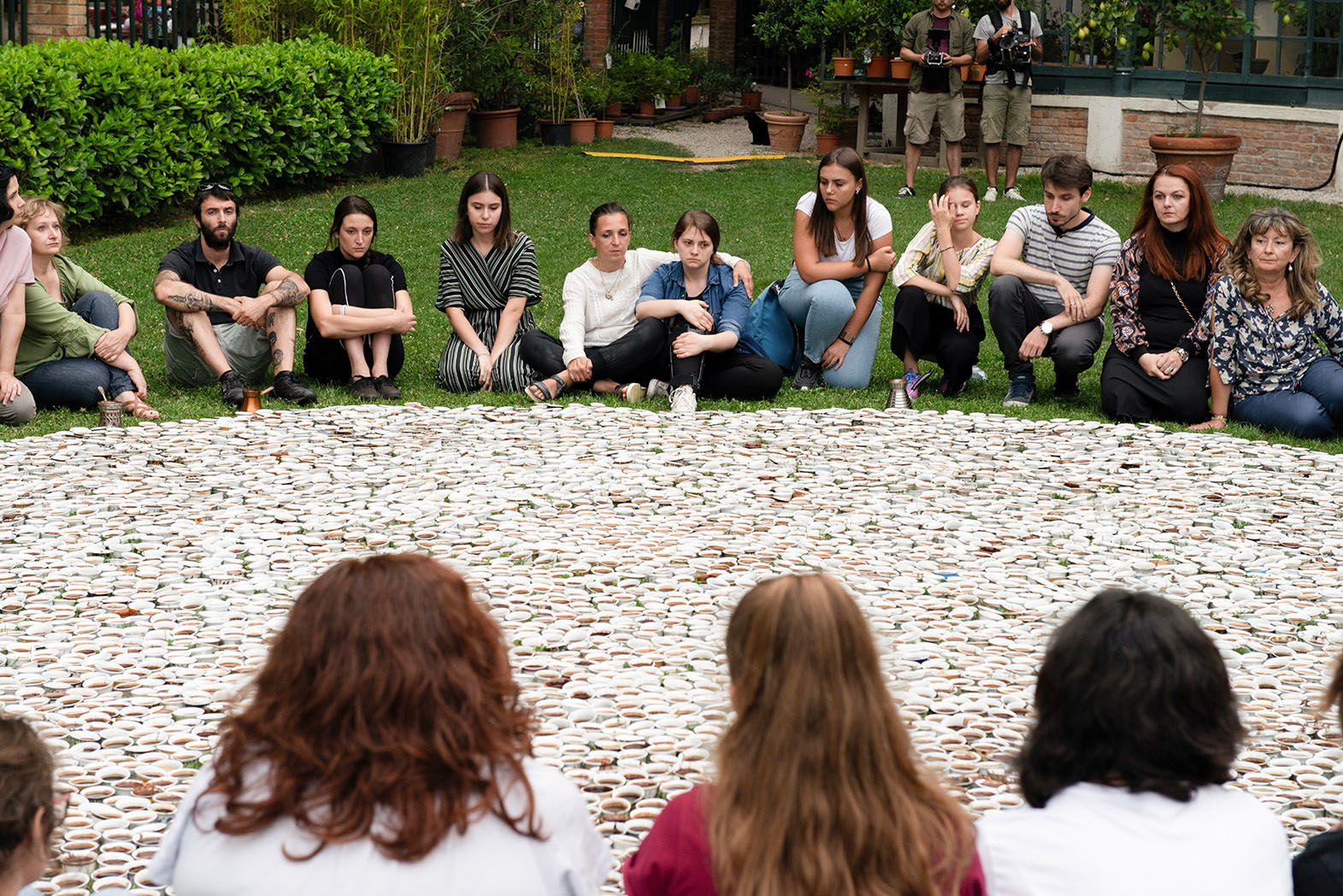
Aida Šehović's nomadi monument, "Sto-Te-Nema" (Why Aren't You Here?) in Venice (photo Adnan Saciragic courtesy Aida Šehović).

18 JULY 2025 • By Claudia Mende

Bosnian American artist Aida Šehović has devoted many of the past 15 years to commemorating the Srebrenica genocide of 1995, the 30th anniversary of which falls in July 2025.  Srebrenica was proclaimed last year as an international day remembrance by the UN. Her art project Što Te Nema (Bosnian for Why Aren't You Here?) is meant to offer a means of healing and resistance. We recently interviewed the artist in Munich, where she presented Što Te Nema, discussing commemoration, empathy and art. The artist went on to present the installation in Graz, Austria and at The Hague (Museum of Art).

Q: Aida, the starting point of your art is a simple cup of Bosnian coffee served in a fildžan (small coffee cup). You started collecting these cups in 2006 and you have been showing Što Te Nema in towns all over the world, interacting with people since then. Is there a difference in the kind of response according to the place where you are?

 Aida Šehović: Yes and no; yes because each culture is different, of course. People have different norms of behavior as a society, especially in public space. In the US for example, which is more of an open culture, a lot of people tend to talk to each other on the street, even when they don’t know each other. When we were setting up the monument there that was the experience versus, for example, Stockholm, Sweden, where I remember speaking with people who were there for hours and didn’t approach, but they were there with us watching. And then only after two or three hours, some of them dared to come up, place the cups down and fill them with coffee as an example. Or they said that they felt they shouldn’t do that out of respect. They were just there. It was quite different from Istanbul, Turkey, where we performed in 2017 in Taksim Square. It’s probably the biggest city we have ever been in, and many people attended. Coffee and the fildžan are very familiar in Turkish culture. People were literally passing the cups from one hand to the other.

TMR: And on the other hand?

Aida Šehović: On the other hand, we have more in common because we are all people. And that’s the whole point. The hopeful thing for me is that through art, we are able actually to communicate. In the end, people become part of the monument. They enjoy and understand it, even if we don’t speak the same language. They’re curious, they ask questions and they do stop and care, which is nice. It’s important for me to keep doing this to see that there is a difference when I see people are moved. That’s the motivation with this kind of artwork. Obviously, money or gallery representation and fame is not the goal here. The objective is really to move somebody and see that people are touched through the work.

TMR: You shifted your work from kind of a nomadic memorial and from an event in the public space to an “archive of memory.” Why are you changing the concept?

Aida Šehović: If we call it a project, even though I hate that word, I started with  Što Te Nema, but it has actually been evolving and moving throughout. Sometimes it’s more visible, sometimes less, but it’s always changing and growing. As an example, the first iteration of the monument, when it was installed in a public space with collected cups and coffee, was a performance where I placed the cups, but my friends were making the coffee, Bosnian coffee, on the site. I was the only one placing the cups down and pouring right then.

Eventually, it became more interactive when I was really in the background, which was the majority of the time during the 15 years that I traveled. I stayed in the background and others came to the public space — the passersby, participants, volunteers. They were the ones placing the cups and filling them with coffee.

 Što Te Nema is also changing because of the size and the quantity of cups that have been collected, from 923 cups for the first iteration in 2006 to more than 8,372 cups in 2020. That year we surpassed that number which is also the official number of Srebrenica genocide victims, but not the final number. Many more people were killed, but 8,372 is the number that we use as a reference. And also in 2020, the cups had touched the ground for the first time in Srebrenica. They were in the place where the Srebrenica Memorial Center was built at the site of the atrocities.

TMR: Wasn’t it the ultimate action showing the cups in Srebrenica and having such a moving event there? How could you continue after that?

Aida Šehović: I felt that when the cups touched the ground on which men and women were separated and people saw each other for the last time, I thought there had to be a change.  Conceptually. Because as cups were being placed, the majority of people who were with us in Srebrenica were families who directly lost their loved ones.

They have experienced the pain of the genocide personally, and they would actually name each cup as they were placing it down. After that the project became something else. And it also became logistically impossible to construct and deconstruct it in one day after we collected more than 8,273 cups. It became just too big as a temporary, ephemeral monument that travels. It outgrew its own form. Then this means it needs to become another form.

It was clear also that there is a need to find a more sustainable way for it to exist, which means that it needs to become some sort of a permanent monument, which is really hard for me to figure out. It should still have a participatory aspect, some kind of a ritual, but it’s very hard to imagine this aspect, if I’m not there.

TMR: There already is a monument site at Srebrenica for commemoration. So should Što Te Nema become something else?

Aida Šehović: I am rethinking the form and looking for something which might be permanent and part of it should be in Bosnia. But in the meantime, we are showing the archive which has recently been to Munich and Graz and which also has that participatory element.

TMR: We are living in difficult times right now. One of our problems is that there’s a lack of empathy for victims of conflict all over the world. You said you believe that art can contribute to connecting people. Is that still true? Can it contribute to people feeling their own emotion and to feeling empathy with others?

Aida Šehović: I have to admit that ever since the atrocities that we are witnessing in Gaza as an example, it’s been very hard for me to have faith in this kind of work, personally. Times change, right? The way we communicate changes. The way the Srebrenica genocide was documented and shared is quite different than the way we share and learn about atrocities today. On one hand it’s so much more open, and information obviously travels faster.

But there is also a really disturbing element. I don’t know what to call it exactly, but we are getting used to watching disturbing images of violence. And on top of that, we watch our politicians who are representing the people twist words and find excuses for inaction or for covering up their own personal goals and motivations and agendas. So, I don’t know what all of this becomes.

TMR: That’s discouraging.

Aida Šehović: And I honestly have been feeling very discouraged. But I have to say now, after Munich, where I observed so many people join and share their perspectives, their different points of view and backgrounds, that gave me hope. But when I’m alone, if you’re asking me, when I wake up and I open just Instagram and see all the pictures [of the genocide in Gaza] I don’t know what that does to us. I mean, I can’t even begin to imagine what it will do to thousands of people affected. Even with the occupation of Ukraine so many people have been killed, so many people have been affected. They have experienced trauma that I just don’t know…and we are all in it. We’re witnessing this. I can certainly speak on my behalf that I feel complicit as a human being.


Aida Šehović's nomadic monument to the victims of Srebrenica displayed in Zurich (photo Ismeta Curkic).
A Zurich visitor to Aida Šehović’s nomadic monument to the victims of Srebrenica pours coffee from a fildžan (photo Ismeta Curkic).

TMR: How can we deal with memory under these circumstances? A country like Germany, for example, has a lot of monuments commemorating the Holocaust and at the same time it has a rise in racism, it has a far-right party in parliament and it is complicit with genocide in Gaza. So what use is memory if history is repeated? 

Sehovic:  That’s the question that I would say drives me constantly, because it is clear that the way we’re dealing with it is not enough or it’s not good enough.

TMR: Obviously. 

Aida Šehović: Because otherwise we would stop doing what we’re doing. But at the same time all of it is important: we need legal processes, we need media. We need art in all of its forms. 

TMR: With the cups you chose some objects as a symbol for atrocities, which usually stand for normal life. You don’t use photographs or other artefacts of the atrocities. Was the idea that it’s easier to connect for people with something rather positive? 

Aida Šehović: It was certainly intentional that I chose the fildžan. It’s one of the reasons why I felt that art is the best form for myself to confront this topic and ask these questions because I’m honestly not sure that I believe in documentation. Of course, atrocities must be documented. But I don’t believe in this wide distribution of graphic images of violence, because I do think that they keep chipping away the humanity that we carry.

Watching a movie almost at any channel today, you can see somebody shooting 20 people just like that. How far we have come, what kind of comfort and dissociation do we feel, watching these violent images? It’s maybe also a sort of comfort that we are okay. We don’t even think about it anymore. I feel that does contribute to this lack of empathy. Because if you’re constantly exposed to this kind of visual imagery of violence, of course, you don’t feel anything anymore. The empathy disappears.

Claudia Mende

Claudia Mende was born in Cologne and spent part of her life in Chicago, Amman, and Cairo. As a journalist, she focuses on topics including women’s rights, life in Arab societies, and the impact of the Arab Spring.

Join Our Community

TMR exists thanks to its readers and supporters. By sharing our stories and celebrating cultural pluralism, we aim to counter racism, xenophobia, and exclusion with knowledge, empathy, and artistic expression.

Learn more

RELATED

Book Reviews

Myth and Migration in the Work of Dalia Al-Dujaili

6 NOVEMBER 2025 • By Noshin Bokth
Myth and Migration in the Work of Dalia Al-Dujaili
Poetry Markaz

Adedayo Agarau presents The Years of Blood

1 NOVEMBER 2025 • By Adedayo Agarau
Adedayo Agarau presents <em>The Years of Blood</em>
Fiction

War and War

26 SEPTEMBER 2025 • By Hussain A. Ayoub
War and War
Featured article

Together for Palestine — Truly Historic

19 SEPTEMBER 2025 • By TMR
Together for Palestine — Truly Historic
Book Reviews

How the Media Fails Armenia and Palestine

19 SEPTEMBER 2025 • By Gabriel Polley
How the Media Fails Armenia and Palestine
Centerpiece

Trauma After Gaza

5 SEPTEMBER 2025 • By Joelle Abi-Rached
Trauma After Gaza
Editorial

Why Out of Our Minds?

5 SEPTEMBER 2025 • By Lina Mounzer
Why <em>Out of Our Minds</em>?
Essays

“A Love That Endures”: How Tamer and Sabreen Defied War and Death

25 JULY 2025 • By Husam Maarouf
“A Love That Endures”: How Tamer and Sabreen Defied War and Death
Featured article

“Silence is Not the Way”—Arab Writers Against Israel’s Genocide

18 JULY 2025 • By Jordan Elgrably
“Silence is Not the Way”—Arab Writers Against Israel’s Genocide
TMR Interviews

Aida Šehović on the 30th Anniversary of the Srebrenica Genocide

18 JULY 2025 • By Claudia Mende
Aida Šehović on the 30th Anniversary of the Srebrenica Genocide
Art

Taqi Spateen Paints Palestine Museum Mural of Aaron Bushnell

11 JULY 2025 • By Hadani Ditmars
Taqi Spateen Paints Palestine Museum Mural of Aaron Bushnell
Poetry

Nasser Rabah on Poetry and Gaza

4 JULY 2025 • By Nasser Rabah
Nasser Rabah on Poetry and Gaza
Columns

Afraid for Our Children’s Future, How Do We Talk About War?

20 JUNE 2025 • By Souseh
Afraid for Our Children’s Future, How Do We Talk About War?
Film Reviews

Contretemps, a Bold Film on Lebanon’s Crises

16 MAY 2025 • By Jim Quilty
Contretemps, a Bold Film on Lebanon’s Crises
Books

Poet Mosab Abu Toha Wins Pulitzer Prize for Essays on Gaza

9 MAY 2025 • By Jordan Elgrably
Poet Mosab Abu Toha Wins Pulitzer Prize for Essays on Gaza
Literature

The Pen and the Sword — Censorship Threatens Us All

2 MAY 2025 • By Anna Badkhen
The Pen and the Sword — Censorship Threatens Us All
Art & Photography

Afghanistan’s Histories of Conflict, Resistance & Desires

7 MARCH 2025 • By Jelena Sofronijevic
Afghanistan’s Histories of Conflict, Resistance & Desires
Art

Finding Emptiness: Gaza Artist Taysir Batniji in Beirut

21 FEBRUARY 2025 • By Jim Quilty
Finding Emptiness: Gaza Artist Taysir Batniji in Beirut
Book Reviews

Omar El Akkad & Mohammed El-Kurd: Liberalism in a Time of Genocide

14 FEBRUARY 2025 • By Rebecca Ruth Gould
Omar El Akkad & Mohammed El-Kurd: Liberalism in a Time of Genocide
Arabic

Huda Fakhreddine & Yasmeen Hanoosh: Translating Arabic & Gaza

17 JANUARY 2025 • By Yasmeen Hanoosh, Huda J. Fakhreddine
Huda Fakhreddine & Yasmeen Hanoosh: Translating Arabic & Gaza
Book Reviews

Criticizing a Militaristic Israel is not Inherently Antisemitic

20 DECEMBER 2024 • By Stephen Rohde
Criticizing a Militaristic Israel is not Inherently Antisemitic
Poetry

Annahita Mahdavi West: Two Poems

19 DECEMBER 2024 • By Annahita Mahdavi West
Annahita Mahdavi West: Two Poems
Opinion

Susan Abulhawa at Oxford Union on Palestine/Israel

6 DECEMBER 2024 • By Susan Abulhawa
Susan Abulhawa at Oxford Union on Palestine/Israel
Essays

Beirut War Diary: 8 Days in October

22 NOVEMBER 2024 • By Rima Rantisi
Beirut War Diary: 8 Days in October
Essays

A Jewish Meditation on the Palestinian Genocide

15 NOVEMBER 2024 • By Sheryl Ono
A Jewish Meditation on the Palestinian Genocide
Film

The Haunting Reality of Beirut, My City

8 NOVEMBER 2024 • By Roger Assaf, Zeina Hashem Beck
The Haunting Reality of <em>Beirut, My City</em>
Essays

Between Two Sieges: Translating Roger Assaf in California

8 NOVEMBER 2024 • By Zeina Hashem Beck
Between Two Sieges: Translating Roger Assaf in California
Opinion

Should a Climate-Destroying Dictatorship Host a Climate-Saving Conference?

25 OCTOBER 2024 • By Lucine Kasbarian
Should a Climate-Destroying Dictatorship Host a Climate-Saving Conference?
Editorial

A Year of War Without End

4 OCTOBER 2024 • By Lina Mounzer
A Year of War Without End
Essays

Depictions of Genocide: The Un-Imaginable Visibility of Extermination

4 OCTOBER 2024 • By Viola Shafik
Depictions of Genocide: The Un-Imaginable Visibility of Extermination
short story

“Deferred Sorrow”—fiction from Haidar Al Ghazali

5 JULY 2024 • By Haidar Al Ghazali, Rana Asfour
“Deferred Sorrow”—fiction from Haidar Al Ghazali
Book Reviews

Is Amin Maalouf’s Latest Novel, On the Isle of Antioch, a Parody?

14 JUNE 2024 • By Farah-Silvana Kanaan
Is Amin Maalouf’s Latest Novel, <em>On the Isle of Antioch</em>, a Parody?
Centerpiece

Dare Not Speak—a One-Act Play

7 JUNE 2024 • By Hassan Abdulrazzak
<em>Dare Not Speak</em>—a One-Act Play
Essays

What Is Home?—Gazans Redefine Place Amid Displacement

31 MAY 2024 • By Nadine Aranki
What Is Home?—Gazans Redefine Place Amid Displacement
Essays

Postscript: Disrupting the Colonial Gaze—Gaza and Israel after October 7th

17 MAY 2024 • By Sara Roy, Ivar Ekeland
Postscript: Disrupting the Colonial Gaze—Gaza and Israel after October 7th
Art

This Year in Venice, it’s the “Palestine Biennale”

10 MAY 2024 • By Hadani Ditmars
This Year in Venice, it’s the “Palestine Biennale”
Centerpiece

Memory Archive: Between Remembering and Forgetting

3 MAY 2024 • By Mai Al-Nakib
Memory Archive: Between Remembering and Forgetting
Art

Malak Mattar: No Words, Only Scenes of Ruin

26 APRIL 2024 • By Nadine Nour el Din
Malak Mattar: No Words, Only Scenes of Ruin
Opinion

Equating Critique of Israel with Antisemitism, US Academics are Being Silenced

12 APRIL 2024 • By Maura Finkelstein
Equating Critique of Israel with Antisemitism, US Academics are Being Silenced
Art & Photography

Will Artists Against Genocide Boycott the Venice Biennale?

18 MARCH 2024 • By Hadani Ditmars
Will Artists Against Genocide Boycott the Venice Biennale?
Editorial

Why “Burn It all Down”?

3 MARCH 2024 • By Lina Mounzer
Why “Burn It all Down”?
Essays

The Time of Monsters

3 MARCH 2024 • By Layla AlAmmar
The Time of Monsters
Fiction

“The Map of a Genocide Victim”—fiction from Faris Lounis

3 MARCH 2024 • By Faris Lounis, Jordan Elgrably
“The Map of a Genocide Victim”—fiction from Faris Lounis
Essays

Israel’s Environmental and Economic Warfare on Lebanon

3 MARCH 2024 • By Michelle Eid
Israel’s Environmental and Economic Warfare on Lebanon
Columns

Genocide: “That bell can’t be unrung. That thought can’t be unthunk.”

3 MARCH 2024 • By Amal Ghandour
Genocide: “That bell can’t be unrung. That thought can’t be unthunk.”
Essays

Messages from Gaza Now / 5

26 FEBRUARY 2024 • By Hossam Madhoun
Messages from Gaza Now / 5
Art

Issam Kourbaj’s Love Letter to Syria in Cambridge

12 FEBRUARY 2024 • By Sophie Kazan Makhlouf
Issam Kourbaj’s Love Letter to Syria in Cambridge
Editorial

Shoot That Poison Arrow to My Heart: The LSD Editorial

4 FEBRUARY 2024 • By Malu Halasa
Shoot That Poison Arrow to My Heart: The LSD Editorial
Featured article

Israel-Palestine: Peace Under Occupation?

29 JANUARY 2024 • By Laëtitia Soula
Israel-Palestine: Peace Under Occupation?
Poetry

Brian Turner: 3 Poems From Three New Books

14 JANUARY 2024 • By Brian Turner
Brian Turner: 3 Poems From Three New Books
Essays

Messages from Gaza Now / 3

8 JANUARY 2024 • By Hossam Madhoun
Messages from Gaza Now / 3
Art & Photography

Cyprus: Return to Petrofani with Ali Cherri & Vicky Pericleous

8 JANUARY 2024 • By Arie Amaya-Akkermans
Cyprus: Return to Petrofani with Ali Cherri & Vicky Pericleous
Books

Inside Hamas: From Resistance to Regime

25 DECEMBER 2023 • By Paola Caridi
Inside <em>Hamas: From Resistance to Regime</em>
Editorial

Why Endings & Beginnings?

3 DECEMBER 2023 • By Jordan Elgrably
Why Endings & Beginnings?
TMR 37 • Endings & Beginnings

“The Summer They Heard Music”—a short story by MK Harb

3 DECEMBER 2023 • By MK Harb
“The Summer They Heard Music”—a short story by MK Harb
Fiction

“I, Hanan”—a Gazan tale of survival by Joumana Haddad

3 DECEMBER 2023 • By Joumana Haddad
“I, Hanan”—a Gazan tale of survival by Joumana Haddad
Art

Hanan Eshaq

3 DECEMBER 2023 • By Hanan Eshaq
Hanan Eshaq
Art & Photography

Palestinian Artists & Anti-War Supporters of Gaza Cancelled

27 NOVEMBER 2023 • By Nada Ghosn
Palestinian Artists & Anti-War Supporters of Gaza Cancelled
Opinion

Beautiful October 7th Art Belies the Horrors of War

13 NOVEMBER 2023 • By Mark LeVine
Beautiful October 7th Art Belies the Horrors of War
Opinion

Palestine’s Pen against Israel’s Swords of Injustice

6 NOVEMBER 2023 • By Mai Al-Nakib
Palestine’s Pen against Israel’s Swords of Injustice
Books

Domicide—War on the City

5 NOVEMBER 2023 • By Ammar Azzouz
<em>Domicide</em>—War on the City
Essays

On Fathers, Daughters and the Genocide in Gaza 

30 OCTOBER 2023 • By Deema K Shehabi
On Fathers, Daughters and the Genocide in Gaza 
Islam

October 7 and the First Days of the War

23 OCTOBER 2023 • By Robin Yassin-Kassab
October 7 and the First Days of the War
Editorial

Palestine and the Unspeakable

16 OCTOBER 2023 • By Lina Mounzer
Palestine and the Unspeakable
Essays

Forging Peace for Artsakh—The Debacle of Nagorno Karabagh

16 OCTOBER 2023 • By Seta Kabranian-Melkonian
Forging Peace for Artsakh—The Debacle of Nagorno Karabagh
Art & Photography

Adel Abidin, October 2023

1 OCTOBER 2023 • By TMR
Adel Abidin, October 2023
Poetry

Three Poems from Pantea Amin Tofangchi’s Glazed With War

3 AUGUST 2023 • By Pantea Amin Tofangchi
Three Poems from Pantea Amin Tofangchi’s <em>Glazed With War</em>
Book Reviews

Can the Kurdish Women’s Movement Transform the Middle East?

31 JULY 2023 • By Matt Broomfield
Can the Kurdish Women’s Movement Transform the Middle East?
Book Reviews

Why Isn’t Ghaith Abdul-Ahad a Household Name?

10 JULY 2023 • By Iason Athanasiadis
Why Isn’t Ghaith Abdul-Ahad a Household Name?
Opinion

The End of the Palestinian State? Jenin Is Only the Beginning

10 JULY 2023 • By Yousef M. Aljamal
The End of the Palestinian State? Jenin Is Only the Beginning
Editorial

EARTH: Our Only Home

4 JUNE 2023 • By Jordan Elgrably
EARTH: Our Only Home
Arabic

Arab Theatre Grapples With Climate Change, Borders, War & Love

4 JUNE 2023 • By Hassan Abdulrazzak
Arab Theatre Grapples With Climate Change, Borders, War & Love
Opinion

Nurredin Amro’s Epic Battle to Save His Home From Demolition

24 APRIL 2023 • By Nora Lester Murad
Nurredin Amro’s Epic Battle to Save His Home From Demolition
Essays

When a Country is not a Country—the Chimera of Borders

17 APRIL 2023 • By Ara Oshagan
When a Country is not a Country—the Chimera of Borders
Essays

Artsakh and the Truth About the Legend of Monte Melkonian

17 APRIL 2023 • By Seta Kabranian-Melkonian
Artsakh and the Truth About the Legend of Monte Melkonian
Beirut

Tel Aviv-Beirut, a Film on War, Love & Borders

20 MARCH 2023 • By Karim Goury
<em>Tel Aviv-Beirut</em>, a Film on War, Love & Borders
Book Reviews

Yemen War Survivors Speak in What Have You Left Behind?

20 FEBRUARY 2023 • By Saliha Haddad
Yemen War Survivors Speak in <em>What Have You Left Behind?</em>
Beirut

Arab Women’s War Stories, Oral Histories from Lebanon

13 FEBRUARY 2023 • By Evelyne Accad
Arab Women’s War Stories, Oral Histories from Lebanon
Book Reviews

Mohamed Makhzangi Despairs at Man’s Cruelty to Animals

26 DECEMBER 2022 • By Saliha Haddad
Mohamed Makhzangi Despairs at Man’s Cruelty to Animals
Art

Museums in Exile—MO.CO’s show for Chile, Sarajevo & Palestine

12 DECEMBER 2022 • By Jordan Elgrably
Museums in Exile—MO.CO’s show for Chile, Sarajevo & Palestine
Editorial

You Don’t Have to Be A Super Hero to Be a Heroine

15 OCTOBER 2022 • By TMR
You Don’t Have to Be A Super Hero to Be a Heroine
Film

Ziad Kalthoum: Trajectory of a Syrian Filmmaker

15 SEPTEMBER 2022 • By Viola Shafik
Ziad Kalthoum: Trajectory of a Syrian Filmmaker
Art

Abundant Middle Eastern Talent at the ’22 Avignon Theatre Fest

18 JULY 2022 • By Nada Ghosn
Abundant Middle Eastern Talent at the ’22 Avignon Theatre Fest
Film Reviews

War and Trauma in Yemen: Asim Abdulaziz’s “1941”

15 JULY 2022 • By Farah Abdessamad
War and Trauma in Yemen: Asim Abdulaziz’s “1941”
Film

Art Film Depicts the Landlocked Drama of Nagorno-Karabakh

2 MAY 2022 • By Taline Voskeritchian
Art Film Depicts the Landlocked Drama of Nagorno-Karabakh
Columns

Nowruz and The Sins of the New Day

21 MARCH 2022 • By Maha Tourbah
Nowruz and The Sins of the New Day
Art

Fiction: “Skin Calluses” by Khalil Younes

15 MARCH 2022 • By Khalil Younes
Fiction: “Skin Calluses” by Khalil Younes
Columns

“There’s Nothing Worse Than War”

24 FEBRUARY 2022 • By Jordan Elgrably
“There’s Nothing Worse Than War”
Fiction

Fiction from “Free Fall”: I fled the city as a murderer whose crime had just been uncovered

15 JANUARY 2022 • By Abeer Esber, Nouha Homad
Fiction from “Free Fall”: I fled the city as a murderer whose crime had just been uncovered
Book Reviews

Temptations of the Imagination: how Jana Elhassan and Samar Yazbek transmogrify the world

10 JANUARY 2022 • By Rana Asfour
Temptations of the Imagination: how Jana Elhassan and Samar Yazbek transmogrify the world
Art

Malak Mattar — Gaza Artist and Survivor

14 JULY 2021 • By Jordan Elgrably
Malak Mattar — Gaza Artist and Survivor
Columns

The Semantics of Gaza, War and Truth

14 JULY 2021 • By Mischa Geracoulis
The Semantics of Gaza, War and Truth
Book Reviews

ISIS and the Absurdity of War in the Age of Twitter

4 JULY 2021 • By Jessica Proett
ISIS and the Absurdity of War in the Age of Twitter
Art

The Murals of Yemen’s Haifa Subay

14 MAY 2021 • By Farah Abdessamad
The Murals of Yemen’s Haifa Subay

Leave a Comment

Your email address will not be published. Required fields are marked *

sixteen − 9 =

Scroll to Top