



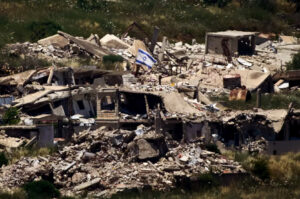
On November 27th, at four o’clock in the morning, a ceasefire agreement was announced between Israel and Lebanon. The night before, and up until the very last moments preceding the announcement, the Israeli army intensified its airstrikes to an unprecedented level. These strikes targeted nearly every region of Lebanon, causing widespread destruction, killing 78 people, and injuring 266 others.
It’s hard to believe that it’s over, this war. It’s because we’ve gotten used to it like one gets used to a nightmare from which it’s impossible to wake. We’ve gotten used to it in our bodies, which no longer tremble when we hear the sound of an explosion, or which tremble when we hear a door slam. Our bodies which can no longer sleep, or which sleep more than ten hours a night. Which no longer eat, or binge with abandon. Our depleted, exhausted bodies, which we thought would never again know any rest.
We got used to it in our souls too, which forgot their previous lives; lives that now belong to a bygone time, separated from us by two months of despair, by two months of staring into the abyss of death and annihilation. A bygone time that can hardly be called beautiful, full as it was with crises and tragedies, but our souls have come to yearn for it as though it were a golden era, a paradise lost.
Our souls, which have become pure fear, longing to flee their exhausted bodies, but can find no escape, or any knowledge of where to escape to, and thus have grown so used to fear that it’s become unnoticeable.
And now, today, Tuesday the 27th of November, 2024, the ceasefire was announced. We woke up (or maybe we never slept at all) and were told that the war is over — after an apocalyptic night in which Israel unleashed all its madness, trying to reap as many souls as it could, like a greedy, gluttonous, depraved child given a box of sweets and told he only has a few minutes to eat whatever he likes before the box is taken away for good, and so he began devouring whatever he could, stuffing his mouth and groaning with pleasure all the while.
We were told it was over and we were shocked: can it really just end like that, because a handful of people decided to end it? But we’d gotten used to it, like some unbridled divine wrath, which no amount of human sacrifice could satisfy or staunch. We’d resigned ourselves to it like an epoch of catastrophic natural disasters set to go on for years and years — only to discover that Netanyahu and a few of his ministers were able to stop it by simply wanting to do so.
And so we woke up from a nightmare from which there was no way to wake up — this is what we were told. We woke up and were unable to believe it. For as soon as we opened our eyes, we found ourselves in a dream. A beautiful dream, even a wonderful one, but still we know it’s a dream. One in which everything is light, weightless. A fragile dream, tainted with images of yesterday’s nightmare. A dream inside which we don’t know how to live. Our terrified bodies don’t know how. Our exhausted souls don’t know how. We have become the creatures of nightmares, living in a great darkness, blinded by the light of day.
Will we ever forget yesterday’s nightmare? No doubt at some point, we will. Sooner or later, we’ll come to remember it the way we do any nightmare: like something frightening that isn’t real, something surreal that only occurs in a dream. A scary dream whose colors will gradually fade away as time goes on. But it’s a dream that leaves us with psychological and spiritual tremors and fissures from which we’ll probably never heal. Tremors and fissures that we might sometimes forget are a result of that nightmare, but which will, at other times, perhaps rarely, remind us that the nightmare was in fact real, and that there is nothing to guarantee that it won’t recur.
Originally published in Arabic in Almodon Online Newspaper on November 28th, 2024.



Beautifully written, sad and true. A notable voice.