A Palestinian American writer loses her words — until she begins finding her way back to language in another tongue.
In the wake of genocide, language thins out, collapses. What kind of knowing is born in that stunned interval, where breath continues but words do not?
This is the threshold Aziza invites us to cross in her searing essay, “Ojalá: Toward an Illiteracy of Liberation.” “Grief-wiped,” “stricken wordless” by her heart, she returns to her first encounter with Arabic to re-enter the silence that had befallen her. Ojalá* stands in lineage with Aziza’s inimitable, award-winning memoir, The Hollow Half: unsettling and agitating language, tongues, mothers and mother tongues so that we might enter the world — and ourselves — anew.
Laced with Aziza’s signature incantatory yet politically piercing interventions, the essay moves beyond memoir into a meditation on what community, solidarity, and belonging mean under annihilating violence. As imperial brutality continues to pummel Palestine, Lebanon, Sudan, Congo, Iran, to name a few, ICE escalations intensify domestically against, among others, Latino immigrant communities in the United States, where Aziza lives. In the silence that overtook her, she turns toward Spanish. Unsure of what she is seeking, she begins with verbs, with sound, with the humility of conjugation. “Towards me, Spanish is generous,” writes Aziza. “It greets me as if expected, and right on time. With the warmth of a neighbor, touching my elbow, leading me inside.”
And inside, Aziza reckons with what it means to seek refuge in the language of an oppressed other; to consider the revolutionary illiteracies we are called toward as we insist on being أُميِّين in empire and its grammars. In Ojalá, Aziza shows us what political otherwise becomes imaginable when we relinquish mastery for radical relation: the fragile, necessary labor of learning how, together, “to outlast the terrifying singularity of now.”
— Abdelrahman ElGendy
TMR Literary Editor
I began the summer of 2025 in silence. A writer, I had not composed a sentence in months. This was not burnout, not writers’ block, but the pall of a shattered heart. For nearly two years, I had watched my family in Gaza slaughtered, burned, and starved. Hundreds of days, I spent screaming — in prose, in English, in Arabic, in the streets — and then the words all fled at once.
The last sentence I remember uttering: corpses, too many corpses, it’s all corpses. . . After, some cord cut, and I plummeted. Down, into the pit where I’d been all along, these last twenty murder months.
Days or weeks later, my body stirs. The movements are mechanical. They are ritual. Soon, they become routine: mornings, in the planet-killing heat, I wake and load a bag with a textbook, water, and notepad. I cross bleached light to my local library, where I sit and conjugate Spanish verbs. Under my breath I repeat their sounds, my throat tasting their textures and shapes — encontrar, encuentro, encuentras, encuentra, encuentran, encontramos, encontráis. On sheet after sheet of paper, I stack new vocabulary — lluviosa, la mitad, leyenda, llamado.
The impulse feels both arbitrary and important. I have no blood ties to the language, yet I sense Spanish has a claim on me. For now, I reside in the United States, where roughly one fifth of the population are Spanish speakers, including nearly two million of my neighbors in New York City and several of my closest friends. For years, my relative ignorance of this language has felt not just uncouth, but callous. A one-sided disjuncture, so American, to rest too easily in English. To accept implicitly a system which does such violence to other tongues.
Yet, after years of good intentions, it is only now — in a summer steeped in death — that this desire comes alive.
Towards me, Spanish is generous. It greets me as if expected, and right on time. With the warmth of a neighbor, touching my elbow, leading me inside.
. . .
In my memory, the spring of 2025 came early and full of sun. Washed in the light of sky and faces, I watched my first book enter the world. For a season, I followed it, breathless, into room after room. There, I found people gathered in various configurations of heartache. All of us, hungry to find language that would sustain us, help us face the monstrous days. Language that might answer us — is there hope, what do we do? I tried my best. I shared my doubts, and my certainty: Palestine must be free. For months, I had used words to do this, to issue warning, mourning, and rage in every forum I could. Meanwhile, beyond these conversations and pages, the void ate my people, swallowed prayer after prayer.
After several months of events, I was set to return home. In Philadelphia, I woke to birdsong and the news that my cousin Ibrahim in Gaza had been shot while standing in line for food. He had snuck out early that morning — against the wishes of his mother — to face the violence of the Gaza Humanitarian Fund, a homicidal group of mercenaries masquerading, poorly, as a charity.
He was still alive. Struck in both his legs. We didn’t know much more.
The last thing I remember hearing for months: the red thunder in my ears, as my heart again, finally, broke.
. . .
I don’t understand where the impulse to write comes from, but for most of my years, I’ve known language as a line between life and me. A seam that stitches me in time and space, a weave of receiving and creation, touching and being touched. It is a function of hunger as often as inspiration — the desire to think, to probe, to know. Sometimes, like dice or runes or coffee grounds, I enter language to jostle, to see what shapes reveal.
Often, writing writhes, electric with pain. Yet the sparks are still evidence of charge, conduction, stakes. To articulate — even the most debased things — is an act of reaching.
Implied: there is some other, whether time or place or mind, where these words might arrive. Implied: there is the possibility of being less alone, whether in this instant, or as a self.
Writing is how I know I still desire to outlast the terrifying singularity of now.
. . .
So, when, for months, I could not write a sentence, I felt in some way like I had died.
Gone: every hunger, all curiousness, even memory.
Arrived: an ambient sense of failure which produced no answers of what, exactly, I should change. A body which felt both gone and unbearably weighted at once.
And because not writing felt like not thinking, I struggled, also, to speak. I walked through the heat in silence, eyes smoking and wide. My mind, grief-wiped, smooth as an egg, in this new childhood. Fully bewildered by the world.
More than once, I found myself weeping in public, among adults. On the sidewalk, in the library, the train. Startled, I cast my gaze around, expecting reprimand. Expecting someone to take my hand.
. . .
Meanwhile, actual children kept perishing — bomb, bullet, hunger, heat. In Sudan and Gaza, thousands of murdered mothers and miscarriages reminding us: genocide is a war on beginnings. Its assault on the living, a prelude to its intent of putting every future to end.
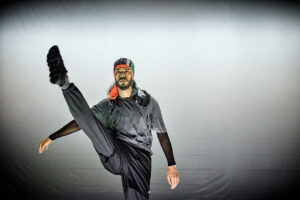
He wants to know if he’ll dance again, Ibrahim’s siblings admit to me. On my phone, I rewatch a video of his young, jubilant body whirling dabke on stage at his college graduation. A few months later, this campus would be flattened by Israeli bombs. His brother Nabil recorded the last few steps of his dance in slow motion. His final leap, suspended in the air, as if he might never come down.
. . .
Sometimes, silence is called for. Fitting, to be stricken wordless by our hearts. To admit where language cannot go. To be a creature in our grief. Sorrow and love — twinned organs — belong to the body first.
Mine says: admit you no longer recognize the world.
Mine says: be humbled, learn the wisdom of no words.
. . .
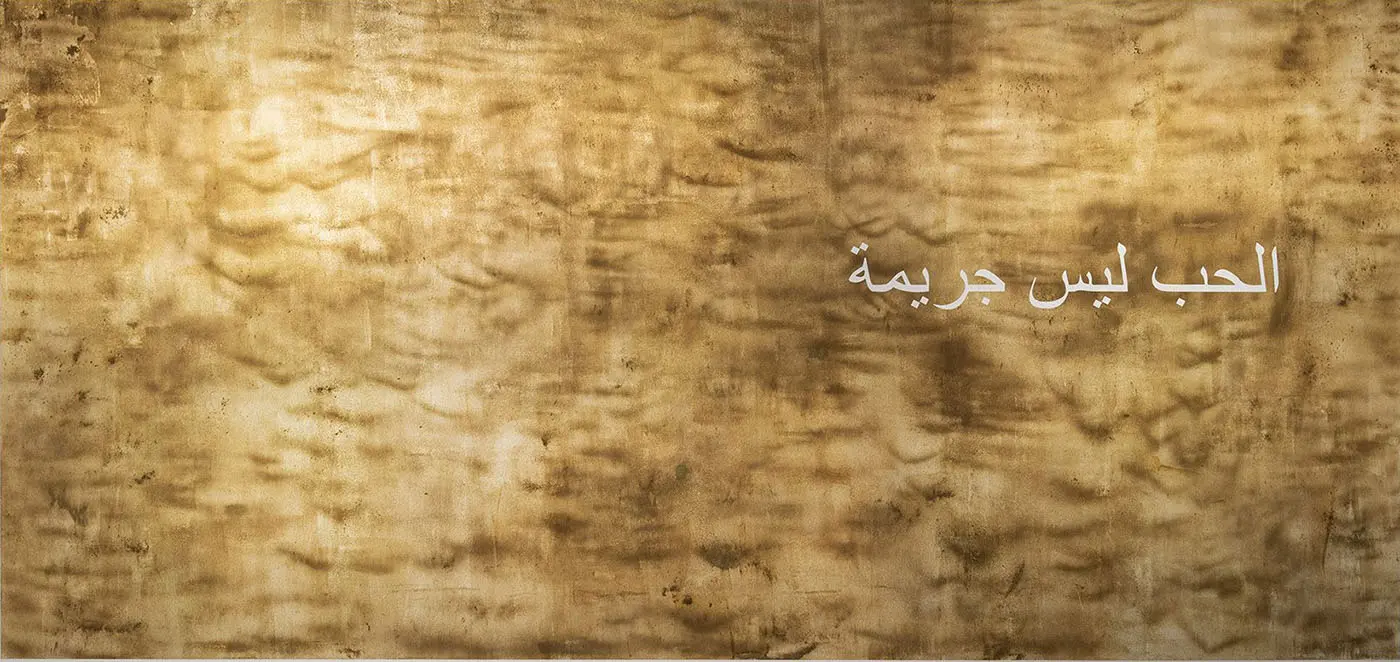
In Arabic, the word for illiterate moves from the same letters that make mother. أُمِّيَّ – the word a root, a tether to remind us of infanthood, of birth. A call back to the darkness where our nature began. We, not yet self-made gods of naming. Still porous, our flesh ringing, plural.
أُمِّيَّ – even in a world that so privileges text, this word is, at least, not the act of subtraction it is in English, its mere negation literate. أُمِّيَّ — also an honorific given the Prophet Mohammed — implies dignity to the state outside officialized language. A place of elemental substance. Feral. Origin.
. . .
My journey to Arabic fluency was like this — a re-mothering, a visceral return. Back to my youngest days, a time when body slurred, mingled with sounds and touch. Then, meaning drifted, warm and benevolent, between the material and imaginary, English and Arabic. These categories I had no words for, nor any need to differentiate.
Until I entered school. My father, a newly-green-carded immigrant from Gaza, encouraged me to excel in English. At home, he increasingly restrained his mother tongue. It just made sense to prioritize English, the dialect of power, which would open horizons my Arab relatives might never reach. When we moved to the Gulf, my relatives tisked their tongues at my clumsy ‘aamiya, while openly coveting my English. Arabic, to my vast refugee family, was the language of the past, and the stagnation of statelessness. Tether to an irretrievable place, the music of a wounded land.
My father’s mother was one of the few who never expressed this view, nor spoke to me anything but Arabic. My sittoo — as a child I knew her as bosom and bangle-music, muscular arms pulling me in, peppering kisses and du’a. Home movies attest to my early fluency, as I laugh and play with her, easily responding to her encouragements and commands. Later, she moved out of our home, and I grew self-conscious in Arabic as it moved from my tongue to my brain. Still, her presence remained a place where my undersized vocabulary felt abundant. There, words were mere subtext. Her Arabic, spoken with gestures and such sheer affection, I grasped implicitly. With her, I was understood.
. . .
In college, acting on another, inchoate inkling, I spent a summer in Palestine, where a grassroots collective in Nablus had offered me a volunteer position at a children’s camp. On the first afternoon, I greeted the organizers fluently, but stiffened as the conversation progressed. By then, I had been trying for years to “learn” Arabic, logging diligent hours in classrooms, but the language still felt like a complex instrument, unrelated to my inner world.
In American textbooks, I encountered a fixed, disciplined version called Modern Standard Arabic. While still capable of much beauty, MSA is an idiom of globalization, officialized and streamlined. It may be familiar to the hundreds of million speakers of Arabic around the world — but it is no one’s mother tongue.
And my body knew this. Though I could pronounce with more dexterity than non-heritage speakers, I struggled to produce orderly sentences. To excel in the classroom, I had to suppress my instinct, block out the music of my childhood which often fluttered to my throat. Not بدي but أريد. For the love of God, stop saying مش. . .
. . .
With children, such worries are frivolous. With children, language is to touch, to reach. Those Nablus mornings, the little ones rushed toward me, khaltu!, clamoring to tell me a story, calling for me to see their craft, band aid, cartwheel. Suddenly, there was neither time nor need to fret my conjugation, to parse منصوب from مجرور . What mattered was caretaking, and with this intention, words flowed — mistakes and all. As the days passed, I began to match their music, their exuberance. Language welled from a deep place near my navel, the lines of my body dissolving into a fluid, transparent field. A shift both startling and familiar. Something new-old, reborn.
. . .
To mature in Arabic would still take years of committed care. I moved to Amman after college with a lover’s reasoning: I wanted simply to be near, to spend time in, this tongue. As the language matured in me, so too did new folds of self emerge. I opened, more vivid in the poetry, the unapologetic exorbitance, of ‘arabi. Returning to visit relatives, we learned each other anew, a lifelong of awkward tenderness at last translating into words. They no longer admonished me about the practicality of speaking English or returning to the U.S. There was something in our newfound intimacy which destabilized our pragmatism, suggesting what, without exile, we might have been.
. . .
The U.S. imperial boomerang has returned to one of its original launching points, the U.S.-Mexico border/frontier, our longest-running forever war, writes Alex Aviña in 2025. This, the second summer of genocide, is also a season of violent ICE escalation, proliferating kidnappings and raids. Except now that border is everywhere. . . fully actualized as a Palestine-Mexico border: a material, (bio)political, and ideological demarcation that separates those marked for life and those marked for disposability.
I stumble on the tenses of Spanish, trip on the complex terrain of temporalities and moods. Indicativo, Subjuntivo, Imperativo, Imperfecto, Indefinido, Condicional, Pretérito, Futuro, Presente. Gorgeous, how every language gives us everything — time, space, ourselves — in unique dimensions, angles, and hues. Gorgeous, and exhausting, trying to pry open my shock-scorched brain, and let the world pour in again. I look up and see: hunters prowling for hispanohablantes. Masked enforcers taking the sound of español, like tattoos and darker skin tones, as pretext for detention, incarceration, and possible deportation. A familiar tyrant’s tactic: to punish bodies not for what they say, but how they are read.
. . .
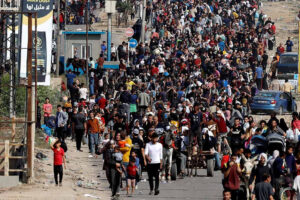
Next to my notebook, my phone blinks, a green banner hatching on the screen. A voice note from Haneen, Ibrahim’s sister, in Gaza. Our correspondence has slowed considerably as Israel’s engineered famine grinds deeper into Gaza’s body, soul. They have been hungry for so long, but in these hot months, her body is wasting faster, looking both younger and older. What food they gather is prioritized for her brother Ibrahim, whose thin body struggles to close multiple shrapnel wounds. Her mother is skipping the most meals. Her mother is losing her teeth.
Haneen’s voice speaks Arabic but sounds more like a slow and melting wind.
Forgive me, my beloved cousin. I have fallen short, I have been so late replying to your message. But I could find nothing to say. My soul is tired. I can’t find the words.
. . .
In 2025, I have almost forgotten Arabic as a language for anything but grief. Turning from the irredeemable western media, I follow events in Arabic, mostly on-the-ground reports. I sit, transfixed in horror, as hell rains from the sky, swallowing sleepless families in their tents. Days and nights, I witness the aftermath: fathers clutching shrouded babies, mothers keening over mothers, children collapsing in each others’ arms. A neverending sequence of depravity, soundtracked by shattering booms and a chorus of voices crying out in Arabic. I hear a profundity of pain and rage that can never translate — wails that call down the cosmos, sobs which protest and bless the dead at once. I wonder how many times we have said allah yarhamha, yarhamhu, yarhamhum. تعبنا، تعبنا . Ya rab, ya rab. How many worlds have ended to the scream of حسبي الله ونعم الوكيل.
Arabic. . . thrums like a disrobed nerve, writes Abdelrahman ElGendy — raw, electric, primal. In the summer of 2025, mine feels so naked I can hardly breathe. The silence spreads to Arabic too, like a limp to a wounded foot.
. . .
Even in my deadness, my body knows its geography. Reminds me my presence here is political, and tells me to prepare.
And so, the hushed walks to the library. The internal incantations — era, eras, era, éramos, erais, eran. Between, I stare out sunset windows or roast myself on grass. I pass endless, airless nights in bed, the ceiling crawling with half-images of horror, threatening to coalesce.
. . .
On the eve of my birthday, I meet my newborn niece, B. As I lift her from my brother’s lap, her eyes open, cool pebbles of blue locked on mine, her tiny body coiling softly into itself.
In many cultures, language often begins with two lips that touch and part — bilabial utterances of m, b, p. Often, these become some variation of papa, baba, mama. One researcher looked at the latter, m as the syllable for mother, and suggested this widespread phenomenon may be connected to the sound a child makes when suckling. Sustenance, body as other-sustaining — the first thing so many learn to name. What if we practiced all language from this place — first and foremost of the flesh, its eloquent instincts of connection, of trust?
Five weeks old, B’s neck is a loose appendage, her head bobbing and careening each time she tries to turn. I hold it, downy and warm in my palm, and tell myself she is safe.
. . .
I put down my Spanish textbook, let the grammar and tables rest. God forbid I mistake another’s language for a regime of techniques and rules. Resetting, I coax myself to come like a child. Imagine: bewilderment as the sign I am ready to be born.
I begin with Mexican cartoons. My body softens. Comprehension washes in as sound, and colors, and shapes. Sometimes, a smile whispers my lips, the faintest déjà vu.
. . .
ICE invasions spread — Los Angeles, Chicago — and are met with resistance, intifadas large and small. Families are severed. New chosen families, forged. In Gaza, children are becoming skulls. The Supreme Court affirms ICE’s right to racial profiling, including on the basis of “speaking Spanish or speaking English with an accent.” Ibrahim is walking on crutches. Some days, he despairs. Online, hundreds of strangers follow his story, send thousands of dollars for his recovery. Each donation rattles my phone. Robotic nudges against my flesh, each one a surprise, small promise. Of others, elsewheres. Numbers, dollars as dirty currency translated, here, as love.
. . .
In the comfort of a mother tongue, it is easy to overlook the physicality of language — how each one has its postures, its contours of throat and ear. For centuries, theorists have debated whether language determines our perceptions and experience more or less than the reverse. All I know is my mouth feels softer, my shoulders more alive, as I sink into the cadences of Spanish, buffered by its textures, stretched around new shapes. Around my brain, a crushing pressure eases a half degree, then one more. The relief of exiting English, of arriving, gradually, at the doorstep of my neighbor’s world. The humility of knowing how much air and danger we have been sharing, and all the while I have been constrained inside inglés. How unfair, and predictable, that any connection between us required them to do all the reaching, to set aside their mother tongue. How grateful I am to slowly undo this shortcoming in my care.
Soon, I am watching most of my coverage of the U.S. in Latin American español. Even with my limitations, I find the world through this lens vastly more comprehensible than what U.S. English calls the news.
. . .
“Los agentes notaron mi presencia. Sacaron a Liam de nuestro carro. Lo llevaron hasta la puerta de mi casa para que yo abriera. Tocaron la puerta y mi hijo Liam me decía: ‘Mami, ábreme la puerta‘. Estaba aterrorizada. Mi esposo me gritaba ‘no abras la puerta’, y no lo hice por miedo que a mí también me arrestaran y dejara solo a mi otro hijo. Al no abrir la puerta, se llevaron a Liam al carro de ICE.”
Erika Ramos’s face is hidden. The interview is recorded, as so much of this cruel age is, on a cellphone. On the screen, we see her fingers, folded, gripping one another in empty air, as her forehead slips in and out of view. She does not want to be seen.
She is strong and sobbing as she describes being forced to choose between — no, on behalf of — two children, their fates, one on each side of the door. Her son Liam Conejo Ramos — the boy the world now knows as the child with the blue bunny hat and backpack — was captured by ICE along with her husband, Adrián Alexander Conejo Arias, as the two walked home from preschool. The officers then used Liam to bait Erika, bringing him to his own doorstep where he then begged his mother to open the door. From behind, Adrián called out to her to refuse, to protect their remaining son inside.
Mi esposo me gritaba, she said. My husband was shouting to me. She could have conjugated differently — like él gritó, he shouted, for example, or había gritado, he had shouted — but she chose the imperfect tense. The form used most commonly for actions which do not have a distinct ending, and/or happen habitually or simultaneously. He was shouting — but this conjugation does not tell us when, or if, he stopped.
. . .
Now, Adrián and Liam are held hostage in Texas. As images of her young boy swirl on social media, she and her remaining child sit besieged in their home. Begging the heavens and the screen: please, let them come back to me.
Me los devuelven, me los devuelven, por favor, she says in a voice of constrained panic, I don’t understand why he was taken from me. . . what they say is not true. We are not criminals, we are not criminals.
Her son is sick, she sobs. He has a fever, he has diarrhea, he is sick and he is not getting any medical attention. . . and it is not just my child, there are other children that are sick inside there too. . .no tienen compasión por ellos.
. . .
In Spanish, thousands of words come perfumed with Arabic, legacy of centuries of Moorish rule. However, I rarely catch these at first. Like slanted shadows, they reveal their origin only with a closer look: aceite, الزيت, hasta, حتى., algodón, القطن. On the other hand, Spanish shares many obvious cognates with English — artist, artista, agent, agente — but there are false echoes, too. Actual is not actual but current. Sensible is not sensible, but sensitive.
And so, I question every too-easy guess, cautious about assuming commonality, let alone intimacy. When I watch Erika, or nine year old Elizabeth, I am seeing them dispatch language in the self-conscious space of an interview. Like the countless Palestinians who have wielded words and cameras to convey fragments of infernal suffering, the testimonies of terrorized immigrants are only faint translations of intimate hells.
I can understand when eleven-year-old Yocelyn tearfully recounts how, as their food dwindled, her mother began skipping meals. Siento que todo fue mi culpa… mi mamá no comió por darme a mí. But I could never know the tenor of her cries, or silence, in the long nights she spent alone after ICE kidnapped her mother. Neither is it for me to know the conjugations of tenderness shared when the two, at last, embraced.
These souls are the only ones who know how their Spanish moves in private — how their arms and throats harmonize affection, or what sounds their pain makes when alchemized with courage.
. . .
I discover a cooperative in the city teaching Spanish for Social Justice classes online. Weekly, I log into virtual classrooms, where we work toward a grim fluency. Our teachers eschew the finer points of grammar for the sake of language which will help us connect to and navigate with our Spanish-speaking kin. Not only learn the shades of ICE violence — expulsión, tribunales, detención, retención, ordenada, impuesta por ICE — but also the vocabulary of community and strategy — Negociación colectiva, trabajadores sindicalizados, despido injustificado, despertar la conciencia, concientizar.
These are not the words I will use when I return to visit dear friends in Colombia, Puerto Rico, and Mexico. Neither are they the words that I hope I will need when conversing with the Salvadoran and Dominican families with whom I share a building, a street. But my Spanish is growing up, too, and is shaped by time and place. Like the children of Gaza and ICE terror, perhaps forced to mature before its time. Still gangly and beginner, but standing, stumbling forward. Training to run.
. . .
Liam is returned. What is the half-life of such a rupture? How his body will make sense of this terror, no one can yet say. He will, God willing, grow up — somewhere. It is not a question of whether, but how, he and his community will hold the small, kidnapped boy who will remain a part of him. Of them. Of us.
. . .
شو بتحس يابا، لما صرت جد؟؟
My father answers in English, as he often does when approaching what is too painful to fully name. It feels sad. . . but after that, happy. His mind cannot unmix, cannot separate the reality of one safe Palestinian infant from the rest.
. . .
A morning of rain, I wake to the news of the murder of my cousin Muhanad in Gaza. He was killed by an Israeli strike from above, as he rode in a car full of neighbors. So many Palestinians have already been slaughtered since the so-called “ceasefire,” but his death, as all deaths, seize me as if a first. For the next hour, I move in a fugue state through the searing yet now-familiar motions of long-distance grief — weeping, texting family on WhatsApp, staring tearfully at the photos of the unreachable “before.” When my Google Calendar alerts me that Spanish class is beginning, I suck in a breath and log on. With my camera off, I enter class to a wash of strident, mournful music notes. The lyrics of “Viva Palestina” bathe me as the screen shows defiant images of Palestinian life. My tears began fresh again. Alone, I sing along, my grief mingling with anger and finding its first expression in another tongue.
. . .
I am still mostly illiterate, أُمِّيَّة — in Spanish, in solidarity, in love. Yet lungful after lungful, practicing the cadence of a neighbor, I am learning again to breathe. Their grammar, triangulating with mine, teaches me our shared terrain. My heart is still staked in Gaza, but it is the bodies nearest me that become the gravity of this return. To earth. To work.
I catch myself thinking: may we threaten the state in every tongue.
Ojalá إِنْ شَاءَ الله
* Ojalá, “I hope so,” used in Spain, Mexico, and much of Latin America, descends from the Arabic spoken in Andalucia a thousand years ago, “Inshallah” — if God wills it.
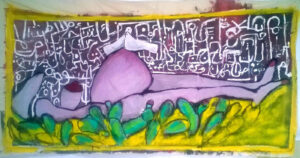
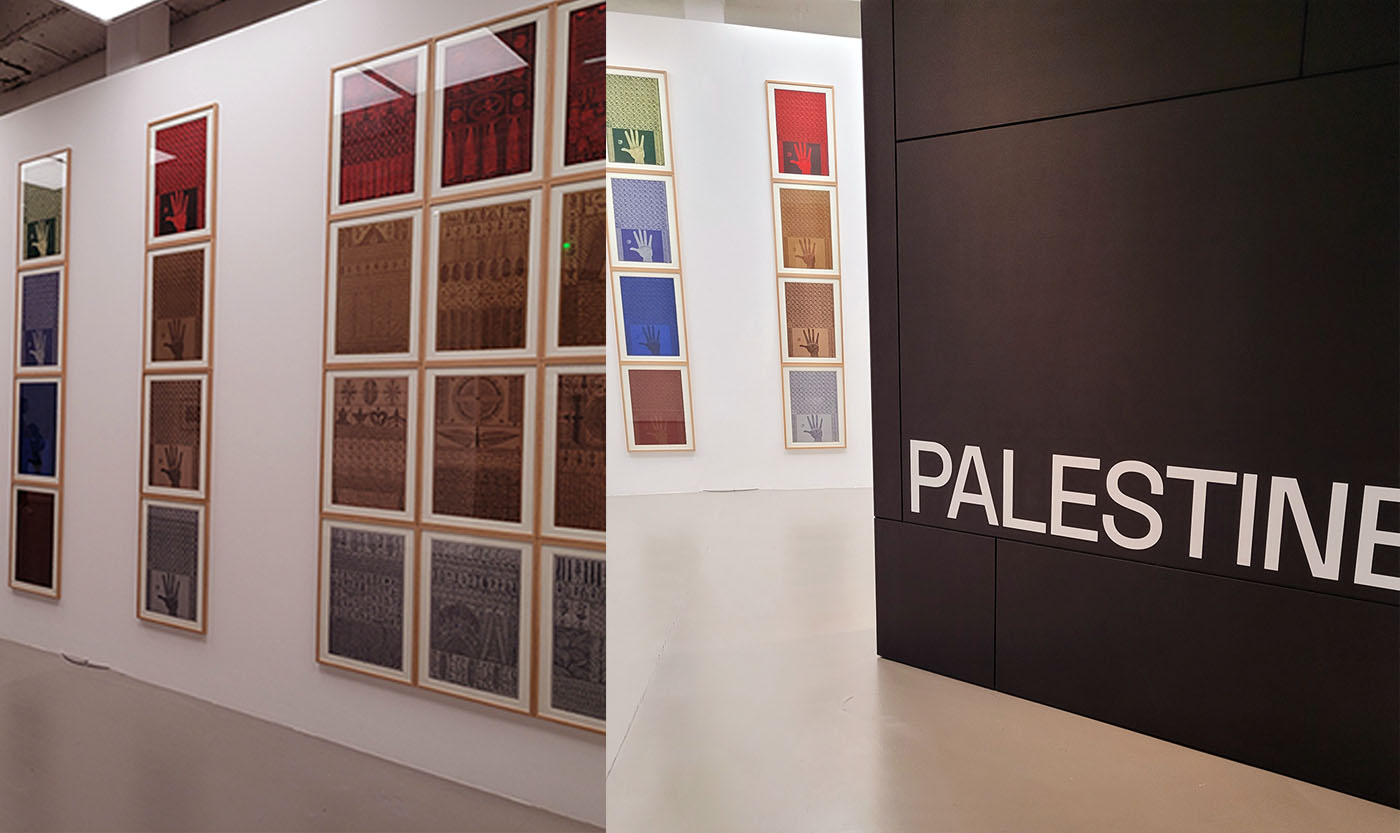
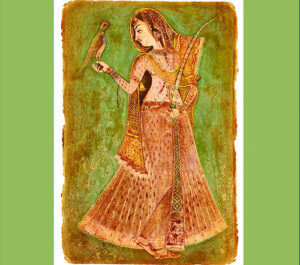
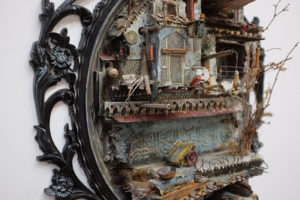
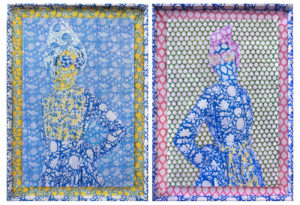
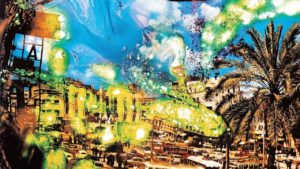
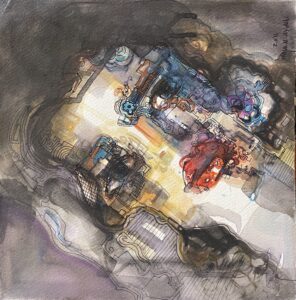
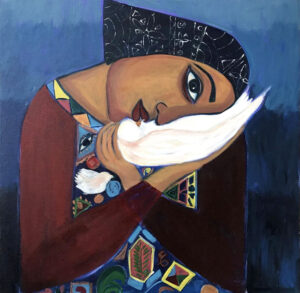
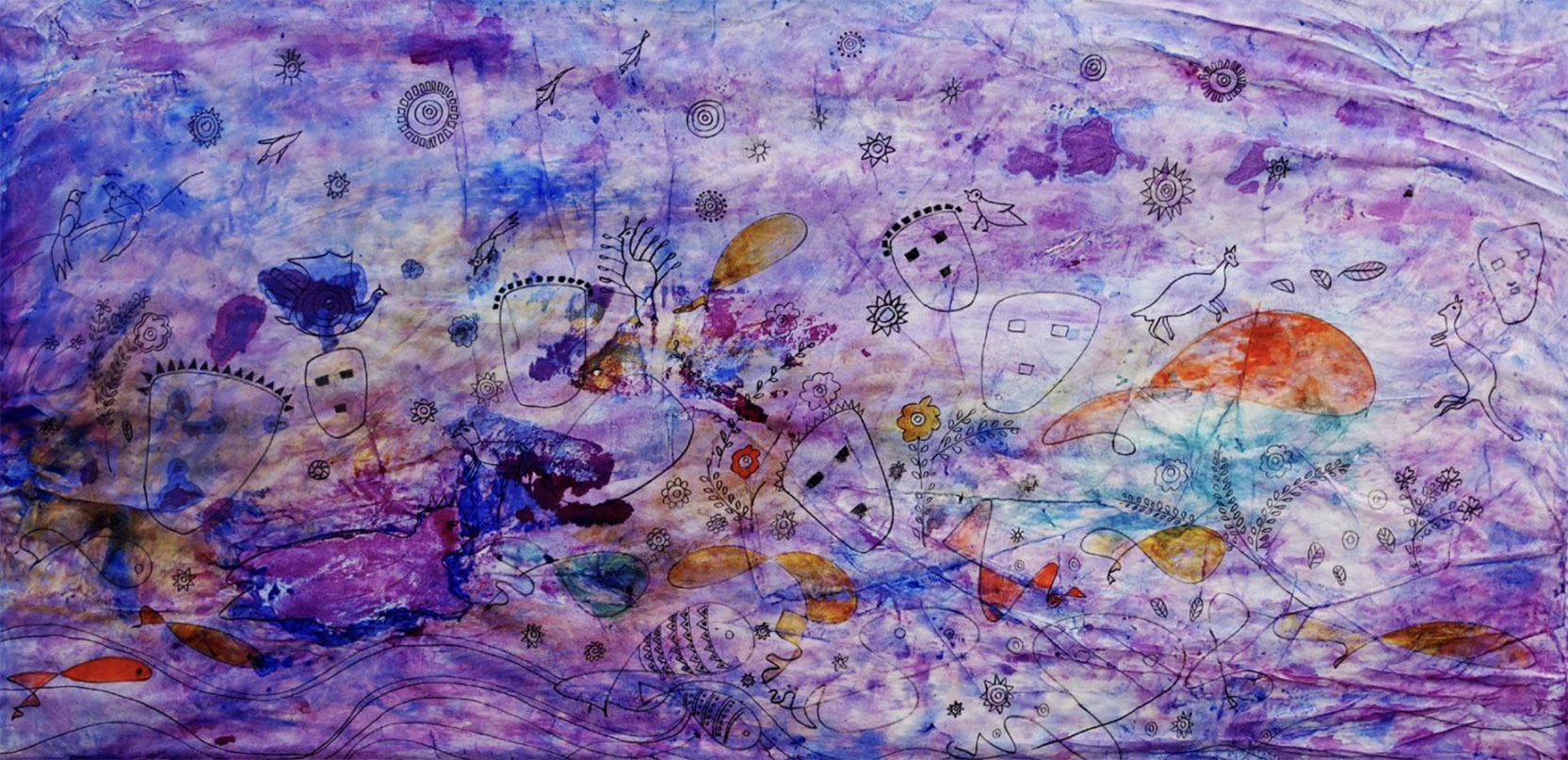
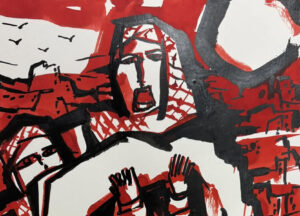
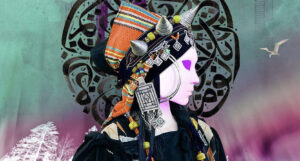
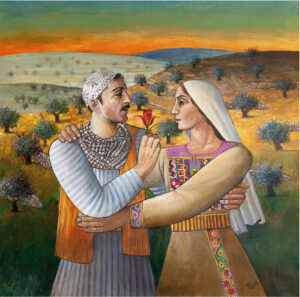
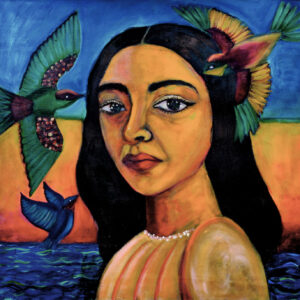
Discover more of artist Salma Arastu’s work here.























![Fady Joudah’s <em>[…]</em> Dares Us to Listen to Palestinian Words—and Silences](https://themarkaz.org/wp-content/uploads/2024/03/SAMAH-SHIHADI-DAIR-AL-QASSI-charcoal-on-paper-100x60-cm-2023-courtesy-Tabari-Artspace.jpg.webp)