“Paradise”—a short story
Monthly
Fiction
Short story

“Paradise”—a short story

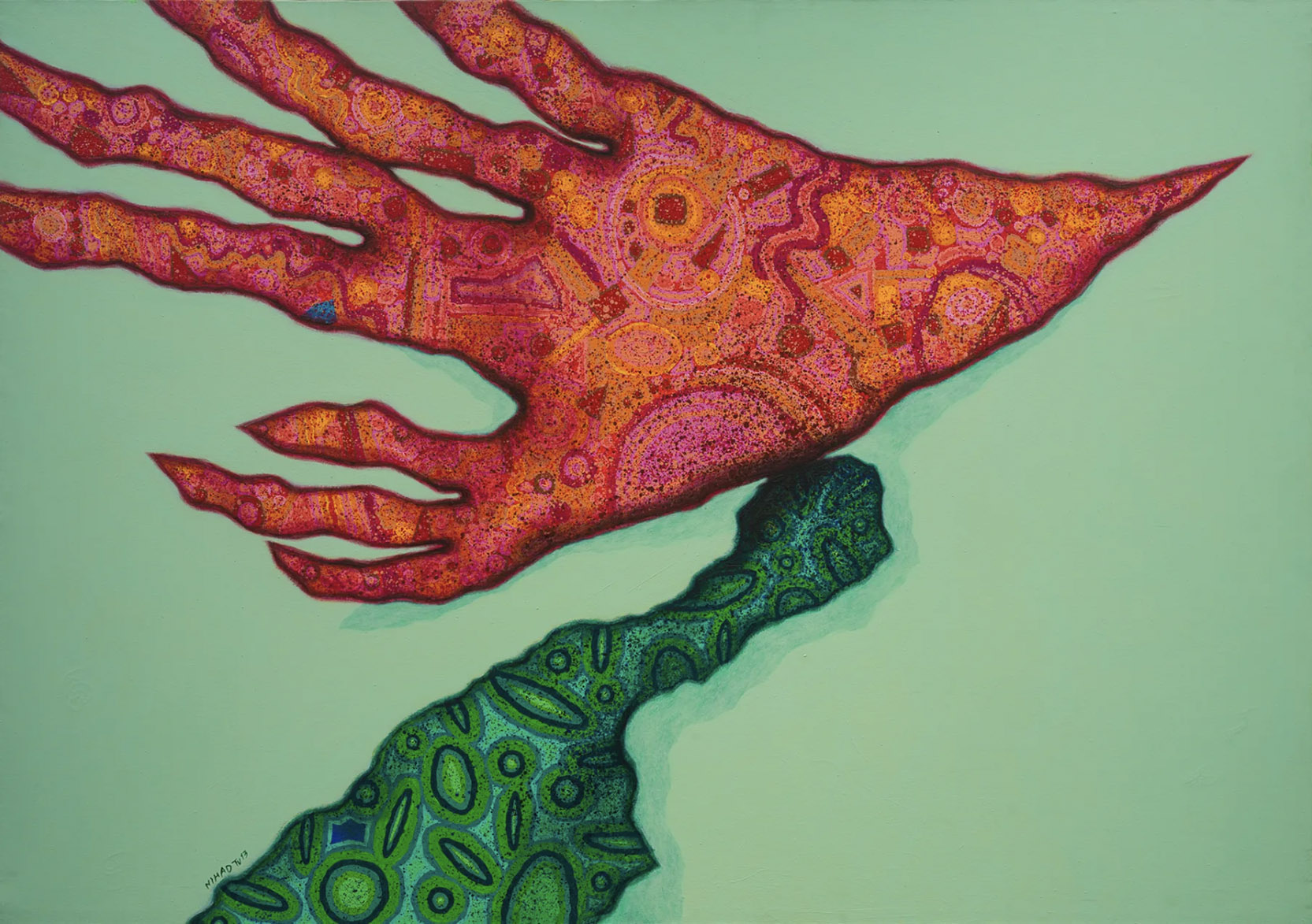
Nihad Al-Turk, "Mythological Bird" (detail).

1 MAY 2026 • By Aisha Abdel Gawad

A young man in Gaza moves between rubble, work, and the sea, holding onto fleeting moments of dignity and fragile illusions of normal life.

Moaz wakes to a strange taste, chalky and metallic. His mouth fills with dust, and he wonders whether it is coming from inside or outside of him. In a panic, he reaches for the glass of water next to his mattress and knocks it over. 

“Shit,” he says, sitting up. 

“Haram, ya Moaz,” his mother calls from the next room. She can hear him. They can all hear each other, all the time. Fourteen of them piled into his uncle’s two-bedroom apartment. He dabs at the water with a corner of his sheet. He shouldn’t waste it. 

He looks around the room. Every centimeter of the floor is covered in mattresses, cushions, and blankets. The children, all nine, sleep in this room. Moaz, twenty-two yet unmarried, still counts as one of them. His parents, his uncle and aunt, and his older sister, recently widowed, sleep in the other bedroom. Across the room, his nine-year-old cousin, Yunis, sleeps on a heap of blankets. His marmalade-colored cat, Mishmish, is curled on his belly, rising and falling with Yunis’ breaths. Beside Moaz is his younger brother, Ahmed. In the small gulf between their mattresses, the puddle of spilled water. 

Ahmed snores softly, his face turned into the crook of his arm. Ahmed can sleep through anything: honking cars, screeching alley cats, or bombs falling just a few kilometers away, as they had last night. The whole apartment had shaken, frames rattling on the walls, a deep, subterranean rumbling. The other children had woken up, terrified and in tears, tearing across the mattresses. As the eldest, he opened his arms and gathered them to him, hugging them tight as he told a story about a friendly giant who was so clumsy that he kept tripping and knocking over buildings. The bombs lasted for hours — it was methodical, moving block by block, inching closer and closer. Ahmed tossed and turned but never woke up, not even when Moaz jumped to close the windows as the air outside turned to ash. The other children whimpered and begged him to come back. “It’s just the giant sneezing,” he said, pinching his nose. 

He can hear the other children in the kitchen now, squabbling over the last of the bread. He is in the room with Yunis and Ahmed, both fast asleep. This is the closest he has come in weeks to being alone. Moaz bends over, his lips hovering over the puddle of water. He slurps it up, sucking as much of it as he can without his lips touching the floor. His father spent three hours and half a week’s wages to buy this water. 

At the sound of Moaz’s slurping, Ahmed’s left eye flickers open, his right eye still buried in his elbow. 

“Why are you lapping water off the floor like a cat?” Ahmed asks, his voice thick with sleep. 

This is what wakes you?” Moaz says, wiping his mouth on his sleeve. 

“Why? What happened?” Ahmed sits up quickly, his eyes darting around the room. 

“Nothing. Look at Mishmish. He’s got the best bed in the house.”

As if on cue, Mishmish stands, turns around, then plops back down on Yunis’ stomach. Ahmed laughs. 

Moaz gets up, wobbling on the mattress, and offers his hand to Ahmed. 

“Let’s get some breakfast, if those other monsters haven’t eaten it all yet.”

 *

Moaz is the last one to the bathroom. By this time, the sink is covered in globs of toothpaste. Every towel on the rack is damp. In the wastebasket, a sanitary pad folded up inside some toilet paper. Worst of all, the room stinks of Ahmed’s hair gel. Moaz has long given up on grooming; weeks earlier, he had taken his father’s shaver to his head and buzzed his thick curls to the scalp. But Ahmed, only sixteen and dangerously aware of how handsome he is, rations his hair gel like it’s the most precious commodity in the world. 

Stories about giants won’t put food on the table or stop the shelling.

Moaz picks up his razor, then thinks better of it. Who cares about a few days’ worth of stubble? Why waste the water? He rubs his palm up and down his cheek. He may be sharing a room with eight children, but at least he can walk around looking like a man. He swipes on some deodorant and brushes his teeth, rinsing the sink out well when he is done. 

At the front door, he endures his mother’s nagging about his beard, kisses her hands, and waits patiently as she prays for his safe return. Then out of the apartment at last, he releases a long sigh. He resists breaking out into a run before anyone can call him back. 

Ahmed is sitting on an overturned paint can a few meters from the building’s entrance, his head gleaming, not a hair out of place. 

“Our clothes are clean!” Ahmed sings. “The cleanest clothes in town! Come and see a demonstration!” 

He has a new side hustle. Ever since the war started, Ahmed has brought home more money than anyone else in the family. He is good at inventing things, at taking the detritus of other people’s lives and seeing its potential for reincarnation. Every few days, Ahmed comes home with a new collection of discarded items. Recently, he’s collected a bike pedal, the blades from inside a fan, a hub cap, and a dented plastic basin. Where people see junk, Ahmed sees opportunity: a washing machine.

As he sings and calls out to passersby, a crowd gathers to watch him operate his new invention. 

“No electricity? No problem!” 

He’s filled the old plastic basin with water and some clothes. He hunches over the basin and sprinkles some powdered soap over the top with a magician’s flourish. Then he cranks the bike pedal, affixed to the hubcap, which is itself attached to the fan blades. As the pedal turns, the hubcap and blades spin, rotating the clothes in the basin. 

“Give me five minutes and your clothes will be as clean as mine! Watch!” 

Moaz looks at the time. He is late to meet Malik. As he walks away, he can hear the negotiations begin. 

“By God, pay me what you think is right,” Ahmed says. 

Moaz smiles and shakes his head. It sometimes bothers him how indispensable his little brother has made himself in this new world. Meanwhile, Moaz feels useless, a glorified babysitter. Stories about giants won’t put food on the table or stop the shelling. Today will be different, because he’s finally found some work. It will be hard. He will return home filthy and exhausted. But for the first time in weeks, he feels almost excited. 

They are all lost, in the city they were born in, the only city most of them have ever known.

In their old lives, it would have taken Moaz ten minutes to get from his uncle’s apartment to Malik’s father’s shop. But in this new world, the landscape of the city changes every night. As he walks, the road suddenly ends at a mountain of debris. Moaz scrambles up and down enormous shards of concrete to continue. The obliteration is disorienting.

 “Do you know where the corner of Al-Jala and Al-Sabah is?” he asks a man sitting in a plastic chair beside a building that has been blasted open like a dollhouse. As the man gives him directions, a woman pokes her head out of one of the apartments. She holds onto some steel beams for balance as she calls down to the man below and asks if he wants any tea. 

Moaz continues, and the road reassembles into something he can recognize. Up ahead, Malik is waving his arms. Moaz grins and wipes the dust from his face. 

“You made it,” Malik calls. 

“Sorry I’m late. Would you believe I got lost?” 

“Habibi, look around. Everyone is lost!” Malik laughs like it’s the funniest thing in the world. They are all lost, in the city they were born in, the only city most of them have ever known.

“I have a gift for you,” Malik reaches into a backpack at his feet and pulls out a small object, which he hides between his hands. He lifts his top hand like a magician pulling a rabbit from a hat. “Mabrouk!”

In his hand is a tiny graduation cap, intricately folded out of white paper. Moaz stares at the paper hat then back up to Malik’s face, confused. 

“I couldn’t sleep last night, it was either the air strikes or indigestion, anyway, I realized: today would have been our graduation.” Malik thrusts the hat into Moaz’s hand. “My sister made them for us. I have one too. Yalla, let’s take a picture.” 

Malik reaches into the backpack and pulls out an identical paper cap. He puts it on his head and waits for Moaz to do the same. 

Moaz counts back the days in his mind. Sometimes he feels like he’s living in a video game, multiple Moazes on a split screen, converging and diverging but never touching. Like if he turns his head, he might see his old life running like a hologram alongside him. On another screen, Malik has just graduated with a degree in computer science, Moaz with a degree in architecture. There is cake and a party by the sea. But on this screen, in this life, there is no university. A diploma here is as worthless as the paper hats on their heads. 

Malik elbows him in the side and tells him to smile for the selfie. “Look alive, ya Moaz. This is the happiest day of our lives!” He flashes a peace sign and Moaz sticks his tongue out. Malik plucks the hats off both their heads and places them back into the bag. If Moaz can’t be like Ahmed — useful, good in a crisis — he can at least try to be more like Malik, who shrugs off despair like an unneeded jacket. 

“Let’s get started,” Moaz says, throwing his arm around his friend’s neck.
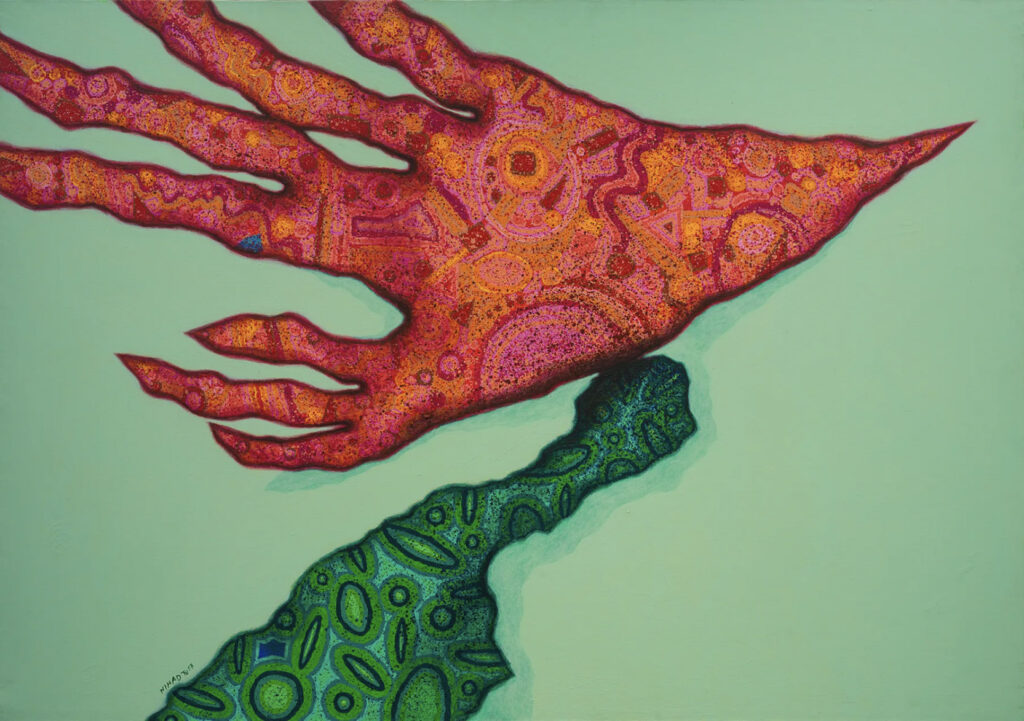

Nihad Al-Turk - Mythological Bird, mixed media on canvas 140x200cm 2025 from his Creature of Hope series courtesy Ayyam Gallery.jpg
Nihad Al-Turk, “Mythological Bird,” mixed media on canvas, 140 x 200 cm, 2025, from his Creature of Hope series, courtesy Ayyam Gallery).

Outside the shop, a few other young men are gathered. Malik’s father, Yassine, is paying them to clear the rubble blocking the entrance. A strike leveled the building next door, sending massive pieces of shrapnel flying. The front door is buried behind a pile of debris.

“Yalla, ya shabab,” Yassine says to the group. “Whoever makes their way inside first gets to take home the cash register.” He laughs and claps his hands, and the men get started. 

Moaz thinks it will take them an hour, maybe two, to carve a path to the entrance. As soon as they begin, he realizes how wrong he is. The work is agonizingly slow. It takes all seven of them to lift some of the larger pieces of concrete. Sweat pours down Moaz’s face within minutes. As the others grunt and swear, Malik and Yassine sing a Fairuz song. We’re coming back, oh love, we’re coming back. 

Cradling a block of concrete, Moaz trips and almost drops the block on his toes. Malik leaps to steady him. 

“Oh, flower of the poor,” Malik croons as he helps carry the block. 

“Your voice is truly one of the worst things I’ve ever heard.” 

“You’re welcome, habibi,” Malik says, slapping Moaz’s cheek lightly with a gloved hand. 

Sometimes he feels like he’s living in a video game, multiple Moazes on a split screen, converging and diverging but never touching. Like if he turns his head, he might see his old life running like a hologram alongside him.

Moaz takes off his own gloves and uses them to wipe the sweat off his face and neck. They’ve been working for two hours and have hardly made a dent. There’s no way they’re getting into the shop today. But if it means another day of work, he is grateful for it. He wants to return home with arms full of bread. He wants to buy Ahmed a fresh tube of hair gel, and his father a jar of olives.

At lunchtime, Malik’s mother and sister arrive with cheese sandwiches. 

“Break time, ya shabab,” Yassine calls out. 

The swearing and grunting stop as the men find perches to sit on to eat. Moaz stretches out on a large slab of concrete and closes his eyes. There is silence as the men devour their sandwiches. All Moaz can hear is his own shallow breath and the buzzing of the drones overhead. Moaz cracks open an eye and watches the black machines swarm in the sky. He pictures another Moaz stretched out across a screen just a few kilometers away, his digital body a riot of neon. With his heart beating so fast, his skin hot and sweaty, he might draw the drones’ thermal imaging right to him. They’re just surveillance drones, he tells himself. Until, of course, one of them pauses, looks at him, and takes aim. 

The wind shifts, and the drones zip higher. But the wind brings something else, an odor that comes to them in waves, getting stronger and thicker. At first, the smell is like flowers decaying in a vase of murky water. The next gust brings a whiff of moldy apricots, of meat left out in the sun. 

He feels someone sit next to him and knows it is Malik. “If we ever get into the shop, let’s get you some deodorant,” he says. “Please, ya Moaz. You stink.” 

Moaz laughs, silently at first, his body shaking gently. But the worse the smell gets, the harder he laughs. Malik joins in, until both of them are clutching their bellies, writhing on the concrete, trying to stop. An image of the other Moaz flashes in his mind — the neon colors pulsing hysterically, in sync with his laughter. 

“I saw this video once,” Malik says, “of this man telling people that the whole city smells of musk.”

“Musk?”

“Yeah, like from the bodies of the martyrs. This guy is grinning into the camera, telling people that martyrs don’t smell like corpses but like musk, the scent of heaven.” 

“You’re kidding me,” Moaz says. The smell is unbearable now. He pulls his shirt over his nose. Malik is lying flat on his back, his hands behind his head.

“The video got, like, a million views. The man quotes this hadith where the prophet, sallallahu alayhi wa salaam, said something about how when the martyrs reach heaven, their blood looks like blood but smells like musk.”

“Huh,” Moaz says, pulling his shirt down again. The worst of the smell has passed over them. The sky pulses with a high-pitched vibration, a frequency he feels in his bones rather than sees with his eyes. 

“I looked it up. There are dozens of hadith about how sinners will smell the stench of rotting corpses when they approach hell and how we will smell musk when we enter paradise.” 

Malik starts quoting the hadith, and Moaz realizes he’s memorized them. 

“Paradise is built from bricks of silver and gold, its mortar is musk of strong fragrance, its pebbles are pearls and rubies, and its soil saffron. Whoever enters it will enjoy bliss without despair and eternity without death. Their clothes will not fade, nor will their youth expire.” 

 “So, all these Muslims out there watching us die? They think our whole city reeks of perfume?” 

Malik shrugs. 

“Does that make this heaven?” Moaz asks. 

Malik makes a sound between a snort and a cough. He reaches to the ground beneath their slab of concrete and scoops up a handful of dirt. “Saffron,” he says, letting the dirt slowly trickle out between his fingers. “Gold,” he says, patting the concrete bed beneath them. Then he takes a deep breath. “Can you smell it? We’re here. We’ve already made it.”

They work until they’ve carved out a hole big enough to look through. They can see shapes in the dark that might be cans, bags of rice, bottles of water. Even if the building collapses on them while they are inside, at least they will be buried with their arms full of Kit Kats and Pepsi, Royal cigarettes and chewing gum. Moaz has the beard of a man but the cravings of a child. What he wouldn’t do for a Fanta! They want to keep going, to make it all the way inside. But Yassine orders them to stop. 

“That’s enough for tonight,” he yells when the boys start to squabble over who gets to look inside. They are getting tired and sloppy, he says. Malik’s cousin has already busted his big toe trying to kick a cinderblock out of the way; the bloody toe swells under his shoe. “Tomorrow Moaz will examine the structure to see if it’s safe.”  

Moaz looks up at the sound of his name. He had been imagining the sound of opening that Fanta, the hiss and sigh of it. 

“Me, ya Amo?” he asks. 

“Yes, of course! As of today, aren’t you officially mister architect?” 

Moaz starts to object, to explain that an architect is different from a structural engineer. What if he tells everyone the building is safe, and it collapses on top of them? Will their corpses still smell like musk if their bodies are crushed not by bombs but by Moaz’s own stupidity? He thinks of his younger brother — what would Ahmed do? 

“Moaz Ibrahim Abu Zuhair, certified architect, at your service, sir,” he says, giving a little bow. The boys roar in approval and Yassine claps his hands. 

“Until tomorrow then, inshallah,” Yassine says. 

 Malik invites Moaz to come back home with them. But Malik has his grandparents and two aunts and their families staying with him. His apartment is even more crowded than Moaz’s. Malik told him that once, when he couldn’t take the sound of eighteen people snoring, he took his pillow and blanket and slept in the bathtub. 

“It wasn’t that bad,” he had said. “Until you wake up to your grandpa pissing two feet from your head.”

All Moaz wants is a little quiet. But quiet is elusive in this city, even in good times. They were packed into a pen and locked in. “Moo moo,” Malik would say. Moaz is tired of trying to be like Malik and Ahmed. He is tired of laughing at their humiliation, of remaking their lives from trash, of eating expired food and drinking filthy water, of recycling ruins. He doesn’t want to be positive. He doesn’t want to make the best of any of it. 

There are still a couple hours before sunset. He knows that if he doesn’t get home before dusk, his mother will start to panic. But he can’t go back just yet. 

He says goodbye to Malik and heads west. He passes a boy selling biscuits, a girl selling hair scrunchies, a boy selling tissues. He has a little money in his pocket from the day’s work. The children call out to him, but he keeps walking. The wind slaps his cheeks like it is trying to knock some sense into him. 

And then, the sea. 

If he only looks straight ahead, at the white sand disappearing under the blue tongue of water, there is absolutely nothing wrong. 

He strips down to his boxers, tosses his clothes on the sand, and runs towards the water, splashing thigh-deep into the surf. He lets the waves knock him around, flip him over and flood his nose. He is limp and compliant until, finally, the sea spits him out and he lays, panting, by the shoreline, splayed out on his back like a starfish. He turns his head, cheek to the sand, toward the horizon — no clouds, no planes, no drones. Only a blue line where sky meets sea, the first gate to heaven. His mother will start to worry soon, and doesn’t paradise also lie beneath her feet? He closes his eyes and listens. Whatever is happening back there is drowned out by the sound of the water. He can’t hear a thing beyond the crashing of the waves and the suck of the sea.

He turns his head, cheek to the sand, toward the horizon — no clouds, no planes, no drones. Only a blue line where sky meets sea, the first gate to heaven.

He thinks of a beach in the north that he and his family used to go to on summer evenings. His mother would pack a picnic and his father would buy them ice cream. One night last summer, they saw a man swimming in the sea with what first appeared to be an enormous dog. As the man came closer, they realized it was not a dog but a horse, frolicking and jumping alongside its owner, rearing her head back as if to catch the ocean spray in her mouth. If the waves moved the man the wrong way, he would drift right under the path of her hooves. But the man trusted her. Moaz’s family laughed and shook their heads as the man finally emerged from the surf, climbed onto the horse’s back, and rode off down the beach like some mythical hero. 

“What is it about our people and their pets?” Moaz had asked as they watched the man disappear. 

“It’s something we can control,” his father said. He had a small dab of vanilla ice cream in his mustache. “We can control whether the animal has a good life, a life of dignity. Even when we can’t give that to ourselves, we can give it to our pets. Take him,” his father pointed at the spot in the distance where the man had disappeared from view. “Who knows what his life is like? But have you ever seen a happier horse?” 

As Moaz lays in the surf, he recalls the stories they had exchanged that night. The story of the woman who broke her fast with beans during Ramadan but insisted on giving her dog lamb. The man who slept on the couch and ceded his bed to his cat because she didn’t like to share. Someone who sang Um Kulthoum songs to his pigeons each night. 

And what of the man and the horse? What has become of them now? 

He stands and dunks his head into the water. He rubs his scalp and scrubs his face with a handful of sand until his skin feels raw. He rinses. The sky is a pale purple. If he doesn’t hurry, his mother will begin to imagine all the ways he could be returned to her. He takes one last look at the glimmering sea and forces himself to turn towards the city, the skyline now bathed in shadow. 

As he trudges up the beach, he sees a boy rifling through his clothes. 

“Hey,” he yells. “Hey, ya walad!” He runs, his muscles screaming, his feet sinking in the sand. He has no doubt the boy could outrun him, and then he would return home not only late, but with nothing to show for his work. 

“Thief!”

The boy freezes, wide-eyed, with his hand in the pocket of Moaz’s jeans. Moaz skids to a halt in front of the boy and reaches down to snatch the jeans from his hands. The boy has dark brown skin and strange copper-colored hair. His eyes are green, enormous and unblinking. Crouched there in the sand, his hand still cupped in an invisible pocket, the boy looks terrified. Of him, Moaz realizes. Six foot four, haggard, nearly naked. He is about to reach out his hand to help him up, when the boy springs to life as if someone has put a coin in him. 

“I’m no thief, you son of a dog!” the boy yells, before unleashing a string of the foulest insults Moaz has ever heard. His grandfather is a donkey-fucker and his grandmother is a whore. On and on he goes as Moaz looks around, trying to find someone the kid belongs to. There is no one around to claim him. 

“Ok, enough, please!” Moaz yells, hurrying to put his clothes on. “If you’re not a thief, why were you going through my pockets?”

“I thought you were dead.” 

Moaz pats himself up and down, then puts two fingers to his pulse. “You thought I was dead?” 

“Well, obviously now I can see that you’re not dead, you idiot. But you looked pretty dead when you were laying on the sand.”

 “Do you make a habit of robbing the dead then?” 

The boy shrugs. “It’s not like they need it where they’re going.” 

Moaz thinks of the hadith: Paradise is built from bricks of silver and gold… “No, I guess they don’t.” 

Moaz reaches his hand down to help him up. The boy flinches. Moaz extends his hand again. This time, the boy puts his bony little hand in his and Moaz pulls him up to standing. 

“Yalla,” he says. “You better get inside. It’s getting dark. Where do you stay?”

People had taken to asking each other this question instead of “Where do you live?” That question had become difficult to answer — too many variables, too many ways to interpret. “Where do you stay?” was better, more precise.

 “I’m sorry I thought you were dead,” the boy grumbles, ignoring the question. 

“I’m sorry I wasn’t dead.” Moaz means this as a joke, but something in the way the boy looks at him makes him feel embarrassed, like he has confessed a secret. 

The planes are upon them without warning. Moaz grabs the boy by the wrist and starts running. He spots a metal dumpster, tipped on its side, and pulls the boy to it. 

“Can you fit underneath?” he screams over the roar of the planes—four of them, massive and flying low. 

The boy doesn’t wait to reply. He gets down on his belly and slides under the dumpster. Moaz is too big, so he crouches beside it, his hands pressed to the rusted metal. He feels something grab him and he almost screams, but it’s only the boy’s fingers clenched around his ankle. He wills himself to look up. One of those giant gray beasts is right above them. A hatch in its belly opens. He reaches down and puts one hand on top of the boy’s. 

“Ma’lesh,” he screams, but he doesn’t know if the boy can hear him. He starts to recite the Shahada. Something slides out of the plane’s belly. A flash of white, a cloud torn to a million pieces. The planes continue south down the coast, thousands of pieces of paper fluttering down in their wake. The wind blows the paper inland in great swirls. Moaz watches the planes go, opening their hatches and releasing more paper. 

“It’s ok,” he says, patting the boy’s hand. “They’re gone.” 

The boy’s head appears. He scans the area, and then shimmies out. They sit with their backs against the dumpster, catching their breath as the sheets swirl above them in slow, gentle arcs. It’s like they’ve won the World Cup, the confetti raining down.

“What do you think they’ll say?” the boy asks. 

“What they always say probably.”

“Maybe the war’s over.” 

Moaz snorts and the boy scowls at him. 

“You don’t know,” he says. “All those other wars had to end sometime. Why can’t this one end today?”

Moaz rests his head against the dumpster and closes his eyes. The sheets of paper flap around them like a swarm of locusts. Maybe the boy is right. The war has to end sometime.

He feels the boy jump up. He opens his eyes and watches the boy hop, arms flailing, trying to snatch a leaflet. He imagines the boy somewhere else, trying to catch a firefly or candy from a piñata. The boy stands very still, his eyes tracking the falling leaflets, until finally he leaps and plucks one from the sky. He grins at Moaz victoriously, then smooths the paper out and starts to read. 

“What does it say?” Moaz asks. 

The boy says nothing. Instead, he shouts in frustration and crumples the paper in his fist. He spikes it to the ground. Tears well in his eyes. He rushes towards the rest of the leaflets fluttering down from the sky, grabbing them, stomping on them and ripping them to shreds, cursing them like he had cursed Moaz on the beach.

“Son of a whore!”

Moaz does nothing to stop or comfort him. He waits until the kid has exhausted himself, standing there limply, shuffling the leaflets around with the toe of his sneaker. 

“What will you do?” Moaz asks. 

The boy shrugs. 

Moaz hoists himself up. The muscles in his legs feel gelatinous, like he can’t rely on them not to collapse. It will be a long walk home. No, not home. Back. It will be a long walk back.

“Where are you staying?” he tries again.

The boy ignores him. 

Moaz reaches into his pocket, feels for the five shekels from Yassine. He grabs one and hands it to the boy, who snatches it and stuffs it into his pocket as if Moaz might change his mind. 

“I really did think you were dead, you know.”

“I know.”

Before turning left on Tariq Ibn Ziyad Street, Moaz pauses to send a message to his mother. He opens his phone and sees a message from Malik’s cousin, the one who kicked the cinder block. The message was sent to all the guys who were helping clear the shop. A picture of his swollen toe, the nail black and cracked. There is a speech bubble coming from the bloody nail. “See you studs tomorrow.” 

The message must have been sent before the leaflets fell. He doesn’t suppose any of them will be back tomorrow. He turns to take one last glance at the sea. There is no sign of the boy, not even a speck in the distance. Ahead of him, a road littered in leaflets that will stick to the bottoms of his shoes as he walks, carrying their orders with him through the city.
MEDITERRANEANS MEDITERRANEANS
Aisha Abdel Gawad

Aisha Abdel Gawad is the author of Between Two Moons, winner of a New York City Book Award, a finalist for the Gotham Book Prize and the Maya Angelou Book Award, and longlisted for the 2024 Carol Shields Prize for Fiction. Her short... Read more

Join Our Community

TMR exists thanks to its readers and supporters. By sharing our stories and celebrating cultural pluralism, we aim to counter racism, xenophobia, and exclusion with knowledge, empathy, and artistic expression.

Learn more

RELATED

TMR 59 • MEDITERRANEANS

The Many Mediterraneans

1 MAY 2026 • By Saleem Haddad
The Many Mediterraneans
TMR 59 • MEDITERRANEANS

“Paradise”—a short story

1 MAY 2026 • By Aisha Abdel Gawad
“Paradise”—a short story
TMR 59 • MEDITERRANEANS

A Sunken Tale—Larissa Sansour on Colonial Theft

1 MAY 2026 • By Jim Quilty
<em>A Sunken Tale</em>—Larissa Sansour on Colonial Theft
Essays

Four Women in Berlin

17 APRIL 2026 • By Alaa Alqaisi
Four Women in Berlin
Essays

The AI Struggle for Middle Earth in the U.S.-Israel War on Iran

13 MARCH 2026 • By Iason Athanasiadis
The AI Struggle for Middle Earth in the U.S.-Israel War on Iran
TMR 58 • MOTHER TONGUE

Ojalá: Toward an Illiteracy of Liberation

6 MARCH 2026 • By Sarah Aziza
<em>Ojalá</em>: Toward an Illiteracy of Liberation
TMR 58 • MOTHER TONGUE

“Sara”—a short story

6 MARCH 2026 • By Majd Aburrub
“Sara”—a short story
Book Reviews

Art and Disillusionment in Saleem Haddad’s Floodlines

20 FEBRUARY 2026 • By Layla AlAmmar
Art and Disillusionment in Saleem Haddad’s <em>Floodlines</em>
Book Reviews

Two New Books Show How Gaza Changed the World

13 FEBRUARY 2026 • By Rebecca Ruth Gould
Two New Books Show How Gaza Changed the World
Columns

On Legal Victories and Human Healing

13 FEBRUARY 2026 • By Amal Ghandour
On Legal Victories and Human Healing
Book Reviews

Stolen Nation: An Argument for Palestinian Reparations

6 FEBRUARY 2026 • By Selma Dabbagh
<em>Stolen Nation</em>: An Argument for Palestinian Reparations
Columns

Small Moments and Their Much Larger Meaning

30 JANUARY 2026 • By Amal Ghandour
Small Moments and Their Much Larger Meaning
Fiction

“Tiny Suns”—a short story

30 JANUARY 2026 • By Sahar Mustafah
“Tiny Suns”—a short story
Essays

Jewish Supremacy and the Making of Genocide in Gaza

30 JANUARY 2026 • By Sheryl Ono
Jewish Supremacy and the Making of Genocide in Gaza
Art

Behind the Seen: Mona Hatoum on Art and Palestine

30 JANUARY 2026 • By Arie Amaya-Akkermans
<em>Behind the Seen</em>: Mona Hatoum on Art and Palestine
Essays

Not Even the Dead Rest in Palestine

30 JANUARY 2026 • By A Mom from Bethlehem
Not Even the Dead Rest in Palestine
Essays

How Can Palestinians and Israelis Live Together?

30 JANUARY 2026 • By Raja Shehadeh
How Can Palestinians and Israelis Live Together?
Film Reviews

With Hasan in Gaza: Salvaged Palestine

30 JANUARY 2026 • By Jim Quilty
<em>With Hasan in Gaza</em>: Salvaged Palestine
TMR 57 • PALESTINE

In Two New Books, Palestinian Writing Bears Witness

30 JANUARY 2026 • By Gabriel Polley
In Two New Books, Palestinian Writing Bears Witness
Book Reviews

You Must Live: A Collection of Palestinian Poetry

30 JANUARY 2026 • By Sholeh Wolpé
<em>You Must Live</em>: A Collection of Palestinian Poetry
TMR 57 • PALESTINE

Letter from Gaza: Our Long Wait for Gas

30 JANUARY 2026 • By Esraa Abo Qamar
Letter from Gaza: Our Long Wait for Gas
TMR 57 • PALESTINE

Letter from Gaza: Stuck in Place

30 JANUARY 2026 • By Mariam Mushtaha
Letter from Gaza: Stuck in Place
Editorial

Why PALESTINE?

30 JANUARY 2026 • By TMR
Why PALESTINE?
Columns

Trump, The Liberator! (and the Fear Wagons)

16 JANUARY 2026 • By Amal Ghandour
Trump, The Liberator! (and the Fear Wagons)
Film

The Palestinian Legacy of Mohammad Bakri

2 JANUARY 2026 • By Hadani Ditmars
The Palestinian Legacy of Mohammad Bakri
Columns

Emm Kamel: The Future Is Here and So Is the Past

19 DECEMBER 2025 • By Amal Ghandour
<em>Emm Kamel</em>: The Future Is Here and So Is the Past
Fiction

A Bomb for Personal Use—an excerpt

5 DECEMBER 2025 • By Mirna Al-Mahdi
<em>A Bomb for Personal Use</em>—an excerpt
short story

“Tuesday”—a story from Palestine

5 DECEMBER 2025 • By Majd Aburrub
“Tuesday”—a story from Palestine
Film

10 Noir Films from the Arab world, Iran, and Turkey

5 DECEMBER 2025 • By TMR
10 Noir Films from the Arab world, Iran, and Turkey
Art & Photography

Artist Interview: Corinne Silva on Israeli Settlement Gardens in Palestine

28 NOVEMBER 2025 • By Jelena Sofronijevic
Artist Interview: Corinne Silva on Israeli Settlement Gardens in Palestine
Book Reviews

Terms of Servitude and the Threats of Digital Settler Colonialism

28 NOVEMBER 2025 • By Maura Finkelstein
<em>Terms of Servitude</em> and the Threats of Digital Settler Colonialism
Interviews

Novelist Jadd Hilal on Being French and Palestinian

7 NOVEMBER 2025 • By Lara Vergnaud
Novelist Jadd Hilal on Being French and Palestinian
Centerpiece

The Grammar of Power: On Journalism, Grief, and the Stories That Break Us

7 NOVEMBER 2025 • By Adam Makary
The Grammar of Power: On Journalism, Grief, and the Stories That Break Us
Film

In Raoul Peck’s Orwell: 2+2=5, Truth is Revolutionary

17 OCTOBER 2025 • By Alex Demyanenko
In Raoul Peck’s <em>Orwell: 2+2=5</em>, Truth is Revolutionary
Essays

The War on Palestinians Didn’t Start on October 7

10 OCTOBER 2025 • By Taqwa Ahmed Al-Wawi
The War on Palestinians Didn’t Start on October 7
Essays

Blue, The Arabian Red Fox

3 OCTOBER 2025 • By Noura Ali-Ramahi
Blue, The Arabian Red Fox
Essays

Lament For My Dear Cousin and Friend in Tulkarm

3 OCTOBER 2025 • By Thoth
Lament For My Dear Cousin and Friend in Tulkarm
Columns

Longing for Love in a Time of Genocide

26 SEPTEMBER 2025 • By Lina Mounzer
Longing for Love in a Time of Genocide
Fiction

Diba’s House

26 SEPTEMBER 2025 • By Sara Masry
Diba’s House
Featured article

Together for Palestine — Truly Historic

19 SEPTEMBER 2025 • By TMR
Together for Palestine — Truly Historic
Book Reviews

How the Media Fails Armenia and Palestine

19 SEPTEMBER 2025 • By Gabriel Polley
How the Media Fails Armenia and Palestine
Film Reviews

New Documentaries from Palestine, Sudan, Afghanistan, and Iran

12 SEPTEMBER 2025 • By Yassin El-Moudden
New Documentaries from Palestine, Sudan, Afghanistan, and Iran
Editorial

Why Out of Our Minds?

5 SEPTEMBER 2025 • By Lina Mounzer
Why <em>Out of Our Minds</em>?
Centerpiece

Trauma After Gaza

5 SEPTEMBER 2025 • By Joelle Abi-Rached
Trauma After Gaza
Film

Once Upon a Time in Gaza Wants to Be an Indie Western

29 AUGUST 2025 • By Karim Goury
<em>Once Upon a Time in Gaza</em> Wants to Be an Indie Western
Essays

From Stitch to Symbol: The Power of Palestinian Tatreez

22 AUGUST 2025 • By Joanna Barakat
From Stitch to Symbol: The Power of Palestinian Tatreez
Essays

Amal Doesn’t Even Know What a Banana Is: Child Malnutrition in Gaza

1 AUGUST 2025 • By Asem Al Jerjawi
Amal Doesn’t Even Know What a Banana Is: Child Malnutrition in Gaza
Essays

“A Love That Endures”: How Tamer and Sabreen Defied War and Death

25 JULY 2025 • By Husam Maarouf
“A Love That Endures”: How Tamer and Sabreen Defied War and Death
Art & Photography

August World Picks from the Editors

25 JULY 2025 • By TMR
August World Picks from the Editors
Fiction

Hiding From Dragons—a short story set in Gaza

18 JULY 2025 • By Richie Billing
Hiding From Dragons—a short story set in Gaza
Featured article

“Silence is Not the Way”—Arab Writers Against Israel’s Genocide

18 JULY 2025 • By Jordan Elgrably
“Silence is Not the Way”—Arab Writers Against Israel’s Genocide
Art

Taqi Spateen Paints Palestine Museum Mural of Aaron Bushnell

11 JULY 2025 • By Hadani Ditmars
Taqi Spateen Paints Palestine Museum Mural of Aaron Bushnell
Poetry

Nasser Rabah on Poetry and Gaza

4 JULY 2025 • By Nasser Rabah
Nasser Rabah on Poetry and Gaza
Book Reviews

Palestine’s Places and Memorials Are Not Forgotten

4 JULY 2025 • By Gabriel Polley
Palestine’s Places and Memorials Are Not <em>Forgotten</em>
Essays

Unwritten Stories from Palestine

4 JULY 2025 • By Thoth
Unwritten Stories from Palestine
Essays

A Voice That Defied Silence: The Legacy of Dr. Refaat Al-Areer

4 JULY 2025 • By Taqwa Ahmed Al-Wawi
A Voice That Defied Silence: The Legacy of Dr. Refaat Al-Areer
Essays

Doaa: From a Dreamworld to the Ashes of Displacement

30 MAY 2025 • By Taqwa Ahmed Al-Wawi
Doaa: From a Dreamworld to the Ashes of Displacement
Interviews

23 Hours Inside State Dept. Press Briefings on the Gaza Genocide

23 MAY 2025 • By Malu Halasa
23 Hours Inside State Dept. Press Briefings on the Gaza Genocide
Featured article

Arrested and Rearrested: Palestinian Women in the West Bank

16 MAY 2025 • By Lynzy Billing
Arrested and Rearrested: Palestinian Women in the West Bank
Books

Algerian-French Author Kamel Daoud on the Defensive

16 MAY 2025 • By Lara Vergnaud
Algerian-French Author Kamel Daoud on the Defensive
Books

Editors’ 2025 Palestinian Lit List

15 MAY 2025 • By TMR
Editors’ 2025 Palestinian Lit List
Books

Poet Mosab Abu Toha Wins Pulitzer Prize for Essays on Gaza

9 MAY 2025 • By Jordan Elgrably
Poet Mosab Abu Toha Wins Pulitzer Prize for Essays on Gaza
Editorial

For Our 50th Issue, Writers Reflect on Going Home

2 MAY 2025 • By TMR
For Our 50th Issue, Writers Reflect on Going Home
Essays

A Kashmiri in Cashmere

2 MAY 2025 • By Nafeesa Syeed
A Kashmiri in Cashmere
Art

Neither Here Nor There

2 MAY 2025 • By Myriam Cohenca
Neither Here Nor There
Literature

The Pen and the Sword — Censorship Threatens Us All

2 MAY 2025 • By Anna Badkhen
The Pen and the Sword — Censorship Threatens Us All
Art

Between Belief and Doubt: Ramzi Mallat’s Suspended Disbelief

11 APRIL 2025 • By Marta Mendes
Between Belief and Doubt: Ramzi Mallat’s Suspended Disbelief
Advice

Dear Souseh: Existential Advice for Third World Problems

4 APRIL 2025 • By Lina Mounzer
Dear Souseh: Existential Advice for Third World Problems
Film

Gaza, Sudan, Israel/Palestine Documentaries Show in Thessaloniki

28 MARCH 2025 • By Iason Athanasiadis
Gaza, Sudan, Israel/Palestine Documentaries Show in Thessaloniki
Essays

A Conversation Among My Homeland’s Trees

7 MARCH 2025 • By Alia Yunis
A Conversation Among My Homeland’s Trees
Fiction

Manifesto of Love & Revolution

7 MARCH 2025 • By Iskandar Abdalla
Manifesto of Love & Revolution
Art

Finding Emptiness: Gaza Artist Taysir Batniji in Beirut

21 FEBRUARY 2025 • By Jim Quilty
Finding Emptiness: Gaza Artist Taysir Batniji in Beirut
Book Reviews

Omar El Akkad & Mohammed El-Kurd: Liberalism in a Time of Genocide

14 FEBRUARY 2025 • By Rebecca Ruth Gould
Omar El Akkad & Mohammed El-Kurd: Liberalism in a Time of Genocide
Editorial

Memoir in the Age of Narcissism

7 FEBRUARY 2025 • By TMR
Memoir in the Age of Narcissism
Centerpiece

Ravaged by Fire

7 FEBRUARY 2025 • By Francisco Letelier
Ravaged by Fire
Book Reviews

Memories of Palestine through Contemporary Media

7 FEBRUARY 2025 • By Malu Halasa
Memories of Palestine through Contemporary Media
Essays

Flight Plans: From Gaza to Singapore

7 FEBRUARY 2025 • By Chin-chin Yap
Flight Plans: From Gaza to Singapore
Books

“Culinary Palestine” — Fadi Kattan in an excerpt from Sumud

31 JANUARY 2025 • By Fadi Kattan
“Culinary Palestine” — Fadi Kattan in an excerpt from <em>Sumud</em>
Book Reviews

Yassini Girls—a Powerful Yet Flawed Account of Historical Trauma

31 JANUARY 2025 • By Natasha Tynes
<em>Yassini Girls</em>—a Powerful Yet Flawed Account of Historical Trauma
Arabic

Huda Fakhreddine & Yasmeen Hanoosh: Translating Arabic & Gaza

17 JANUARY 2025 • By Yasmeen Hanoosh, Huda J. Fakhreddine
Huda Fakhreddine & Yasmeen Hanoosh: Translating Arabic & Gaza
Book Reviews

Radwa Ashour’s Classic Granada Now in a New English Edition

17 JANUARY 2025 • By Guy Mannes-Abbott
Radwa Ashour’s Classic <em>Granada</em> Now in a New English Edition
Uncategorized

Malu Halasa and Jordan Elgrably publish Sumūd: a New Palestinian Reader

4 JANUARY 2025 • By TMR
Malu Halasa and Jordan Elgrably publish Sumūd: a New Palestinian Reader
Book Reviews

Maya Abu Al-Hayyat’s Defiant Exploration of Palestinian Life

20 DECEMBER 2024 • By Zahra Hankir
Maya Abu Al-Hayyat’s Defiant Exploration of Palestinian Life
Book Reviews

Criticizing a Militaristic Israel is not Inherently Antisemitic

20 DECEMBER 2024 • By Stephen Rohde
Criticizing a Militaristic Israel is not Inherently Antisemitic
Featured Artist

Palestine Features in Larissa Sansour’s Sci-Fi Future

6 DECEMBER 2024 • By Larissa Sansour
Palestine Features in Larissa Sansour’s Sci-Fi Future
Opinion

Susan Abulhawa at Oxford Union on Palestine/Israel

6 DECEMBER 2024 • By Susan Abulhawa
Susan Abulhawa at Oxford Union on Palestine/Israel
Essays

A Fragile Ceasefire as Lebanon Survives, Traumatized

29 NOVEMBER 2024 • By Tarek Abi Samra, Lina Mounzer
A Fragile Ceasefire as Lebanon Survives, Traumatized
Art

Basel Abbas & Ruanne Abou-Rahme: Palestinian artists at Copenhagen’s Glyptotek

22 NOVEMBER 2024 • By Arie Amaya-Akkermans
Basel Abbas & Ruanne Abou-Rahme: Palestinian artists at Copenhagen’s Glyptotek
Essays

A Jewish Meditation on the Palestinian Genocide

15 NOVEMBER 2024 • By Sheryl Ono
A Jewish Meditation on the Palestinian Genocide
Art & Photography

Palestinian Artists Reflect on the Role of Art in Catastrophic Times

1 NOVEMBER 2024 • By Nina Hubinet
Palestinian Artists Reflect on the Role of Art in Catastrophic Times
Centerpiece

“Habib”—a story by Ghassan Ghassan

1 NOVEMBER 2024 • By Ghassan Ghassan
“Habib”—a story by Ghassan Ghassan
Books

“The Ballad of Lulu and Amina” — from Jerusalem to Gaza

1 NOVEMBER 2024 • By Izzeldin Bukhari
“The Ballad of Lulu and Amina” — from Jerusalem to Gaza
Art & Photography

The Palestinian Gazelle

1 NOVEMBER 2024 • By Manal Mahamid
The Palestinian Gazelle
Books

November World Picks from the Editors

25 OCTOBER 2024 • By TMR
November World Picks from the Editors
Interviews

The Hybrid — The Case of Michael Vatikiotis

18 OCTOBER 2024 • By Rana Haddad
The Hybrid — The Case of Michael Vatikiotis
Essays

Palestine, the Land of Grapes and Wine

11 OCTOBER 2024 • By Fadi Kattan, Anna Patrowicz
Palestine, the Land of Grapes and Wine
Editorial

A Year of War Without End

4 OCTOBER 2024 • By Lina Mounzer
A Year of War Without End
TMR 45 • From Here, One Year On

Witnessing Catastrophe: a Painter in Lebanon

4 OCTOBER 2024 • By Ziad Suidan
Witnessing Catastrophe: a Painter in Lebanon
Art & Photography

Visuals and Voices: Palestine Will Not Be a Palimpsest

4 OCTOBER 2024 • By Malu Halasa
Visuals and Voices: Palestine Will Not Be a Palimpsest
Featured article

Censorship and Cancellation Fail to Camouflage the Ugly Truth

4 OCTOBER 2024 • By Jordan Elgrably
Censorship and Cancellation Fail to Camouflage the Ugly Truth
Essays

Shamrocks & Watermelons: Palestine Politics in Belfast

4 OCTOBER 2024 • By Stuart Bailie
Shamrocks & Watermelons: Palestine Politics in Belfast
Essays

Depictions of Genocide: The Un-Imaginable Visibility of Extermination

4 OCTOBER 2024 • By Viola Shafik
Depictions of Genocide: The Un-Imaginable Visibility of Extermination
Opinion

Everything Has Changed, Nothing Has Changed

4 OCTOBER 2024 • By Amal Ghandour
Everything Has Changed, Nothing Has Changed
Art

Activism in the Landscape: Environmental Arts & Resistance in Palestine

4 OCTOBER 2024 • By Katie Logan
Activism in the Landscape: Environmental Arts & Resistance in Palestine
Poetry

Poems by Nasser Rabah, Amanee Izhaq and Mai Al-Nakib

4 OCTOBER 2024 • By Nasser Rabah, Amanee Izhaq, Mai Al-Nakib, Wiam El-Tamami
Poems by Nasser Rabah, Amanee Izhaq and Mai Al-Nakib
Book Reviews

Don’t Look Left: A Diary of Genocide by Atif Abu Saif

20 SEPTEMBER 2024 • By Selma Dabbagh
<em>Don’t Look Left: A Diary of Genocide</em> by Atif Abu Saif
Featured Artist

Featured Artists: “Barred From Home”

6 SEPTEMBER 2024 • By Malu Halasa
Featured Artists: “Barred From Home”
Book Reviews

Egypt’s Gatekeeper — President or Despot?

6 SEPTEMBER 2024 • By Elias Feroz
Egypt’s Gatekeeper — President or Despot?
Fiction

“Fragments from a Gaza Nightmare”—fiction from Sama Hassan

30 AUGUST 2024 • By Sama Hassan, Rana Asfour
“Fragments from a Gaza Nightmare”—fiction from Sama Hassan
Essays

Beyond Rubble — Cultural Heritage and Healing After Disaster

23 AUGUST 2024 • By Arie Amaya-Akkermans
Beyond Rubble — Cultural Heritage and Healing After Disaster
Books

“Kill the Music”—an excerpt from a new novel by Badar Salem

16 AUGUST 2024 • By Badar Salem
“Kill the Music”—an excerpt from a new novel by Badar Salem
Film

World Picks from the Editors: AUGUST

2 AUGUST 2024 • By TMR
World Picks from the Editors: AUGUST
Art & Photography

World Picks from the Editors: July 15 — August 2

12 JULY 2024 • By TMR
World Picks from the Editors: July 15 — August 2
Fiction

“The Cockroaches”—flash fiction

5 JULY 2024 • By Stanko Uyi Srsen
“The Cockroaches”—flash fiction
short story

“Deferred Sorrow”—fiction from Haidar Al Ghazali

5 JULY 2024 • By Haidar Al Ghazali, Rana Asfour
“Deferred Sorrow”—fiction from Haidar Al Ghazali
Book Reviews

Is Amin Maalouf’s Latest Novel, On the Isle of Antioch, a Parody?

14 JUNE 2024 • By Farah-Silvana Kanaan
Is Amin Maalouf’s Latest Novel, <em>On the Isle of Antioch</em>, a Parody?
Centerpiece

Dare Not Speak—a One-Act Play

7 JUNE 2024 • By Hassan Abdulrazzak
<em>Dare Not Speak</em>—a One-Act Play
Books

Palestine, Political Theatre & the Performance of Queer Solidarity in Jean Genet’s Prisoner of Love

7 JUNE 2024 • By Saleem Haddad
Palestine, Political Theatre & the Performance of Queer Solidarity in Jean Genet’s <em>Prisoner of Love</em>
Essays

A Small Kernel of Human Kindness: Some Notes on Solidarity and Resistance

24 MAY 2024 • By Nancy Kricorian
A Small Kernel of Human Kindness: Some Notes on Solidarity and Resistance
Art

Demarcations of Identity: Rushdi Anwar

10 MAY 2024 • By Malu Halasa
Demarcations of Identity: Rushdi Anwar
Editorial

Why FORGETTING?

3 MAY 2024 • By Malu Halasa, Jordan Elgrably
Why FORGETTING?
Centerpiece

Memory Archive: Between Remembering and Forgetting

3 MAY 2024 • By Mai Al-Nakib
Memory Archive: Between Remembering and Forgetting
Essays

The Elephant in the Box

3 MAY 2024 • By Asmaa Elgamal
The Elephant in the Box
Art & Photography

Not Forgotten, Not (All) Erased: Palestine’s Sacred Shrines

3 MAY 2024 • By Gabriel Polley
Not Forgotten, Not (All) Erased: Palestine’s Sacred Shrines
Book Reviews

Palestinian Culture, Under Assault, Celebrated in New Cookbook

3 MAY 2024 • By Mischa Geracoulis
Palestinian Culture, Under Assault, Celebrated in New Cookbook
Art & Photography

Malak Mattar: No Words, Only Scenes of Ruin

26 APRIL 2024 • By Nadine Nour el Din
Malak Mattar: No Words, Only Scenes of Ruin
Opinion

Censorship over Gaza and Palestine Roils the Arts Community

12 APRIL 2024 • By Hassan Abdulrazzak
Censorship over Gaza and Palestine Roils the Arts Community
Art

Past Disquiet at the Palais de Tokyo in Paris

1 APRIL 2024 • By Kristine Khouri, Rasha Salti
<em>Past Disquiet</em> at the Palais de Tokyo in Paris
Essays

Undoing Colonial Geographies from Paris with Ariella Aïsha Azoulay

1 APRIL 2024 • By Sasha Moujaes, Jordan Elgrably
Undoing Colonial Geographies from Paris with Ariella Aïsha Azoulay
Book Reviews

Fady Joudah’s […] Dares Us to Listen to Palestinian Words—and Silences

25 MARCH 2024 • By Eman Quotah
Fady Joudah’s <em>[…]</em> Dares Us to Listen to Palestinian Words—and Silences
Art & Photography

Will Artists Against Genocide Boycott the Venice Biennale?

18 MARCH 2024 • By Hadani Ditmars
Will Artists Against Genocide Boycott the Venice Biennale?
Editorial

Why “Burn It all Down”?

3 MARCH 2024 • By Lina Mounzer
Why “Burn It all Down”?
Books

Four Books to Revolutionize Your Thinking

3 MARCH 2024 • By Rana Asfour
Four Books to Revolutionize Your Thinking
Columns

Genocide: “That bell can’t be unrung. That thought can’t be unthunk.”

3 MARCH 2024 • By Amal Ghandour
Genocide: “That bell can’t be unrung. That thought can’t be unthunk.”
Essays

The Story of the Keffiyeh

3 MARCH 2024 • By Rajrupa Das
The Story of the Keffiyeh
Essays

Messages from Gaza Now / 5

26 FEBRUARY 2024 • By Hossam Madhoun
Messages from Gaza Now / 5
Weekly

World Picks from the Editors: Feb 23 — Mar 7

23 FEBRUARY 2024 • By TMR
World Picks from the Editors: Feb 23 — Mar 7
Poetry

“WE” and “4978 and One Nights” by Ghayath Almadhoun

4 FEBRUARY 2024 • By Ghayath Al Madhoun
“WE” and “4978 and One Nights” by Ghayath Almadhoun
Editorial

Shoot That Poison Arrow to My Heart: The LSD Editorial

4 FEBRUARY 2024 • By Malu Halasa
Shoot That Poison Arrow to My Heart: The LSD Editorial
Art & Photography

The Body, Intimacy and Technology in the Middle East

4 FEBRUARY 2024 • By Naima Morelli
The Body, Intimacy and Technology in the Middle East
Columns

Driving in Palestine Now is More Dangerous Than Ever

29 JANUARY 2024 • By TMR
Driving in Palestine Now is More Dangerous Than Ever
Featured article

Israel-Palestine: Peace Under Occupation?

29 JANUARY 2024 • By Laëtitia Soula
Israel-Palestine: Peace Under Occupation?
Books

Illuminated Reading for 2024: Our Anticipated Titles

22 JANUARY 2024 • By TMR
Illuminated Reading for 2024: Our Anticipated Titles
Fiction

“New Reasons”—a short story by Samira Azzam

15 JANUARY 2024 • By Samira Azzam, Ranya Abdelrahman
“New Reasons”—a short story by Samira Azzam
Art

Palestinian Artists

12 JANUARY 2024 • By TMR
Palestinian Artists
Essays

Gaza Sunbirds: the Palestinian Para-Cyclists Who Won’t Quit

25 DECEMBER 2023 • By Malu Halasa
Gaza Sunbirds: the Palestinian Para-Cyclists Who Won’t Quit
Essays

Jesus Was Palestinian, But Bethlehem Suspends Christmas

25 DECEMBER 2023 • By Ahmed Twaij
Jesus Was Palestinian, But Bethlehem Suspends Christmas
Books

Inside Hamas: From Resistance to Regime

25 DECEMBER 2023 • By Paola Caridi
Inside <em>Hamas: From Resistance to Regime</em>
Columns

Messages from Gaza Now / 2

18 DECEMBER 2023 • By Hossam Madhoun
Messages from Gaza Now / 2
Music

We Will Sing Until the Pain Goes Away—a Palestinian Playlist

18 DECEMBER 2023 • By Brianna Halasa
We Will Sing Until the Pain Goes Away—a Palestinian Playlist
Columns

Messages From Gaza Now

11 DECEMBER 2023 • By Hossam Madhoun
Messages From Gaza Now
Featured excerpt

The Palestine Laboratory and Gaza: An Excerpt

4 DECEMBER 2023 • By Antony Loewenstein
<em>The Palestine Laboratory</em> and Gaza: An Excerpt
Editorial

Why Endings & Beginnings?

3 DECEMBER 2023 • By Jordan Elgrably
Why Endings & Beginnings?
Fiction

“I, Hanan”—a Gazan tale of survival by Joumana Haddad

3 DECEMBER 2023 • By Joumana Haddad
“I, Hanan”—a Gazan tale of survival by Joumana Haddad
Opinion

Gaza vs. Mosul from a Medical and Humanitarian Standpoint

27 NOVEMBER 2023 • By Ahmed Twaij
Gaza vs. Mosul from a Medical and Humanitarian Standpoint
Opinion

What’s in a Ceasefire?

20 NOVEMBER 2023 • By Adrian Kreutz, Enzo Rossi, Lillian Robb
What’s in a Ceasefire?
Opinion

Beautiful October 7th Art Belies the Horrors of War

13 NOVEMBER 2023 • By Mark LeVine
Beautiful October 7th Art Belies the Horrors of War
Arabic

Poet Ahmad Almallah

9 NOVEMBER 2023 • By Ahmad Almallah
Poet Ahmad Almallah
Opinion

Palestine’s Pen against Israel’s Swords of Injustice

6 NOVEMBER 2023 • By Mai Al-Nakib
Palestine’s Pen against Israel’s Swords of Injustice
Books

Domicide—War on the City

5 NOVEMBER 2023 • By Ammar Azzouz
<em>Domicide</em>—War on the City
Essays

On Fathers, Daughters and the Genocide in Gaza 

30 OCTOBER 2023 • By Deema K Shehabi
On Fathers, Daughters and the Genocide in Gaza 
Islam

October 7 and the First Days of the War

23 OCTOBER 2023 • By Robin Yassin-Kassab
October 7 and the First Days of the War
Editorial

Palestine and the Unspeakable

16 OCTOBER 2023 • By Lina Mounzer
Palestine and the Unspeakable
Art

The Ongoing Nakba—Rasha Al-Jundi’s Embroidery Series

16 OCTOBER 2023 • By Rasha Al Jundi
The Ongoing Nakba—Rasha Al-Jundi’s Embroidery Series
Art

Vera Tamari’s Lifetime of Palestinian Art

16 OCTOBER 2023 • By Taline Voskeritchian
Vera Tamari’s Lifetime of Palestinian Art
Book Reviews

A Day in the Life of Abed Salama: A Palestine Story

16 OCTOBER 2023 • By Dalia Hatuqa
<em>A Day in the Life of Abed Salama</em>: A Palestine Story
Weekly

World Picks from the Editors, Oct 13 — Oct 27, 2023

12 OCTOBER 2023 • By TMR
World Picks from the Editors, Oct 13 — Oct 27, 2023
Poetry

Home: New Arabic Poems in Translation

11 OCTOBER 2023 • By Sarah Coolidge
<em>Home</em>: New Arabic Poems in Translation
Books

Edward Said: Writing in the Service of Life 

9 OCTOBER 2023 • By Layla AlAmmar
Edward Said: Writing in the Service of Life 
Books

Fairouz: The Peacemaker and Champion of Palestine

1 OCTOBER 2023 • By Dima Issa
Fairouz: The Peacemaker and Champion of Palestine
Book Reviews

Saqi’s Revenant: Sahar Khalifeh’s Classic Nablus Novel Wild Thorns

25 SEPTEMBER 2023 • By Noshin Bokth
Saqi’s Revenant: Sahar Khalifeh’s Classic Nablus Novel <em>Wild Thorns</em>
Book Reviews

Laila Halaby’s The Weight of Ghosts is a Haunting Memoir

28 AUGUST 2023 • By Thérèse Soukar Chehade
Laila Halaby’s <em>The Weight of Ghosts</em> is a Haunting Memoir
Book Reviews

What’s the Solution for Jews and Palestine in the Face of Apartheid Zionism?

21 AUGUST 2023 • By Jonathan Ofir
What’s the Solution for Jews and Palestine in the Face of Apartheid Zionism?
Book Reviews

Ilan Pappé on Tahrir Hamdi’s Imagining Palestine

7 AUGUST 2023 • By Ilan Pappé
Ilan Pappé on Tahrir Hamdi’s <em> Imagining Palestine</em>
Art

What Palestine Brings to the World—a Major Paris Exhibition

31 JULY 2023 • By Sasha Moujaes
<em>What Palestine Brings to the World</em>—a Major Paris Exhibition
Opinion

The End of the Palestinian State? Jenin Is Only the Beginning

10 JULY 2023 • By Yousef M. Aljamal
The End of the Palestinian State? Jenin Is Only the Beginning
Fiction

Tears from a Glass Eye—a story by Samira Azzam

2 JULY 2023 • By Samira Azzam, Ranya Abdelrahman
Tears from a Glass Eye—a story by Samira Azzam
Columns

The Rite of Flooding: When the Land Speaks

19 JUNE 2023 • By Bint Mbareh
The Rite of Flooding: When the Land Speaks
Arabic

Arab Theatre Grapples With Climate Change, Borders, War & Love

4 JUNE 2023 • By Hassan Abdulrazzak
Arab Theatre Grapples With Climate Change, Borders, War & Love
Essays

Alien Entities in the Desert

4 JUNE 2023 • By Dror Shohet
Alien Entities in the Desert
Featured Artist

Nasrin Abu Baker: The Markaz Review Featured Artist, June 2023

4 JUNE 2023 • By TMR
Nasrin Abu Baker: The Markaz Review Featured Artist, June 2023
Book Reviews

How Bethlehem Evolved From Jerusalem’s Sleepy Backwater to a Global Town

15 MAY 2023 • By Karim Kattan
How Bethlehem Evolved From Jerusalem’s Sleepy Backwater to a Global Town
TMR Conversations

TMR CONVERSATIONS: Amal Ghandour Interviews Raja Shehadeh

11 MAY 2023 • By Amal Ghandour, Raja Shehadeh
TMR CONVERSATIONS: Amal Ghandour Interviews Raja Shehadeh
Film Reviews

Yallah Gaza! Presents the Case for Gazan Humanity

10 APRIL 2023 • By Karim Goury
<em>Yallah Gaza!</em> Presents the Case for Gazan Humanity
Book Reviews

In Search of Fathers: Raja Shehadeh’s Palestinian Memoir

13 MARCH 2023 • By Amal Ghandour
In Search of Fathers: Raja Shehadeh’s Palestinian Memoir
Centerpiece

Broken Home: Britain in the Time of Migration

5 MARCH 2023 • By Malu Halasa
Broken Home: Britain in the Time of Migration
Essays

More Photographs Taken From The Pocket of a Dead Arab

5 MARCH 2023 • By Saeed Taji Farouky
More Photographs Taken From The Pocket of a Dead Arab
Essays

Home Under Siege: a Palestine Photo Essay

5 MARCH 2023 • By Anam Raheem
Home Under Siege: a Palestine Photo Essay
Columns

Sudden Journeys: Deluge at Wadi Feynan

6 FEBRUARY 2023 • By Jenine Abboushi
Sudden Journeys: Deluge at Wadi Feynan
TV Review

Palestinian Territories Under Siege But Season 4 of Fauda Goes to Brussels and Beirut Instead

6 FEBRUARY 2023 • By Brett Kline
Palestinian Territories Under Siege But Season 4 of <em>Fauda</em> Goes to Brussels and Beirut Instead
Art

The Creative Resistance in Palestinian Art

26 DECEMBER 2022 • By Malu Halasa
The Creative Resistance in Palestinian Art
Art

Art World Picks: Albraehe, Kerem Yavuz, Zeghidour, Amer & Tatah

12 DECEMBER 2022 • By TMR
Art

Museums in Exile—MO.CO’s show for Chile, Sarajevo & Palestine

12 DECEMBER 2022 • By Jordan Elgrably
Museums in Exile—MO.CO’s show for Chile, Sarajevo & Palestine
Art

Where is the Palestinian National Museum of Modern and Contemporary Art?

12 DECEMBER 2022 • By Nora Ounnas Leroy
Where is the Palestinian National Museum of Modern and Contemporary Art?
Columns

Sudden Journeys: Israel’s Intimate Separations—Part 3

5 DECEMBER 2022 • By Jenine Abboushi
Sudden Journeys: Israel’s Intimate Separations—Part 3
Book Reviews

Fida Jiryis on Palestine in Stranger in My Own Land

28 NOVEMBER 2022 • By Diana Buttu
Fida Jiryis on Palestine in <em>Stranger in My Own Land</em>
Fiction

“Eleazar”—a short story by Karim Kattan

15 NOVEMBER 2022 • By Karim Kattan
“Eleazar”—a short story by Karim Kattan
Opinion

Fragile Freedom, Fragile States in the Muslim World

24 OCTOBER 2022 • By I. Rida Mahmood
Fragile Freedom, Fragile States in the Muslim World
Interviews

Interview with Ahed Tamimi, an Icon of the Palestinian Resistance

15 OCTOBER 2022 • By Nora Lester Murad
Interview with Ahed Tamimi, an Icon of the Palestinian Resistance
Columns

Sudden Journeys: Israel’s Intimate Separations—Part 1

26 SEPTEMBER 2022 • By Jenine Abboushi
Sudden Journeys: Israel’s Intimate Separations—Part 1
Essays

Phoneless in Filthy Berlin

15 SEPTEMBER 2022 • By Maisan Hamdan, Rana Asfour
Phoneless in Filthy Berlin
Art & Photography

Photographer Mohamed Badarne (Palestine) and his U48 Project

15 SEPTEMBER 2022 • By Viola Shafik
Photographer Mohamed Badarne (Palestine) and his U48 Project
Editorial

Editorial: Is the World Driving Us Mad?

15 JULY 2022 • By TMR
Editorial: Is the World Driving Us Mad?
Book Reviews

A Poet and Librarian Catalogs Life in Gaza

20 JUNE 2022 • By Eman Quotah
A Poet and Librarian Catalogs Life in Gaza
Art & Photography

Featured Artist: Steve Sabella, Beyond Palestine

15 JUNE 2022 • By TMR
Featured Artist: Steve Sabella, Beyond Palestine
Essays

Sulafa Zidani: “Three Buses and the Rhythm of Remembering”

15 JUNE 2022 • By Sulafa Zidani
Sulafa Zidani: “Three Buses and the Rhythm of Remembering”
Film

Saeed Taji Farouky: “Strange Cities Are Familiar”

15 JUNE 2022 • By Saeed Taji Farouky
Saeed Taji Farouky: “Strange Cities Are Familiar”
Art & Photography

Steve Sabella: Excerpts from “The Parachute Paradox”

15 JUNE 2022 • By Steve Sabella
Steve Sabella: Excerpts from “The Parachute Paradox”
Fiction

Selma Dabbagh: “Trash”

15 JUNE 2022 • By Selma Dabbagh
Selma Dabbagh: “Trash”
Book Reviews

Fragmented Love in Alison Glick’s “The Other End of the Sea”

16 MAY 2022 • By Nora Lester Murad
Fragmented Love in Alison Glick’s “The Other End of the Sea”
Featured excerpt

Palestinian and Israeli: Excerpt from “Haifa Fragments”

15 MAY 2022 • By khulud khamis
Palestinian and Israeli: Excerpt from “Haifa Fragments”
Opinion

Palestinians and Israelis Will Commemorate the Nakba Together

25 APRIL 2022 • By Rana Salman, Yonatan Gher
Palestinians and Israelis Will Commemorate the Nakba Together
Columns

Green Almonds in Ramallah

15 APRIL 2022 • By Wafa Shami
Green Almonds in Ramallah
Latest Reviews

Food in Palestine: Five Videos From Nasser Atta

15 APRIL 2022 • By Nasser Atta
Food in Palestine: Five Videos From Nasser Atta
Columns

Libyan, Palestinian and Syrian Family Dinners in London

15 APRIL 2022 • By Layla Maghribi
Libyan, Palestinian and Syrian Family Dinners in London
Film Reviews

Palestine in Pieces: Hany Abu-Assad’s Huda’s Salon

21 MARCH 2022 • By Jordan Elgrably
Palestine in Pieces: Hany Abu-Assad’s <em>Huda’s Salon</em>
Opinion

U.S. Sanctions Russia for its Invasion of Ukraine; Now Sanction Israel for its Occupation of Palestine

21 MARCH 2022 • By Yossi Khen, Jeff Warner
U.S. Sanctions Russia for its Invasion of Ukraine; Now Sanction Israel for its Occupation of Palestine
Essays

Mariupol, Ukraine and the Crime of Hospital Bombing

17 MARCH 2022 • By Neve Gordon, Nicola Perugini
Mariupol, Ukraine and the Crime of Hospital Bombing
Columns

“There’s Nothing Worse Than War”

24 FEBRUARY 2022 • By Jordan Elgrably
“There’s Nothing Worse Than War”
Fiction

Three Levantine Tales

15 DECEMBER 2021 • By Nouha Homad
Three Levantine Tales
Columns

Sudden Journeys: The Villa Salameh Bequest

29 NOVEMBER 2021 • By Jenine Abboushi
Sudden Journeys: The Villa Salameh Bequest
Book Reviews

The Vanishing: Are Arab Christians an Endangered Minority?

15 NOVEMBER 2021 • By Hadani Ditmars
The Vanishing: Are Arab Christians an Endangered Minority?
Centerpiece

The Untold Story of Zakaria Zubeidi

15 OCTOBER 2021 • By Ramzy Baroud
The Untold Story of Zakaria Zubeidi
Film Reviews

Will Love Triumph in the Midst of Gaza’s 14-Year Siege?

11 OCTOBER 2021 • By Jordan Elgrably
Will Love Triumph in the Midst of Gaza’s 14-Year Siege?
Weekly

Heba Hayek’s Gaza Memories

1 AUGUST 2021 • By Shereen Malherbe
Heba Hayek’s Gaza Memories
Memoir

“Guns and Figs” from Heba Hayek’s new Gaza book

1 AUGUST 2021 • By Heba Hayek
“Guns and Figs” from Heba Hayek’s new Gaza book
Weekly

Wafa Shami’s Palestinian Mulukhiyah

25 JULY 2021 • By Wafa Shami
Wafa Shami’s Palestinian Mulukhiyah
Weekly

Fadi Kattan’s Fatteh Ghazawiya الفتة الغزاوية

25 JULY 2021 • By Fadi Kattan
Fadi Kattan’s Fatteh Ghazawiya الفتة الغزاوية
Columns

When War is Just Another Name for Murder

15 JULY 2021 • By Norman G. Finkelstein
When War is Just Another Name for Murder
Fiction

Gazan Skies, from the novel “Out of It”

14 JULY 2021 • By Selma Dabbagh
Gazan Skies, from the novel “Out of It”
Art

Malak Mattar — Gaza Artist and Survivor

14 JULY 2021 • By Jordan Elgrably
Malak Mattar — Gaza Artist and Survivor
Essays

The Gaza Mythologies

14 JULY 2021 • By Ilan Pappé
The Gaza Mythologies
Columns

The Semantics of Gaza, War and Truth

14 JULY 2021 • By Mischa Geracoulis
The Semantics of Gaza, War and Truth
Latest Reviews

No Exit

14 JULY 2021 • By Allam Zedan
No Exit
Essays

Gaza, You and Me

14 JULY 2021 • By Abdallah Salha
Gaza, You and Me
Columns

Gaza’s Catch-22s

14 JULY 2021 • By Khaled Diab
Gaza’s Catch-22s
Essays

Making a Film in Gaza

14 JULY 2021 • By Elana Golden
Making a Film in Gaza
Essays

Gaza IS Palestine

14 JULY 2021 • By Jenine Abboushi
Gaza IS Palestine
Latest Reviews

A Response to “Gaza: Mowing the Lawn” 2014-15

14 JULY 2021 • By Tony Litwinko
A Response to “Gaza: Mowing the Lawn” 2014-15
Centerpiece

“Gaza: Mowing the Lawn” by Artist Jaime Scholnick

14 JULY 2021 • By Sagi Refael
“Gaza: Mowing the Lawn” by Artist Jaime Scholnick
Essays

Sailing to Gaza to Break the Siege

14 JULY 2021 • By Greta Berlin
Sailing to Gaza to Break the Siege
Weekly

A New Book on Music, Palestine-Israel & the “Three State Solution”

28 JUNE 2021 • By Mark LeVine
A New Book on Music, Palestine-Israel & the “Three State Solution”
Book Reviews

The Triumph of Love and the Palestinian Revolution

16 MAY 2021 • By Fouad Mami
Essays

Is Tel Aviv’s Neve Tzedek, Too, Occupied Territory?

14 MAY 2021 • By Taylor Miller, TMR
Is Tel Aviv’s Neve Tzedek, Too, Occupied Territory?
Essays

Between Thorns and Thistles in Bil’in

14 MAY 2021 • By Francisco Letelier
Between Thorns and Thistles in Bil’in
Weekly

“I Advance in Defeat”, the Poems of Najwan Darwish

28 MARCH 2021 • By Patrick James Dunagan
“I Advance in Defeat”, the Poems of Najwan Darwish
Poetry

A visual poem from Hala Alyan: Gaza

14 MARCH 2021 • By TMR
A visual poem from Hala Alyan: Gaza
TMR 7 • Truth?

Poetry Against the State

14 MARCH 2021 • By Gil Anidjar
Poetry Against the State
TMR 6 • Revolutions

Ten Years of Hope and Blood

14 FEBRUARY 2021 • By Robert Solé
Ten Years of Hope and Blood
Book Reviews

The Howling of the Dog: Adania Shibli’s “Minor Detail”

30 DECEMBER 2020 • By Layla AlAmmar
The Howling of the Dog: Adania Shibli’s “Minor Detail”
TMR 4 • Small & Indie Presses

Children of the Ghetto, My Name Is Adam

14 DECEMBER 2020 • By Elias Khoury
Children of the Ghetto, My Name Is Adam
Centerpiece

The Road to Jerusalem, Then and Now

15 NOVEMBER 2020 • By Raja Shehadeh
The Road to Jerusalem, Then and Now
World Picks

Interlink Proposes 4 New Arab Novels

22 SEPTEMBER 2020 • By TMR
Interlink Proposes 4 New Arab Novels

Leave a Comment

Your email address will not be published. Required fields are marked *

4 × two =

Scroll to Top