Bassem Khandaqji’s <em>Mask</em> is a novel of Palestinian Resistance

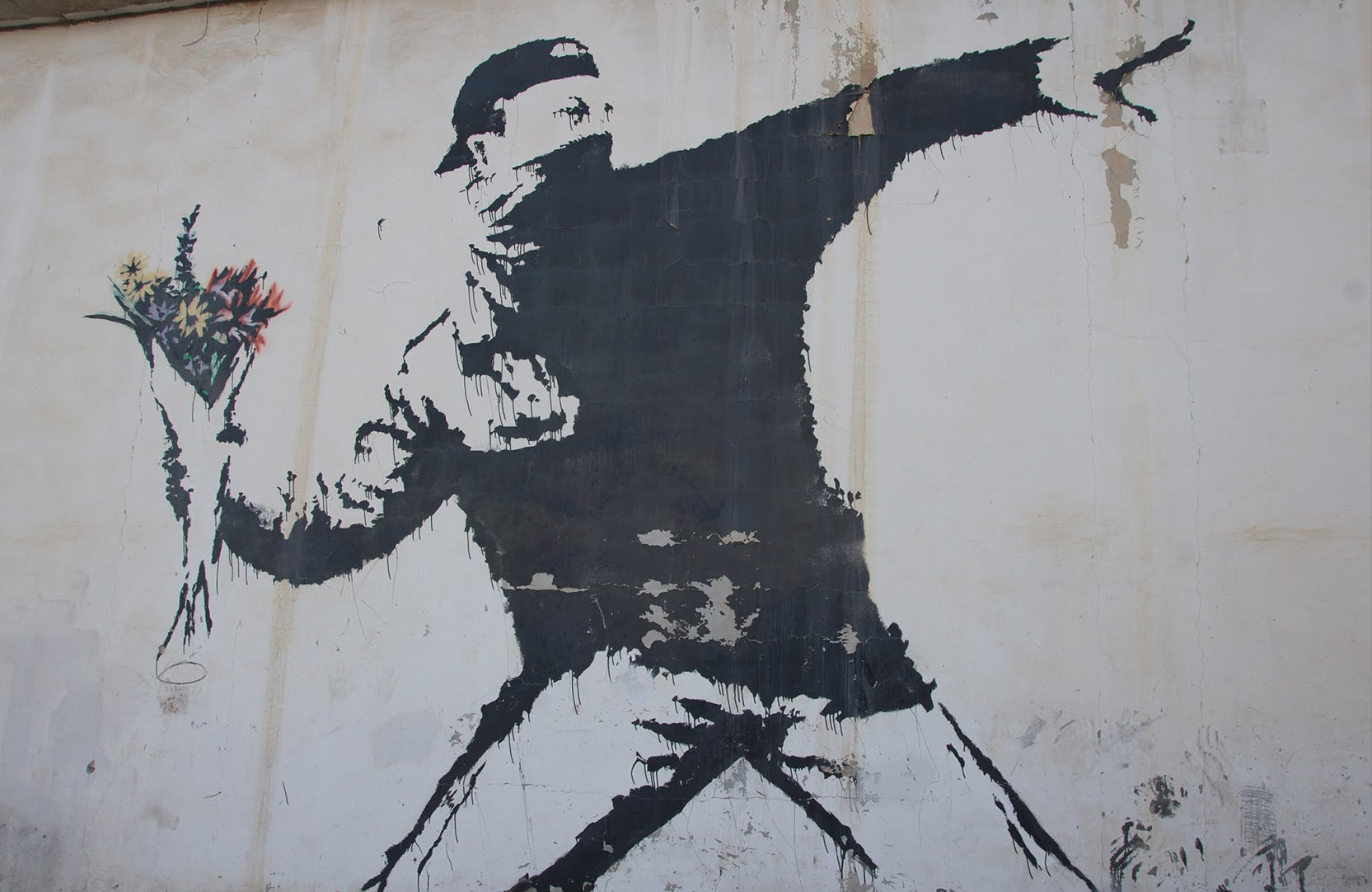
A Banksy mural on a West Bank wall, "The Flower Thrower" (photo Maria Abrashkina).

15 MAY 2026 • By Francesca Vawdrey

This award-winning novel is more than just a gripping story — it performs a literary excavation of history and myth in contemporary Palestine.

A Mask the Colour of the Sky, a novel by Bassem Khandaqji, translated by Addie Leak
Europa Editions 2026
ISBN 9781787706330

——–

In April 2024, Bassem Khandaqji discovered he had won the International Prize for Arabic Fiction when he was abruptly summoned for interrogation, beaten, and thrown into solitary confinement. He was, at the time, serving out a life sentence (although he has since been released, after twenty years of incarceration, as part of a prisoner exchange deal in 2025). 
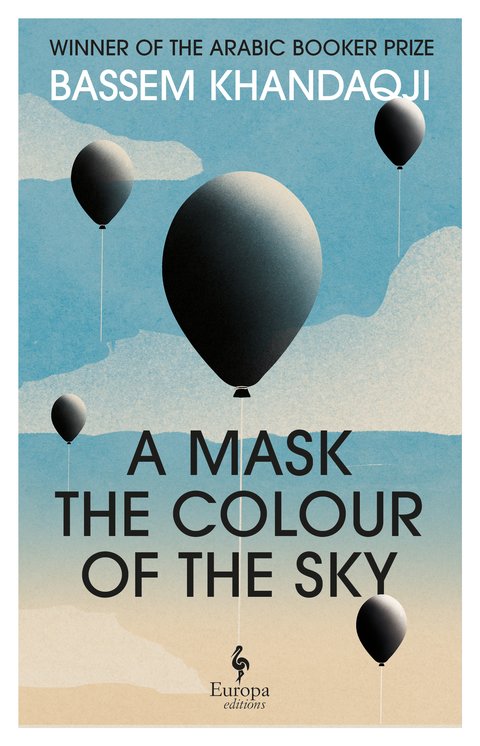
A Mask the Colour of the Sky cover
Published by Europa Editions.

Written entirely from within the confines of Israel’s high-security Gilboa Prison, A Mask the Colour of the Sky performs a literary excavation of the Palestinian past that writes against the logic of erasure at the heart of the Israeli state. The novel revolves around Nur, an archaeology graduate from a refugee camp in Ramallah, who commits identity fraud to uncover the “true story” of Mary Magdalene. The quest to uncover this truth, which has been marginalized and obscured within mainstream Christian theology for centuries, provides a conduit for critiquing Israel’s erasure of Palestinian history, via the weaponization of archaeology, which is aimed at bolstering the Zionist “myth of origins.” Though set in 2021, against the backdrop of Israel’s Supreme Court rule to evict six Palestinian families from Sheikh Jarrah in East Jerusalem, the ghostly presence of the 1948 Nakba casts an ominous shadow over the novel. Traces of this event, alongside other pivotal moments in Palestinian history, including the 1987-1993 “War of the Stones,” are scattered throughout the novel to preserve Palestinian collective memory and keep the resistance alive.

This speaks to the popular Palestinian concept of ṣumūd, which is about persistence, insistence, and survival against the odds.

As a Palestinian living in the West Bank’s “Area A,” Nur cannot access the ancient sites around Jerusalem that hold valuable information for his research. His only experience of the “inside” has been through illegal entry as a laborer for Israeli companies, and various other service roles — an ordeal that many Palestinians from the West Bank are forced to endure as a result of the occupation’s economic strangulation. Khandaqji highlights this predicament, which some criticize as collaboration with the enemy, through Nur, who has no other option when it comes to funding his education. He must choose between temporary negotiation with the occupation and a life of poverty like his father, Mahdi. At one time a freedom fighter, Mahdi is arrested and then released from prison in the wake of the Oslo Accords, and ends up selling ahwa and shai from a rusty old cart in the camp.

One of the novel’s strengths is how attuned Khandaqji is to the “tango” between negotiation and resistance, whereby Nur plays the system to his advantage while seeming to abide by its logic. For example, as a tour guide in the Old City — a job he can get away with despite not having a permit, due to his Ashkenazi looks — he takes a group of American visitors on a propagandistic excursion to “Tzora Forest,” only to change the Zionist script midway through by reverting to the forest’s indigenous name, Sar’a, and detailing how it was destroyed. Khandaqji frames negotiation not as a form of selling out, but as a strategy for outsmarting the occupier and living as freely as he can in a situation where the basic requirements for a dignified human life have been stripped away. This speaks to the popular Palestinian concept of ṣumūd, which is about persistence, insistence, and survival against the odds.

Nur’s fortune changes when he finds a misplaced Israeli identity card in a secondhand jacket at a flea market in Jaffa, presenting an ideal opportunity for subterfuge. Trapped in the suffocating environment of the refugee camp’s tight alleys and Mahdi’s oppressive silence — a consequence of his wife’s death and the defeat of his revolutionary ideals — Nur decides to escape. His blond hair and blue eyes facilitate his transition into Or Shapira, the Ashkenazi owner of the ID, which radically alters his life: where he can go, who he interacts with, and how he is perceived. Though seamless on the surface, this transition demonstrates the arbitrariness of Zionist discrimination, whereby one’s appearance — regardless of actual ethnicity or religious beliefs — dictates their chances of survival and the way they navigate the space around them. Or’s mask is a double-edged sword. On the one hand, it allows Nur to be “totally at ease,” providing (the illusion of) safety and “invulnerability,” as he slips “into the depths of the colonial world.” On the other hand, whilst wearing it, Nur feels “hunted, afraid, weak, confused and full of contradictions.” These emotions are explored through the imagined dialogues between Nur and Or, which push against the boundaries between the two identities, at times threatening to dissolve them. After a day of impersonating Or, alone in his room, he wonders, “Whose shadow was trembling now — Nur’s or Or’s?”

Khandaqji’s mask trope engages with Frantz Fanon’s theory, developed in Black Skin, White Masks, that the colonized subject is forced to adopt a white persona or “mask” to survive in a society that deems Blackness inferior. Khandaqji applies this to the context of Israeli settler-colonialism to probe the power dimensions between colonizer and colonized under Israeli apartheid. Nur’s feeling of “success” at passing as an Israeli and reaping the rewards — namely freedom of movement, recognition, and humanization — produces in him a feeling of unease and inferiority, since it is only through imitating the colonizer that he is treated with respect. While the direct references to Fanon in Nur’s letters to his incarcerated friend Murad (another vehicle for exploring Nur’s inner thoughts) are heavy-handed, and there are moments where Khandaqji does a little too much hand-holding (like when he asks: “If I were Nur, would he have left me alone here, with no supervision, no guards?”), the overall framing is effective. It allows Khandaqji to imagine a sustained dialogue between an Israeli and a Palestinian in the occupied lands (something impossible in the current political climate), while delving into the internal fissures in Nur’s identity that stem from Israeli settler-colonialism, which has transformed him into an outsider within his native home.

The land itself also testifies to Palestinian life before the Nakba.

These imagined conversations resemble a major aspect of Ghassan Kanafani’s notion of resistance literature: a dialogue with one’s opposite. Kanafani argued that a knowledge of Zionist literature, which played a fundamental role in shaping Israeli consciousness in Israel’s formative years, was vital in resisting colonial oppression, especially cultural erasure. It is through Nur’s dialogue with Or that Khandaqji outlines, then deconstructs, the Zionist narrative. These moments occur most prominently in Part III, set in Tel Megiddo, where Nur (or rather Or) is hired for an archaeological dig. Khandaqji deliberately sets his story in Tel Megiddo because, according to the Book of Revelation (16:16), this is where “the final battle between the forces of good and evil, the Battle of Armageddon” will take place. The site thus becomes a stage for the contest over the historical narrative, which is a matter of legitimacy that can be used to either justify or discredit the existence of the State of Israel. For example, when Or refers to Al-Lajjun as “Kibbutz Megiddo,” Nur says “No, Al-Lajjun — it’s a whole village buried under your feet. My god, you guys are masters at cleaning crime scenes, aren’t you? Just throw a little green on it, some trees,” bringing forth the buried violence beneath Israeli tourist sites like Tzora Forest (grown atop the depopulated ruins of Sar’a), which are built to de-Palestinianize the space and prevent its memorialization.

Nur continues to document the Palestinian history of Al-Lajjun in a voice note to himself: another device in the novel that Khandaqji uses to track Nur’s historical discoveries on Mary Magdalene. His encyclopedic record charts the district, population, and settlements before and after 1948, in addition to its precise geographical location and changing governance over time — from the Crusaders to the present. He notes that it was destroyed in 1948 because “it was the base for the Arab Liberation Army’s attack on the settlement of Mishmar HaEmek, just five kilometers north of the village,” and that the counterattack led to the murder and displacement of the entire population of Al-Lajjun. Khandaqji thus commemorates the Palestinian history of resistance in the area, negating the condescending view that Palestinians were led like lambs to the slaughter during the Nakba, at the same time highlighting the violent forces that suppressed the resistance and erased all traces of its existence.

The land itself also testifies to Palestinian life before the Nakba. For example, a Belgian archaeologist contradicts the propagandist spiel of Natan, the kibbutz security guard, when she raises doubt about the veracity of his story. She asks, “What about these stones, Mr. Natan? They look like the remains of houses, don’t you think?” When Natan dismisses these stones as “ancient ruins,” sarcastically asking “Have you forgotten you are in the land of the Torah and the Old Testament?” she replies: “Have you forgotten I’m an archaeologist? I can tell whether these stones are Biblical or the ruins of an Arab village.”

Contrary to the blurb’s claim, the novel is not about Nur’s “insight into the lives of those he’s been taught to perceive as enemies,” or in other words, Palestinians learning how to re-humanize their occupier. While Khandaqji refrains from casting his Israeli characters as evil monsters, Nur’s insider/outsider perspective exposes the logic of racism that underpins their views and interactions with Palestinians. As an Israeli, he gains access to a world where, for once, he holds the keys. Yet, however tempting this transgression might seem, Nur knows that liberation cannot be secured by imitating, or rather becoming, the oppressor. Khandaqji’s foray into the Israeli psyche is a vehicle for developing his counter-historical narrative, which insists upon Palestinians’ “permission to narrate.” As Nur writes, “Scheherazade, Murad. Narration is life […] The story’s the Holy Grail … and I will tell it, my friend.”

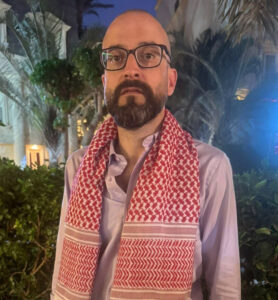
Bassem Khandaqji, 41, poses for a photo at a hotel in Cairo on Oct. 17, 2025, days after Israel freed him and other Palestinian prisoners in the Gaza ceasefire deal. He was imprisoned for helping plan a deadly 2004 bombing in Tel Aviv, and went on to become an award-winning novelist in prison.Ahmed Abuhamda/NPR
Bassem Khandaqji (photo Ahmed Abuhamda/NPR).

Bassem Khandaqji is a Palestinian novelist and poet born in Nablus in 1983. He spent twenty-one years in an Israeli prison, where he produced several creative works dealing primarily with themes of Palestinian history, memory, and resistance, shaped by the politics of incarceration. His novel A Mask the Colour of the Sky, written entirely in prison, won the International Prize for Arabic Fiction. Here he is seen in a photo taken at his hotel in Cairo on Oct. 17, 2025, just days after Israel freed him and other Palestinian prisoners in the Gaza ceasefire deal (courtesy NPR).

Francesca Vawdrey

Francesca Vawdrey is a PhD researcher at the University of Cambridge, specializing in Palestinian women’s literature. She has written for The Markaz Review and Middle East Eye.

Join Our Community

TMR exists thanks to its readers and supporters. By sharing our stories and celebrating cultural pluralism, we aim to counter racism, xenophobia, and exclusion with knowledge, empathy, and artistic expression.

Learn more

RELATED

Book Reviews

Bassem Khandaqji’s Mask is a novel of Palestinian Resistance

15 MAY 2026 • By Francesca Vawdrey
Bassem Khandaqji’s <em>Mask</em> is a novel of Palestinian Resistance
Columns

The Meaning of Palestine to This Levantine: A Matter of Love, a Question of Justice

15 MAY 2026 • By Amal Ghandour
The Meaning of Palestine to This Levantine: A Matter of Love, a Question of Justice
TMR 59 • MEDITERRANEANS

“Paradise”—a short story

1 MAY 2026 • By Aisha Abdel Gawad
“Paradise”—a short story
TMR 59 • MEDITERRANEANS

A Sunken Tale—Larissa Sansour on Colonial Theft

1 MAY 2026 • By Jim Quilty
<em>A Sunken Tale</em>—Larissa Sansour on Colonial Theft
Centerpiece

Don’t Forget to Say I Love You: Notes on Water

1 MAY 2026 • By Gabriela Mitrushi
Don’t Forget to Say I Love You: Notes on Water
TMR 58 • MOTHER TONGUE

Culture Got Your Tongue

6 MARCH 2026 • By Amy Omar
Culture Got Your Tongue
TMR 58 • MOTHER TONGUE

Ojalá: Toward an Illiteracy of Liberation

6 MARCH 2026 • By Sarah Aziza
<em>Ojalá</em>: Toward an Illiteracy of Liberation
TMR 58 • MOTHER TONGUE

“Sara”—a short story

6 MARCH 2026 • By Majd Aburrub
“Sara”—a short story
TMR 58 • MOTHER TONGUE

“Words That Don’t Sink”—a short story

6 MARCH 2026 • By Zeinab Ghassan Khaddour
“Words That Don’t Sink”—a short story
Book Reviews

Art and Disillusionment in Saleem Haddad’s Floodlines

20 FEBRUARY 2026 • By Layla AlAmmar
Art and Disillusionment in Saleem Haddad’s <em>Floodlines</em>
Book Reviews

Two New Books Show How Gaza Changed the World

13 FEBRUARY 2026 • By Rebecca Ruth Gould
Two New Books Show How Gaza Changed the World
Book Reviews

Stolen Nation: An Argument for Palestinian Reparations

6 FEBRUARY 2026 • By Selma Dabbagh
<em>Stolen Nation</em>: An Argument for Palestinian Reparations
Columns

Small Moments and Their Much Larger Meaning

30 JANUARY 2026 • By Amal Ghandour
Small Moments and Their Much Larger Meaning
Fiction

“Tiny Suns”—a short story

30 JANUARY 2026 • By Sahar Mustafah
“Tiny Suns”—a short story
Essays

Jewish Supremacy and the Making of Genocide in Gaza

30 JANUARY 2026 • By Sheryl Ono
Jewish Supremacy and the Making of Genocide in Gaza
Essays

Not Even the Dead Rest in Palestine

30 JANUARY 2026 • By A Mom from Bethlehem
Not Even the Dead Rest in Palestine
Essays

How Can Palestinians and Israelis Live Together?

30 JANUARY 2026 • By Raja Shehadeh
How Can Palestinians and Israelis Live Together?
Film Reviews

With Hasan in Gaza: Salvaged Palestine

30 JANUARY 2026 • By Jim Quilty
<em>With Hasan in Gaza</em>: Salvaged Palestine
TMR 57 • PALESTINE

In Two New Books, Palestinian Writing Bears Witness

30 JANUARY 2026 • By Gabriel Polley
In Two New Books, Palestinian Writing Bears Witness
Book Reviews

You Must Live: A Collection of Palestinian Poetry

30 JANUARY 2026 • By Sholeh Wolpé
<em>You Must Live</em>: A Collection of Palestinian Poetry
TMR 57 • PALESTINE

Letter from Gaza: Our Long Wait for Gas

30 JANUARY 2026 • By Esraa Abo Qamar
Letter from Gaza: Our Long Wait for Gas
TMR 57 • PALESTINE

Letter from Gaza: Stuck in Place

30 JANUARY 2026 • By Mariam Mushtaha
Letter from Gaza: Stuck in Place
Editorial

Why PALESTINE?

30 JANUARY 2026 • By TMR
Why PALESTINE?
Columns

Trump, The Liberator! (and the Fear Wagons)

16 JANUARY 2026 • By Amal Ghandour
Trump, The Liberator! (and the Fear Wagons)
Film

The Palestinian Legacy of Mohammad Bakri

2 JANUARY 2026 • By Hadani Ditmars
The Palestinian Legacy of Mohammad Bakri
Columns

Emm Kamel: The Future Is Here and So Is the Past

19 DECEMBER 2025 • By Amal Ghandour
<em>Emm Kamel</em>: The Future Is Here and So Is the Past
Fiction

A Bomb for Personal Use—an excerpt

5 DECEMBER 2025 • By Mirna Al-Mahdi
<em>A Bomb for Personal Use</em>—an excerpt
short story

“Tuesday”—a story from Palestine

5 DECEMBER 2025 • By Majd Aburrub
“Tuesday”—a story from Palestine
Film

10 Noir Films from the Arab world, Iran, and Turkey

5 DECEMBER 2025 • By TMR
10 Noir Films from the Arab world, Iran, and Turkey
Art & Photography

Artist Interview: Corinne Silva on Israeli Settlement Gardens in Palestine

28 NOVEMBER 2025 • By Jelena Sofronijevic
Artist Interview: Corinne Silva on Israeli Settlement Gardens in Palestine
Centerpiece

The Grammar of Power: On Journalism, Grief, and the Stories That Break Us

7 NOVEMBER 2025 • By Adam Makary
The Grammar of Power: On Journalism, Grief, and the Stories That Break Us
Poetry Markaz

Adedayo Agarau presents The Years of Blood

1 NOVEMBER 2025 • By Adedayo Agarau
Adedayo Agarau presents <em>The Years of Blood</em>
Essays

The War on Palestinians Didn’t Start on October 7

10 OCTOBER 2025 • By Taqwa Ahmed Al-Wawi
The War on Palestinians Didn’t Start on October 7
Essays

Lament For My Dear Cousin and Friend in Tulkarm

3 OCTOBER 2025 • By Thoth
Lament For My Dear Cousin and Friend in Tulkarm
Columns

Longing for Love in a Time of Genocide

26 SEPTEMBER 2025 • By Lina Mounzer
Longing for Love in a Time of Genocide
Fiction

Diba’s House

26 SEPTEMBER 2025 • By Sara Masry
Diba’s House
Featured article

Together for Palestine — Truly Historic

19 SEPTEMBER 2025 • By TMR
Together for Palestine — Truly Historic
Book Reviews

How the Media Fails Armenia and Palestine

19 SEPTEMBER 2025 • By Gabriel Polley
How the Media Fails Armenia and Palestine
Film Reviews

New Documentaries from Palestine, Sudan, Afghanistan, and Iran

12 SEPTEMBER 2025 • By Yassin El-Moudden
New Documentaries from Palestine, Sudan, Afghanistan, and Iran
Film

Once Upon a Time in Gaza Wants to Be an Indie Western

29 AUGUST 2025 • By Karim Goury
<em>Once Upon a Time in Gaza</em> Wants to Be an Indie Western
Essays

From Stitch to Symbol: The Power of Palestinian Tatreez

22 AUGUST 2025 • By Joanna Barakat
From Stitch to Symbol: The Power of Palestinian Tatreez
Essays

Amal Doesn’t Even Know What a Banana Is: Child Malnutrition in Gaza

1 AUGUST 2025 • By Asem Al Jerjawi
Amal Doesn’t Even Know What a Banana Is: Child Malnutrition in Gaza
Essays

“A Love That Endures”: How Tamer and Sabreen Defied War and Death

25 JULY 2025 • By Husam Maarouf
“A Love That Endures”: How Tamer and Sabreen Defied War and Death
Art & Photography

August World Picks from the Editors

25 JULY 2025 • By TMR
August World Picks from the Editors
Featured article

“Silence is Not the Way”—Arab Writers Against Israel’s Genocide

18 JULY 2025 • By Jordan Elgrably
“Silence is Not the Way”—Arab Writers Against Israel’s Genocide
Essays

A Voice That Defied Silence: The Legacy of Dr. Refaat Al-Areer

4 JULY 2025 • By Taqwa Ahmed Al-Wawi
A Voice That Defied Silence: The Legacy of Dr. Refaat Al-Areer
Book Reviews

Palestine’s Places and Memorials Are Not Forgotten

4 JULY 2025 • By Gabriel Polley
Palestine’s Places and Memorials Are Not <em>Forgotten</em>
Essays

Unwritten Stories from Palestine

4 JULY 2025 • By Thoth
Unwritten Stories from Palestine
Essays

Doaa: From a Dreamworld to the Ashes of Displacement

30 MAY 2025 • By Taqwa Ahmed Al-Wawi
Doaa: From a Dreamworld to the Ashes of Displacement
Book Reviews

The End of Civilization as We Know It — a Catastrophology

23 MAY 2025 • By Iason Athanasiadis
The End of Civilization as We Know It — a Catastrophology
Books

Editors’ 2025 Palestinian Lit List

15 MAY 2025 • By TMR
Editors’ 2025 Palestinian Lit List
Books

Poet Mosab Abu Toha Wins Pulitzer Prize for Essays on Gaza

9 MAY 2025 • By Jordan Elgrably
Poet Mosab Abu Toha Wins Pulitzer Prize for Essays on Gaza
Editorial

For Our 50th Issue, Writers Reflect on Going Home

2 MAY 2025 • By TMR
For Our 50th Issue, Writers Reflect on Going Home
Art

Neither Here Nor There

2 MAY 2025 • By Myriam Cohenca
Neither Here Nor There
Essays

The anger and sadness I brought back from Damascus. And the urge to shave my head

2 MAY 2025 • By Batoul Ahmad
The anger and sadness I brought back from Damascus. And the urge to shave my head
Art

On Forgiveness and Path—an Exhibition in Damascus

18 APRIL 2025 • By Robert Bociaga
On Forgiveness and <em>Path</em>—an Exhibition in Damascus
Film

Gaza, Sudan, Israel/Palestine Documentaries Show in Thessaloniki

28 MARCH 2025 • By Iason Athanasiadis
Gaza, Sudan, Israel/Palestine Documentaries Show in Thessaloniki
Essays

A Conversation Among My Homeland’s Trees

7 MARCH 2025 • By Alia Yunis
A Conversation Among My Homeland’s Trees
Art

Finding Emptiness: Gaza Artist Taysir Batniji in Beirut

21 FEBRUARY 2025 • By Jim Quilty
Finding Emptiness: Gaza Artist Taysir Batniji in Beirut
Book Reviews

Omar El Akkad & Mohammed El-Kurd: Liberalism in a Time of Genocide

14 FEBRUARY 2025 • By Rebecca Ruth Gould
Omar El Akkad & Mohammed El-Kurd: Liberalism in a Time of Genocide
Centerpiece

Ravaged by Fire

7 FEBRUARY 2025 • By Francisco Letelier
Ravaged by Fire
Book Reviews

Resilient Cartographies: Histories of the Persian Gulf

7 FEBRUARY 2025 • By Todd Reisz
Resilient Cartographies: Histories of the Persian Gulf
Book Reviews

Memories of Palestine through Contemporary Media

7 FEBRUARY 2025 • By Malu Halasa
Memories of Palestine through Contemporary Media
Essays

Flight Plans: From Gaza to Singapore

7 FEBRUARY 2025 • By Chin-chin Yap
Flight Plans: From Gaza to Singapore
Books

“Culinary Palestine” — Fadi Kattan in an excerpt from Sumud

31 JANUARY 2025 • By Fadi Kattan
“Culinary Palestine” — Fadi Kattan in an excerpt from <em>Sumud</em>
Arabic

Huda Fakhreddine & Yasmeen Hanoosh: Translating Arabic & Gaza

17 JANUARY 2025 • By Yasmeen Hanoosh, Huda J. Fakhreddine
Huda Fakhreddine & Yasmeen Hanoosh: Translating Arabic & Gaza
Book Reviews

Radwa Ashour’s Classic Granada Now in a New English Edition

17 JANUARY 2025 • By Guy Mannes-Abbott
Radwa Ashour’s Classic <em>Granada</em> Now in a New English Edition
Book Reviews

Maya Abu Al-Hayyat’s Defiant Exploration of Palestinian Life

20 DECEMBER 2024 • By Zahra Hankir
Maya Abu Al-Hayyat’s Defiant Exploration of Palestinian Life
Featured Artist

Palestine Features in Larissa Sansour’s Sci-Fi Future

6 DECEMBER 2024 • By Larissa Sansour
Palestine Features in Larissa Sansour’s Sci-Fi Future
Opinion

Susan Abulhawa at Oxford Union on Palestine/Israel

6 DECEMBER 2024 • By Susan Abulhawa
Susan Abulhawa at Oxford Union on Palestine/Israel
Art

Basel Abbas & Ruanne Abou-Rahme: Palestinian artists at Copenhagen’s Glyptotek

22 NOVEMBER 2024 • By Arie Amaya-Akkermans
Basel Abbas & Ruanne Abou-Rahme: Palestinian artists at Copenhagen’s Glyptotek
Art & Photography

The Palestinian Gazelle

1 NOVEMBER 2024 • By Manal Mahamid
The Palestinian Gazelle
Interviews

The Hybrid — The Case of Michael Vatikiotis

18 OCTOBER 2024 • By Rana Haddad
The Hybrid — The Case of Michael Vatikiotis
Book Reviews

Courage and Compassion, a Memoir of War and its Aftermath

18 OCTOBER 2024 • By Nektaria Anastasiadou
<em>Courage and Compassion</em>, a Memoir of War and its Aftermath
Essays

Palestine, the Land of Grapes and Wine

11 OCTOBER 2024 • By Fadi Kattan, Anna Patrowicz
Palestine, the Land of Grapes and Wine
TMR 45 • From Here, One Year On

Witnessing Catastrophe: a Painter in Lebanon

4 OCTOBER 2024 • By Ziad Suidan
Witnessing Catastrophe: a Painter in Lebanon
Art & Photography

Visuals and Voices: Palestine Will Not Be a Palimpsest

4 OCTOBER 2024 • By Malu Halasa
Visuals and Voices: Palestine Will Not Be a Palimpsest
Essays

Shamrocks & Watermelons: Palestine Politics in Belfast

4 OCTOBER 2024 • By Stuart Bailie
Shamrocks & Watermelons: Palestine Politics in Belfast
Opinion

Everything Has Changed, Nothing Has Changed

4 OCTOBER 2024 • By Amal Ghandour
Everything Has Changed, Nothing Has Changed
Art

Activism in the Landscape: Environmental Arts & Resistance in Palestine

4 OCTOBER 2024 • By Katie Logan
Activism in the Landscape: Environmental Arts & Resistance in Palestine
Poetry

Poems by Nasser Rabah, Amanee Izhaq and Mai Al-Nakib

4 OCTOBER 2024 • By Nasser Rabah, Amanee Izhaq, Mai Al-Nakib, Wiam El-Tamami
Poems by Nasser Rabah, Amanee Izhaq and Mai Al-Nakib
Books

“Kill the Music”—an excerpt from a new novel by Badar Salem

16 AUGUST 2024 • By Badar Salem
“Kill the Music”—an excerpt from a new novel by Badar Salem
Film

World Picks from the Editors: AUGUST

2 AUGUST 2024 • By TMR
World Picks from the Editors: AUGUST
Art & Photography

World Picks from the Editors: July 15 — August 2

12 JULY 2024 • By TMR
World Picks from the Editors: July 15 — August 2
Fiction

“The Cockroaches”—flash fiction

5 JULY 2024 • By Stanko Uyi Srsen
“The Cockroaches”—flash fiction
Book Reviews

Life Along Istanbul’s Byzantine Walls, a Review

28 JUNE 2024 • By Arie Amaya-Akkermans
Life Along Istanbul’s Byzantine Walls, a Review
Centerpiece

Dare Not Speak—a One-Act Play

7 JUNE 2024 • By Hassan Abdulrazzak
<em>Dare Not Speak</em>—a One-Act Play
Books

Palestine, Political Theatre & the Performance of Queer Solidarity in Jean Genet’s Prisoner of Love

7 JUNE 2024 • By Saleem Haddad
Palestine, Political Theatre & the Performance of Queer Solidarity in Jean Genet’s <em>Prisoner of Love</em>
Essays

A Small Kernel of Human Kindness: Some Notes on Solidarity and Resistance

24 MAY 2024 • By Nancy Kricorian
A Small Kernel of Human Kindness: Some Notes on Solidarity and Resistance
Art

Demarcations of Identity: Rushdi Anwar

10 MAY 2024 • By Malu Halasa
Demarcations of Identity: Rushdi Anwar
Editorial

Why FORGETTING?

3 MAY 2024 • By Malu Halasa, Jordan Elgrably
Why FORGETTING?
Centerpiece

Memory Archive: Between Remembering and Forgetting

3 MAY 2024 • By Mai Al-Nakib
Memory Archive: Between Remembering and Forgetting
Film

Asmae El Moudir’s The Mother of All Lies

3 MAY 2024 • By Brittany Landorf
Asmae El Moudir’s <em>The Mother of All Lies</em>
Essays

The Elephant in the Box

3 MAY 2024 • By Asmaa Elgamal
The Elephant in the Box
Book Reviews

Forgotten & Silenced Histories in Moroccan Other-Archives

3 MAY 2024 • By Natalie Bernstien, Mustapha Outbakat
Forgotten & Silenced Histories in <em>Moroccan Other-Archives</em>
Art & Photography

Not Forgotten, Not (All) Erased: Palestine’s Sacred Shrines

3 MAY 2024 • By Gabriel Polley
Not Forgotten, Not (All) Erased: Palestine’s Sacred Shrines
Book Reviews

Palestinian Culture, Under Assault, Celebrated in New Cookbook

3 MAY 2024 • By Mischa Geracoulis
Palestinian Culture, Under Assault, Celebrated in New Cookbook
Essays

The Art of Letting Go: On the Path to Willful Abandonment

3 MAY 2024 • By Nashwa Nasreldin
The Art of Letting Go: On the Path to Willful Abandonment
Art & Photography

Malak Mattar: No Words, Only Scenes of Ruin

26 APRIL 2024 • By Nadine Nour el Din
Malak Mattar: No Words, Only Scenes of Ruin
Opinion

Censorship over Gaza and Palestine Roils the Arts Community

12 APRIL 2024 • By Hassan Abdulrazzak
Censorship over Gaza and Palestine Roils the Arts Community
Art

Past Disquiet at the Palais de Tokyo in Paris

1 APRIL 2024 • By Kristine Khouri, Rasha Salti
<em>Past Disquiet</em> at the Palais de Tokyo in Paris
Essays

Undoing Colonial Geographies from Paris with Ariella Aïsha Azoulay

1 APRIL 2024 • By Sasha Moujaes, Jordan Elgrably
Undoing Colonial Geographies from Paris with Ariella Aïsha Azoulay
Book Reviews

Fady Joudah’s […] Dares Us to Listen to Palestinian Words—and Silences

25 MARCH 2024 • By Eman Quotah
Fady Joudah’s <em>[…]</em> Dares Us to Listen to Palestinian Words—and Silences
Art & Photography

Will Artists Against Genocide Boycott the Venice Biennale?

18 MARCH 2024 • By Hadani Ditmars
Will Artists Against Genocide Boycott the Venice Biennale?
Books

Four Books to Revolutionize Your Thinking

3 MARCH 2024 • By Rana Asfour
Four Books to Revolutionize Your Thinking
Book Reviews

Do or Despair: Political Action in My Great Arab Melancholy

3 MARCH 2024 • By Katie Logan
Do or Despair: Political Action in <em>My Great Arab Melancholy</em>
Essays

The Story of the Keffiyeh

3 MARCH 2024 • By Rajrupa Das
The Story of the Keffiyeh
Essays

Messages from Gaza Now / 5

26 FEBRUARY 2024 • By Hossam Madhoun
Messages from Gaza Now / 5
Weekly

World Picks from the Editors: Feb 23 — Mar 7

23 FEBRUARY 2024 • By TMR
World Picks from the Editors: Feb 23 — Mar 7
Art & Photography

The Body, Intimacy and Technology in the Middle East

4 FEBRUARY 2024 • By Naima Morelli
The Body, Intimacy and Technology in the Middle East
Columns

Driving in Palestine Now is More Dangerous Than Ever

29 JANUARY 2024 • By TMR
Driving in Palestine Now is More Dangerous Than Ever
Featured article

Israel-Palestine: Peace Under Occupation?

29 JANUARY 2024 • By Laëtitia Soula
Israel-Palestine: Peace Under Occupation?
Books

Illuminated Reading for 2024: Our Anticipated Titles

22 JANUARY 2024 • By TMR
Illuminated Reading for 2024: Our Anticipated Titles
Fiction

“New Reasons”—a short story by Samira Azzam

15 JANUARY 2024 • By Samira Azzam, Ranya Abdelrahman
“New Reasons”—a short story by Samira Azzam
Book Reviews

An Iranian Novelist Seeks the Truth About a Plane Crash

15 JANUARY 2024 • By Sepideh Farkhondeh
An Iranian Novelist Seeks the Truth About a Plane Crash
Essays

Jesus Was Palestinian, But Bethlehem Suspends Christmas

25 DECEMBER 2023 • By Ahmed Twaij
Jesus Was Palestinian, But Bethlehem Suspends Christmas
Columns

Messages from Gaza Now / 2

18 DECEMBER 2023 • By Hossam Madhoun
Messages from Gaza Now / 2
Music

We Will Sing Until the Pain Goes Away—a Palestinian Playlist

18 DECEMBER 2023 • By Brianna Halasa
We Will Sing Until the Pain Goes Away—a Palestinian Playlist
Arabic

Poet Ahmad Almallah

9 NOVEMBER 2023 • By Ahmad Almallah
Poet Ahmad Almallah
Opinion

Palestine’s Pen against Israel’s Swords of Injustice

6 NOVEMBER 2023 • By Mai Al-Nakib
Palestine’s Pen against Israel’s Swords of Injustice
Fiction

“The Hauntology of Varosha” or “Room Number 137 of the Argo Hotel”

5 NOVEMBER 2023 • By Salamis Aysegul Sentug Tugyan
“The Hauntology of Varosha” or “Room Number 137 of the Argo Hotel”
Essays

On Fathers, Daughters and the Genocide in Gaza 

30 OCTOBER 2023 • By Deema K Shehabi
On Fathers, Daughters and the Genocide in Gaza 
Editorial

Palestine and the Unspeakable

16 OCTOBER 2023 • By Lina Mounzer
Palestine and the Unspeakable
Art

Vera Tamari’s Lifetime of Palestinian Art

16 OCTOBER 2023 • By Taline Voskeritchian
Vera Tamari’s Lifetime of Palestinian Art
Book Reviews

A Day in the Life of Abed Salama: A Palestine Story

16 OCTOBER 2023 • By Dalia Hatuqa
<em>A Day in the Life of Abed Salama</em>: A Palestine Story
Weekly

World Picks from the Editors, Oct 13 — Oct 27, 2023

12 OCTOBER 2023 • By TMR
World Picks from the Editors, Oct 13 — Oct 27, 2023
Poetry

Home: New Arabic Poems in Translation

11 OCTOBER 2023 • By Sarah Coolidge
<em>Home</em>: New Arabic Poems in Translation
Poetry

Albanian Poet Luljeta Lleshanaku

11 OCTOBER 2023 • By Luljeta Lleshanaku
Albanian Poet Luljeta Lleshanaku
Books

Edward Said: Writing in the Service of Life 

9 OCTOBER 2023 • By Layla AlAmmar
Edward Said: Writing in the Service of Life 
Books

Fairouz: The Peacemaker and Champion of Palestine

1 OCTOBER 2023 • By Dima Issa
Fairouz: The Peacemaker and Champion of Palestine
Book Reviews

Saqi’s Revenant: Sahar Khalifeh’s Classic Nablus Novel Wild Thorns

25 SEPTEMBER 2023 • By Noshin Bokth
Saqi’s Revenant: Sahar Khalifeh’s Classic Nablus Novel <em>Wild Thorns</em>
Art

Memory Art: Water and Islands in the Work of Hera Büyüktaşçıyan

18 SEPTEMBER 2023 • By Arie Amaya-Akkermans
Memory Art: Water and Islands in the Work of Hera Büyüktaşçıyan
Book Reviews

Laila Halaby’s The Weight of Ghosts is a Haunting Memoir

28 AUGUST 2023 • By Thérèse Soukar Chehade
Laila Halaby’s <em>The Weight of Ghosts</em> is a Haunting Memoir
Book Reviews

On Museums and the Preservation of Cultural Heritage

21 AUGUST 2023 • By Arie Amaya-Akkermans
On Museums and the Preservation of Cultural Heritage
Book Reviews

What’s the Solution for Jews and Palestine in the Face of Apartheid Zionism?

21 AUGUST 2023 • By Jonathan Ofir
What’s the Solution for Jews and Palestine in the Face of Apartheid Zionism?
Book Reviews

Ilan Pappé on Tahrir Hamdi’s Imagining Palestine

7 AUGUST 2023 • By Ilan Pappé
Ilan Pappé on Tahrir Hamdi’s <em> Imagining Palestine</em>
Art

What Palestine Brings to the World—a Major Paris Exhibition

31 JULY 2023 • By Sasha Moujaes
<em>What Palestine Brings to the World</em>—a Major Paris Exhibition
Fiction

“The Burden of Inheritance”—fiction from Mai Al-Nakib

2 JULY 2023 • By Mai Al-Nakib
“The Burden of Inheritance”—fiction from Mai Al-Nakib
Fiction

Tears from a Glass Eye—a story by Samira Azzam

2 JULY 2023 • By Samira Azzam, Ranya Abdelrahman
Tears from a Glass Eye—a story by Samira Azzam
Art & Photography

The Ghost of Gezi Park—Turkey 10 Years On

19 JUNE 2023 • By Arie Amaya-Akkermans
The Ghost of Gezi Park—Turkey 10 Years On
Art & Photography

Newly Re-Opened, Beirut’s Sursock Museum is a Survivor

12 JUNE 2023 • By Arie Amaya-Akkermans
Newly Re-Opened, Beirut’s Sursock Museum is a Survivor
Arabic

Arab Theatre Grapples With Climate Change, Borders, War & Love

4 JUNE 2023 • By Hassan Abdulrazzak
Arab Theatre Grapples With Climate Change, Borders, War & Love
Essays

Alien Entities in the Desert

4 JUNE 2023 • By Dror Shohet
Alien Entities in the Desert
Featured Artist

Nasrin Abu Baker: The Markaz Review Featured Artist, June 2023

4 JUNE 2023 • By TMR
Nasrin Abu Baker: The Markaz Review Featured Artist, June 2023
Book Reviews

How Bethlehem Evolved From Jerusalem’s Sleepy Backwater to a Global Town

15 MAY 2023 • By Karim Kattan
How Bethlehem Evolved From Jerusalem’s Sleepy Backwater to a Global Town
TMR Conversations

TMR CONVERSATIONS: Amal Ghandour Interviews Raja Shehadeh

11 MAY 2023 • By Amal Ghandour, Raja Shehadeh
TMR CONVERSATIONS: Amal Ghandour Interviews Raja Shehadeh
Book Reviews

In Search of Fathers: Raja Shehadeh’s Palestinian Memoir

13 MARCH 2023 • By Amal Ghandour
In Search of Fathers: Raja Shehadeh’s Palestinian Memoir
Centerpiece

Broken Home: Britain in the Time of Migration

5 MARCH 2023 • By Malu Halasa
Broken Home: Britain in the Time of Migration
Essays

More Photographs Taken From The Pocket of a Dead Arab

5 MARCH 2023 • By Saeed Taji Farouky
More Photographs Taken From The Pocket of a Dead Arab
Cities

Nabeul, Mon Amour

5 MARCH 2023 • By Yesmine Abida
Nabeul, Mon Amour
Essays

Home Under Siege: a Palestine Photo Essay

5 MARCH 2023 • By Anam Raheem
Home Under Siege: a Palestine Photo Essay
Art & Photography

Becoming Palestine Imagines a Liberated Future

27 FEBRUARY 2023 • By Katie Logan
<em>Becoming Palestine</em> Imagines a Liberated Future
Book Reviews

Salman Rushdie’s Victory City: a Novel in Search of an Empire

20 FEBRUARY 2023 • By Anis Shivani
Salman Rushdie’s <em>Victory City</em>: a Novel in Search of an Empire
Columns

Sudden Journeys: Deluge at Wadi Feynan

6 FEBRUARY 2023 • By Jenine Abboushi
Sudden Journeys: Deluge at Wadi Feynan
TV Review

Palestinian Territories Under Siege But Season 4 of Fauda Goes to Brussels and Beirut Instead

6 FEBRUARY 2023 • By Brett Kline
Palestinian Territories Under Siege But Season 4 of <em>Fauda</em> Goes to Brussels and Beirut Instead
Art

On Lebanon and Lamia Joreige’s “Uncertain Times”

23 JANUARY 2023 • By Arie Amaya-Akkermans
On Lebanon and Lamia Joreige’s “Uncertain Times”
Art

The Creative Resistance in Palestinian Art

26 DECEMBER 2022 • By Malu Halasa
The Creative Resistance in Palestinian Art
Art

Art World Picks: Albraehe, Kerem Yavuz, Zeghidour, Amer & Tatah

12 DECEMBER 2022 • By TMR
Art

Museums in Exile—MO.CO’s show for Chile, Sarajevo & Palestine

12 DECEMBER 2022 • By Jordan Elgrably
Museums in Exile—MO.CO’s show for Chile, Sarajevo & Palestine
Art

Where is the Palestinian National Museum of Modern and Contemporary Art?

12 DECEMBER 2022 • By Nora Ounnas Leroy
Where is the Palestinian National Museum of Modern and Contemporary Art?
Columns

Sudden Journeys: Israel’s Intimate Separations—Part 3

5 DECEMBER 2022 • By Jenine Abboushi
Sudden Journeys: Israel’s Intimate Separations—Part 3
Book Reviews

Fida Jiryis on Palestine in Stranger in My Own Land

28 NOVEMBER 2022 • By Diana Buttu
Fida Jiryis on Palestine in <em>Stranger in My Own Land</em>
Fiction

“Eleazar”—a short story by Karim Kattan

15 NOVEMBER 2022 • By Karim Kattan
“Eleazar”—a short story by Karim Kattan
Opinion

Fragile Freedom, Fragile States in the Muslim World

24 OCTOBER 2022 • By I. Rida Mahmood
Fragile Freedom, Fragile States in the Muslim World
Interviews

Interview with Ahed Tamimi, an Icon of the Palestinian Resistance

15 OCTOBER 2022 • By Nora Lester Murad
Interview with Ahed Tamimi, an Icon of the Palestinian Resistance
Book Reviews

Cassette Tapes Once Captured Egypt’s Popular Culture

10 OCTOBER 2022 • By Mariam Elnozahy
Cassette Tapes Once Captured Egypt’s Popular Culture
Columns

Sudden Journeys: Israel’s Intimate Separations—Part 1

26 SEPTEMBER 2022 • By Jenine Abboushi
Sudden Journeys: Israel’s Intimate Separations—Part 1
Essays

Phoneless in Filthy Berlin

15 SEPTEMBER 2022 • By Maisan Hamdan, Rana Asfour
Phoneless in Filthy Berlin
Art & Photography

Photographer Mohamed Badarne (Palestine) and his U48 Project

15 SEPTEMBER 2022 • By Viola Shafik
Photographer Mohamed Badarne (Palestine) and his U48 Project
Editorial

Editorial: Is the World Driving Us Mad?

15 JULY 2022 • By TMR
Editorial: Is the World Driving Us Mad?
Art & Photography

Featured Artist: Steve Sabella, Beyond Palestine

15 JUNE 2022 • By TMR
Featured Artist: Steve Sabella, Beyond Palestine
Essays

Sulafa Zidani: “Three Buses and the Rhythm of Remembering”

15 JUNE 2022 • By Sulafa Zidani
Sulafa Zidani: “Three Buses and the Rhythm of Remembering”
Film

Saeed Taji Farouky: “Strange Cities Are Familiar”

15 JUNE 2022 • By Saeed Taji Farouky
Saeed Taji Farouky: “Strange Cities Are Familiar”
Fiction

Dima Mikhayel Matta: “This Text Is a Very Lonely Document”

15 JUNE 2022 • By Dima Mikhayel Matta
Dima Mikhayel Matta: “This Text Is a Very Lonely Document”
Fiction

Selma Dabbagh: “Trash”

15 JUNE 2022 • By Selma Dabbagh
Selma Dabbagh: “Trash”
Art & Photography

Film Review: “Memory Box” on Lebanon Merges Art & Cinema

13 JUNE 2022 • By Arie Amaya-Akkermans
Film Review: “Memory Box” on Lebanon Merges Art & Cinema
Opinion

Palestinians and Israelis Will Commemorate the Nakba Together

25 APRIL 2022 • By Rana Salman, Yonatan Gher
Palestinians and Israelis Will Commemorate the Nakba Together
Columns

Green Almonds in Ramallah

15 APRIL 2022 • By Wafa Shami
Green Almonds in Ramallah
Columns

Libyan, Palestinian and Syrian Family Dinners in London

15 APRIL 2022 • By Layla Maghribi
Libyan, Palestinian and Syrian Family Dinners in London
Film Reviews

Palestine in Pieces: Hany Abu-Assad’s Huda’s Salon

21 MARCH 2022 • By Jordan Elgrably
Palestine in Pieces: Hany Abu-Assad’s <em>Huda’s Salon</em>
Opinion

U.S. Sanctions Russia for its Invasion of Ukraine; Now Sanction Israel for its Occupation of Palestine

21 MARCH 2022 • By Yossi Khen, Jeff Warner
U.S. Sanctions Russia for its Invasion of Ukraine; Now Sanction Israel for its Occupation of Palestine
Columns

“There’s Nothing Worse Than War”

24 FEBRUARY 2022 • By Jordan Elgrably
“There’s Nothing Worse Than War”
Fiction

Three Levantine Tales

15 DECEMBER 2021 • By Nouha Homad
Three Levantine Tales
Columns

Sudden Journeys: The Villa Salameh Bequest

29 NOVEMBER 2021 • By Jenine Abboushi
Sudden Journeys: The Villa Salameh Bequest
Centerpiece

The Untold Story of Zakaria Zubeidi

15 OCTOBER 2021 • By Ramzy Baroud
The Untold Story of Zakaria Zubeidi
Film Reviews

Will Love Triumph in the Midst of Gaza’s 14-Year Siege?

11 OCTOBER 2021 • By Jordan Elgrably
Will Love Triumph in the Midst of Gaza’s 14-Year Siege?
Essays

Gaza, You and Me

14 JULY 2021 • By Abdallah Salha
Gaza, You and Me
Book Reviews

The Triumph of Love and the Palestinian Revolution

16 MAY 2021 • By Fouad Mami
Essays

Is Tel Aviv’s Neve Tzedek, Too, Occupied Territory?

14 MAY 2021 • By Taylor Miller, TMR
Is Tel Aviv’s Neve Tzedek, Too, Occupied Territory?
Essays

Between Thorns and Thistles in Bil’in

14 MAY 2021 • By Francisco Letelier
Between Thorns and Thistles in Bil’in
Weekly

“I Advance in Defeat”, the Poems of Najwan Darwish

28 MARCH 2021 • By Patrick James Dunagan
“I Advance in Defeat”, the Poems of Najwan Darwish
Editorial

Why TRUTH? الحقيقه

15 MARCH 2021 • By Jordan Elgrably
Why TRUTH? الحقيقه
Columns

Memory and the Assassination of Lokman Slim

14 MARCH 2021 • By Claire Launchbury
Memory and the Assassination of Lokman Slim
TMR 7 • Truth?

Poetry Against the State

14 MARCH 2021 • By Gil Anidjar
Poetry Against the State
Poetry

A visual poem from Hala Alyan: Gaza

14 MARCH 2021 • By TMR
A visual poem from Hala Alyan: Gaza
Book Reviews

The Howling of the Dog: Adania Shibli’s “Minor Detail”

30 DECEMBER 2020 • By Layla AlAmmar
The Howling of the Dog: Adania Shibli’s “Minor Detail”
TMR 4 • Small & Indie Presses

Children of the Ghetto, My Name Is Adam

14 DECEMBER 2020 • By Elias Khoury
Children of the Ghetto, My Name Is Adam
Centerpiece

The Road to Jerusalem, Then and Now

15 NOVEMBER 2020 • By Raja Shehadeh
The Road to Jerusalem, Then and Now
World Picks

Interlink Proposes 4 New Arab Novels

22 SEPTEMBER 2020 • By TMR
Interlink Proposes 4 New Arab Novels

Leave a Comment

Your email address will not be published. Required fields are marked *

five × five =

Scroll to Top