A writer interrogates the Palestinian body as both archive and battleground, where home is continually pursued and negotiated.
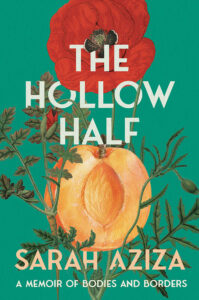
The Hollow Half, a Memoir of Bodies and Borders, by Sarah Aziza
Catapult 2025
ISBN 9781646222438
“Nothing records the effects of a sad life so graphically as the human body,” wrote Naguib Mahfouz in Palace of Desire. The melancholy that burdens the Arab body — its heart, its mind — has always been a portal to both past and present. The Arab body exists as both archive and witness to a world that seeks to disappear it into nothingness. This threat of disappearance demands a language to keep us alive, to settle inside and — once the time is right — to release all that it carries.
Like the human body, the Arabic language’s orality and lexicon carries a living, almost corporeal quality that holds its own mythology and transformations. (I, for instance, can still hear the fellahi musicality of Khalil Gibran’s “The Greater Sea” recited by my late uncle Muhammed a year after his death).
Before The Hollow Half begins, Sarah Aziza offers us an epigraph by Palestinian writer Emile Habibi that signals this very inheritance held within the Arabic language:
قلت: وسري الدفين؟
.قال: فجد به<
.وها أنا فاعل
Aziza’s memoir, likewise, becomes an act of release.
The Hollow Half, recipient of the 2026 Anisfield-Wolf Book Award for Memoir, interrogates the tension between a False Self and a True Self of one’s origin and becoming. Moving non-chronologically, the memoir traces Aziza’s personal and familial history, including her Palestinian father’s displacement from the Deir al-Balah refugee camp to an unnamed city in Jordan, and later to “Little Palestine” in Jeddah. In exile, Sarah’s father, Ziyad — perpetually on the move from the age of seven — becomes entranced by the grand illusions of “Amreeka” (that “benevolent meritocracy, the colorblind melting pot”), which foreign emissaries glorified at the middle school he attended. After a bumpy road, he finally arrives in the United States, and on New Years Eve, 1983, ends up at a house party in a Chicago neighborhood. There, the Sunni Palestinian man meets a born-again Christian American woman; their romance leads to “a leap of faith” marriage that unravels within five years. But right before their separation is finalized, a pregnancy test returns positive; fate has intervened, and a nos-wa-nos newborn arrives: Sarah enters the world into the ghourba of multiple, fragmented selves.
Time flits to the present, and it is here that the memoir becomes a dutiful record of various ruptures, the longing of the scorned body, the anorexic body, the queer body. Aziza, struggling with a near-fatal eating disorder, is admitted to an inpatient unit in a Manhattan hospital. Under constant surveillance, her body serves as the ultimate register and dictation. The hospital staff push Aziza to eat more consistently (conferring small punishments if she doesn’t). We witness her isolation, her doubt. Her partner, C, tends to her during visitation hours, becoming her anchor to the realm of the living.
“Am I Palestinian?” A question not freely chosen, but one that teaches Aziza that “To choose yes is to invoke, accept, the catastrophe of love.”
The memoir avoids the cliché of anorexia as delusion. Instead, it presents it as a darkly logical state, akin to a Kafkaesque tyrant, and centers reckoning and radical confession as lifelines toward revival. Through footnotes — ranging from historical speeches to scientific journals, to mental status examinations, to Arabic lessons where Aziza herself rebuilds her relationship to her mother tongue — Aziza develops a language that bridges the clinical and the intimate. Yet what I found particularly haunting is how the disorder sharpens perception itself into paradoxical clarity. Aziza writes:
Of course I had always sensed I was an aberration. But what alarmed me was not the vise grip of compulsion, not my cage of hunger not the lock around my throat. These were the lesser tortures, abuse that came to feel like comfort, obliteration as balm. In the haze of starvation, I could scarcely recall — how I have lived for years inside a throbbing sense of loss, a sorrow I could not explain. How it frightened me to hold palpable despair inside a life called fortunate, beautiful. This paradox worse, perhaps, than the sorrow itself. A secret I kept tightly, amid real and forced happiness. Feeding my body to compulsions. Chasing the violent mirage of relief until my limbs disappeared. Until I forgot every country. Until I could not imagine stopping, could not remember why I ran at all.
Aziza understands that spatial distortion shapes narrative, just as the body — the time-capsule that it is — is an overture to living, and through this we dispel linear chronology in favor of Aziza’s private salvations following her discharge.
One such moment arrives through the question of Fayaz, the late Ghassan Kanafani’s Palestinian Danish son, who carries the same ghourba as Aziza: “Am I Palestinian?” A question not freely chosen, but one that teaches Aziza that “To choose yes is to invoke, accept, the catastrophe of love.” Another comes during the 2021 George Floyd protests, showing, through a solemn conversation with C about the risk of placing her body amid a demonstration, how the care of one’s body is a shared rather than solitary responsibility. A third appears in the ghostly reminiscence about Aziza’s beloved Sittoo, the dear matriarch of her childhood whose presence shapes Aziza’s early understanding of the body. These brief salvations illuminate Aziza’s vast memoryscape, while interrogating the hardships and fears of faith and personhood, suggesting that “our displacements teach us the shape of what was lost. غربة resists indifference. It stirs the instinct to return, a longing that can sustain or break a soul.”
Among these salvations, one stands out: Aziza’s return to Palestine to visit the remains of ‘Ibdis, her family’s village. This journey becomes a pursuit of familial documentation and connection, an archive where her history seeks closure from estrangement.
In ‘Ibdis, we searched for the shattered cemetery my father had seen on his last visit, but no trace remained. Perhaps bulldozers had returned to finish what invaders had begun. Perhaps the graves had been swallowed under new layers of soil. I stepped as light as I could. Somewhere, near or beneath my feet, my great-grandfather slept. Alongside him, generations, their bones stacking deep in the past. Family lines cut to sudden, ragged edges after 1948. Already, members of ‘Ibdis had been buried in Deir al-Balah, Jordan, and Saudi Arabia; the living were even farther flung. I looked at my brother — where would our bodies rest?
In resisting erasure, the bodies of the living and the dead become both manifesto and elegy, a decolonial record and generational condemnation of the historical violence against the collective indigenous body of Palestine and a prolepsis of the burdens that lie ahead. This sorrow recalls the poetic register of Solmaz Sharif’s The End of Exile: “As the dead, so I come / to the city I am of. / Am without. / To watch play out around me / as theater — / audience as the dead are audience / to the life that is not mine. / Is as not / as never.”
Homeland is as much a restless and reaped body as it is a sanctuary of comfort and dhikr, a ghourba of the land tethered to the ghourba of the physical self. It is this intersection — where contours are shaped by imagination and physical preoccupations — that the complexity of estrangement in both anorexia and the occupation of Palestine deepens. Both Aziza and ‘Ibdis become a mirror of predicament, each reflecting, interpreting, and reacting to the other. Aziza’s return to the body serves as reclamation, repatriation, but we are also made to understand how the many forms of love tied to life and land — communal, amorous, revolutionary, intimate, radical, and anachronistic — can temper and converse with the lifelong hostilities waged within, and a body can be at “war with itself.”
The Hollow Half is an evocative declaration and testimony of Arab melancholy at its most felt. It navigates historical traumas and erasure without hesitation, tracing how bodies — Arab, both remembered and alive; personal, societal, canonized, invisible, or (trans)national — inflict and receive great harm, relief, and love in equal and unequal measure. Through these shifting cycles of moral fatigue and personal collapse and recovery, Aziza has written a mesmeric and meticulous narrative that would have her interlocutors — Ghassan Kanafani, Christina Sharpe, Mourid Barghouti, Edward Said, and others — pause to nod in recognition. At its core, The Hollow Half leaves us with a gentle, fierce reminder of how our bodies bear witness to the disasters of our time. Yet, Aziza offers a quiet solace: “There will come a day when you realize the loop has closed. And you feel it — how the time for opening has come.”