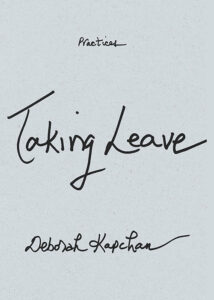
In this lyrical memoir, a writer's inner and outer journeys allow her to explore her Christian childhood, Jewish lineage, and the epiphany she found in Islam.
Taking Leave, a memoir by Deborah Kapchan
Duke University Press 2025
ISBN 9781478032823
In the prologue to her memoir, Deborah Kapchan explains that the word “leave” comes from the Old English læfan, which means “to allow or remain in the same state or condition.” What does it mean to leave, but remain? It is a slippery contradiction to explore, both in the literal and metaphorical senses presented in Kapchan’s memoir. The prologue also serves as the author’s origin story. It opens with a scene from her childhood: Brought up in the Protestant church by her mother, little Deborah is coloring at Sunday school in a cemetery when her Jewish father comes to pick her up and take her to the Bronx, where she visits with her Jewish relatives. Before he arrives, however, she is sitting quietly in a meditative state. “It’s not physical death I am sensing at the time, but the death before death that, I later learn, is a theme in all human myths, particularly the ones I’ll go on to explore [.]”
By locating her awareness of a “death before death” in childhood, Kapchan quietly unsettles the expectation of narrative progression. The memoir does not move toward revelation so much as circle an intuition already half-formed, returning to it across places, traditions, and selves. What emerges is not a story of finding answers, but a rather philosophical work in which experience becomes a medium for meditating on, rather than resolving, questions of faith and identity.
We learn that although her mother had converted to Judaism to appease her mother-in-law, her parents divorced when Kapchan was a baby. The author grows up between two religions, which presents her early on with an existential dilemma as to who she is and where she belongs.
The story begins, fittingly, in an airport, between places. Kapchan, an ethnographer, has been asked to speak in Jerusalem, although she confesses that it’s a place she has never wanted to go. While being questioned by customs, Kapchan imagines what she would tell them about her faith. The thirty years she spent traveling back and forth to Morocco, where she lived in a Sufi order, and gathered the poetry she edited and translated for Poetic Justice — the first anthology of contemporary Moroccan poetry in English? We are taken back to a time where “I would also experience my own departure from the quotidian into other states, not only attending Sufi rituals but participating in spirit possession ceremonies in Rabat as well. I began trafficking with the jinn, taking leave of my senses in multiple ways.”
She decides no, nor will she tell the customs officer “the way my Judaism haunts everything that came before and would come after: the three religions of the book that live in me like breath.”
Kapchan has been avoiding her Judaism; it haunts her, the word derived from Middle English meaning to frequent or return to a place, coincidentally similar to a distant cousin of “home.” Is this haunting of “everything that came before and would come after” not, after all, an entire ancestry she has avoided by taking leave of half of her heredity and adopting Sufism?
After the conference and her talk on poetry translation, the author meets with her Israeli guide, Avi. He takes her to the Jewish Quarter where she recognizes the Orthodox Jews from her time as an adult living in Brooklyn near an Orthodox community. Afterward, she writes, “…even if this may be a part of my heritage, when I look at them, nothing signals home. That is a place I’ve yet to find, except perhaps in the spaces I inhabit when taking leave.”
The author, like St. Augustin, would like one answer, one truth, but she knows, as she has written over and over, that truth for her is in the spaces in between.
Kapchan’s meditation on “leave” ultimately proves less about departure than about the persistence of what cannot be left behind. Although the book often presents itself as resisting resolution, its final movement suggests a different kind of arrival — not conversion or closure, but an acknowledgment of enduring attachment. To “take leave,” in this sense, is not to escape one’s inheritance but to recognize how it continues to inhabit the self.
Next Avi takes her to the roof of the oldest Christian guesthouse of Jerusalem, with a view over the city, from the Jewish Quarter to Mount Zion. Here, Kapchan realizes that the forty-nine square miles of Jews, Christians, and Muslims living amongst each other is a map of her history. She ponders, “How can I reside in that multiplicity without falling apart, to be without belonging? Perhaps it’s that question that led me to Islam, a religion with no claim on me, at least not one that I remembered.” With this revelation, it becomes clear that Taking Leave is not so much a travel memoir as it is in line with confessional writing, marked more by philosophical thought than narrative. From this perspective, we can locate Kapchan’s precursors in St.Augustine’s Confessions, whose movement is toward certainty, and in the writings of Sor Juana Ines de la Cruz, who persists in what cannot be renounced.
In Jerusalem, Kapchan hires two other guides, a Christian, Adam, and a Muslim, Ahmed. Adam is a pragmatic believer, noting that the landmarks are largely speculative, and not historically accurate. When they arrive at Gethsemane, Kapchan asks if the trees are thousands of years old, and he corrects that they are only hundreds of years old. When they come across pilgrims from the Philippines, one carrying a cross on his shoulder, Adam explains that the crosses are rented out. Kapchan contemplates, “[Jerusalem] is a storytelling industry. And that is why I am here: to gather them. But aren’t I also waiting for something to move in me, to tell me which story to enter definitively, so to take my leave of the other two?” The author, like St. Augustin, would like one answer, one truth, but she knows, as she has written over and over, that truth for her is in the spaces in between. Kapchan is on an exploration of how to live beyond religious strictures or cultural boundaries. Rather than dismissing religion outright, Kapchan seeks out the beauty and truth in doctrine while also questioning hardened traditions.
Kapchan’s last guide, Ahmed, leaves her at the Dome of the Rock, where it is thought the first two Jewish temples were erected and destroyed. Now it is a Muslim place of worship and Kapchan must go through both Jewish and Arab scrutiny to gain entrance. She is familiar here with the prayers she learned with the Sufis, and the bodily offer of genuflection. She repeats that it is with movement that one is wholly immersed in the prayers offered up, and her history with corporeal trance and movement comes alive as she prays for her family. “Yet even here, while I have known devotion, it is not my path. I can perform it, can repeatedly pray, but choosing one path over another is hard. The directions in which they lead somehow seem arbitrary in the end, as I always come back to the null point of existence, the absence at the heart of every presence.” For her final excursion, Ahmed puts Kapchan on a tram to the Holocaust Museum, where she is ripped apart.
When Kapchan returns to Abu Dhabi, she decides to celebrate the Jewish High Holidays, choosing to declare herself publicly as a Jew in the UAE. She writes, “I am drawn to Judaism in a way I have not been before. Is it the many years of reading Hannah Arendt, and Adorno, Spinoza, Bergson, Levinas, Benjamin, Cixous, and Derrida? Am I not always identified as a Jew by others, because of my name and physical type? Would I not also, with my father, have been sent to the ovens?”
Kapchan repeatedly locates meaning in what she calls the “space between identities,” a metaphorical zone of movement, overlap, and relation that she elevates into a kind of sacred dwelling — her “Jerusalem,” her “holy of holies.” In these passages, belonging is not tied to any single tradition but to the fluidity that emerges between them. Yet this valorization of in-betweenness sits uneasily alongside her recurring desire to “enter” one story definitively and “take leave” of the others. The memoir thus stages a tension between two competing impulses: the pull toward singular belonging and the recognition that identity is constituted in movement and entanglement. If Kapchan ultimately “arrives,” it is not by resolving this tension, but by learning to inhabit it — finding, in the very space that resists closure, a provisional form of home.