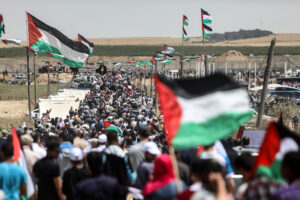
We devote our last monthly issue to the land of the postmodern world's longest military occupation, and the subject of enduring debate, and violence.
For many of us, a free Palestine remains a cause close to our hearts, and for some it has been the cause of a lifetime. It may be the last colony of the twenty-first century, yet its occupation, destruction, and annexation is a hundred-year-old saga, and Palestinian autonomy, a chimera. How could it be otherwise when Israel, all the while imperiously insisting on its “right to exist,” continues to colonize historic Palestine and subject the Palestinian people to a system of apartheid?
Recently Netanyahu claimed that “there will be no Palestinian state to the west of the Jordan River,” because, he emphasized, “this land is ours.”
Clearly, the story didn’t begin on October 7, 2023. For Palestinians, the terror started in the 1940s and has never ceased, in Gaza most brutally and spectacularly, though Israeli genocidal violence continues apace in the West Bank, where settlers attack villages, destroy vehicles, burn olive groves, and shoot at unarmed Palestinian civilians. And what is the world doing about it? Very little is the tragic, obvious, answer.
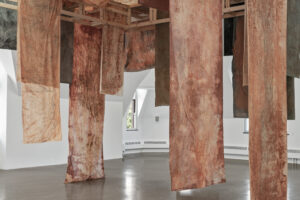
In the 57th issue of The Markaz Review, we feature those who are doing something — through their art, their words, their example. We begin with an exclusive interview with award-winning Palestinian writer Nasser Abu Srour, who spent thirty-two grueling years in Israeli prisons, followed by two testimonies from young writers in Gaza, Esraa Abo Qamar and Mariam Mushtaha, who reveal the hardships of a life without the daily commodities to which most of us are so accustomed. Our featured artist is Mona Hatoum, an icon in the art world, with new and recent work on view in London, Orani, Italy, and Qatar. Palestinian American fiction writer Sahar Mustafah returns with a moving new short story, “Tiny Suns,” while Jim Quilty in Beirut reviews the latest film release by Kamal Aljafari. The issue also features several of the latest books on Palestine, including Palestine Minus One, reviewed by Gabriel Polley, Edward Said: Oppositional Intellectual, reviewed by Mark Levine, and the poetry collection You Must Live, reviewed by Sholeh Wolpé. Ramallah-based author Raja Shehadeh returns to TMR with an essay that asks, “How Can Palestinians and Israelis Live Together?”, while Sheryl Ono is back with a potentially controversial but vital essay, entitled “Jewish Supremacy and the Making of Genocide in Gaza.”
PALESTINE is rounded out by an anonymous essay, “Not Even the Dead Rest in Palestine,” in which three Palestinian friends, in a seemingly ordinary stroll through Beit Jala, near Bethlehem, contemplate the past and imagine a future replete with increasing checkpoints, fences, walls, and settlements.
If Palestine is to be free and a land for all its inhabitants, it seems to us that it must remain the cause of our lifetimes, however protracted, however difficult, however insurmountable it may seem.
— The Editors
Select Other Languages Français.