During a Mediterranean crossing, a group of migrant Syrians find a temporary homeland in their diverse dialects in this poignant exploration of how language becomes the ultimate lifeline in the face of loss.
Translator’s Note:
When I read through this short story by Zeinab Ghassan Khaddour, I was certain of two things: it was perfect for TMR’s MOTHER TONGUE, and despite its brevity, translating it wouldn’t be easy.
As any translator will tell you, the act of taking one language into another isn’t merely a technical exercise; a large part of the success of the project hinges on the translator’s genuine emotional investment in seeing the message delivered safely to the other side. Without this, the story will lack the spirit of the original. Kaddour’s short story felt like a big responsibility, as it centers on one of the most urgent humanitarian crises of our time: the plight of migrants forced to abandon everything for safety and survival. How does one translate such immense loss?
As a Jordanian, my country shares two northern border crossings with Syria, which allows trade and travel between the two countries. This close proximity makes us relatively well-acquainted with the various Syrian dialects. Like Jordan, the official language in Syria is Modern Standard Arabic (Fus-ha), although everyday interactions, in both countries, unfold in diverse local dialects that vary from one governorate to another, and from region to region within the same country. These dialects, as if children springing from the same mother tongue, are further demonstrations of the region’s rich complexity.
In Khaddour’s piece, we encounter Syrian communities from the Sahil and Horani regions as well as people from Damascus, Homs, and Deir Az-Zor. Once pitted against each other by the Assad regime, they now share a rubber dinghy headed on a perilous journey to safety. At first, hesitant to converse with one another, a simple exchange involving a humble kitchen utensil (a spoon) — a seemingly trivial moment that serves as a striking example of how language can be translated within the same language — allows them to find common ground. They band together over the variations in their dialects, exchanging the different names for that one utensil. Gradually, the boundaries between them soften, and the differences fade. Soon, they are united not only by their diversity and loss but also by the realization they share a common past.
Nonetheless, it is the passengers’ initial discomfort that I found most poignant and wanted to preserve and convey to readers. Readers will notice that I chose to keep some text in Arabic. My intention was twofold: first to unsettle the reader by interrupting the flow of reading, thereby creating a gap — an arrested moment, if you will — that underscores how some meanings, in translations, cannot be perfectly carried over from one language to another. Secondly, I hoped this lingering discomfiture would serve as an invitation for deeper immersion in the story and its complex layers, pushing the reader to truly engage with and make space for the language, and by extension, the presence and perspective of the “other.” In doing so, the text becomes a space for genuine encounter and understanding across difference, instead of a straightforward or superficial reading.
Despite the sadness that courses through the story, hope ultimately emerges “from the rubble of words and scattered languages,” presenting an alternative homeland. As the protagonist’s mother shares makdous from Syria with her new neighbors, food and language converge in purpose: connection and belonging. In a world currently mired in war, displacement, censorship, and identity politics, isn’t that what everyone aspires to?
—Rana Asfour

We spend our lives oblivious to what fate has in store. We content ourselves with daily scraps, chasing faint threads of hope for a better life. When war roars and the drums sound, the masks fall off, and at its core, war is a losing gamble, wagered by the masses for the benefit of their masters. Victims reduced to fuel for a bonfire, huddled in trenches while those in charge watch coldly from a safe distance, bloated with fortune and influence amassed atop the rubble of our souls. Death never seems to disturb their peace.
War arrived with the onset of winter, shattering residents into isolated islands of hatred, where neighbors hurled insults mercilessly at one another, leveling unwarranted accusations of “treason” and “terrorism,” tearing apart a community that had once, together, broken bread. As chaos spread, Fairouz’s morning voice faded, replaced by the relentless hail of bullets. Any hope of building a future became an unattainable luxury, and life dwindled to a desperate struggle for survival.
Inside our house, fear crept like ivy into my parents’ eyes, mingling with dread born of stories of kidnappings and senseless identity-based murders. Lives stolen without a shred of mercy. With death lurking around every corner, we invested the savings set aside for better days — days that had betrayed us by never arriving — in the man known as the Smuggler of Souls across the Mediterranean. At the height of our existential despair, we believed that surrendering our bodies to the waves was easier than facing a treacherous death at the hands of our own countrymen.
In that moment, the humble, much-debated spoon became a small homeland.
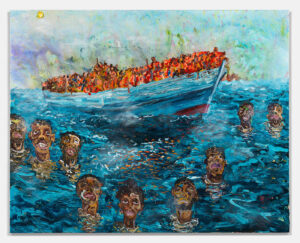
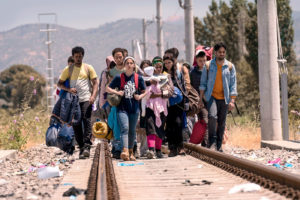
We arrived at the appointed shore, where a tattered rubber boat rocked precariously on the water — a coffin adrift, awaiting its occupants. We scrambled aboard, strangers pressed together by fate, our Syrian dialects mingling and colliding. The Homsi comforted the northern Deiri, the Damascene championed the Sahili with words that sounded like final hymns in the darkness at sea. We exchanged words eagerly, as though cramming the remnants of our identity between letters before the winds of alienation could carry them away. It was as if each of us sought to mend our wearied soul with the tattered cloth of a language that had once sheltered us, just before facing the cold arrogance of the unknown. In that dinghy, the hurtful names faded; the presumed “traitor” and “terrorist” that had once divided us vanished, and together we found ourselves united in the immensity of absence.
Amid the stifling crowd and the smell of rubber, a laugh broke out — like a crack in the wall of fear. My mother had just asked a young man sitting beside the engine to reach into her bag for a “khashouga,” so she could administer a dose of anti-nausea medicine trembling in her hand. The young man stared at her in utter astonishment. Khashouga? Shoo Khashouga, khalti? He asked. One of the young men from Deir-Az-Zor burst out laughing, correcting him with a confident grin: Mil’aka Ya Khouy! From the far corner of the boat, a man from Homs shouted: Khashouga, khashouga ya rajul!
A wave of muted laughter rippled through the passengers as the various dialects raced to get the final say. Amid the debate between those who called the spoon a mil’aka and those who insisted on khashouga, the simple utensil struggled to deliver medicine to soothe the stomachs of the seasick. We laughed as if clinging to the last threads of familiarity that bound us to the earth, as though these varied synonyms were talismans shielding us from collapse. In that moment, the humble, much-debated spoon became a small homeland — a place where we shared warmth and began to heal what was broken within us, before facing our linguistic helplessness in a country that would reduce our stories to numbers in the asylum records.
I glanced at my sister, and together we watched my mother insist on resurrecting the words of her distant village in that fragile space, weaving an alternative homeland from the fragments of language. In the throes of impending death, it was as if she reclaimed, through these words, our authentic multiplicity, stolen from us at departure. Her resurrection of the word khashouga for “spoon” brought the village dialects back to life on that dinghy — a deliberate attempt to rebuild bridges of warmth amid encroaching emptiness, a way to ward off the touch of nostalgia that erodes memory before absence claims it. In that moment, she was conjuring reassurance and familiarity, hoping that we — pressed between the waves and the sky — might become the homeland, whole again, before it was torn apart by readily packaged accusations.
Hours passed at sea, accompanied by the steady rhythm of the waves and the night settling over the horizon. In that watery seclusion, our secrets surfaced, and we exchanged stories with unbridled honesty, each of us unveiling a hidden pain. We realized, with bitter astonishment, that we had spent many years as strangers under the same sky, trapped within a system designed to condition us to fear “the other.”
The young man from Al-Deira spoke with burning passion about the beauty of his languid city on the banks of the Euphrates, and his deep desire to prepare tharoud the moment we disembarked onto the shores of safety. When most of us admitted our ignorance of the dish, he explained with pride and vivid detail how bread is combined with broth and meat to create a feast that promises closure for any wanderer. In that moment, he gathered the tatters of our collective memory, showing that a single dish could undo what years of incitement had built. In the darkness, we devoured his words as though nourishing ourselves on the traces of a homeland we’d lost in a swarm.
While I adapted, my mother was like a tree forcibly uprooted from its land.
I understood my mother’s wish to delay our arrival. She wanted us to remain together like this, a single human mass, before the sorting process in the asylum center ground us back down. She was stealing time to fill herself up with who she was, and to discover in her countrymen what years of fear and isolation had kept hidden from her.
In the corner of the boat, a young man from Daraa sat lost in thought. In the moonlight, my mother leaned toward him, piercing his stillness with a direct question: “Tell me about Daraa? My sister studied there and eventually died there. It remains a strange city in my memory.” When the young man remained silent, she prodded again: “Talk to us,” she urged. After attributing his seclusion to a deep-seated shyness, he began to quiz us on authentic Hourani vocabulary. With a faint smile, he asked if we knew the meaning of the phrase “طلع باللوح”. When we couldn’t answer, he explained that it described someone who overstepped their boundaries. Amid our laughter, he posed another question about the disposition of a person who has “طاق اللصمة”. Again, when we came up empty, he revealed that it referred to someone whose face appears so grotesquely angry that others urge him to hide it. Finally, he asked: “Does anyone know what ‘شق اللفت’ means?” At this, my mother’s eyes sparkled with recognition, and with an explosion of joy, she shouted: “Pure white!” A resounding cheer spread throughout the boat, and in that moment, my mother seemed to regain part of her lost soul. These words became the stake that connected us all to the shared land we had left behind, before the northern winds flung us, untethered, into the unknown.
With our feet finally on solid ground, our eyes lingered on one another, wishing that exile might one day bring an unexpected reunion with these companions who had braved the same waves and tasted the salty bitterness of a shared fear.
We were given a two-story house, which we shared with an African family. As English became the language my sister and I shared, it also became the barrier that cut my parents off from their surroundings. They sank into a desolate loneliness, and every morning my mother walked among the neighbors’ houses, listening intently for a Deiriya or Hourani accent that might ease her solitude, yearning for a familiar face from the dinghy to restore her sanity.
Two months passed, and my mother withered, humoring us with a forced smile while stunned confusion haunted her eyes. Guilt swelled within me, and I blamed my selfishness for bringing her here. While I adapted, she was like a tree forcibly uprooted from its land.
One morning, I wandered the streets, obsessed with finding among the unfamiliar and blank faces a Deiri, Dara’awi, or Homsi to bring back to her — someone who could, even if for a fleeting moment, deliver her back into the bosom of her lost homeland. But the streets were deaf to my pleas, and I returned home, dragging the weight of my disappointment to our doorstep. Before I opened the door, I braced myself for my mother’s usual sadness, but what I saw inside surpassed all expectations and dispelled my anxiety. There was my mother, setting the table with jars of makdous she had brought with her, like a precious treasure from our homeland. As she prepared a bite for each member of the African family gathered around her table, she gently insisted they try to pronounce its name in their own hesitant dialect. By coaxing their tongues to share in her identity, she guided anyone who succeeded into an exploration of the ingredients: pepper, walnuts, oil.
My tears fell despite the smile on my face. In that moment, the truth became clear: Language is mother, refuge, and womb. It is the hidden bond and the force that keeps life moving forward despite the trials of exile. With a bite of makdous and an Arabic letter, my mother planted her identity and sense of belonging in mouths and hearts that had never known us. From the rubble of words and scattered languages, she built an alternative homeland — one that could embrace us all. Such a homeland needed no passport, only a heart able to recognize its people in the face of strangers.