L'exposition d’Ali Cherri au [mac] de Marseille vous regarde

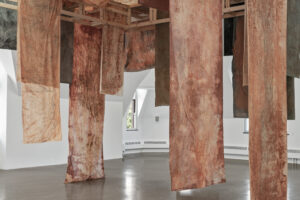
Ali Cherri, "Les Veilleurs," at the [mac], Marseille's Musée d'art contemporain (photo Grégoire Edouard, Ville de Marseille).

15 AUGUST 2025 • By Naima Morelli

Select Other Languages French.

Est-ce nous qui regardons ou est-ce que l’on nous regarde ? La nouvelle exposition d’Ali Cherri à Marseille, ouverte jusqu’au 4 janvier 2025, déconstruit ce qu’est un musée de l’intérieur.

C’est un peu comme cette citation sur l’abîme : si vous regardez l’histoire assez longtemps, c’est elle qui, alors, commence à vous regarder. C’est ce dont le spectateur prend conscience en entrant dans l’exposition Les Veilleurs, de l’artiste Ali Cherri, au [mac], le Musée d’Art Contemporain de Marseille.

L’exposition invite les spectateurs à réévaluer ce qu’est le musée et, à travers lui, ce qu’est notre perception de l’histoire, en bouleversant le concept maya d’une chronologie stricte. Nous commençons à envisager l’histoire moins comme une succession linéaire d’événements, de guerres et de mouvements artistiques – principalement sous l’influence occidentale – que comme une histoire de rencontres, de découvertes, d’histoires. Quelque chose qui commence in medias res.

Cette conception non linéaire de l’histoire est celle que mettent en avant les musées du monde entier, de l’exposition principale du Louvre Abu Dhabi à la National Gallery de Singapour et à la National Gallery de Rome. Il est dès lors impossible entretenir l’illusion d’un temps linéaire, l’illusion de l’ordre, l’illusion de l’histoire de l’art, l’illusion d’être ceux qui regardent et non ceux qui sont regardés.

C’est ce que nous dit Les Veilleurs dès la première salle. L’œuvre à l’entrée est déjà une mise en abyme : une photographie prise en 2020 montre l’espace de stockage du Musée d’histoire de Marseille, dont la géométrie reproduit et multiplie l’architecture réelle de la salle du mac, une sorte de passerelle. En présentant des rangées de tiroirs et d’étagères d’archives, Cherri affirme clairement que ce qui se cache derrière la façade mérite tout autant notre attention. Nous sommes prêts à entrer dans une exposition qui se tourne vers l’intérieur, exposant sa propre architecture et sa propre logique.

Derrière la photographie, une autre surprise, un autre renversement : sur une table éclairée sont exposés une série d’assemblages de têtes et d’yeux, tous tournés vers le spectateur. Parmi les objets, on trouve des visages votifs de l’Antiquité, des fragments décoratifs provenant de monuments funéraires du XIXe siècle, des têtes romanes et des bustes anthropomorphiques aux traits usés. Les matériaux sont variés : pierre, terre cuite, plâtre et bronze. À première vue, ces visages semblent simplement exposés, mais on se rend vite compte qu’ils sont également positionnés de manière à regarder le spectateur. Chaque fragment nous observe en retour.

Les vitrines les divisent et les reflètent, créant un kaléidoscope d’identités partielles. Certains n’ont pas d’yeux, d’autres ne sont que des yeux. Leur présentation dégage une intimité tactile. Aucune étiquette explicative, aucune hiérarchie claire. Le visiteur est obligé de faire le tour de la table, de se pencher, de reculer, et dans ce processus, son propre corps s’intègre au rythme dicté par l’exposition.

La boîte éclairée dans laquelle sont placés les artefacts élimine toutes les ombres, créant une suspension fantomatique de la matière. Les objets flottent dans l’espace, décontextualisés mais, pour autant, bien présents dans leur singularité. Les vitrines transparentes qui les séparent amplifient presque les formes imparfaites et endommagées des objets archéologiques, disposant les fragments en constellations lâches. Regroupés par taille et par matériau plutôt que par chronologie historique, ils semblent avoir un rythme et une tonalité, presque comme une composition musicale.


Genèse d’une exposition

Stéphanie Airaud, directrice du [mac] et commissaire de l’exposition, nous explique que tout remonte à 2024, lorsque le musée a acquis l’œuvre d’Ali Cherri « Les Veilleurs FEU et EAU », créée à l’origine pour Manifesta, elle avait alors suggéré à Cherri de proposer une présentation spécifique qui dialoguerait avec les collections des musées marseillais.

Pour choisir les œuvres et les objets qui seraient inclus, l’artiste et la commissaire ont identifié plusieurs thèmes directement liés aux totems des « Veilleurs », tels que l’animalité, l’hybridation, le regard, le visage, le sommeil et la vulnérabilité.

L’artiste n’a pas privilégié les chefs-d’œuvre, mais plutôt les œuvres marginales : sculptures endommagées, artefacts mineurs, bustes insignifiants, fragments anonymes. Il a sélectionné des œuvres rarement exposées et les a disposées de manière à brouiller les frontières entre conservation et apparition, à la manière de Gustave Moreau.

« Avec Cherri, nous avons sélectionné les pièces à travers un dialogue sur leur matérialité, leur présence, leur trajectoire et les correspondances sensibles et formelles qui se sont dégagées entre ces pièces issues des collections des musées marseillais et le travail d’Ali, explique Airaud. Les pièces rassemblées et exposées ici sont des objets rarement ou jamais montrés, fragmentaires, peu reconnus ou peu connus, mais qui témoignent tous de la production matérielle des civilisations humaines, de l’Égypte antique au Mexique contemporain. »

Le scénographe Martin Michel et le concepteur lumière François Austerlitz ont su traduire avec justesse les idées d’Ali Cherri, pour qui l’agencement spatial fait partie intégrante de l’expérience du visiteur.

L’absence de légendes souligne l’importance de laisser les objets libres d’être présentés au spectateur et ensemble, sans l’appareil de connaissances constitué par les institutions. La seule voix écrite de l’exposition est celle de l’auteur Karim Kattan, dont le texte commandé pour l’exposition figure dans le livret de l’exposition, qui contient des notes sur les œuvres présentées.


La chimère

Au fur et à mesure que les visiteurs parcourent les salles du [mac], ils commencent à s’interroger sur ce qu’ils voient, car tout au long de l’exposition, Cherri mélange les objets réels provenant des réserves des musées marseillais avec des sculptures, des objets, des vidéos et des œuvres d’art de sa propre création, au point qu’il est parfois difficile de distinguer ce qui est « original » de ce qui est « créé par l’artiste ». Et dans une exposition sans étiquette et sans chronologie stricte, y a-t-il même une différence ?

Cette frontière floue entre conservation et œuvre d’art rappelle la pratique d’autres artistes qui ont créé leurs propres sciences et institutions fictives, comme Waalid Raad et sa fondation fictive The Atlas Group, Khalil Rabah, créateur du Musée palestinien d’histoire naturelle, ou encore le Singapourien Robert Zhao Renhui, fondateur de l’Institut des géologues critiques, où il présentait au public une science en partie réelle, en partie fictive.

L’image de la chimère illustre bien cette manière dont les artistes brouillent les pistes pour remettre en question les vérités absolues. C’est cette figure mythique, la seule œuvre de l’exposition que le [mac] a choisie pour promouvoir l’événement sur les panneaux d’affichage et les bus de Marseille, qui résume la signification de tout le projet de l’exposition.

Un corps, mi-animal, mi-humain, surmontée d’une petite tête d’aspect archaïque. La tête semble disproportionnée par sa petite taille, comme si la créature n’avait pas de cerveau, mais plutôt une dimension mythique issue du passé. La sculpture est réalisée à partir d’un mélange de matériaux : argile, paille et sable, ce qui lui confère un aspect à la fois archaïque, effrayant et inventé.

La chimère est une image intéressante, car elle correspond en quelque sorte à notre façon d’interpréter l’histoire, ou peut-être à celle dont l’artiste le fait. Il y a le corps de la chimère, que nous pouvons assimiler à la partie dure, factuelle et la source de la connaissance historique, et puis il y a l’imaginaire, notre propre superposition sur ces faits, la façon dont nous lisons l’histoire en fonction de notre sensibilité.
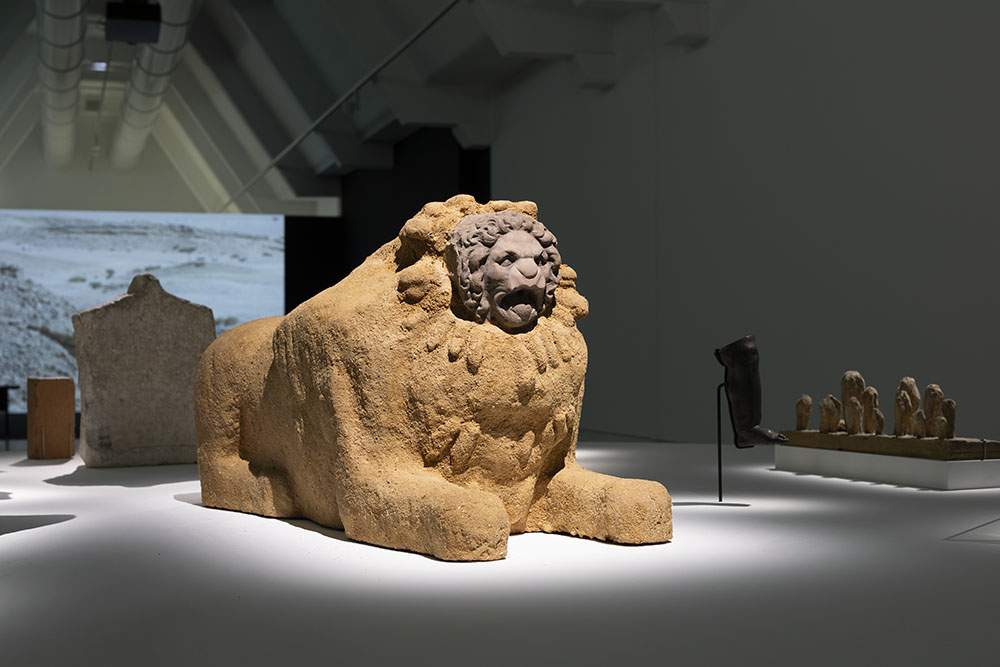

Ali Cherri, « La Chimère », dans l’exposition Les Veilleurs (photo Grégoire Edouard, avec l’aimable autorisation de la Ville de Montpellier).

D’une couche à l’autre

Au-delà de la première galerie, la stratégie de la mise en abyme s’intensifie. Une deuxième photographie, présentée comme une fenêtre, représente la Salle de Paléontologie et d’Anatomie Comparée du Musée National d’Histoire Naturelle à Paris. Il ne s’agit pas d’une image créée spécialement pour Les Veilleurs, mais elle trouve une résonnance particulièrement forte dans le reste de l’exposition.

Elle montre une salle remplie de squelettes d’animaux et d’animaux empaillés, des vitrines remplies d’os et, au centre, un modèle anatomique humain, un écorché, dont la peau a été retirée. Le seul personnage vivant est l’artiste, qui dort sur un banc, juste aux pieds du modèle.

Cette photographie est intitulée « Nature morte ». La référence au genre pictural est intentionnelle et ironique : ce qui est « vivant » dans ce tableau est précisément ce qu’il y a de plus artificiel. L’écorché devient un symbole supplémentaire d’une couche de réalité qui a été retirée, mais aussi un substitut de l’artiste lui-même, qui habite toujours son corps, tout en étant perdu dans ses rêves.

En entrant dans la deuxième galerie, l’ambiance change à nouveau. Une grande table en bois, qui rappelle l’établi d’un taxidermiste, expose de délicates aquarelles représentant des oiseaux morts. Elles ont été peintes par Cherri lui-même pendant le confinement dû au coronavirus, et s’inspirent de spécimens issus de sa collection personnelle d’animaux empaillés.

Les dessins sont méticuleusement disposés sur la table, chacun est accompagné de petites étiquettes manuscrites, imitant le système d’étiquetage des archives d’histoire naturelle. Nous sommes confrontés à une nouvelle remise en question des étiquettes, des descriptions, de la tentative de catégoriser la vie elle-même. Mais plus que des études scientifiques, ces aquarelles s’apparentent à des portraits funèbres et légèrement morbides. Nous sommes amenés à penser que l’acte de classification lui-même peut priver les créatures de leur vitalité. Et en ce sens, l’acte créatif qu’est le dessin a-t-il le pouvoir d’éterniser la vie ?

Autour de la table, des vitrines présentent d’autres œuvres sculpturales : là encore, un mélange de pièces propres à l’artiste et d’artefacts empruntés. Dans l’une, un oiseau est perché à côté d’un lion de pierre, dans une autre, deux chouettes empaillées fixent le vide de l’autre côté de la pièce. L’ambiguïté entre le naturel et l’artificiel, entre spécimen et sculpture, atteint ici son paroxysme. Il y a ici l’idée d’une écologie de la forme, résistante aux catégorisations.


Le théâtre des ombres

La dernière galerie fonctionne comme une scène. Ici, la lumière est théâtrale. Cherri installe l’une de ses sculptures sur une plate-forme surélevée, accompagnée d’une figurine mexicaine, et derrière elle, un écran projette des silhouettes allongées. Le jeu entre les formes réelles et projetées rappelle un théâtre d’ombres chinoises ou les débuts du cinéma. D’une certaine manière, nous commençons à étudier les ombres comme si elles étaient des personnages à part entière. Nous regardons la sculpture, mais nous regardons également son double.

Non loin de ces figurines, deux œuvres vidéo sont projetées en dialogue. Dans l’une d’elles, nous rencontrons « Le creuseur », un homme qui visite une nécropole à Sharjah, un site archéologique réel dont les tombes ont été vidées et dont le contenu a été transféré dans un musée voisin. L’homme, que nous ne voyons que de loin, patrouille sur le sol sec et abandonné, dernier témoin d’un passé déraciné. La deuxième vidéo, projetée en face de la première, montre l’intérieur du Musée naturel de Sharjah, un espace luxuriant mais immaculé, qui contraste fortement avec le désert environnant.

L’exposition présente également quelques peintures qui fonctionnent par surprise ou par association libre. Parmi les œuvres les plus troublantes, on trouve une image fissurée de la Nativité. Le leitmotiv d’aller au-delà de la surface des choses revient ici : la peinture est tellement usée que la toile brute, qui sert de support, apparaît à travers.

Les experts en conservation ont interrompu la restauration de la toile, qui a été vernie non pas pour la restaurer, mais pour empêcher qu’elle ne se détériore davantage. Elle se trouve désormais dans un état de décomposition figée. Le choix de Cherri de l’inclure dans l’exposition est révélateur. Tout comme l’écorché, les oiseaux et le gardien endormi, cette peinture est un emblème du temps suspendu et un memento mori de l’impermanence de toutes choses.

Enfin, en parcourant l’exposition, nous rencontrons enfin les gardiens, Les Veilleurs, les deux figures totémiques que l’artiste a créées à l’origine pour Manifesta, qui constituent à la fois le point de départ et la conclusion de l’exposition.

On a l’impression que plutôt que de représenter une sortie, ces deux personnages constituent un portail vers une conscience nouvelle. Ce que l’artiste semble proposer n’est pas une histoire alternative, mais une critique de la manière dont l’histoire a été conçue jusqu’à aujourd’hui. Il ouvre la voie à une nouvelle conception de ce qu’est un musée.

Comme l’explique Cherri, « en tant que cinéaste, je donne au spectateur un point de vue que je détermine avec ma caméra, je dicte ce que je vois : d’abord un paysage, puis un gros plan sur un visage, suivi de la pluie à travers la fenêtre, et ainsi de suite. J’essaie d’aborder l’expérience de l’exposition de la même manière.

« Je me mets donc à la place du visiteur pour réfléchir à la scénographie et à l’éclairage. De plus, comme les œuvres sont présentées sans leurs références académiques et muséologiques, les repères sont flous et les formes se confondent.

« C’est peut-être ainsi que l’on peut construire un imaginaire universel où tout se mélange, où l’on a le sentiment que tel ou tel objet appartient à tous, » conclut Cherri.

Finalement, les Veilleurs nous invitent à veiller, à nous attarder, à prêter attention, à nous familiariser avec ce que l’on voit, et enfin à aborder la réalité au-delà des catégories strictes. Nous sommes appelés à la faire en tant que sujets, en tant que créateurs de nos histoires et participants au grand récit commun. Nous sommes ceux qui posons la petite tête que nous avons créée sur le corps d’un lion plus ancien. Toujours hybrides, mais constamment en quête d’ordre.


Traduit de l’anglais par Marion Beauchamp-Levet

Naima Morelli

Naima Morelli is an arts writer and journalist specialized in contemporary art from Asia-Pacific and the MENA region. She has written for the Financial Times, Al-Jazeera, The Art Newspaper, ArtAsiaPacific, Internazionale and Il Manifesto, among others, and she is a regular contributor... Read more

Join Our Community

TMR exists thanks to its readers and supporters. By sharing our stories and celebrating cultural pluralism, we aim to counter racism, xenophobia, and exclusion with knowledge, empathy, and artistic expression.

Learn more

RELATED

Book Reviews

Controlled Demolition: an Epistolary Review

16 JANUARY 2026 • By Lina Mounzer
<em>Controlled Demolition</em>: an Epistolary Review
Book Reviews

Rewriting Beirut’s “Bad Boy Architect” Bernard Khoury

9 JANUARY 2026 • By Bridget Peak
Rewriting Beirut’s “Bad Boy Architect” Bernard Khoury
Columns

Two Spectacles: A Lebanese Farce, an American Fault Line

2 JANUARY 2026 • By Amal Ghandour
Two Spectacles: A Lebanese Farce, an American Fault Line
Columns

Emm Kamel: The Future Is Here and So Is the Past

19 DECEMBER 2025 • By Amal Ghandour
<em>Emm Kamel</em>: The Future Is Here and So Is the Past
Film

10 Noir Films from the Arab world, Iran, and Turkey

5 DECEMBER 2025 • By TMR
10 Noir Films from the Arab world, Iran, and Turkey
Columns

The Whispers Of Nadia Tueni and Maroun Baghdadi

5 DECEMBER 2025 • By Amal Ghandour
The Whispers Of Nadia Tueni and Maroun Baghdadi
Beirut

In Lebanon, It’s Business as Usual

21 NOVEMBER 2025 • By Amal Ghandour
In Lebanon, It’s Business as Usual
Columns

How Much Do We Miss Umm Khulthum?

7 NOVEMBER 2025 • By Amal Ghandour
How Much Do We Miss Umm Khulthum?
Fiction

Sultana to the Rescue

7 NOVEMBER 2025 • By MK Harb
Sultana to the Rescue
Essays

The Absent Homeland

7 NOVEMBER 2025 • By Maysaa Alajjan
The Absent Homeland
Art

On Identity—Ayşegül Savaş’ Long Distance

7 NOVEMBER 2025 • By Amy Omar
On Identity—Ayşegül Savaş’ <em>Long Distance</em>
Columns

Dear Souseh: Stuck Between Families

24 OCTOBER 2025 • By Lina Mounzer
Dear Souseh: Stuck Between Families
Film

A Love Letter to the Ghosts of Armenian Cinema

17 OCTOBER 2025 • By Jim Quilty
A Love Letter to the Ghosts of Armenian Cinema
Film Reviews

New Documentaries from Palestine, Sudan, Afghanistan, and Iran

12 SEPTEMBER 2025 • By Yassin El-Moudden
New Documentaries from Palestine, Sudan, Afghanistan, and Iran
Editorial

Why Out of Our Minds?

5 SEPTEMBER 2025 • By Lina Mounzer
Why <em>Out of Our Minds</em>?
Centerpiece

Trauma After Gaza

5 SEPTEMBER 2025 • By Joelle Abi-Rached
Trauma After Gaza
Essays

From Stitch to Symbol: The Power of Palestinian Tatreez

22 AUGUST 2025 • By Joanna Barakat
From Stitch to Symbol: The Power of Palestinian Tatreez
Art & Photography

Ali Cherri’s show at Marseille’s [mac] Is Watching You

15 AUGUST 2025 • By Naima Morelli
Ali Cherri’s show at Marseille’s [mac] Is Watching You
Essays

Ziad Rahbani: The Making of a Lebanese Jazz Legend

8 AUGUST 2025 • By Diran Mardirian
Ziad Rahbani: The Making of a Lebanese Jazz Legend
Art

Architectural Biennale Confronts Brutality of Climate Change

1 AUGUST 2025 • By Iason Athanasiadis
Architectural Biennale Confronts Brutality of Climate Change
Art

Kaynuna: Interview with Mohammad Kassem on Kuwait’s Pavilion

1 AUGUST 2025 • By Georgina Van Welie
<em>Kaynuna</em>: Interview with Mohammad Kassem on Kuwait’s Pavilion
Featured Artist

Syria and the Future of Art: an Intimate Portrait

4 JULY 2025 • By Arie Amaya-Akkermans
Syria and the Future of Art: an Intimate Portrait
Film

From A World Not Ours to a Land Unknown

13 JUNE 2025 • By Jim Quilty
From A World Not Ours to a <em>Land Unknown</em>
Art

Iraq’s Kurdish Genocide and Three Wars: Artists Osman Ahmed & Fakher Mohammed

6 JUNE 2025 • By Hadani Ditmars
Iraq’s Kurdish Genocide and Three Wars: Artists Osman Ahmed & Fakher Mohammed
Essays

Imagining Ghanem—My Return to Lebanon

6 JUNE 2025 • By Amelia Izmanki
Imagining Ghanem—My Return to Lebanon
Book Reviews

An Intimate History of Violence: Beirut Under Siege in Nejmeh Khalil Habib’s A Spring that Did Not Blossom 

30 MAY 2025 • By Rebecca Ruth Gould
An Intimate History of Violence: Beirut Under Siege in Nejmeh Khalil Habib’s <em>A Spring that Did Not Blossom</em> 
Arabic

Jawdat Fakreddine Presents Three Poems

20 MAY 2025 • By Jawdat Fakhreddine, Huda J. Fakhreddine
Jawdat Fakreddine Presents Three Poems
Film Reviews

Contretemps, a Bold Film on Lebanon’s Crises

16 MAY 2025 • By Jim Quilty
Contretemps, a Bold Film on Lebanon’s Crises
Art

Going Home to South Lebanon: Abdel Hamid Baalbaki

2 MAY 2025 • By Karina El Helou
Going Home to South Lebanon: Abdel Hamid Baalbaki
Essays

A Letter To My Cruel Lover: Tripoli

2 MAY 2025 • By Lara Kassem
A Letter To My Cruel Lover: Tripoli
Art

Between Belief and Doubt: Ramzi Mallat’s Suspended Disbelief

11 APRIL 2025 • By Marta Mendes
Between Belief and Doubt: Ramzi Mallat’s Suspended Disbelief
Essays

Heartbreak and Commemoration in Beirut’s Southern Suburbs

7 MARCH 2025 • By Sabah Haider
Heartbreak and Commemoration in Beirut’s Southern Suburbs
Book Reviews

Art History and the United Arab Emirates

10 JANUARY 2025 • By Jelena Sofronijevic
Art History and the United Arab Emirates
Book Reviews

Maya Abu Al-Hayyat’s Defiant Exploration of Palestinian Life

20 DECEMBER 2024 • By Zahra Hankir
Maya Abu Al-Hayyat’s Defiant Exploration of Palestinian Life
Book Reviews

Barrack Zailaa Rima’s Beirut Resists Categorization

6 DECEMBER 2024 • By Katie Logan
Barrack Zailaa Rima’s <em>Beirut</em> Resists Categorization
Art

In Lebanon, Art is a Matter of Survival

22 NOVEMBER 2024 • By Nada Ghosn
In Lebanon, Art is a Matter of Survival
Editorial

The Editor’s Letter Following the US 2024 Presidential Election

8 NOVEMBER 2024 • By Jordan Elgrably
The Editor’s Letter Following the US 2024 Presidential Election
Film

The Haunting Reality of Beirut, My City

8 NOVEMBER 2024 • By Roger Assaf, Zeina Hashem Beck
The Haunting Reality of <em>Beirut, My City</em>
Essays

Between Two Sieges: Translating Roger Assaf in California

8 NOVEMBER 2024 • By Zeina Hashem Beck
Between Two Sieges: Translating Roger Assaf in California
Art & Photography

Palestinian Artists Reflect on the Role of Art in Catastrophic Times

1 NOVEMBER 2024 • By Nina Hubinet
Palestinian Artists Reflect on the Role of Art in Catastrophic Times
Art & Photography

Beyond Our Gaze: Rethinking Animals in Contemporary Art

1 NOVEMBER 2024 • By Naima Morelli
Beyond Our Gaze: Rethinking Animals in Contemporary Art
TMR Interviews

Aïda Nosrat of Atine: Artist at Work

11 OCTOBER 2024 • By Jordan Elgrably
Aïda Nosrat of Atine: Artist at Work
TMR 45 • From Here, One Year On

Witnessing Catastrophe: a Painter in Lebanon

4 OCTOBER 2024 • By Ziad Suidan
Witnessing Catastrophe: a Painter in Lebanon
Opinion

Everything Has Changed, Nothing Has Changed

4 OCTOBER 2024 • By Amal Ghandour
Everything Has Changed, Nothing Has Changed
Fiction

The Last Millefeuille in Beirut

4 OCTOBER 2024 • By MK Harb
The Last Millefeuille in Beirut
Opinion

Lebanon’s Holy Gatekeepers of Free Speech

6 SEPTEMBER 2024 • By Joumana Haddad
Lebanon’s Holy Gatekeepers of Free Speech
Film

Soudade Kaadan: Filmmaker Interview

30 AUGUST 2024 • By Jordan Elgrably
Soudade Kaadan: Filmmaker Interview
Essays

Meditations on Palestinian Exile and Return

16 AUGUST 2024 • By Dana El Saleh
Meditations on Palestinian Exile and Return
Book Reviews

Nabil Kanso: Lebanon and the Split of Life—a Review

2 AUGUST 2024 • By Sophie Kazan Makhlouf
Nabil Kanso: <em>Lebanon and the Split of Life</em>—a Review
Art & Photography

World Picks from the Editors: July 15 — August 2

12 JULY 2024 • By TMR
World Picks from the Editors: July 15 — August 2
Fiction

“We Danced”—a story by MK Harb

5 JULY 2024 • By MK Harb
“We Danced”—a story by MK Harb
Books

Ripped from Memoirs of a Lebanese Policeman

5 JULY 2024 • By Fawzi Zabyan, Lina Mounzer
Ripped from <em>Memoirs of a Lebanese Policeman</em>
Columns

Creating Community with Community Theatre

21 JUNE 2024 • By Victoria Lupton
Creating Community with Community Theatre
Book Reviews

Is Amin Maalouf’s Latest Novel, On the Isle of Antioch, a Parody?

14 JUNE 2024 • By Farah-Silvana Kanaan
Is Amin Maalouf’s Latest Novel, <em>On the Isle of Antioch</em>, a Parody?
Essays

Wajdi Mouawad’s “Controversial” Wedding Day

7 JUNE 2024 • By Elie Chalala
Wajdi Mouawad’s “Controversial” <em>Wedding Day</em>
Theatre

What Kind Of Liar Am I?—a Short Play

7 JUNE 2024 • By Mona Mansour
<em>What Kind Of Liar Am I?</em>—a Short Play
Essays

Omar Naim Exclusive: Two Films on Beirut & Theatre

7 JUNE 2024 • By Omar Naim
Omar Naim Exclusive: Two Films on Beirut & Theatre
Books

Palestine, Political Theatre & the Performance of Queer Solidarity in Jean Genet’s Prisoner of Love

7 JUNE 2024 • By Saleem Haddad
Palestine, Political Theatre & the Performance of Queer Solidarity in Jean Genet’s <em>Prisoner of Love</em>
Fiction

“I, Mariam”—a story by Joumana Haddad

26 APRIL 2024 • By Joumana Haddad
“I, Mariam”—a story by Joumana Haddad
Featured Artist

Bani Khoshnoudi: Featured Artist for PARIS

1 APRIL 2024 • By TMR, Jordan Elgrably
Bani Khoshnoudi: Featured Artist for PARIS
Music

Nass El Ghiwane’s Moroccan Folk, Radical Politics, Forged in Paris

1 APRIL 2024 • By Benjamin Jones
Nass El Ghiwane’s Moroccan Folk, Radical Politics, Forged in Paris
Art

Paris, Abstraction and the Art of Yvette Achkar

1 APRIL 2024 • By Arie Amaya-Akkermans
Paris, Abstraction and the Art of Yvette Achkar
Art

When Fatma Haddad Became “Baya”—a Paris Art Story

1 APRIL 2024 • By Naima Morelli
When Fatma Haddad Became “Baya”—a Paris Art Story
Fiction

“Paris of the Middle East”—fiction by MK Harb

1 APRIL 2024 • By MK Harb
“Paris of the Middle East”—fiction by MK Harb
Essays

Holding Back the Bobos: Portrait of Paris’ Belleville

1 APRIL 2024 • By Cole Stangler
Holding Back the Bobos: Portrait of Paris’ Belleville
Essays

Undoing Colonial Geographies from Paris with Ariella Aïsha Azoulay

1 APRIL 2024 • By Sasha Moujaes, Jordan Elgrably
Undoing Colonial Geographies from Paris with Ariella Aïsha Azoulay
Essays

Happy as an Arab in Paris

1 APRIL 2024 • By Wanis El Kabbaj, Jordan Elgrably
Happy as an Arab in Paris
Book Reviews

Feurat Alani: Paris, Fallujah and Recovered Memory

1 APRIL 2024 • By Nada Ghosn, Rana Asfour
Feurat Alani: Paris, Fallujah and Recovered Memory
Columns

They/Them: Identify Yourself Immediately

1 APRIL 2024 • By Sabah Haider
They/Them: Identify Yourself Immediately
Poetry

Two Poems from Maram Al-Masri

3 MARCH 2024 • By Maram Al-Masri, Hélène Cardona
Two Poems from Maram Al-Masri
Essays

Israel’s Environmental and Economic Warfare on Lebanon

3 MARCH 2024 • By Michelle Eid
Israel’s Environmental and Economic Warfare on Lebanon
Poetry

“The Scent Censes” & “Elegy With Precious Oil” by Majda Gama

4 FEBRUARY 2024 • By Majda Gama
“The Scent Censes” & “Elegy With Precious Oil” by Majda Gama
Essays

“Double Apple”—a short story by MK Harb

4 FEBRUARY 2024 • By MK Harb
“Double Apple”—a short story by MK Harb
TMR 37 • Endings & Beginnings

“The Summer They Heard Music”—a short story by MK Harb

3 DECEMBER 2023 • By MK Harb
“The Summer They Heard Music”—a short story by MK Harb
Fiction

Huda Fakhreddine’s A Brief Time Under a Different Sun

3 DECEMBER 2023 • By Huda J. Fakhreddine, Rana Asfour
Huda Fakhreddine’s <em>A Brief Time Under a Different Sun</em>
Art

In the Beginning and the End is the Book

3 DECEMBER 2023 • By Sophie Kazan Makhlouf
In the Beginning and the End is the Book
Fiction

“The Followers”—a short story by Youssef Manessa

3 DECEMBER 2023 • By Youssef Manessa
“The Followers”—a short story by Youssef Manessa
Art & Photography

War and Art: A Lebanese Photographer and His Protégés

13 NOVEMBER 2023 • By Nicole Hamouche
War and Art: A Lebanese Photographer and His Protégés
Featured Artist

Mohamed Al Mufti, Architect and Painter of Our Time

5 NOVEMBER 2023 • By Nicole Hamouche
Mohamed Al Mufti, Architect and Painter of Our Time
Book Reviews

The Refugee Ocean—An Intriguing Premise

30 OCTOBER 2023 • By Natasha Tynes
<em>The Refugee Ocean</em>—An Intriguing Premise
Books

World Picks from the Editors: Oct 28 – Nov 10

27 OCTOBER 2023 • By TMR
World Picks from the Editors: Oct 28 – Nov 10
Art & Photography

Middle Eastern Artists and Galleries at Frieze London

23 OCTOBER 2023 • By Sophie Kazan Makhlouf
Middle Eastern Artists and Galleries at Frieze London
Fiction

I, SOUAD or the Six Deaths of a Refugee From Aleppo

9 OCTOBER 2023 • By Joumana Haddad
I, SOUAD or the Six Deaths of a Refugee From Aleppo
Theatre

Hartaqât: Heresies of a World with Policed Borders

9 OCTOBER 2023 • By Nada Ghosn
<em>Hartaqât</em>: Heresies of a World with Policed Borders
Theatre

Lebanese Thespian Aida Sabra Blossoms in International Career

9 OCTOBER 2023 • By Nada Ghosn
Lebanese Thespian Aida Sabra Blossoms in International Career
Books

Fairouz: The Peacemaker and Champion of Palestine

1 OCTOBER 2023 • By Dima Issa
Fairouz: The Peacemaker and Champion of Palestine
Fiction

“Kaleidoscope: In Pursuit of the Real in a Virtual World”—fiction from Dina Abou Salem

1 OCTOBER 2023 • By Dina Abou Salem
“Kaleidoscope: In Pursuit of the Real in a Virtual World”—fiction from Dina Abou Salem
Amazigh

World Picks: Festival Arabesques in Montpellier

4 SEPTEMBER 2023 • By TMR
World Picks: Festival Arabesques in Montpellier
Books

“Sadness in My Heart”—a story by Hilal Chouman

3 SEPTEMBER 2023 • By Hilal Chouman, Nashwa Nasreldin
“Sadness in My Heart”—a story by Hilal Chouman
Book Reviews

Laila Halaby’s The Weight of Ghosts is a Haunting Memoir

28 AUGUST 2023 • By Thérèse Soukar Chehade
Laila Halaby’s <em>The Weight of Ghosts</em> is a Haunting Memoir
Film

The Soil and the Sea: The Revolutionary Act of Remembering

7 AUGUST 2023 • By Farah-Silvana Kanaan
<em>The Soil and the Sea</em>: The Revolutionary Act of Remembering
Art

What Palestine Brings to the World—a Major Paris Exhibition

31 JULY 2023 • By Sasha Moujaes
<em>What Palestine Brings to the World</em>—a Major Paris Exhibition
Essays

“My Mother is a Tree”—a story by Aliyeh Ataei

2 JULY 2023 • By Aliyeh Ataei
“My Mother is a Tree”—a story by Aliyeh Ataei
Beirut

“The City Within”—fiction from MK Harb

2 JULY 2023 • By MK Harb
“The City Within”—fiction from MK Harb
Cities

In Shahrazad’s Hammam—fiction by Ahmed Awadalla

2 JULY 2023 • By Ahmed Awadalla
In Shahrazad’s Hammam—fiction by Ahmed Awadalla
Arabic

Inside the Giant Fish—excerpt from Rawand Issa’s graphic novel

2 JULY 2023 • By Rawand Issa, Amy Chiniara
Inside the Giant Fish—excerpt from Rawand Issa’s graphic novel
Fiction

“Nadira of Tlemcen”—fiction from Abdellah Taïa

2 JULY 2023 • By Abdellah Taïa
“Nadira of Tlemcen”—fiction from Abdellah Taïa
Art & Photography

Newly Re-Opened, Beirut’s Sursock Museum is a Survivor

12 JUNE 2023 • By Arie Amaya-Akkermans
Newly Re-Opened, Beirut’s Sursock Museum is a Survivor
Art & Photography

Garden of Africa: Interview with Rachid Koraïchi

4 JUNE 2023 • By Rose Issa
Garden of Africa: Interview with Rachid Koraïchi
Art & Photography

And Yet Our Brothers: Portraits of France

22 MAY 2023 • By Laëtitia Soula
And Yet Our Brothers: Portraits of France
Beirut

The Saga of Mounia Akl’s Costa Brava, Lebanon

1 MAY 2023 • By Meera Santhanam
The Saga of Mounia Akl’s <em>Costa Brava, Lebanon</em>
Columns

Yogurt, Surveillance and Book Covers

1 MAY 2023 • By Malu Halasa
Yogurt, Surveillance and Book Covers
Beirut

Remembering the Armenian Genocide From Lebanon

17 APRIL 2023 • By Mireille Rebeiz
Remembering the Armenian Genocide From Lebanon
Columns

Sudden Journeys: Paris Arabe

27 MARCH 2023 • By Jenine Abboushi
Sudden Journeys: Paris Arabe
Beirut

Tel Aviv-Beirut, a Film on War, Love & Borders

20 MARCH 2023 • By Karim Goury
<em>Tel Aviv-Beirut</em>, a Film on War, Love & Borders
Beirut

Interview with Michale Boganim, Director of Tel Aviv-Beirut

20 MARCH 2023 • By Karim Goury
Interview with Michale Boganim, Director of <em>Tel Aviv-Beirut</em>
Book Reviews

War and the Absurd in Zein El-Amine’s Watermelon Stories

20 MARCH 2023 • By Rana Asfour
War and the Absurd in Zein El-Amine’s <em>Watermelon</em> Stories
Fiction

“Counter Strike”—a story by MK HARB

5 MARCH 2023 • By MK Harb
“Counter Strike”—a story by MK HARB
Fiction

“Mother Remembered”—Fiction by Samir El-Youssef

5 MARCH 2023 • By Samir El-Youssef
“Mother Remembered”—Fiction by Samir El-Youssef
Essays

More Photographs Taken From The Pocket of a Dead Arab

5 MARCH 2023 • By Saeed Taji Farouky
More Photographs Taken From The Pocket of a Dead Arab
Cities

The Odyssey That Forged a Stronger Athenian

5 MARCH 2023 • By Iason Athanasiadis
The Odyssey That Forged a Stronger Athenian
Beirut

The Curious Case of Middle Lebanon

13 FEBRUARY 2023 • By Amal Ghandour
The Curious Case of Middle Lebanon
Beirut

Arab Women’s War Stories, Oral Histories from Lebanon

13 FEBRUARY 2023 • By Evelyne Accad
Arab Women’s War Stories, Oral Histories from Lebanon
Featured excerpt

Fiction: Inaam Kachachi’s The Dispersal, or Tashari

5 FEBRUARY 2023 • By Inaam Kachachi
Fiction: Inaam Kachachi’s <em>The Dispersal</em>, or <em>Tashari</em>
Book Reviews

Sabyl Ghoussoub Heads for Beirut in Search of Himself

23 JANUARY 2023 • By Adil Bouhelal
Sabyl Ghoussoub Heads for Beirut in Search of Himself
Art

On Lebanon and Lamia Joreige’s “Uncertain Times”

23 JANUARY 2023 • By Arie Amaya-Akkermans
On Lebanon and Lamia Joreige’s “Uncertain Times”
Fiction

Broken Glass, a short story

15 DECEMBER 2022 • By Sarah AlKahly-Mills
<em>Broken Glass</em>, a short story
Art

Art World Picks: Albraehe, Kerem Yavuz, Zeghidour, Amer & Tatah

12 DECEMBER 2022 • By TMR
Art

French-Algerian Artist Djamel Tatah’s Solitary Crowds

12 DECEMBER 2022 • By Laëtitia Soula
French-Algerian Artist Djamel Tatah’s Solitary Crowds
Art

Museums in Exile—MO.CO’s show for Chile, Sarajevo & Palestine

12 DECEMBER 2022 • By Jordan Elgrably
Museums in Exile—MO.CO’s show for Chile, Sarajevo & Palestine
Art

Where is the Palestinian National Museum of Modern and Contemporary Art?

12 DECEMBER 2022 • By Nora Ounnas Leroy
Where is the Palestinian National Museum of Modern and Contemporary Art?
Book Reviews

Fida Jiryis on Palestine in Stranger in My Own Land

28 NOVEMBER 2022 • By Diana Buttu
Fida Jiryis on Palestine in <em>Stranger in My Own Land</em>
Columns

For Electronica Artist Hadi Zeidan, Dance Clubs are Analogous to Churches

24 OCTOBER 2022 • By Melissa Chemam
For Electronica Artist Hadi Zeidan, Dance Clubs are Analogous to Churches
Fiction

“Ride On, Shooting Star”—fiction from May Haddad

15 OCTOBER 2022 • By May Haddad
“Ride On, Shooting Star”—fiction from May Haddad
Art & Photography

Two Women Artists Dialogue with Berlin and the Biennale

15 SEPTEMBER 2022 • By Viola Shafik
Two Women Artists Dialogue with Berlin and the Biennale
Film

Ziad Kalthoum: Trajectory of a Syrian Filmmaker

15 SEPTEMBER 2022 • By Viola Shafik
Ziad Kalthoum: Trajectory of a Syrian Filmmaker
Essays

Kairo Koshary, Berlin’s Egyptian Food Truck

15 SEPTEMBER 2022 • By Mohamed Radwan
Kairo Koshary, Berlin’s Egyptian Food Truck
Film

The Mystery of Tycoon Michel Baida in Old Arab Berlin

15 SEPTEMBER 2022 • By Irit Neidhardt
The Mystery of Tycoon Michel Baida in Old Arab Berlin
Essays

Exile, Music, Hope & Nostalgia Among Berlin’s Arab Immigrants

15 SEPTEMBER 2022 • By Diana Abbani
Exile, Music, Hope & Nostalgia Among Berlin’s Arab Immigrants
Art & Photography

16 Formidable Lebanese Photographers in an Abbey

5 SEPTEMBER 2022 • By Nada Ghosn
16 Formidable Lebanese Photographers in an Abbey
Film

Two Syrian Brothers Find Themselves in “We Are From There”

22 AUGUST 2022 • By Angélique Crux
Two Syrian Brothers Find Themselves in “We Are From There”
Music Reviews

Hot Summer Playlist: “Diaspora Dreams” Drops

8 AUGUST 2022 • By Mischa Geracoulis
Hot Summer Playlist: “Diaspora Dreams” Drops
Editorial

Editorial: Is the World Driving Us Mad?

15 JULY 2022 • By TMR
Editorial: Is the World Driving Us Mad?
Film

Lebanon in a Loop: A Retrospective of “Waves ’98”

15 JULY 2022 • By Youssef Manessa
Lebanon in a Loop: A Retrospective of “Waves ’98”
Book Reviews

Leaving One’s Country in Mai Al-Nakib’s “An Unlasting Home”

27 JUNE 2022 • By Rana Asfour
Leaving One’s Country in Mai Al-Nakib’s “An Unlasting Home”
Columns

Why I left Lebanon and Became a Transitional Citizen

27 JUNE 2022 • By Myriam Dalal
Why I left Lebanon and Became a Transitional Citizen
Featured excerpt

Joumana Haddad: “Victim #232”

15 JUNE 2022 • By Joumana Haddad, Rana Asfour
Joumana Haddad: “Victim #232”
Fiction

Rabih Alameddine: “Remembering Nasser”

15 JUNE 2022 • By Rabih Alameddine
Rabih Alameddine: “Remembering Nasser”
Film

Saeed Taji Farouky: “Strange Cities Are Familiar”

15 JUNE 2022 • By Saeed Taji Farouky
Saeed Taji Farouky: “Strange Cities Are Familiar”
Fiction

Dima Mikhayel Matta: “This Text Is a Very Lonely Document”

15 JUNE 2022 • By Dima Mikhayel Matta
Dima Mikhayel Matta: “This Text Is a Very Lonely Document”
Fiction

“The Salamander”—fiction from Sarah AlKahly-Mills

15 JUNE 2022 • By Sarah AlKahly-Mills
“The Salamander”—fiction from Sarah AlKahly-Mills
Art & Photography

Film Review: “Memory Box” on Lebanon Merges Art & Cinema

13 JUNE 2022 • By Arie Amaya-Akkermans
Film Review: “Memory Box” on Lebanon Merges Art & Cinema
Book Reviews

Fragmented Love in Alison Glick’s “The Other End of the Sea”

16 MAY 2022 • By Nora Lester Murad
Fragmented Love in Alison Glick’s “The Other End of the Sea”
Beirut

Fairouz is the Voice of Lebanon, Symbol of Hope in a Weary Land

25 APRIL 2022 • By Melissa Chemam
Fairouz is the Voice of Lebanon, Symbol of Hope in a Weary Land
Book Reviews

Joumana Haddad’s The Book of Queens: a Review

18 APRIL 2022 • By Laila Halaby
Joumana Haddad’s <em>The Book of Queens</em>: a Review
Art & Photography

Ghosts of Beirut: a Review of “displaced”

11 APRIL 2022 • By Karén Jallatyan
Ghosts of Beirut: a Review of “displaced”
Columns

Music in the Middle East: Bring Back Peace

21 MARCH 2022 • By Melissa Chemam
Music in the Middle East: Bring Back Peace
Essays

“Gluttony” from Abbas Beydoun’s “Frankenstein’s Mirrors”

15 MARCH 2022 • By Abbas Baydoun, Lily Sadowsky
“Gluttony” from Abbas Beydoun’s “Frankenstein’s Mirrors”
Poetry

Three Poems of Love and Desire by Nouri Al-Jarrah

15 MARCH 2022 • By Nouri Al-Jarrah
Three Poems of Love and Desire by Nouri Al-Jarrah
Fiction

Fiction from “Free Fall”: I fled the city as a murderer whose crime had just been uncovered

15 JANUARY 2022 • By Abeer Esber, Nouha Homad
Fiction from “Free Fall”: I fled the city as a murderer whose crime had just been uncovered
Book Reviews

Temptations of the Imagination: how Jana Elhassan and Samar Yazbek transmogrify the world

10 JANUARY 2022 • By Rana Asfour
Temptations of the Imagination: how Jana Elhassan and Samar Yazbek transmogrify the world
Columns

Sudden Journeys: From Munich with Love and Realpolitik

27 DECEMBER 2021 • By Jenine Abboushi
Sudden Journeys: From Munich with Love and Realpolitik
Columns

My Lebanese Landlord, Lebanese Bankdits, and German Racism

15 DECEMBER 2021 • By Tariq Mehmood
My Lebanese Landlord, Lebanese Bankdits, and German Racism
Fiction

Three Levantine Tales

15 DECEMBER 2021 • By Nouha Homad
Three Levantine Tales
Comix

Lebanon at the Point of Drowning in Its Own…

15 DECEMBER 2021 • By Raja Abu Kasm, Rahil Mohsin
Lebanon at the Point of Drowning in Its Own…
Comix

How to Hide in Lebanon as a Western Foreigner

15 DECEMBER 2021 • By Nadiyah Abdullatif, Anam Zafar
How to Hide in Lebanon as a Western Foreigner
Columns

Sudden Journeys: The Villa Salameh Bequest

29 NOVEMBER 2021 • By Jenine Abboushi
Sudden Journeys: The Villa Salameh Bequest
Music Reviews

Electronic Music in Riyadh?

22 NOVEMBER 2021 • By Melissa Chemam
Electronic Music in Riyadh?
Art

Etel Adnan’s Sun and Sea: In Remembrance

19 NOVEMBER 2021 • By Arie Amaya-Akkermans
Etel Adnan’s Sun and Sea: In Remembrance
Columns

Burning Forests, Burning Nations

15 NOVEMBER 2021 • By Hadani Ditmars
Burning Forests, Burning Nations
Book Reviews

Diary of the Collapse—Charif Majdalani on Lebanon’s Trials by Fire

15 NOVEMBER 2021 • By A.J. Naddaff
<em>Diary of the Collapse</em>—Charif Majdalani on Lebanon’s Trials by Fire
Book Reviews

The Vanishing: Are Arab Christians an Endangered Minority?

15 NOVEMBER 2021 • By Hadani Ditmars
The Vanishing: Are Arab Christians an Endangered Minority?
Interviews

The Anguish of Being Lebanese: Interview with Author Racha Mounaged

18 OCTOBER 2021 • By A.J. Naddaff
The Anguish of Being Lebanese: Interview with Author Racha Mounaged
Book Reviews

Racha Mounaged’s Debut Novel Captures Trauma of Lebanese Civil War

18 OCTOBER 2021 • By A.J. Naddaff
Racha Mounaged’s Debut Novel Captures Trauma of Lebanese Civil War
Featured excerpt

Memoirs of a Militant, My Years in the Khiam Women’s Prison

15 OCTOBER 2021 • By Nawal Qasim Baidoun
Memoirs of a Militant, My Years in the Khiam Women’s Prison
Art & Photography

Displaced: From Beirut to Los Angeles to Beirut

15 SEPTEMBER 2021 • By Ara Oshagan
Displaced: From Beirut to Los Angeles to Beirut
Weekly

Palestinian Akram Musallam Writes of Loss and Memory

29 AUGUST 2021 • By khulud khamis
Palestinian Akram Musallam Writes of Loss and Memory
Editorial

Why COMIX? An Emerging Medium of Writing the Middle East and North Africa

15 AUGUST 2021 • By Aomar Boum
Why COMIX? An Emerging Medium of Writing the Middle East and North Africa
Latest Reviews

Rebellion Resurrected: The Will of Youth Against History

15 AUGUST 2021 • By George Jad Khoury
Rebellion Resurrected: The Will of Youth Against History
Latest Reviews

Puigaudeau & Sénones: a Graphic Novel on Mauritania Circa 1933

15 AUGUST 2021 • By Paraska Tolan-Szkilnik 
Puigaudeau & Sénones: a Graphic Novel on Mauritania Circa 1933
Latest Reviews

Women Comic Artists, from Afghanistan to Morocco

15 AUGUST 2021 • By Sherine Hamdy
Women Comic Artists, from Afghanistan to Morocco
Weekly

World Picks: August 2021

12 AUGUST 2021 • By Lawrence Joffe
World Picks: August 2021
Columns

Beirut Drag Queens Lead the Way for Arab LGBTQ+ Visibility

8 AUGUST 2021 • By Anonymous
Beirut Drag Queens Lead the Way for Arab LGBTQ+ Visibility
Columns

Remember 18:07 and Light a Flame for Beirut

4 AUGUST 2021 • By Jordan Elgrably
Remember 18:07 and Light a Flame for Beirut
Art & Photography

Gaza’s Shababek Gallery for Contemporary Art

14 JULY 2021 • By Yara Chaalan
Gaza’s Shababek Gallery for Contemporary Art
Columns

The Semantics of Gaza, War and Truth

14 JULY 2021 • By Mischa Geracoulis
The Semantics of Gaza, War and Truth
Columns

Lebanon’s Wasta Has Contributed to the Country’s Collapse

14 JUNE 2021 • By Samir El-Youssef
Lebanon’s Wasta Has Contributed to the Country’s Collapse
Columns

Lebanese Oppose Corruption with a Game of Wasta

14 JUNE 2021 • By Victoria Schneider
Lebanese Oppose Corruption with a Game of Wasta
Weekly

War Diary: The End of Innocence

23 MAY 2021 • By Arie Amaya-Akkermans
War Diary: The End of Innocence
Essays

Reviving Hammam Al Jadeed

14 MAY 2021 • By Tom Young
Reviving Hammam Al Jadeed
Art

The Labyrinth of Memory

14 MAY 2021 • By Ziad Suidan
The Labyrinth of Memory
Weekly

Beirut Brings a Fragmented Family Together in “The Arsonists’ City”

9 MAY 2021 • By Rana Asfour
Columns

Memory and the Assassination of Lokman Slim

14 MARCH 2021 • By Claire Launchbury
Memory and the Assassination of Lokman Slim
Weekly

Hanane Hajj Ali, Portrait of a Theatrical Trailblazer

14 FEBRUARY 2021 • By Nada Ghosn
Hanane Hajj Ali, Portrait of a Theatrical Trailblazer
TMR 6 • Revolutions

Revolution in Art, a review of “Reflections” at the British Museum

14 FEBRUARY 2021 • By Malu Halasa
Revolution in Art, a review of “Reflections” at the British Museum
Film Reviews

Muhammad Malas, Syria’s Auteur, is the subject of a Film Biography

10 JANUARY 2021 • By Rana Asfour
Muhammad Malas, Syria’s Auteur, is the subject of a Film Biography
TMR 4 • Small & Indie Presses

Algiers, Algeria in the novel “Our Riches”

14 DECEMBER 2020 • By Kaouther Adimi
Algiers, Algeria in the novel “Our Riches”
TMR 4 • Small & Indie Presses

Children of the Ghetto, My Name Is Adam

14 DECEMBER 2020 • By Elias Khoury
Children of the Ghetto, My Name Is Adam
TMR 3 • Racism & Identity

Find the Others: on Becoming an Arab Writer in English

15 NOVEMBER 2020 • By Rewa Zeinati
TMR 3 • Racism & Identity

I am the Hyphen

15 NOVEMBER 2020 • By Sarah AlKahly-Mills
I am the Hyphen
World Picks

World Art, Music & Zoom Beat the Pandemic Blues

28 SEPTEMBER 2020 • By Malu Halasa
World Art, Music & Zoom Beat the Pandemic Blues
Beirut

Wajdi Mouawad, Just the Playwright for Our Dystopian World

15 SEPTEMBER 2020 • By Melissa Chemam
Wajdi Mouawad, Just the Playwright for Our Dystopian World
Art & Photography

Arts in the Pandemic Age

15 SEPTEMBER 2020 • By Melissa Chemam
Arts in the Pandemic Age
Beirut

Beirut In Pieces

15 SEPTEMBER 2020 • By Jenine Abboushi
Beirut In Pieces
Art

Beirut Comix Tell the Story

15 SEPTEMBER 2020 • By Lina Ghaibeh & George Khoury
Beirut Comix Tell the Story
Editorial

Beirut, Beirut

15 SEPTEMBER 2020 • By Jordan Elgrably
Beirut

It’s Time for a Public Forum on Lebanon

15 SEPTEMBER 2020 • By Wajdi Mouawad
It’s Time for a Public Forum on Lebanon
Book Reviews

Salvaging the shipwreck of humanity in Amin Maalouf’s Adrift

15 SEPTEMBER 2020 • By Sarah AlKahly-Mills
Salvaging the shipwreck of humanity in Amin Maalouf’s <em>Adrift</em>

Leave a Comment

Your email address will not be published. Required fields are marked *

15 − 4 =

Scroll to Top