La Biennale d’architecture de Venise se confronte à la brutalité du changement climatique

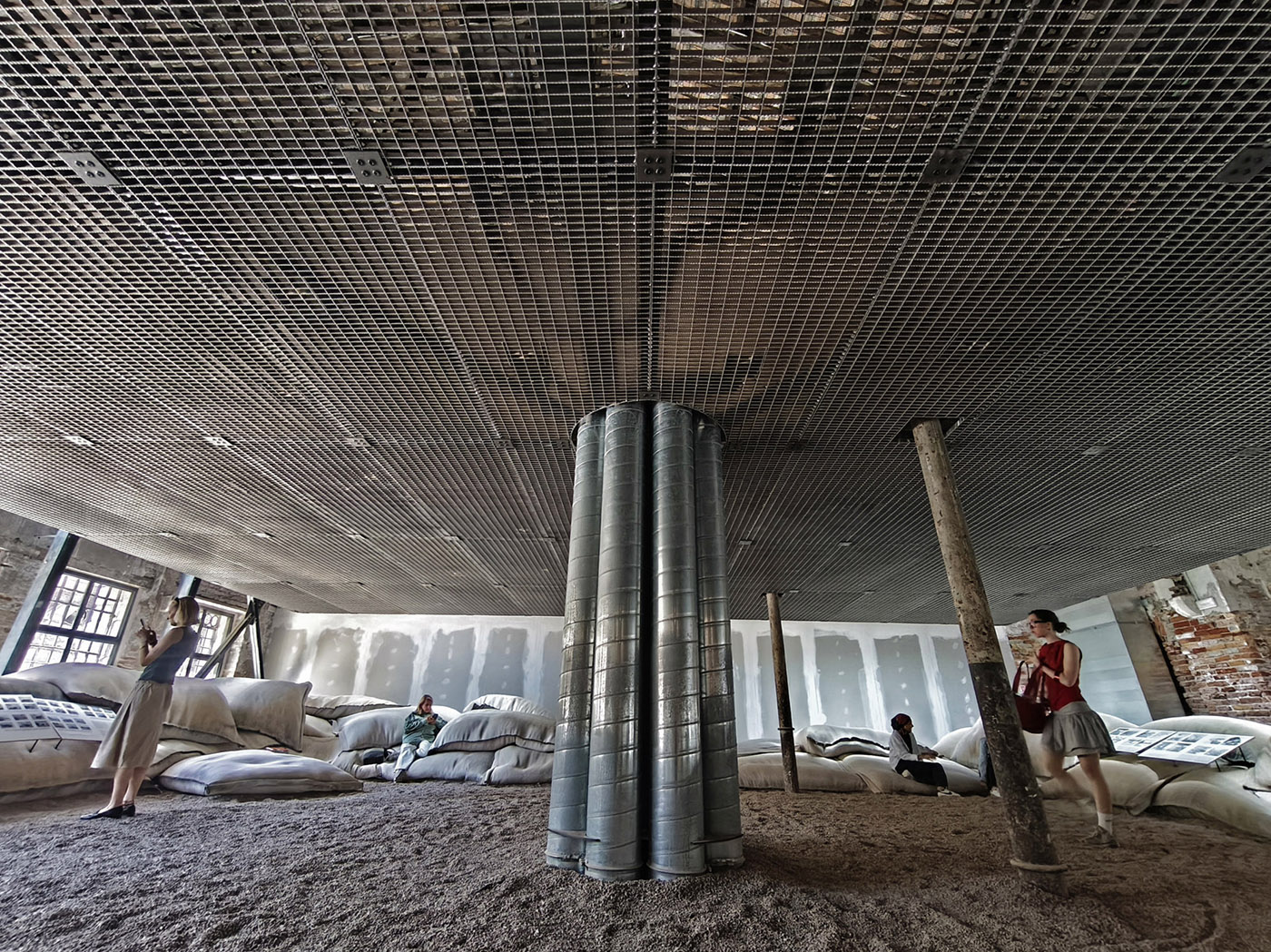
The Bahrain pavilion's winning proposal of a passive climate cooling installation seeks to recreate the courtyards, roofscapes, shaded souqs and palm groves that were pre-modern staples of communal life, offering a respite from the harsh climatic conditions (all photos Iason Athanasiadis).

1 AUGUST 2025 • By Iason Athanasiadis

Select Other Languages French.

La version vénitienne du waterboarding : climatisation, architecture et changement climatique à la Biennale d'architecture de 2025 Les architectes qui cherchent à imiter la nature doivent d'abord se débarrasser des matériaux fossiles et de l'inefficacité énergétique de leurs pratiques. Alors que les températures de la planète augmentent, les architectes du Moyen-Orient renoncent aux solutions occidentales et redonnent vie aux solutions locales. Le pavillon de Bahreïn et un système traditionnel de refroidissement par le vent ont remporté le Lion d'or de la Biennale pour la meilleure participation nationale.

Pour accéder à l’exposition principale, les visiteurs de la Biennale d’architecture de Venise de cette année doivent traverser une pièce étouffante et sombre, équipée d’unités de ventilation extérieures, envahie par une chaleur polluée et des flaques d’eau stagnante. Cet avant-gôut oppressant et moite est la vision des organisateurs de la Biennale de ce que sera un avenir plus chaud et plus inégalitaire pour ceux qui, du mauvais côté de la précarité énergétique, ne pourront pas se permettre de se rafraîchir artificiellement et seront condamnés à subir la chaleur torride de l’extérieur.

Plonger les visiteurs privilégiés de la biennale dans la chaleur résiduelle émise par les besoins en climatisation de l’organisation est la version vénitienne du waterboarding. La mise en scène évoque la zone de sacrifice créée par notre ère des combustibles fossiles, tout en constituant une introduction percutante à cette 45e édition exceptionnellement dense.

Étouffé par ce narthex étouffant, le visiteur pousse un rideau noir pour émerger dans une salle d’exposition épurée et délicieusement fraîche. Se délectant du relief tendu, un regard en arrière vers le mur de séparation révèle deux arbres climatiseurs (douze unités de climatisation empilées en deux rangées) qui apportent un répit face à la hausse des températures. Bien qu’initialement accueillis comme une aubaine, ces dispositifs suggèrent que la climatisation, loin de résoudre le problème qu’elle est censée régler, ne fait que l’aggraver.

Le texte d’introduction nous rappelle que l’accueil brutal de la biennale est une allégorie spatiale des inégalités mondiales flagrantes et croissantes de notre avenir thermique. Plutôt que de considérer l’architecture comme un simple ajout matériel, la biennale explore les processus d’entropie et un avenir où l’homme s’associe à la nature plutôt que de la dominer. Au lieu d’être traitée comme un élément décoratif ou déracinée pour faire place à des bâtiments plus rentables, la végétation peut être adaptée pour former une infrastructure biologique pour refroidir les villes, purifier leur air et rétablir un semblant d’équilibre.

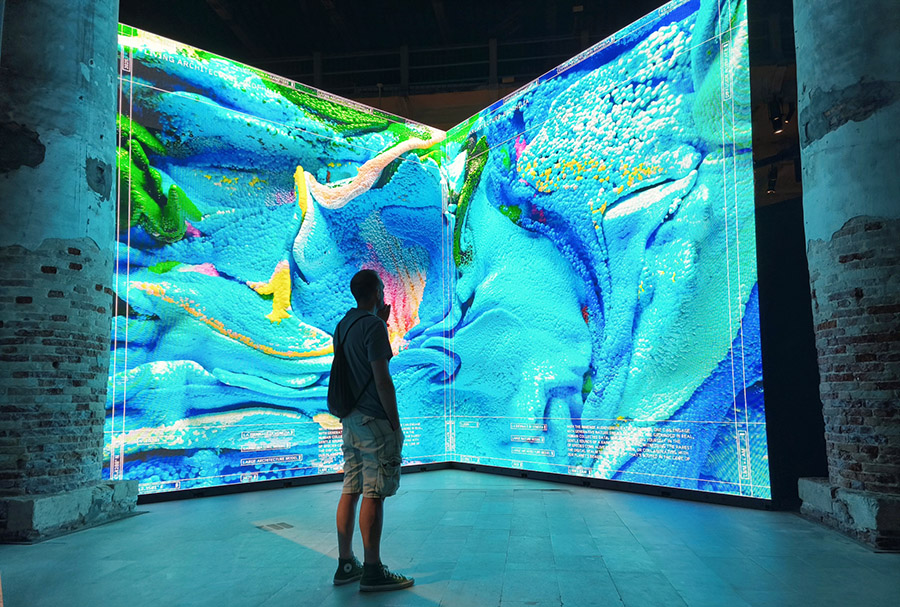
La salle principale de la biennale, où résonnent les échos, est remplie d’expositions démontrant comment le biomimétisme – l’idée que les architectes peuvent imiter la nature – peut réduire l’empreinte énergétique élevée des constructions, isoler les bâtiments et recréer les effets bénéfiques des zones humides sur la population. Cependant, tout comme le biomimétisme a été critiqué comme étant simplement un moyen superficiel d’imiter la nature qui ne parvient pas à réduire les matériaux non durables ou les processus énergivores, la biennale agite la perspective d’une multitude de solutions sans jamais aborder le problème central : sans un changement radical dans la manière dont les élites mondiales cherchent à maintenir leur mode de vie énergivore et leurs querelles militarisées, nous ne faisons que sombrer vers notre perte. 

Des solutions rapides pour lutter contre la chaleur au Moyen-Orient ?

Aucune autre région n’est autant confrontée à la fois au changement climatique imminent et à l’insouciance de ses élites que la péninsule arabique. Confrontés à des températures parmi les plus extrêmes de la planète, à une pénurie d’eau et à une dépendance quasi totale à l’importation de produits de première nécessité, ses dirigeants se sont lancés depuis deux décennies dans une course à la puissance géopolitique et dans des projets prestigieux extrêmement coûteux, au lieu de s’attaquer aux menaces structurelles et existentielles qui pèsent sur leurs sociétés. L’Arabie saoudite a dépensé ses revenus pétroliers, en baisse, pour construire une ville futuriste, The Line, et avec les Émirats arabes unis et le Qatar, a consacré des milliards de dollars à envahir et à déstabiliser des pays plus pauvres comme le Yémen, la Libye, la Syrie et le Soudan. Ce trésor et ce temps précieux auraient pu être consacrés à adapter leurs économies afin de ne plus dépendre presque exclusivement de l’exportation de combustibles fossiles pour faire face au double défi d’un avenir post-pétrolier marqué par des conditions climatiques plus extrêmes.

C’est donc une surprise que ce soit le petit État insulaire du Bahreïn, ayant réussi à contourner l’extraction pétrolière en développant des services bancaires régionaux, qui remporte le prestigieux Lion d’or de la Biennale. En 2010, il est devenu le premier pays du Golfe à participer à la Biennale de Venise, créant la surprise en remportant le prix de la meilleure participation nationale pour son pavillon sur le thème « Reclaim » (« Se Réapproprier »). La lutte contre le changement climatique s’est avérée être un thème récurrent des expositions du pays, et le conservateur du pavillon 2025 sur le thème « Heatwave » (« Canicule) », l’architecte italien Andrea Faraguna, formé à Venise, a conçu un système de refroidissement extérieur inspiré des techniques traditionnelles de refroidissement grâce au vent qui étaient autrefois courantes des deux côtés du golfe Persique.

« Nous avons déjà des exemples fabuleux et très solides sur lesquels nous pouvons nous appuyer dans notre patrimoine », a déclaré l’architecte égyptienne Omniya Abdel Barr, qui admet qu’un corpus de connaissances indigènes a été perdu au cours du demi-siècle qui s’est écoulé entre la génération d’architectes des années 1940 et celle des années 1990. « Mais comme la plupart des systèmes éducatifs sont basés sur des méthodologies occidentales, même lorsque nous nous fixons pour tâche de résoudre des problèmes liés à la chaleur pour lesquels nous disposons d’une vaste réserve de techniques, nous les abordons toujours d’un point de vue occidental plutôt que local et traditionnel. »

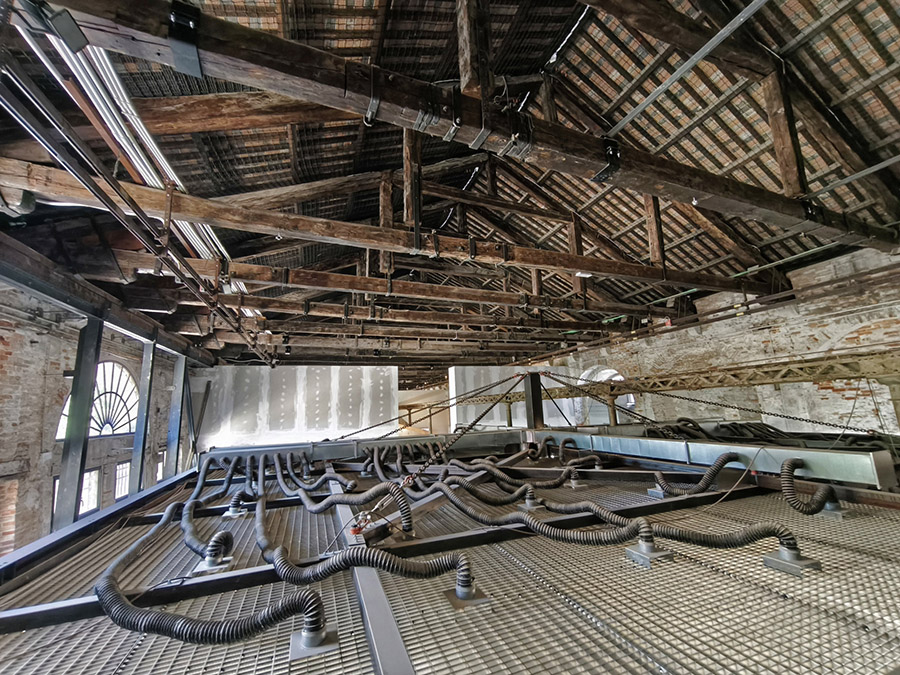
Bien que la représentation du Bahreïn par un architecte italien ait suscité quelques interrogations, le projet de Faraguna proposait de rafraîchir les espaces extérieurs à l’aide de tuyaux plongeant à 20 mètres de profondeur, puis d’utiliser un réseau d’embouts dissimulés dans une structure métallique pour canaliser l’air chaud à température ambiante et l’emmener vers le sol plus frais, avant de le renvoyer vers l’espace extérieur. Le pavillon s’est adapté à l’interdiction de creuser imposée par la Biennale en captant l’air plus frais provenant du canal qui longeait l’entrepôt.

« C’est de la physique élémentaire », a déclaré Dana Ahmed, l’une des deux modératrices du pavillon bahreïni. « L’air frais dense a tendance à descendre tandis que l’air chaud plus léger monte, c’est donc un phénomène tout à fait naturel, et la seule électricité que nous utilisons sert à absorber l’air, la partie la plus énergivore de la climatisation, à savoir le refroidissement, se fait naturellement grâce au cycle de l’air dans le sol. »

Une fois la biennale terminée, cette technique de refroidissement offrira un répit contre la chaleur, sous forme d’espace de repos sur l’une des places de Venise et sur les chantiers de Bahreïn, où les ouvriers travaillent dans des conditions de chaleur et d’humidité extrêmes.

« Sans un changement radical dans la manière dont les élites mondiales cherchent à maintenir leur mode de vie énergivore et leurs querelles militarisées, nous ne faisons que sombrer vers notre perte.»

Sécurité alimentaire et écocide

La guerre entre Israël et l’Iran en juin a fait prendre conscience aux États du Golfe de la nécessité d’une plus grande autosuffisance en soulignant leur fragilité face aux perturbations de leur approvisionnement en biens de consommation. La sécurité alimentaire était au cœur du pavillon des Émirats arabes unis, où l’architecte Azza Aboualam a montré comment les serres peuvent être adaptées pour faciliter l’agriculture urbaine dans un climat désertique, en répondant aux besoins locaux en matière d’ombrage et de rétention d’eau.

Peut-être conscients que quelques jours de pénurie alimentaire (ou une usine de dessalement d’eau en panne) suffisent à faire basculer une situation normale en situtation chaotique, les Émiratis ont commencé à cultiver et à élever toute une gamme de denrées alimentaires essentielles et populaires, notamment du blé, de la volaille, des agrumes et du café. Les Saoudiens ont fait de même, comme en témoignent les grands cercles de culture qui parsèment les déserts de la péninsule arabique. Les fonds souverains du Golfe ont réalisé d’importants investissements dans les terres agricoles d’Afrique de l’Est, s’exposant ainsi à des critiques selon lesquelles ils achètent des terres arables qui pourraient être utilisées pour nourrir les populations locales pauvres.

La guerre était au cœur de la contribution libanaise, préparée alors même qu’Israël bombardait et envahissait le Liban l’année dernière. Une bande-son dérangeante, un enregistrement de drone israélien, accompagne les visiteurs de l’exposition « The Land Remembers » (« La terre se souvient »). « Beaucoup d’entre eux n’avaient aucune idée que nous avions récemment connu une guerre », a fait remarquer le co-commissaire Édouard Souhaid, qui examine la dégradation systématique et continue des champs et des oliveraies du sud du Liban par Israël, à travers une pratique connue sous le nom d’écocide. L’exemple le plus viral de la destruction systématique des terres agricoles du sud du Liban est sans doute une vidéo montrant des soldats israéliens debout à la frontière avec leur voisin, catapultant des boules de feu. L’une des dernières actions d’Osama Farhat a été d’enregistrer ces images des zones incendiées, saturées de bombes et striées de phosphore qui figuraient dans le pavillon libanais. Ce membre de la défense civile a été assassiné par un drone israélien en mai dernier.

« Ce que les Israéliens semblent avoir compris, c’est qu’un arc en béton peut être reconstruit, mais que les communautés sont détruites lorsque l’agriculture est touchée », a déclaré Souhaid, qui participe actuellement à un projet de recyclage des débris de construction produits par les bombardements israéliens. « C’est ce qui motive leurs bombardements incessants dans le sud du Liban. »

Une biennale timide et pleine de greenwashing

Le pavillon libanais, ouvertement politique, a fait figure d’exception dans une biennale globalement timide, critiquée pour l’approche « rêve enfiévré de tech bro » de son conservateur et professeur au MIT Carlo Ratti. Alors que le changement climatique continue de menacer l’humanité d’extinction, sa priorité a été reléguée au second plan depuis que le monde est plongé dans un conflit mondial en 2022. Mais ce nouveau tournant est à peine reflété dans la biennale où, à l’exception des contributions du Liban et de l’œuvre Calculating Empires: a Genealogy of Technology and Power Since 1500, récompensée par le Lion d’argent, presque personne n’a mentionné les effets du conflit mondial actuel sur notre environnement déjà fragilisé, parmi les quelque 800 contributeurs.

« Nous avions peur d’être censurés (par la biennale) et avons fini par être critiqués pour ne pas avoir mentionné Israël dans notre déclaration curatoriale », a déclaré Souhaid à propos de la timidité avec laquelle ils ont abordé ce sujet controversé. Le pavillon israélien a été fermé « pour travaux ».

Malgré les tentatives répétées de The Markaz Review pour obtenir une interview avec un représentant de la biennale, la seule option qui nous a été proposée était une réponse écrite à des questions soumises par e-mail.

Venise est un cadre idéal pour la Biennale. Autrefois l’une des cités-États les plus puissantes du monde, cette extraordinaire construction maritime et urbaine s’est transformée en une destination touristique de premier plan dès qu’elle a vu son pouvoir décliner après que la circumnavigation de l’Afrique a ouvert de nouvelles routes commerciales vers l’Orient. À partir du XVIIe siècle, Venise a mis à profit son carnaval pour se transformer en lieu de divertissement privilégié des aristocrates britanniques engagés dans ce qui était censé être un voyage initiatique appelé le Grand Tour. La ville a créé la Biennale en 1895 afin de remplir les hôtels, de préserver son attrait et d’attirer une population plus aisée et plus avertie.

« Les débuts de l’économie touristique remontent au Moyen Âge, lorsque les pèlerins venaient ici pour embarquer sur des galeani (une forme de navire médiéval destiné au transport de passagers et de marchandises) à destination de la Terre Sainte », explique Margherita Carlon Minoia, militante et étudiante en master qui a protesté contre le mariage très médiatisé du fondateur d’Amazon, Jeff Bezos, dans la ville en juin dernier. « À l’époque du Grand Tour, Venise était une ville très décadente, où les théâtres et les maisons closes constituaient une part importante de l’industrie touristique. »

Aujourd’hui, les réseaux sociaux et les GPS ont accéléré la gentrification et la touristification de Venise, alors même que le changement climatique provoque des marées hautes (acqua alta) plus extrêmes qui submergent les places et les ruelles de la ville et font naviguer les gondoles sur des terres inondées. Seul un Vénitien sur quatre vit encore sur l’île principale, contre 175 000 habitants dans les années 1950. À la place, des dizaines de milliers d’Italiens et de travailleurs immigrés font quotidiennement la navette depuis le continent pour travailler dans les cafés, restaurants, boutiques et hôtels bondés de touristes de cette ville piétonne.

« Les loyers élevés des lieux d’exposition de la Biennale ont un effet d’inflation sur l’immobilier de la ville, explique Margherita. Le battage médiatique et le cycle des Biennales créent un marché élitiste constant pour la location de ces espaces, plus c’est “étranger” ou “exotique”, mieux c’est ! »

Les bateaux qui quittent Venise à l’heure de la relève sont bondés d’ouvriers et de serveurs, serrés les uns contre les autres à la fin de leur journée de travail. Alors qu’ils descendent du bateau à Piazzale Roma pour disparaître parmi les voitures qui les attendent pour les ramener chez eux, leur statut social inférieur à celui des touristes qu’ils ont servis est visible non seulement dans les traits tirés et le vieillissement prématuré de leurs visages, mais aussi dans leurs yeux : plus blasés et pragmatiques que le regard émerveillé et brillant de leurs clients touristes élégants.


Traduit de l’anglais par Marion Beauchamp-Levet


Iason Athanasiadis

Iason Athanasiadis is a Mediterranean-focused multimedia journalist based between Athens, Istanbul, and Tunis. He uses all media to recount the story of how we can adapt to the era of climate change, mass migration, and the misapplication of distorted modernities. He studied... Read more

Join Our Community

TMR exists thanks to its readers and supporters. By sharing our stories and celebrating cultural pluralism, we aim to counter racism, xenophobia, and exclusion with knowledge, empathy, and artistic expression.

Learn more

RELATED

Book Reviews

Controlled Demolition: an Epistolary Review

16 JANUARY 2026 • By Lina Mounzer
<em>Controlled Demolition</em>: an Epistolary Review
Book Reviews

Rewriting Beirut’s “Bad Boy Architect” Bernard Khoury

9 JANUARY 2026 • By Bridget Peak
Rewriting Beirut’s “Bad Boy Architect” Bernard Khoury
Columns

Two Spectacles: A Lebanese Farce, an American Fault Line

2 JANUARY 2026 • By Amal Ghandour
Two Spectacles: A Lebanese Farce, an American Fault Line
Columns

Emm Kamel: The Future Is Here and So Is the Past

19 DECEMBER 2025 • By Amal Ghandour
<em>Emm Kamel</em>: The Future Is Here and So Is the Past
Film

10 Noir Films from the Arab world, Iran, and Turkey

5 DECEMBER 2025 • By TMR
10 Noir Films from the Arab world, Iran, and Turkey
Beirut

In Lebanon, It’s Business as Usual

21 NOVEMBER 2025 • By Amal Ghandour
In Lebanon, It’s Business as Usual
Columns

How Much Do We Miss Umm Khulthum?

7 NOVEMBER 2025 • By Amal Ghandour
How Much Do We Miss Umm Khulthum?
Book Reviews

The Non-Citizen Gulf Resident Novel: An Emergent Genre?

7 NOVEMBER 2025 • By Gaar Adams
The Non-Citizen Gulf Resident Novel: An Emergent Genre?
Fiction

Sultana to the Rescue

7 NOVEMBER 2025 • By MK Harb
Sultana to the Rescue
Essays

The Absent Homeland

7 NOVEMBER 2025 • By Maysaa Alajjan
The Absent Homeland
Columns

Dear Souseh: Stuck Between Families

24 OCTOBER 2025 • By Lina Mounzer
Dear Souseh: Stuck Between Families
Book Reviews

Reading The Orchards of Basra

12 SEPTEMBER 2025 • By Jacob Wirtschafter
Reading <em>The Orchards of Basra</em>
Art & Photography

Ali Cherri’s show at Marseille’s [mac] Is Watching You

15 AUGUST 2025 • By Naima Morelli
Ali Cherri’s show at Marseille’s [mac] Is Watching You
Book Reviews

Egyptian Novelist Skewers British Bureaucracy with Black Humor

15 AUGUST 2025 • By Valeria Berghinz
Egyptian Novelist Skewers British Bureaucracy with Black Humor
Book Reviews

Without Women, the 2011 Revolution Might Have Never Been

8 AUGUST 2025 • By Jasmin Attia
Without Women, the 2011 Revolution Might Have Never Been
Book Reviews

Brutally Honest Exploration of Taboo Subjects in Empty Cages

8 AUGUST 2025 • By Ahmed Naji
Brutally Honest Exploration of Taboo Subjects in <em>Empty Cages</em>
Art

Architectural Biennale Confronts Brutality of Climate Change

1 AUGUST 2025 • By Iason Athanasiadis
Architectural Biennale Confronts Brutality of Climate Change
Fiction

“Waving at the Sky”—a story by Nahla Karam

4 JULY 2025 • By Nahla Karam, Nada Faris
“Waving at the Sky”—a story by Nahla Karam
Art & Photography

Cairo: A Downtown in Search of Lost Global City Status

13 JUNE 2025 • By Iason Athanasiadis
Cairo: A Downtown in Search of Lost Global City Status
Film

From A World Not Ours to a Land Unknown

13 JUNE 2025 • By Jim Quilty
From A World Not Ours to a <em>Land Unknown</em>
Essays

Imagining Ghanem—My Return to Lebanon

6 JUNE 2025 • By Amelia Izmanki
Imagining Ghanem—My Return to Lebanon
Book Reviews

An Intimate History of Violence: Beirut Under Siege in Nejmeh Khalil Habib’s A Spring that Did Not Blossom 

30 MAY 2025 • By Rebecca Ruth Gould
An Intimate History of Violence: Beirut Under Siege in Nejmeh Khalil Habib’s <em>A Spring that Did Not Blossom</em> 
Arabic

Jawdat Fakreddine Presents Three Poems

20 MAY 2025 • By Jawdat Fakhreddine, Huda J. Fakhreddine
Jawdat Fakreddine Presents Three Poems
Art

Going Home to South Lebanon: Abdel Hamid Baalbaki

2 MAY 2025 • By Karina El Helou
Going Home to South Lebanon: Abdel Hamid Baalbaki
Essays

A Letter To My Cruel Lover: Tripoli

2 MAY 2025 • By Lara Kassem
A Letter To My Cruel Lover: Tripoli
Essays

Arabic Jazz and Yazz Ahmed: A Music Between Homelands

2 MAY 2025 • By Gabriel Polley
Arabic Jazz and Yazz Ahmed: A Music Between Homelands
Art

Between Belief and Doubt: Ramzi Mallat’s Suspended Disbelief

11 APRIL 2025 • By Marta Mendes
Between Belief and Doubt: Ramzi Mallat’s Suspended Disbelief
Book Reviews

Art History and the United Arab Emirates

10 JANUARY 2025 • By Jelena Sofronijevic
Art History and the United Arab Emirates
Fiction

“The Small Clay Plate”—a Siwa folk tale

6 DECEMBER 2024 • By Bel Parker
“The Small Clay Plate”—a Siwa folk tale
Books

“Ghosts of Farsis” — a cyberpunk story

6 DECEMBER 2024 • By Hussein Fawzy, Rana Asfour
“Ghosts of Farsis” — a cyberpunk story
Books

The Time-Travels of the Man who Sold Pickles and Sweets — an Excerpt

6 DECEMBER 2024 • By Khairy Shalaby, Michael Cooperson
<em>The Time-Travels of the Man who Sold Pickles and Sweets</em> — an Excerpt
Essays

Liberation Cosplay: on the Day of the Imprisoned Writer

15 NOVEMBER 2024 • By Abdelrahman ElGendy
Liberation Cosplay: on the Day of the Imprisoned Writer
Editorial

The Editor’s Letter Following the US 2024 Presidential Election

8 NOVEMBER 2024 • By Jordan Elgrably
The Editor’s Letter Following the US 2024 Presidential Election
Film

The Haunting Reality of Beirut, My City

8 NOVEMBER 2024 • By Roger Assaf, Zeina Hashem Beck
The Haunting Reality of <em>Beirut, My City</em>
Editorial

Animal Truths

1 NOVEMBER 2024 • By Malu Halasa
Animal Truths
Art & Photography

Beyond Our Gaze: Rethinking Animals in Contemporary Art

1 NOVEMBER 2024 • By Naima Morelli
Beyond Our Gaze: Rethinking Animals in Contemporary Art
TMR 45 • From Here, One Year On

Witnessing Catastrophe: a Painter in Lebanon

4 OCTOBER 2024 • By Ziad Suidan
Witnessing Catastrophe: a Painter in Lebanon
Opinion

Everything Has Changed, Nothing Has Changed

4 OCTOBER 2024 • By Amal Ghandour
Everything Has Changed, Nothing Has Changed
Fiction

The Last Millefeuille in Beirut

4 OCTOBER 2024 • By MK Harb
The Last Millefeuille in Beirut
Art

Photographer Mohamed Mahdy—Artist at Work

27 SEPTEMBER 2024 • By Marianne Roux
Photographer Mohamed Mahdy—Artist at Work
Book Reviews

Tragic Consequences — On Western Meddling in the Middle East

13 SEPTEMBER 2024 • By Dina Rezk
Tragic Consequences — On Western Meddling in the Middle East
Centerpiece

Mohammad Hafez Ragab: Upsetting the Guards of Cairo

6 SEPTEMBER 2024 • By Maha Al Aswad, Rana Asfour
Mohammad Hafez Ragab: Upsetting the Guards of Cairo
Book Reviews

Egypt’s Gatekeeper — President or Despot?

6 SEPTEMBER 2024 • By Elias Feroz
Egypt’s Gatekeeper — President or Despot?
Opinion

Lebanon’s Holy Gatekeepers of Free Speech

6 SEPTEMBER 2024 • By Joumana Haddad
Lebanon’s Holy Gatekeepers of Free Speech
Essays

Meditations on Palestinian Exile and Return

16 AUGUST 2024 • By Dana El Saleh
Meditations on Palestinian Exile and Return
Book Reviews

All That Rage: On Comma Press’ Egypt +100

2 AUGUST 2024 • By Alex Tan
All That Rage: On Comma Press’ <em>Egypt +100</em>
Art

Deena Mohamed

5 JULY 2024 • By Katie Logan
Deena Mohamed
Essays

The Butcher’s Assistant—a true story set in Alexandria

5 JULY 2024 • By Bel Parker
The Butcher’s Assistant—a true story set in Alexandria
Fiction

“Certainty”—a short story by Nora Nagi

5 JULY 2024 • By Nora Nagi, Nada Faris
“Certainty”—a short story by Nora Nagi
Books

Ripped from Memoirs of a Lebanese Policeman

5 JULY 2024 • By Fawzi Zabyan, Lina Mounzer
Ripped from <em>Memoirs of a Lebanese Policeman</em>
Book Reviews

Upheavals of Beauty and Oppression in The Oud Player of Cairo

28 JUNE 2024 • By Tala Jarjour
Upheavals of Beauty and Oppression in <em>The Oud Player of Cairo</em>
Columns

Creating Community with Community Theatre

21 JUNE 2024 • By Victoria Lupton
Creating Community with Community Theatre
Book Reviews

Is Amin Maalouf’s Latest Novel, On the Isle of Antioch, a Parody?

14 JUNE 2024 • By Farah-Silvana Kanaan
Is Amin Maalouf’s Latest Novel, <em>On the Isle of Antioch</em>, a Parody?
Essays

Wajdi Mouawad’s “Controversial” Wedding Day

7 JUNE 2024 • By Elie Chalala
Wajdi Mouawad’s “Controversial” <em>Wedding Day</em>
Theatre

What Kind Of Liar Am I?—a Short Play

7 JUNE 2024 • By Mona Mansour
<em>What Kind Of Liar Am I?</em>—a Short Play
Essays

Omar Naim Exclusive: Two Films on Beirut & Theatre

7 JUNE 2024 • By Omar Naim
Omar Naim Exclusive: Two Films on Beirut & Theatre
Books

Palestine, Political Theatre & the Performance of Queer Solidarity in Jean Genet’s Prisoner of Love

7 JUNE 2024 • By Saleem Haddad
Palestine, Political Theatre & the Performance of Queer Solidarity in Jean Genet’s <em>Prisoner of Love</em>
Essays

Laughing for Change—Activist Theatre Tours Egypt

7 JUNE 2024 • By Nada Sabet
Laughing for Change—Activist Theatre Tours Egypt
Editorial

Why FORGETTING?

3 MAY 2024 • By Malu Halasa, Jordan Elgrably
Why FORGETTING?
Essays

A Proustian Alexandria

3 MAY 2024 • By Mohamed Gohar
A Proustian Alexandria
Essays

The Elephant in the Box

3 MAY 2024 • By Asmaa Elgamal
The Elephant in the Box
Fiction

“Cotton Flower”—a short story by Areej Gamal

3 MAY 2024 • By Areej Gamal, Manal Shalaby
“Cotton Flower”—a short story by Areej Gamal
Fiction

“I, Mariam”—a story by Joumana Haddad

26 APRIL 2024 • By Joumana Haddad
“I, Mariam”—a story by Joumana Haddad
Art

Paris, Abstraction and the Art of Yvette Achkar

1 APRIL 2024 • By Arie Amaya-Akkermans
Paris, Abstraction and the Art of Yvette Achkar
Art

The Mood At This Year’s Dubai Art Week 2024

18 MARCH 2024 • By Sophie Kazan Makhlouf
The Mood At This Year’s Dubai Art Week 2024
Books

Four Books to Revolutionize Your Thinking

3 MARCH 2024 • By Rana Asfour
Four Books to Revolutionize Your Thinking
Essays

Israel’s Environmental and Economic Warfare on Lebanon

3 MARCH 2024 • By Michelle Eid
Israel’s Environmental and Economic Warfare on Lebanon
Book Reviews

Rotten Evidence: Ahmed Naji Writes About Writing in Prison

12 FEBRUARY 2024 • By Lina Mounzer
<em>Rotten Evidence</em>: Ahmed Naji Writes About Writing in Prison
Essays

Tears of the Patriarch

4 FEBRUARY 2024 • By Dina Wahba
Tears of the Patriarch
Essays

Don’t Ask me to Reveal my Lover’s Name لا تسألوني ما اسمهُ حبيبي

4 FEBRUARY 2024 • By Mohammad Shawky Hassan
Don’t Ask me to Reveal my Lover’s Name لا تسألوني ما اسمهُ حبيبي
Poetry

Four Poems by Alaa Hassanien from The Love That Doubles Loneliness

4 FEBRUARY 2024 • By Alaa Hassanien, Salma Moustafa Khalil
Four Poems by Alaa Hassanien from <em>The Love That Doubles Loneliness</em>
Art & Photography

War and Art: A Lebanese Photographer and His Protégés

13 NOVEMBER 2023 • By Nicole Hamouche
War and Art: A Lebanese Photographer and His Protégés
Essays

Atom Bombs and Earthquakes: Changing Arabian Culture Via Architecture

5 NOVEMBER 2023 • By T.H. Shalaby
Atom Bombs and Earthquakes: Changing Arabian Culture Via Architecture
Essays

Interview: Oorvi Sharma, Architectural Researcher and Designer

5 NOVEMBER 2023 • By Rabi Georges
Interview: Oorvi Sharma, Architectural Researcher and Designer
Essays

The Floods of Derna: Historical Parallels to Libya’s Crisis

5 NOVEMBER 2023 • By Lama Elsharif
The Floods of Derna: Historical Parallels to Libya’s Crisis
Featured Artist

Mohamed Al Mufti, Architect and Painter of Our Time

5 NOVEMBER 2023 • By Nicole Hamouche
Mohamed Al Mufti, Architect and Painter of Our Time
Essays

Sustainability: Rethinking the City in the United Arab Emirates

5 NOVEMBER 2023 • By Rana Asfour
Sustainability: Rethinking the City in the United Arab Emirates
Book Reviews

The Refugee Ocean—An Intriguing Premise

30 OCTOBER 2023 • By Natasha Tynes
<em>The Refugee Ocean</em>—An Intriguing Premise
Fiction

“My Rebellious Feet”—a story by Diary Marif

23 OCTOBER 2023 • By Diary Marif
“My Rebellious Feet”—a story by Diary Marif
Poetry

Home: New Arabic Poems in Translation

11 OCTOBER 2023 • By Sarah Coolidge
<em>Home</em>: New Arabic Poems in Translation
Fiction

I, SOUAD or the Six Deaths of a Refugee From Aleppo

9 OCTOBER 2023 • By Joumana Haddad
I, SOUAD or the Six Deaths of a Refugee From Aleppo
Theatre

Hartaqât: Heresies of a World with Policed Borders

9 OCTOBER 2023 • By Nada Ghosn
<em>Hartaqât</em>: Heresies of a World with Policed Borders
Theatre

Lebanese Thespian Aida Sabra Blossoms in International Career

9 OCTOBER 2023 • By Nada Ghosn
Lebanese Thespian Aida Sabra Blossoms in International Career
Essays

The Vanishing of the Public Intellectual

1 OCTOBER 2023 • By Moustafa Bayoumi
The Vanishing of the Public Intellectual
Essays

Alaa Abd El-Fattah: Political Prisoner and Public Intellectual

1 OCTOBER 2023 • By Yasmine El Rashidi
Alaa Abd El-Fattah: Political Prisoner and Public Intellectual
Fiction

“Kaleidoscope: In Pursuit of the Real in a Virtual World”—fiction from Dina Abou Salem

1 OCTOBER 2023 • By Dina Abou Salem
“Kaleidoscope: In Pursuit of the Real in a Virtual World”—fiction from Dina Abou Salem
Amazigh

World Picks: Festival Arabesques in Montpellier

4 SEPTEMBER 2023 • By TMR
World Picks: Festival Arabesques in Montpellier
Books

“Sadness in My Heart”—a story by Hilal Chouman

3 SEPTEMBER 2023 • By Hilal Chouman, Nashwa Nasreldin
“Sadness in My Heart”—a story by Hilal Chouman
Fiction

“A Dog in the Woods”—a short story by Malu Halasa

3 SEPTEMBER 2023 • By Malu Halasa
“A Dog in the Woods”—a short story by Malu Halasa
Book Reviews

Laila Halaby’s The Weight of Ghosts is a Haunting Memoir

28 AUGUST 2023 • By Thérèse Soukar Chehade
Laila Halaby’s <em>The Weight of Ghosts</em> is a Haunting Memoir
Book Reviews

On Museums and the Preservation of Cultural Heritage

21 AUGUST 2023 • By Arie Amaya-Akkermans
On Museums and the Preservation of Cultural Heritage
Opinion

The Middle East is Once Again West Asia

14 AUGUST 2023 • By Chas Freeman, Jr.
The Middle East is Once Again West Asia
Film

The Soil and the Sea: The Revolutionary Act of Remembering

7 AUGUST 2023 • By Farah-Silvana Kanaan
<em>The Soil and the Sea</em>: The Revolutionary Act of Remembering
A Day in the Life

A Day in the Life: Cairo

24 JULY 2023 • By Sarah Eltantawi
A Day in the Life: Cairo
Fiction

Rich and Poor People—fiction by Farah Ahamed

2 JULY 2023 • By Farah Ahamed
Rich and Poor People—fiction by Farah Ahamed
Arabic

Inside the Giant Fish—excerpt from Rawand Issa’s graphic novel

2 JULY 2023 • By Rawand Issa, Amy Chiniara
Inside the Giant Fish—excerpt from Rawand Issa’s graphic novel
Fiction

Abortion Tale: On Our Ground

2 JULY 2023 • By Ghadeer Ahmed, Hala Kamal
Abortion Tale: On Our Ground
Fiction

Genesis and East Cairo—fiction from Shady Lewis Botros

2 JULY 2023 • By Shady Lewis Botros, Salma Moustafa Khalil
Genesis and East Cairo—fiction from Shady Lewis Botros
Book Reviews

Youssef Rakha Practices Literary Deception in Emissaries

19 JUNE 2023 • By Zein El-Amine
Youssef Rakha Practices Literary Deception in <em>Emissaries</em>
Book Reviews

Wounded Tigris: A River Journey Through the Cradle of Civilisation

12 JUNE 2023 • By Nazli Tarzi
<em>Wounded Tigris: A River Journey Through the Cradle of Civilisation</em>
Editorial

EARTH: Our Only Home

4 JUNE 2023 • By Jordan Elgrably
EARTH: Our Only Home
Essays

An Island Without a Sea: Bahrain Odyssey

4 JUNE 2023 • By Ali Al-Jamri
An Island Without a Sea: Bahrain Odyssey
Arabic

Arab Theatre Grapples With Climate Change, Borders, War & Love

4 JUNE 2023 • By Hassan Abdulrazzak
Arab Theatre Grapples With Climate Change, Borders, War & Love
TMR Interviews

The Markaz Review Interview—Leila Aboulela, Writing Sudan

29 MAY 2023 • By Yasmine Motawy
The Markaz Review Interview—Leila Aboulela, Writing Sudan
Books

Cruising the Abu Dhabi International Book Fair

29 MAY 2023 • By Rana Asfour
Cruising the Abu Dhabi International Book Fair
Book Reviews

Radius Recounts a History of Sexual Assault in Tahrir Square

15 MAY 2023 • By Sally AlHaq
<em>Radius</em> Recounts a History of Sexual Assault in Tahrir Square
Book Reviews

A Debut Novel, Between Two Moons, is set in “Arabland” Brooklyn

15 MAY 2023 • By R.P. Finch
A Debut Novel, <em>Between Two Moons</em>, is set in “Arabland” Brooklyn
Beirut

The Saga of Mounia Akl’s Costa Brava, Lebanon

1 MAY 2023 • By Meera Santhanam
The Saga of Mounia Akl’s <em>Costa Brava, Lebanon</em>
Cities

In Luxor, Egypt Projects Renewed Tourism Economy

10 APRIL 2023 • By William Carruthers
In Luxor, Egypt Projects Renewed Tourism Economy
Fiction

“The Stranger”—a Short Story by Hany Ali Said

2 APRIL 2023 • By Hany Ali Said, Ibrahim Fawzy
“The Stranger”—a Short Story by Hany Ali Said
Beirut

Tel Aviv-Beirut, a Film on War, Love & Borders

20 MARCH 2023 • By Karim Goury
<em>Tel Aviv-Beirut</em>, a Film on War, Love & Borders
Beirut

Interview with Michale Boganim, Director of Tel Aviv-Beirut

20 MARCH 2023 • By Karim Goury
Interview with Michale Boganim, Director of <em>Tel Aviv-Beirut</em>
Fiction

“Raise Your Head High”—new fiction from Leila Aboulela

5 MARCH 2023 • By Leila Aboulela
“Raise Your Head High”—new fiction from Leila Aboulela
Fiction

“Counter Strike”—a story by MK HARB

5 MARCH 2023 • By MK Harb
“Counter Strike”—a story by MK HARB
Fiction

“Mother Remembered”—Fiction by Samir El-Youssef

5 MARCH 2023 • By Samir El-Youssef
“Mother Remembered”—Fiction by Samir El-Youssef
Cities

Coming of Age in a Revolution

5 MARCH 2023 • By Lushik Lotus Lee
Coming of Age in a Revolution
Beirut

The Curious Case of Middle Lebanon

13 FEBRUARY 2023 • By Amal Ghandour
The Curious Case of Middle Lebanon
Art & Photography

Dispossessed by Climate—Iraqi Refugees in Their Own Country

5 FEBRUARY 2023 • By Susan Schulman
Dispossessed by Climate—Iraqi Refugees in Their Own Country
Art

Art World Picks: Albraehe, Kerem Yavuz, Zeghidour, Amer & Tatah

12 DECEMBER 2022 • By TMR
Book Reviews

Fida Jiryis on Palestine in Stranger in My Own Land

28 NOVEMBER 2022 • By Diana Buttu
Fida Jiryis on Palestine in <em>Stranger in My Own Land</em>
Art & Photography

Our Shared Future: Marwa Arsanios’ “Reverse Shot”

28 NOVEMBER 2022 • By Mariam Elnozahy
Our Shared Future: Marwa Arsanios’ “Reverse Shot”
Book Reviews

Football in the Middle East: State, Society, and the Beautiful Game

21 NOVEMBER 2022 • By Justin Olivier Salhani
<em>Football in the Middle East: State, Society, and the Beautiful Game</em>
Essays

Stadiums, Ghosts & Games—Football’s International Intrigue

15 NOVEMBER 2022 • By Francisco Letelier
Stadiums, Ghosts & Games—Football’s International Intrigue
Art & Photography

Abu Dhabi Shows Noura Ali-Ramahi’s “Allow Me Not to Explain”

7 NOVEMBER 2022 • By Rana Asfour
Abu Dhabi Shows Noura Ali-Ramahi’s “Allow Me Not to Explain”
Columns

For Electronica Artist Hadi Zeidan, Dance Clubs are Analogous to Churches

24 OCTOBER 2022 • By Melissa Chemam
For Electronica Artist Hadi Zeidan, Dance Clubs are Analogous to Churches
Fiction

“Ride On, Shooting Star”—fiction from May Haddad

15 OCTOBER 2022 • By May Haddad
“Ride On, Shooting Star”—fiction from May Haddad
Featured excerpt

“Malika,” an excerpt from Abdellah Taïa’s Vivre à ta lumìere

15 OCTOBER 2022 • By Abdellah Taïa
“Malika,” an excerpt from Abdellah Taïa’s <em>Vivre à ta lumìere</em>
Essays

Nawal El-Saadawi, a Heroine in Prison

15 OCTOBER 2022 • By Ibrahim Fawzy
Nawal El-Saadawi, a Heroine in Prison
Book Reviews

Cassette Tapes Once Captured Egypt’s Popular Culture

10 OCTOBER 2022 • By Mariam Elnozahy
Cassette Tapes Once Captured Egypt’s Popular Culture
Fiction

“Another German”—a short story by Ahmed Awadalla

15 SEPTEMBER 2022 • By Ahmed Awadalla
“Another German”—a short story by Ahmed Awadalla
Art

My Berlin Triptych: On Museums and Restitution

15 SEPTEMBER 2022 • By Viola Shafik
My Berlin Triptych: On Museums and Restitution
Film

The Mystery of Tycoon Michel Baida in Old Arab Berlin

15 SEPTEMBER 2022 • By Irit Neidhardt
The Mystery of Tycoon Michel Baida in Old Arab Berlin
Art & Photography

16 Formidable Lebanese Photographers in an Abbey

5 SEPTEMBER 2022 • By Nada Ghosn
16 Formidable Lebanese Photographers in an Abbey
Opinion

Attack on Salman Rushdie is Shocking Tip of the Iceberg

15 AUGUST 2022 • By Jordan Elgrably
Attack on Salman Rushdie is Shocking Tip of the Iceberg
Music Reviews

Hot Summer Playlist: “Diaspora Dreams” Drops

8 AUGUST 2022 • By Mischa Geracoulis
Hot Summer Playlist: “Diaspora Dreams” Drops
Editorial

Editorial: Is the World Driving Us Mad?

15 JULY 2022 • By TMR
Editorial: Is the World Driving Us Mad?
Book Reviews

Alaa Abd El-Fattah—the Revolutionary el-Sissi Fears Most?

11 JULY 2022 • By Fouad Mami
Alaa Abd El-Fattah—the Revolutionary el-Sissi Fears Most?
Book Reviews

Leaving One’s Country in Mai Al-Nakib’s “An Unlasting Home”

27 JUNE 2022 • By Rana Asfour
Leaving One’s Country in Mai Al-Nakib’s “An Unlasting Home”
Columns

Why I left Lebanon and Became a Transitional Citizen

27 JUNE 2022 • By Myriam Dalal
Why I left Lebanon and Became a Transitional Citizen
Book Reviews

Traps and Shadows in Noor Naga’s Egypt Novel

20 JUNE 2022 • By Ahmed Naji
Traps and Shadows in Noor Naga’s Egypt Novel
Fiction

“Godshow.com”—a short story by Ahmed Naji

15 JUNE 2022 • By Ahmed Naji, Rana Asfour
“Godshow.com”—a short story by Ahmed Naji
Featured excerpt

Joumana Haddad: “Victim #232”

15 JUNE 2022 • By Joumana Haddad, Rana Asfour
Joumana Haddad: “Victim #232”
Fiction

“The Suffering Mother of the Whole World”—a story by Amany Kamal Eldin

15 JUNE 2022 • By Amany Kamal Eldin
“The Suffering Mother of the Whole World”—a story by Amany Kamal Eldin
Film Reviews

Film Review: “How to Kill a Cloud” Brings Rain to the UAE

16 MAY 2022 • By Farah Abdessamad
Film Review: “How to Kill a Cloud” Brings Rain to the UAE
Book Reviews

Fragmented Love in Alison Glick’s “The Other End of the Sea”

16 MAY 2022 • By Nora Lester Murad
Fragmented Love in Alison Glick’s “The Other End of the Sea”
Book Reviews

Siena and Her Art Soothe a Writer’s Grieving Soul

25 APRIL 2022 • By Rana Asfour
Siena and Her Art Soothe a Writer’s Grieving Soul
Beirut

Fairouz is the Voice of Lebanon, Symbol of Hope in a Weary Land

25 APRIL 2022 • By Melissa Chemam
Fairouz is the Voice of Lebanon, Symbol of Hope in a Weary Land
Book Reviews

Egyptian Comedic Novel Captures Dark Tale of Bedouin Migrants

18 APRIL 2022 • By Saliha Haddad
Egyptian Comedic Novel Captures Dark Tale of Bedouin Migrants
Columns

Music in the Middle East: Bring Back Peace

21 MARCH 2022 • By Melissa Chemam
Music in the Middle East: Bring Back Peace
Essays

“Gluttony” from Abbas Beydoun’s “Frankenstein’s Mirrors”

15 MARCH 2022 • By Abbas Baydoun, Lily Sadowsky
“Gluttony” from Abbas Beydoun’s “Frankenstein’s Mirrors”
Essays

The Alexandrian: Life and Death in L.A.

15 FEBRUARY 2022 • By Noreen Moustafa
The Alexandrian: Life and Death in L.A.
Film

“The Translator” Brings the Syrian Dilemma to the Big Screen

7 FEBRUARY 2022 • By Jordan Elgrably
“The Translator” Brings the Syrian Dilemma to the Big Screen
Essays

Taming the Immigrant: Musings of a Writer in Exile

15 JANUARY 2022 • By Ahmed Naji, Rana Asfour
Taming the Immigrant: Musings of a Writer in Exile
Book Reviews

Temptations of the Imagination: how Jana Elhassan and Samar Yazbek transmogrify the world

10 JANUARY 2022 • By Rana Asfour
Temptations of the Imagination: how Jana Elhassan and Samar Yazbek transmogrify the world
Fiction

“Turkish Delights”—fiction from Omar Foda

15 DECEMBER 2021 • By Omar Foda
“Turkish Delights”—fiction from Omar Foda
Columns

My Lebanese Landlord, Lebanese Bankdits, and German Racism

15 DECEMBER 2021 • By Tariq Mehmood
My Lebanese Landlord, Lebanese Bankdits, and German Racism
Fiction

Three Levantine Tales

15 DECEMBER 2021 • By Nouha Homad
Three Levantine Tales
Comix

How to Hide in Lebanon as a Western Foreigner

15 DECEMBER 2021 • By Nadiyah Abdullatif, Anam Zafar
How to Hide in Lebanon as a Western Foreigner
Art

Etel Adnan’s Sun and Sea: In Remembrance

19 NOVEMBER 2021 • By Arie Amaya-Akkermans
Etel Adnan’s Sun and Sea: In Remembrance
Columns

Burning Forests, Burning Nations

15 NOVEMBER 2021 • By Hadani Ditmars
Burning Forests, Burning Nations
Centerpiece

Climate Disasters Hasten the Advent of a World Refugee Crisis

15 NOVEMBER 2021 • By Omar El Akkad
Climate Disasters Hasten the Advent of a World Refugee Crisis
Book Reviews

Diary of the Collapse—Charif Majdalani on Lebanon’s Trials by Fire

15 NOVEMBER 2021 • By A.J. Naddaff
<em>Diary of the Collapse</em>—Charif Majdalani on Lebanon’s Trials by Fire
Essays

Reconsidering Thoreau in a Burning World

15 NOVEMBER 2021 • By Megan Marshall
Reconsidering Thoreau in a Burning World
Book Reviews

The Vanishing: Are Arab Christians an Endangered Minority?

15 NOVEMBER 2021 • By Hadani Ditmars
The Vanishing: Are Arab Christians an Endangered Minority?
Featured excerpt

Memoirs of a Militant, My Years in the Khiam Women’s Prison

15 OCTOBER 2021 • By Nawal Qasim Baidoun
Memoirs of a Militant, My Years in the Khiam Women’s Prison
Essays

The Complexity of Belonging: Reflections of a Female Copt

15 SEPTEMBER 2021 • By Nevine Abraham
The Complexity of Belonging: Reflections of a Female Copt
Editorial

Why COMIX? An Emerging Medium of Writing the Middle East and North Africa

15 AUGUST 2021 • By Aomar Boum
Why COMIX? An Emerging Medium of Writing the Middle East and North Africa
Latest Reviews

Rebellion Resurrected: The Will of Youth Against History

15 AUGUST 2021 • By George Jad Khoury
Rebellion Resurrected: The Will of Youth Against History
Latest Reviews

Women Comic Artists, from Afghanistan to Morocco

15 AUGUST 2021 • By Sherine Hamdy
Women Comic Artists, from Afghanistan to Morocco
Weekly

World Picks: August 2021

12 AUGUST 2021 • By Lawrence Joffe
World Picks: August 2021
Columns

Remember 18:07 and Light a Flame for Beirut

4 AUGUST 2021 • By Jordan Elgrably
Remember 18:07 and Light a Flame for Beirut
Essays

Making a Film in Gaza

14 JULY 2021 • By Elana Golden
Making a Film in Gaza
Weekly

The Unfinished Presidency of Jimmy Carter

4 JULY 2021 • By Maryam Zar
The Unfinished Presidency of Jimmy Carter
Weekly

War Diary: The End of Innocence

23 MAY 2021 • By Arie Amaya-Akkermans
War Diary: The End of Innocence
Art & Photography

Walls, Graffiti and Youth Culture in Egypt, Libya & Tunisia

14 MAY 2021 • By Claudia Wiens
Walls, Graffiti and Youth Culture in Egypt, Libya & Tunisia
Essays

Reviving Hammam Al Jadeed

14 MAY 2021 • By Tom Young
Reviving Hammam Al Jadeed
Art

The Labyrinth of Memory

14 MAY 2021 • By Ziad Suidan
The Labyrinth of Memory
Weekly

Hanane Hajj Ali, Portrait of a Theatrical Trailblazer

14 FEBRUARY 2021 • By Nada Ghosn
Hanane Hajj Ali, Portrait of a Theatrical Trailblazer
TMR 6 • Revolutions

The Revolution Sees its Shadow 10 Years Later

14 FEBRUARY 2021 • By Mischa Geracoulis
The Revolution Sees its Shadow 10 Years Later
Film Reviews

Muhammad Malas, Syria’s Auteur, is the subject of a Film Biography

10 JANUARY 2021 • By Rana Asfour
Muhammad Malas, Syria’s Auteur, is the subject of a Film Biography
Columns

Remember 2020 Not for Covid-19 or Trump Chaos, But Climate Change

10 JANUARY 2021 • By Iason Athanasiadis
Remember 2020 Not for Covid-19 or Trump Chaos, But Climate Change
Weekly

Cairo 1941: Excerpt from “A Land Like You”

27 DECEMBER 2020 • By TMR
Cairo 1941: Excerpt from “A Land Like You”
TMR 4 • Small & Indie Presses

Children of the Ghetto, My Name Is Adam

14 DECEMBER 2020 • By Elias Khoury
Children of the Ghetto, My Name Is Adam
TMR 3 • Racism & Identity

I am the Hyphen

15 NOVEMBER 2020 • By Sarah AlKahly-Mills
I am the Hyphen
World Picks

World Art, Music & Zoom Beat the Pandemic Blues

28 SEPTEMBER 2020 • By Malu Halasa
World Art, Music & Zoom Beat the Pandemic Blues
Beirut

Wajdi Mouawad, Just the Playwright for Our Dystopian World

15 SEPTEMBER 2020 • By Melissa Chemam
Wajdi Mouawad, Just the Playwright for Our Dystopian World
Beirut

Beirut In Pieces

15 SEPTEMBER 2020 • By Jenine Abboushi
Beirut In Pieces
Book Reviews

Salvaging the shipwreck of humanity in Amin Maalouf’s Adrift

15 SEPTEMBER 2020 • By Sarah AlKahly-Mills
Salvaging the shipwreck of humanity in Amin Maalouf’s <em>Adrift</em>

Leave a Comment

Your email address will not be published. Required fields are marked *

5 × four =

Scroll to Top