What it means when an Arab dictator cries.
Coercion and repression are not the only ways in which the Egyptian regime uses emotions to govern. Interestingly, Abdel Fattah al-Sisi is one of the most publicly emotional Egyptian leaders. He has been filmed crying during public events and speeches more than any other Egyptian president.
A turning point in the Egyptian revolution was Mubarak’s heartfelt speech, in which he pleaded with “his people” — especially the youth on the streets, whom he called his sons and daughters. He referenced his sacrifice for the nation during the 1973 war, and asked them to give him a chance to leave peacefully through elections. He declared that he would die in Egypt, the land he loves so much. Even though the speech was “presidential,” it was written in formal (fusha) Arabic and not colloquial Egyptian. He didn’t shed a tear, yet it moved millions of people, even some of those who initially empathized with his immediate removal. Many analysts believe that if it were not for the “Battle of the Camel” that took place the very next day, revolutionaries might not have been able to sustain mobilization. This is a lesson the Egyptian state learned very well.
Mubarak’s speech marks a discursive shift in how the patriarch addresses the nation. Mubarak’s predecessors such as Nasser and Sadat made several speeches highly charged with emotions, but these were mostly in response to dramatic incidents, such as the defeat of 1967, or Sadat’s speech at the Israeli parliament after the 1973 war. Neither of those leaders shed a tear. The image of the strong, capable, rational and non-emotional patriarch remained intact for years.

The noted historian Hisham Sharabi (1927–2005) characterized post-colonial Arab states as “neo-patriarchal” in cases where modernization was accepted in the public sphere while gender norms were upheld in the name of preserving traditions, values and identities. The head of the nation was seen as the ultimate patriarch of a big family that is the nation, with all its citizens as his sons and daughters — both structures reproducing each other.
The mass mobilizations of 2011 brought these gender complexities to the forefront. The practices of protestors — whether men or women, young or old, from different social classes — defied certain gender norms. This was an exceptional time that required a suspension of the gender order, which also triggered state strategies of co-optation and backlash. The events of 2011 cannot be seen as a single incident, but as the culmination of years of contestation of the gender order that led to open opposition of the then ultimate national patriarch, Mubarak. When the ousted president came out and tried to gain the people’s empathy by reaching out to protestors and calling them his sons and daughters, protestors held their shoes in the face of the patriarch, transgressing gender norms.
Mubarak’s speech, “Al Khitab El ‘Atefy” [The emotional speech], may not have been successful in changing the course of the revolution, but it seems that the lesson lingered. Abdel Fattah al-Sisi had been known to use an emotional narrative even before he became president. His use of intimate language addressing the Egyptian people is unparalleled compared to his predecessors. One of his famous early quotes from 2015 is: “Hazal el-sha’ab lam yagid min yahno ‘aleh [The (Egyptian) people never found someone to treat them with tenderness.”]
During another speech from October 2013, he said, “Ento mish ‘arfen en ento nour ‘anena wala eh [Don’t you know that you are the light of our eyes?]”
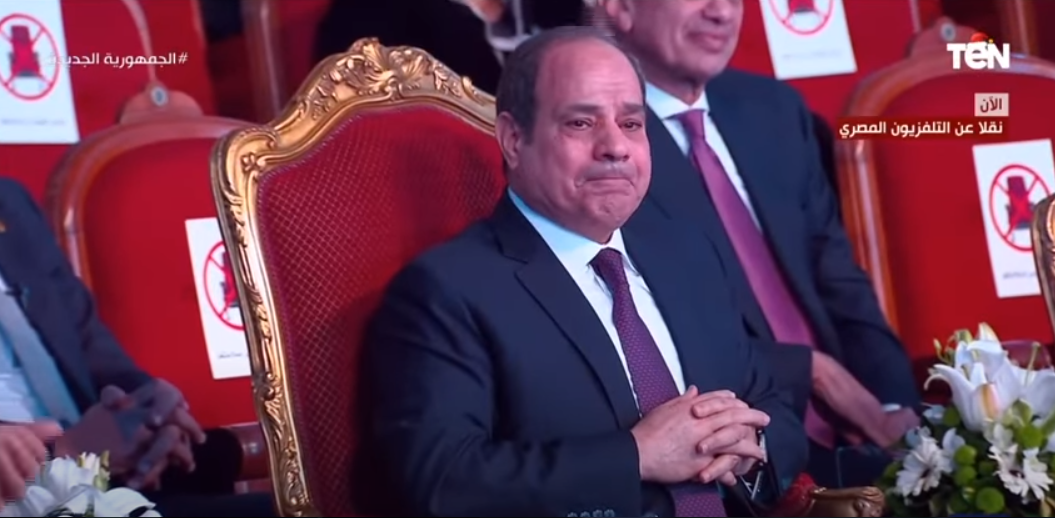
These emotional statements earned him the love of many Egyptians. He was portrayed as the tough but fair patriarch, who expresses his love for his people. Moreover, on more than one occasion, al-Sisi was filmed with tears in his eyes.
One incident stands out: during a 2018 ceremony celebrating national Police Day — which also corresponds with January 25. Al-Sisi was commemorating “the children and the families of the martyrs of the police force” — this is how the state officially refers to officers who died in the line of duty. On this occasion, a young girl came forward to receive her late father’s medal and started crying. Al-Sisi teared up as he hugged her, comforted her and dried her tears to the applause of the crowd.
This is the image of a loving father who is easily moved to tears. Al-Sisi takes great care to show his people that he is kind, empathetic, and vulnerable; a people who, according to him, “never found someone to treat them with tenderness.” This selectively performed grief signals to the nation worthy of the patriarch’s tears that it is also worthy of his wrath.
Excerpted from Counter Revolutionary Egypt: From the Midan to the Neighbourhood, by Dina Wahba, published by Routledge, 2024.