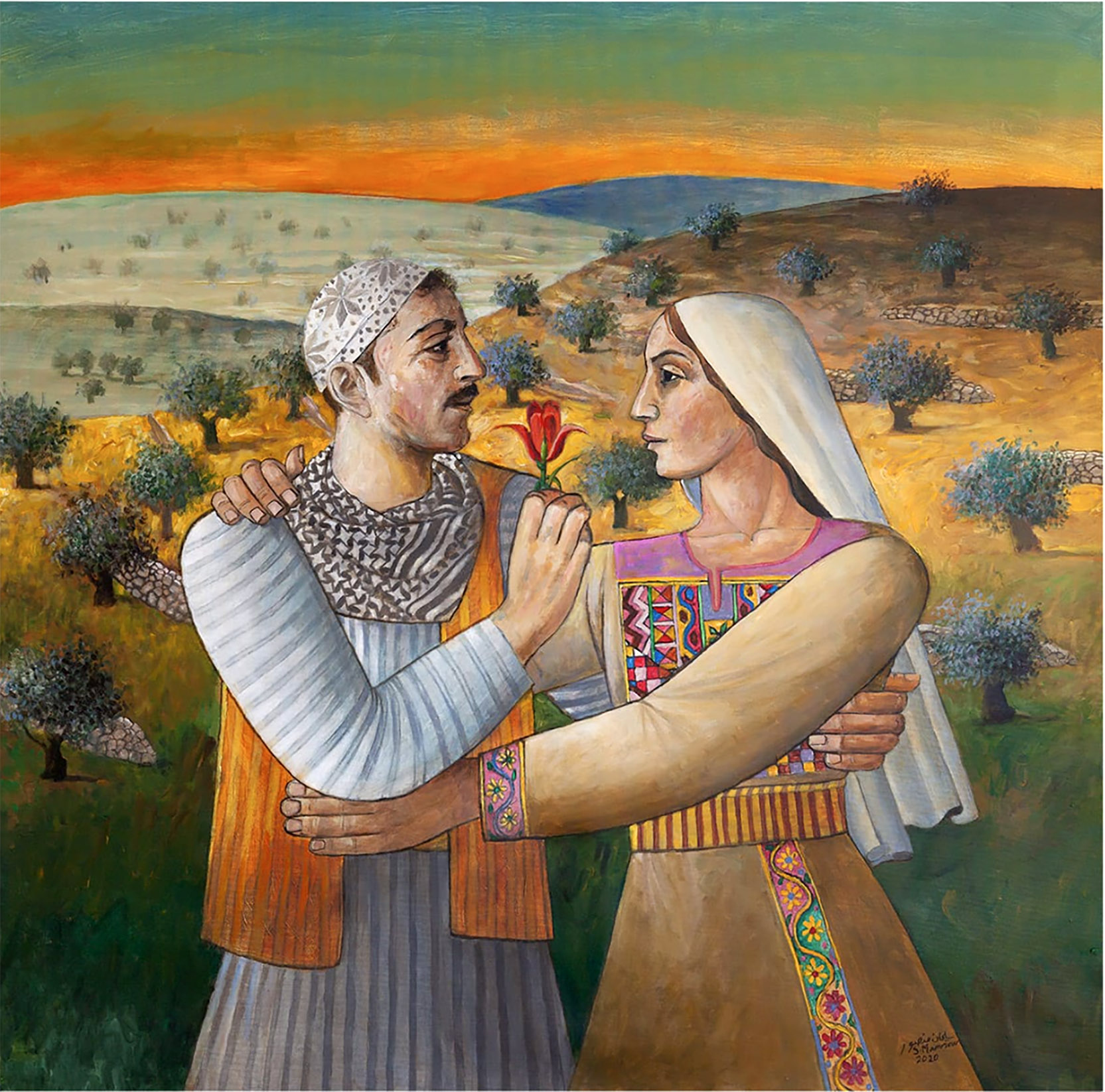
Set in 1948 amid the Nakba, this Arabic-language novel follows a cast of characters from diverse backgrounds, including Armenian refugees, living under occupation and political pressure.
Jerusalem, April 1948
1.
Jerusalem Anemone (Wild Red Poppy)
As Elias Khalil Al-Maqdisi faced his final hour on this Earth, his thoughts were consumed by the rich history of Hanoun Al-Quds restaurant. Like all the city’s residents, he was aware that its original owner, a Palestinian farmer who’d come to Jerusalem from Galilee with his wife, had painstakingly built it from stones sourced from a mountainous quarry, where the fragrant scent of wild thyme infused the very stone itself. However, when the British mandate began, an arrogant, blond general seized control of the establishment and renamed it the Jerusalem Poppy. And now, God alone knew what its new owner, the Polish Zionist who’d bought it from the British after the declaration of the partition, was going to call it.
What angered Elias the most as he sat in the restaurant now was how the recent thief had not only taken over the establishment but had completely stripped it of its identity and soul. The beautifully embroidered Galilean cushions that once graced the plush sofas, intricately made with mother-of-pearl inlays from Akka, had all been replaced with cold, dark wooden benches.
And it hadn’t stopped there. The new owner had exchanged the beloved Palestinian musicians for a Jewish jazz band. Elias longed for the days when he used to hum along to the familiar melodies of Al-Alayi, Al-Awf, Al-Ataba, and Al-Mijana while he puffed away at his narghileh.
Despite Elias’s strong dislike for the changes that had tarnished his family’s treasured memories of Sunday lunches spent in this old restaurant, he reflected on how the settler’s poor taste actually turned out to be in Elias’s favor. Had the sofas not been replaced with these dark, rectangular, coffin-like wooden benches, he would not have been able to hide his bomb inside one of them. Moreover, the lively music from the Jewish band completely drowned out the ticking sound of the bomb, now nestled among at least forty members of the Irgun and Stern gangs, who were celebrating the aftermath of a massacre they had conducted in a small village a few days prior.
Elias’s train of thought was interrupted by the familiar chime of the door swinging open, a movement that struck the bell hanging above the eave. The blond, blue-eyed maître d’, dressed in a crisp white tuxedo and flashing a smile that highlighted his dimples every time he welcomed in a group of the gang members, also took notice. As Elias observed the scene, his gaze shifted to the open glass-fronted door of the restaurant. Outside, he noted a man in his fifties with a dark complexion casually leaning against the wall next to the entrance, eating what looked like a sesame bun. The man adjusted his fedora, which sat atop his shiny, slicked-back hair generously coated in a layer of Vaseline.
Just a few meters away from the man, he clocked a taxi with a driver who looked to be in his forties. The bearded man with black hair wore a silver band on his left hand paired with a small gold ring. While munching on a chocolate bar, he constantly shifted his attention between the side mirrors and the rearview mirror, as though making sure he had a clear view of both the road and the restaurant’s glass façade.
Elias looked at his gold watch, which hung from the elegant suit he’d had made in Majdala.
He had precisely 55 minutes remaining in his life.
The front door chimed again.
A young woman, probably in her late twenties, walked in, wearing a striking red dress that matched the fiery shade of her hair and the rosy glow of her cheeks.
Something caught his attention and he stopped… The ticking of a nearby bomb.
The maître d’ greeted her in Hebrew: “Madame, under what name do we have your reservation?”
“Ms. Ruth Schwartz,” she answered promptly.
“I see that the reservation is for two. Are you waiting for a member of the Irgun or Stern?”
“I have no ties to either. My guest will be here shortly,” she replied.
“I am sorry, Miss, but the restaurant is exclusively booked tonight for members of the Stern and Irgun.”
“Excuse me?”
“Miss, the restaurant is booked…”
“Commander Avraham Linman is the one who made this reservation with the restaurant owner directly. Are you going to show me to my table, or would you prefer to risk your job by continuing to talk back?” she interrupted him sharply.
The maître d’ suddenly broke into a broad smile. To Ruth, he appeared to be little more than a twenty-year-old.
“You’re with Commander Linman, then! My apologies. Please come this way.”
He guided her to the table beside Elias, where she took a seat, her eyes lingering on the maître d’ with a visible expression of annoyance even after he had stepped away to return to his station by the door.
She took a moment to scan the restaurant, her eyes gliding over every corner before finally landing on Elias. She barely acknowledged him, casting only a fleeting glance at his handsome features, her indifference as clear as her observation of the entrance, the exit doors, and the band members. In contrast, he found himself captivated by the allure of her kohl-rimmed blue eyes, the sprinkle of freckles along her delicate features, and the pearl necklace that adorned her slender neck. Realizing he was getting lost in her European allure, he quickly shook off the distraction — now was not the time for distractions.
Elias glanced once more at the restaurant’s glass door. The brown-skinned man in his fifties had polished off his bun and was now focused on lighting his pipe. Meanwhile, the taxi driver was tucking away the last bit of his chocolate bar into the front pocket of his white shirt.
Elias lit a cigarette, wrestling with the temptation to order a drink. His attention, however, was once again pulled toward the red-haired beauty sitting nearby, deeply engrossed in Joseph Conrad’s novella Heart of Darkness. This wasn’t, he noted, a run-of-the-mill edition; it was a personalized gem, with a green leather cover, the title embossed in gold letters, and a blue seal bearing the owner’s name. He had memorized the dedication and noticed that the bottom corner of the last page was dog-eared.
He was finding it impossible to peel his eyes off of her. At last, she looked up and noticed him.
She set the book down on the table in front of her and slid a cigarette into her sleek black holder. As she smoked, she regarded him with an air of steely disapproval, clearly unimpressed by his insolent bravado. The staring contest dragged on in silence until the door chimed once more, prompting them both to turn to inspect the new arrival. It was a stout man, dressed in a navy-blue suit with a red fez atop his head. On his chest sparkled a diamond pin shaped like a pomegranate.
The maître d’ asked about his reservation, and, as he responded, Elias noticed that the man appeared slightly out of breath and flushed, despite the short walk from his car to the entrance of the restaurant.
“Miss Ruth Schwartz,” he replied to the maître d’s’ question.
Something in the way he pronounced her name prompted the maître d’ to switch to Turkish. Just as he was about to guide him to Ruth, the man caught sight of her raising her hand, signaling for him to come over.
Making his way toward her, his eyes drank in her beauty. When he finally stood before her, he greeted her in German, saying, “Ah, Miss Schwartz, at last, we meet. Welcome to Jerusalem!”
He pressed an indulgent, lingering kiss on her outstretched hand before settling into the chair across from her.
“What made you change the date from Saturday to tonight?” he inquired. “Hold on, let me guess — it’s because you don’t have to work on Saturday, right?”
“Did you really figure out I was Jewish just from my name?” she replied.
“Rather, from your nose! That’s the giveaway for you people,” he said.
She chuckled, brushing off his casually racist remark, then stole one last glance at Elias, whose attention darted between her, the activity outside, and his watch.
He had exactly forty-five minutes left to live.
The Turk called the waiter over with an air of arrogance. “Boy, bring me my wine! Allow me to treat you to the finest vintage, Miss Ruth.”
The waiter promptly produced a half-full green bottle, poured two glasses, and then left it on the table before stepping away.
Ruth inhaled the rich aroma of the wine. She turned to the Turk and asked, “Murad Pasha, is this pomegranate wine?”
“Indeed, it’s from my hometown, Mardin. Won’t you try it?”
“Why don’t we first address what we came here for?”
“I laid out everything clearly in our correspondence. Now it’s up to you to propose a fair price for my property, keeping in mind that our deal must remain strictly confidential.”
“Wouldn’t the Sublime Porte prefer that the Jews trade with you in Palestine?”
“I am not selling the property on behalf of the Ottoman Empire; this is a personal matter. I’d like to wrap this up as quickly as possible.”
“Why the rush, Pasha? You’ve owned those lands for decades.”
One of the armed soldiers rose unsteadily and stumbled toward the band. He called out, urging them to play the anthem of the Stern: “Hayalim Almonim! Play Hayalim Almonim!”
The band obliged, and soon nearly everyone was on their feet, dancing and singing the poem that had become the gangs’ anthem and rallying cry. Murad Pasha let out a deep sigh and downed his wine in one gulp before refilling his glass.
“Investing in Palestine is no longer a wise decision. These drunken, armed fools are clear proof of that.”
“What are your plans after selling your property?”
“I will buy more land and real estate in Mardin.”
“What if I’m looking to buy one of your properties in Mardin, not in Jaffa?”
“But your letters mentioned that…”
“What about house number four?” she interjected. “It has five pomegranate trees in the garden, the door is painted a dark red, and it features striking black Forvogue windows. The balcony overlooks Anatolia, doesn’t it?”
“But, that’s my house!”
“But it isn’t yours, Murad Pasha. It’s the home of the Armenian composer Albon Partamian. Don’t you remember Albon, Miriam, and their two daughters?”
For the first time, Elias looked at Ruth, not with anger, but with a sense of dread. She stubbed out her cigarette and adjusted her silk gloves as the Turk flashed a sarcastic smirk.
“Are you related to Albon?” he asked.
“I’m his daughter.”
“Albon only had two daughters: Arin is six feet under, and Kanush is well past her forties. So, tell me, who are you really, young lady?”
“Nairy. The Armenian baby who survived a city where your soldiers were commanded to loot and kill.”
“Why, you’re alive because of me, then! I pardoned Kanush and granted her mercy to walk away with you and her son.”
“Dragging her on a death march was supposed to be an act of mercy? She nursed me on one side while cradling her lifeless son, who had succumbed under the relentless sun of the Syrian desert. Your thugs wouldn’t even let her stop to bury him.”
“And for that, your sister carved up three of my assistants in Munich.”
“Three miscreants for one and a half million Armenian souls butchered by your orders. Wouldn’t you agree that’s a fair exchange, Pasha?”
“You must be part of the Hayk gang then!”
“Damn my luck!” Elias grumbled under his breath as he signaled to the waiter and requested a plate of olives, in Hebrew.
The waiter nodded in acknowledgment and made his way to the kitchen. Meanwhile, the blond maître d’, intrigued by the comment he’d overheard from the handsome gentleman, watched as Elias stood up from his table and walked down the corridor toward the restroom, located near the employees’ back entrance. The maître d’ chose that moment to open the restaurant’s front door to call out to the man smoking his pipe: “Sir, it is forbidden for Arabs to loiter around the restaurant. Move along now.”
The smoker reflected on the remark for a moment before slowly making his way in the direction of the parked taxi, distancing himself from the restaurant as well as from the taxi driver’s view.
When the maître d’ was sure the man had left, he turned and called to his colleague.
“Cover for me, Ira. I’m off for a smoke.”
He weaved his way through the restaurant, passed the restrooms, and slipped through the busy kitchen door. He stepped out the back entrance, locking it behind him with a key. Outside, he found himself in an alleyway, enclosed by stone walls, with garbage bins lined up at the far end — each one a reminder of the restaurant’s nightly cleanup routine. Hidden beneath a pile of refuse in one of the bins, the restaurant’s actual maître d’ lay unconscious, incapacitated by a dose of chloroform. Earlier that evening, Jacir Jacir Jacir Al-Halabi had swiped the maître d’s uniform, disguising himself as a friend brought in to cover for the man, whom, he explained, was battling a severe case of bronchitis.
Jacir lit a cigarette, taking a deep drag before exhaling the smoke toward his clothes, hoping to mask his lie. He strolled down the alley until he found Elias, who was bent over picking up a piece of bread discarded on the ground. With gentle reverence, he kissed it twice and then placed it against the wall, protecting it from any foot that might crush this humble offering of God’s grace.
“It appears that Avraham Linman will not be coming tonight. Should I alter the plan, comrade?” Jacir asked Elias, his words rolling off his tongue in the rich cadence of the Aleppo Nabulsi dialect.
“What were you playing at seating that damned woman beside me?” answered Elias.
“I tried to stop her, but she said she was Avraham’s friend, so I figured she was a soldier, like the rest of them, or at the very least a Zionist.”
“She’s Albon Partamian’s daughter.”
Elias lit a cigarette and took a long drag, his hands trembling slightly. They soon heard footsteps approaching and quickly recognized Ayoub Zahran Al-Menoufy — the man who’d been hanging around at the front.
“I hope you’ve taken a moment out from the mission and risked us being seen together for something urgent!” he said, exhaling a puff of smoke from his pipe.
“There’s a civilian inside,” answered Jacir.
“A Zionist?” asked Ayoub
“Armenian. Kiraz’s niece.”
“What is the Khawaja’s relative doing in this Zionist establishment tonight of all nights? Jacir, wasn’t it your responsibility to check the reservation log? To ensure that all patrons were gang members? You fool,” said Ayoub.
“By God! How could I have ever anticipated that an Armenian woman would introduce herself as a German Jew? Do I come across as some kind of fortune teller?” Jacir exclaimed.
“I swear, anyone who puts their trust in you will end up selling their children!” said Ayoub
“I refuse to take the blame for this. Ever since that God-knows-who Iraqi joined our team, bad luck seems to be haunting us. He even sounds like a cawing crow — if not something even more ominous,” Jacir replied.
He cursed the past, the present, the future, life and death, the Ottomans, the English, the Zionists, and all those who were complicit.
Just then, Jacir’s words were abruptly interrupted by the sound of an engine rumbling as a car turned into the alley. The forty-something taxi driver stepped out of the parked vehicle. He cut a broad, towering figure, as if he were descended from giants. His thick black beard was complemented by a bushy mustache, flecked with strands of gray. Arms crossed tightly across his chest, he joined his three comrades.
Paying him no heed, Jacir continued: “It looks like this mission is set to fail like the others, Iraqi. That makes the fourth mission we’ve messed up this month. So, tell me, how long have you been part of our crew? About a month, right?”
The Iraqi fixed Jacir with a steady gaze, as he carefully contemplated his words. Gradually closing the distance between them, he suddenly grabbed Jacir by the armpits, lifting him toward the fence with surprising ease. Just as Jacir opened his mouth to shout in protest, Ayoub swiftly covered it with his hand to muffle any sound that could draw the attention of diners in the restaurant. With his other hand, he struggled to push the Iraqi away.
“Listen, comrade, it’s all about give and take. This guy isn’t suggesting you’re a traitor,” said Ayoub.
Jacir shoved Ayoub’s hand away from his mouth, his voice dropping to a hushed, incredulous tone as he replied, “Traitor?! Heaven forbid, comrade! I only meant to say you’re a jinx!”
The Iraqi locked eyes with him, his gaze as dark as the night, a spark of anger flickering in his eyes. As he took in Jacir’s words of apology and reassurances of his good intentions, that flame began to dim.
Elias chose not to get involved, letting out a frustrated sigh as he puffed on his cigarette. He glanced at his watch and spoke with a calmness that felt out of place amid the heated argument erupting behind him: “Men, the bomb is set to go off in thirty minutes.”
The Iraqi let go of Jacir, who, once back on his feet, straightened his clothes, wrinkled now as much as his self-esteem. Ayoub muttered about Jacir’s impulsiveness while he helped him smooth out his jacket. Meanwhile, the three stood beside Elias, deep in thought over Elias’ information. Ayoub was just about to share a plan to get the Armenian woman out of the restaurant before the bomb exploded when something caught his attention and he stopped…
The ticking of a nearby bomb.
Although Ayoub would be the first to admit that age had somewhat dulled his senses, his hearing remained as sharp as a bat’s in the dark. He could easily detect the ticking of the bomb timer echoing within their circle. Fighting the urge to shout, Ayoub whispered, “Which one of you fools has strapped themselves with explosives?”
“What do you mean?” Jacir asked, his body tensing with unease. “That was never part of the plan; the whole point was to…”
Before Jacir could finish his sentence, Ayoub’s hands moved quickly over Jacir’s chest and stomach, but found nothing. He repeated the search with the Iraqi, only to come up empty again. When Ayoub turned to Elias, the latter raised his arms, surrendering to the search without any fight. Once more, no dynamite or explosive belt was found.
“Unstrap the dynamite wrapped around your leg,” Ayoub commanded, standing in front of Elias and fixing him with an intense glare.
Jacir and the Iraqi glanced at Elias, and for a brief moment, silence hung in the air as they all heard the ominous ticking sound.
“You would really give up your life for these fuckers, comrade?” asked the Iraqi.
“Rather, for the sake of the four hundred brothers who were treacherously slaughtered in Deir Yassin,” answered Elias.
“We rigged the place because we are a people with a cause and stand for something bigger. But you, on the other hand, are just wearing an explosive belt to settle a personal score. The one you’re after isn’t coming,” said Ayoub.
“Ayoub, do you really think I would blow myself up for that vile low-life?” said Elias.
“Ayoub does not think, Ayoub knows. Take off your belt, Avraham is not coming,” said Ayoub.
“He may be late, but Abed assured us that he would come after…” insisted Elias.
“When? After your belt explodes and deprives your mother of the chance to bury you?” interjected Ayoub.
Elias looked towards the three other men searching for someone to support his position, but their silence was a sure sign of who they sided with. Al-Menoufy opened his fist and extended his hand towards Elias, pinning him with a firm, commanding look.
Elias caved. Sighing, he dropped his lighted cigarette, stomping it as he cursed the past, the present, the future, life and death, the Ottomans, the English, the Zionists, and all those who were complicit. He lifted the leg of his pants to reveal a belt lined with dynamite sticks and a timer secured around his leg. He unstrapped the device and disabled it before depositing the whole thing into Al-Menoufy’s open palm.
“Stash it in the trunk of the car,” Al-Menoufy instructed the Iraqi.
The Iraqi complied, opened the trunk, and placed the dynamite into a burlap sack, making sure the device was securely concealed before placing it beside a rifle and two pistols.
“If I didn’t share your bitterness, I would have made you spit out your teeth as punishment for this reckless move,” said Al-Menoufy. “None of us is permitted to act alone without consulting with all of us first. None is allowed to carry out personal vendettas at the expense of our collective mission. None may put the lives of any one of our comrades in danger. And, more importantly, none of you is allowed to die before me, you bastards. You are the youth I am relying on to one day carry my coffin, cry for me, and hold a funeral worthy of Ayoub Zahran Al-Menoufy. Do I make myself clear?”
The Iraqi nodded in agreement. Jacir gave him a reassuring pat on the shoulder, while Elias, eager to avoid Ayoub’s reproachful gaze, checked his watch and announced: “We’ve got twenty minutes to think of a way to get Kiraz’s relative out of that joint.”
“We could say she’s gotten a phone call from her uncle,” suggested Jacir.
“But that puts Kiraz at risk,” Elias countered.
“What if we knock her out with chloroform?” Ayoub proposed.
“In front of everyone?”
“No, I meant after we get her outside, Elias,” Ayoub clarified.
“And what if she refuses to leave?” asked Elias.
“We’ll just have to force her,” Ayoub replied.
“We don’t know how she’ll react. She’s clearly on a mission for the Hayk, and won’t leave before she’s finished off the Pasha.”
With a weary sigh, Al-Menoufy drew fiercely on his pipe, his eyes fixed on the Iraqi who was pulling out a half-eaten chocolate bar from his shirt pocket.
“Maybe it’s about time we heard your thoughts?” Al-Menoufy addressed the Iraqi.
The Iraqi simply shrugged and remained silent, eating his chocolate bar.
“Well, I have an idea that will save her from the explosion and save us from the gunfire of forty damned individuals,” announced Elias.
***