Select Other Languages Français.
Historically, Palestinian refugees have been treated as an afterthought, or worse, an inevitability.
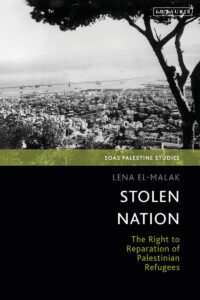
Stolen Nation: The Right to Reparation of Palestinian Refugees, by Lena El-Malak
I.B. Tauris/Bloomsbury December 2024
ISBN 9780755652792
What Restitution?
Between 1948 and 1967, the Palestinian struggle was commonly referred to in the West as “the Arab refugee problem,” as though it were nothing more and nothing less than a question of humanitarian aid and resettlement programs, required for an amorphous group of people in the region. UNWRA was then, as it is now, almost 80 years later, the lifeline of support for around 750,000 Palestinians forcibly displaced by the Nakba of 1948, with 325,000 joining their ranks in the Naksa of 1967.
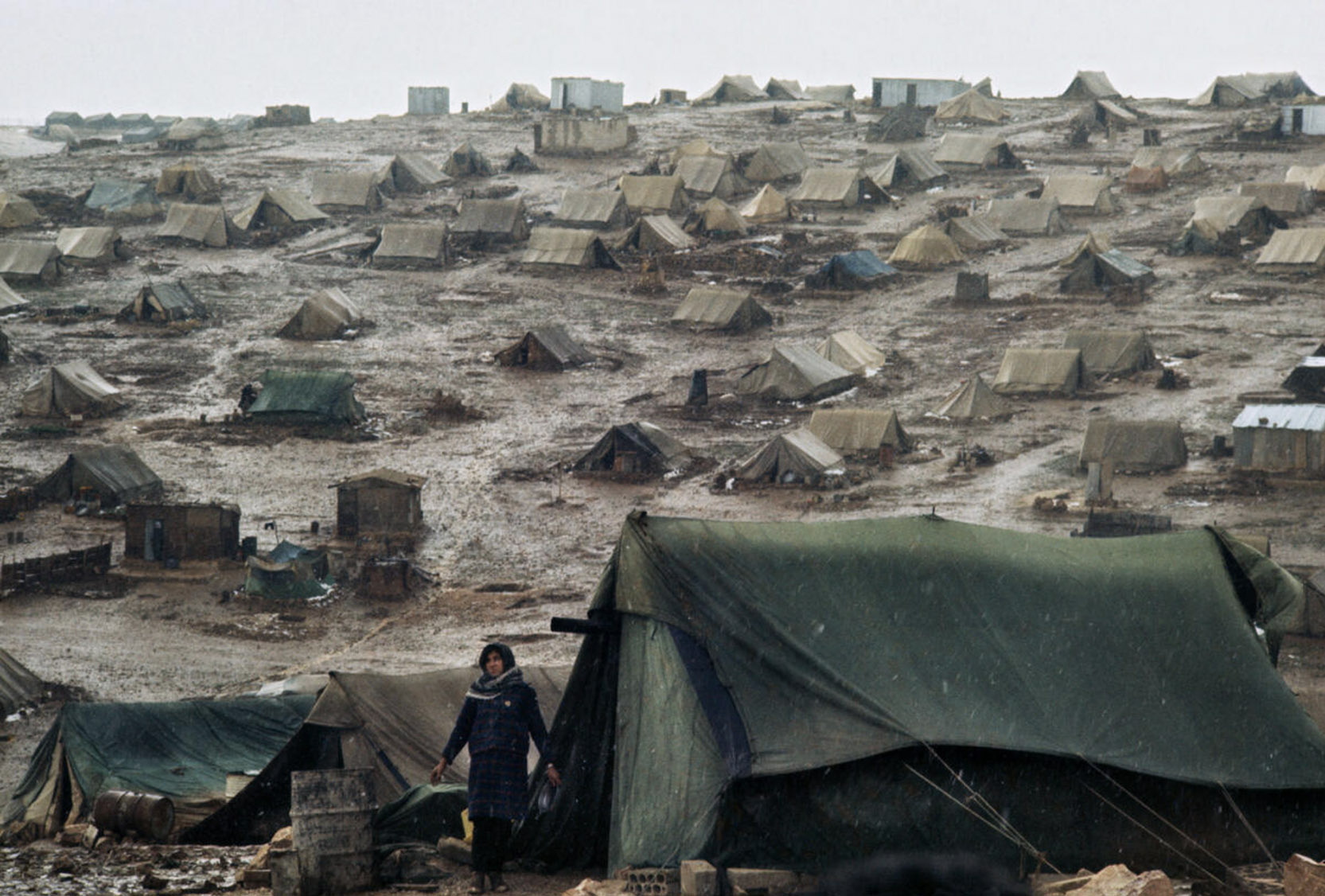
The past 15 years have seen a staggering rise in the number of refugees and forcibly displaced persons globally, with 123.2 million people having been displaced (1 in every 67 people) by the end of 2024, a figure that includes 42.7 million refugees displaced across borders. Back in 2003, Al-Awda, The Palestinian Right to Return Coalition, reported that “one in three refugees worldwide is Palestinian.” This is probably no longer the case, not because the number of Palestinian refugees globally is lower (it is estimated now that there are 5.9 million who are eligible for UNWRA services alone), but because the global picture in general has become mind-blowingly worse.
When it comes to negotiations over Palestine, however, several decades of refugee rights have been shunted aside. During the Oslo peace process, they were relegated to final status negotiations, dealt with pragmatically and then abandoned. While some fine reports and studies were prepared for the negotiations, these never got off the ground. The “issue” of millions of lives, their rights, losses, and aspirations have been kicked into the long grass. The cramped and insalubrious conditions in the 58 camps in the West Bank, Gaza Strip, and neighboring Arab states, where nearly six million Palestinians eke out a precarious existence, have deteriorated year by year. The vulnerability of Palestinian refugees is as pronounced as the intransigence in resolving their fate.
Violence and sieges have led to mass displacement at Nahr el Bared in northern Lebanon in 2007 (home to 31,000 refugees), as have massacres in Yarmouk camp in Syria in 2015 (home to 18,000), and recent killings in Ein el Helwah camp in southern Lebanon, where many residents of Nahr el Bared had already been displaced in 2007. This is without even mentioning the decimation of camps (Jenin, Tulkarem, Nablus) in the West Bank since 2023 and the genocide in Gaza, where 66% of the population are refugees.
Resettlement, or “tawteen” in Arabic, became a dirty word, as it was construed as a negation of a right of return.
In its most recent report of July 2025, UNWRA detailed the “devastating Israeli response” following October 7, 2023, “and resulting humanitarian catastrophe” in which “at least 315 UNWRA personnel have been killed in Gaza and over 300 installations have been damaged or destroyed.” The report goes on to list additional Israeli measures to throttle the agency: the closure of the East Jerusalem office, the imposition of a “no-contact” policy, the exclusion of staff, and obstruction of aid delivery. The current funding crisis is of a radically different magnitude, following the suspension or reduction of funding by several key donors, the report continues soberly. What is being described here is a liquidation policy, not just of an agency, but of the people who have no option but to be dependent upon it. As I write, US plans for Gaza are cutting UNWRA out of humanitarian relief proposals for the Strip.
Historically, solutions for Palestinian refugees have fallen into two main camps: return or resettlement. Both options have met with considerable political intransigence. While Israel has rejected the idea of return outright, the states where most of the refugee camps are based have, in the main, prohibited resettlement. Resettlement, or “tawteen” in Arabic, became a dirty word, as it was construed as a negation of a right of return. The Arab League took a stand in the 1950s, declaring that Palestinians have both the aspiration and the right to return to their land, thus giving Arab host states an ideological basis for not naturalizing Palestinians. The idea was to keep their political identity distinct while at the same time affording them economic and social rights in their Arab host countries. And yet most states have frequently fallen short of honoring the latter part of this commitment. Jordan alone chose to grant nationality to most of the Palestinians living within its borders.
Against this background, Lena El-Malak’s Stolen Nation is a refreshing, robust, and comprehensive examination of one neglected and frequently misunderstood aspect of the Palestinian refugee “question”: that of reparations. The book builds, in part, on Sami Hadawi’s 1988 work, Palestinian Rights and Losses in 1948, as well as Salman Abu Sitta’s various works mapping the possibility of return. El-Malak uses Atif Kubursi’s valuation of Palestinian material losses, which he put at US $22.5 billion in 2000. Raja Shehadeh’s seminal studies of Israeli laws that affect land expropriation in Palestine are also drawn from in the earlier chapters.
El-Malak, a technology and data privacy attorney in London, is also an expert in public international law and refugee law. She clearly delineates the focus of her research in the introduction. Only refugees from 1948 are to be considered and the questions are set out as follows:
How did Israel proceed to expropriate property belonging to 1948 Palestinian refugees? What are the legal grounds for the Palestinian refugees’ right to reparation for loss of, or damage to, property? Which legal avenues can be used by these refugees, or their legitimate representative, the observer State of Palestine, to invoke the right to reparation? What are the forms of reparation available under international law, and what are the legal obstacles to the enforcement of a right to reparation? And finally: How have Israeli-Palestinian negotiations addressed the issue of Palestinian refugee property claims?
The two main forms of reparation for property losses are restitution and compensation, with restitution being the preferred option under international law. Compensation “can only be considered an alternative to restitution if the refugees voluntarily choose compensation over restitution or when restitution is ‘factually impossible,’” writes El-Malak. And yet, she goes on to argue that “Israel’s resistance to implement return-based restitution, and the international community’s unwillingness to support restitution rights do not automatically make compensation an acceptable alternative to property restitution.”
The right to restitution goes beyond the original property owner and is passed on to their descendants. El-Malak refers here to the UN High Commissioner for Refugees (UNHCR) Pinheiro Principles, which urge states to include in their property laws all claimants legally entitled to the restitution of their housing, land, and property, including subsidiary claimants, such as “resident family members at the time of displacement, spouses, domestic partners, dependents, legal heirs, and others.” Examples as to when these principles have been applied include Bosnia, Kosovo, and South Africa. As for how reparations mechanisms might be used, El-Malak points out that mass claims tribunals offer the best venue for resolving Palestinian refugees’ property claims. The chapters of the book that focus on the implementation of property restitution, and the possibilities and challenges, and that provide various levers available to claimants, including potential lawsuits, are informative and serve as a basis for further research.
The legal obstacles are not insurmountable, says El-Malak, but it is the “political and ideological obstacles to return-based restitution that are much harder to overcome, particularly as Israel’s settler ideology continues to be one of territorial expansion and transfer.” Setting a precedent in eroding the Palestinian right to restitution risks compromising the rights of other dispossessed communities. Conversely, the provision of reparations can act as a deterrent to further injustice globally.
There are many admirable aspects of this densely researched book, not simply that the subject alone embodies an optimism of the will, given that it was published in the midst of the Gaza genocide. El-Malak untangles the Israeli government’s approach to the Nakba and expulsions of 1948, which are complicated to say the least. Israeli officials both deny and celebrate the Nakba at the same time, often using it as a threat of more to come, saying that they will have to “finish off the job.” Recently, international legal scholar Rabae Eghbariah argued that the ongoing Nakba provides a legal framework for Palestinian self-determination. Eghbariah insists on returning to the roots of the issue, pointing out that while 1948 may be receding temporally, it is more relevant now than ever. Lena El-Malak seems to agree. By contrast, the recent UNWRA report of July 2025 omits any mention of 1948, pointing not only to the scale of the divide between even sympathetic UN agencies and Palestinian claims, but also to the chasm between Palestinian legal aspirations and the overt hostility of the US government, which has openly pitted itself against the UN generally and UNWRA specifically.
Reparations should form a critical part of the Palestinian fight for international recognition, self-determination, justice, and liberation, which in turn means reinforcing the idea of the Nakba as the original wrong that needs to be righted. El-Malak’s book — to date the most comprehensive contemporary study of the subject — argues that even if international law prefers restitution over compensation as a reparation for property losses, the political refusal to allow for restitution, “does not automatically make compensation an acceptable alternative.” And “this is particularly true when the displacement and dispossession of refugees were part of a wider campaign of ethnic cleaning.” In those situations, she writes, “every effort to secure return-based restitution and reverse ethnic cleaning must be exhaustively exercised before pursuing any subsequent efforts which may rely on compensation based durable solutions to displacement.”
At a time when there is little evidence of any political will to find a solution that includes the Palestinians as equal partners in the search, many readers may question the relevance of international law at all. El-Malak anticipates this hesitation. “One of the aims of this book,” she writes, “is to draw international law into a realpolitik negotiation framework on the rights of Palestinian refugees, though international law and politics are inevitably intertwined. This is not to argue that international law is the magic formula that will bring about liberation. In fact, there is a lot of skepticism on the role of international law and valid criticism of the way in which it is used as a tool for the oppressor. It is, however, a tool that needs to be deployed more effectively, and it cannot be marginalized in the context of ‘peace’ negotiations, if and when these resume under the pretext of political realism.”
Stolen Nation deserves a wide audience, not just for those concerned with Palestine and dispossessed communities, but also for non-legal readers seeking inspiration for new routes for developing justice mechanisms in an increasingly violent and racist world. It is written with a succinctness and clarity that belies the extensive sources utilized to reach its conclusions. Restitution, El-Malak argues, is a claim that should be made, evidenced, and argued for. As El-Malak sets out, the erosion of these rights for Palestinians will have far broader consequences for global order as enshrined by international law. Which makes Palestinian rights an issue of fundamental importance throughout the world.
Select Other Languages Français.