This award-winning novel is more than just a gripping story — it performs a literary excavation of history and myth in contemporary Palestine.
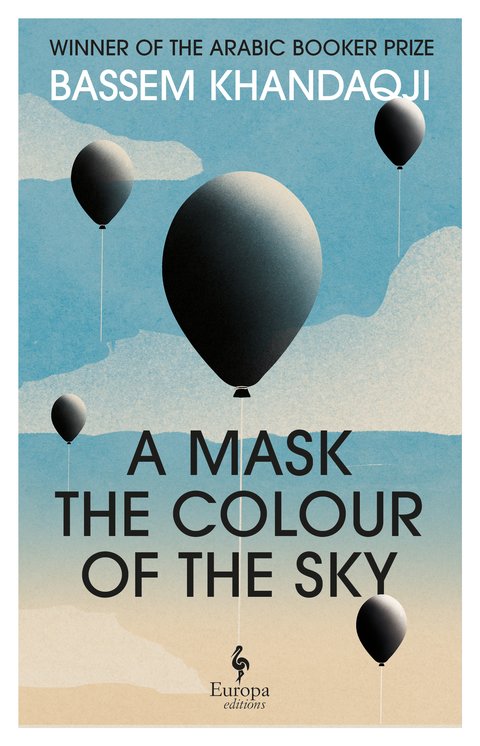
A Mask the Colour of the Sky, a novel by Bassem Khandaqji, translated by Addie Leak
Europa Editions 2026
ISBN 9781787706330
——–
In April 2024, Bassem Khandaqji discovered he had won the International Prize for Arabic Fiction when he was abruptly summoned for interrogation, beaten, and thrown into solitary confinement. He was, at the time, serving out a life sentence (although he has since been released, after twenty-one years of incarceration, as part of a prisoner exchange deal in 2025).
Written entirely from within the confines of Israel’s high-security Gilboa Prison, A Mask the Colour of the Sky performs a literary excavation of the Palestinian past that writes against the logic of erasure at the heart of the Israeli state. The novel revolves around Nur, an archaeology graduate from a refugee camp in Ramallah, who commits identity fraud to uncover the “true story” of Mary Magdalene. The quest to uncover this truth, which has been marginalized and obscured within mainstream Christian theology for centuries, provides a conduit for critiquing Israel’s erasure of Palestinian history, via the weaponization of archaeology, which is aimed at bolstering the Zionist “myth of origins.” Though set in 2021, against the backdrop of Israel’s Supreme Court rule to evict six Palestinian families from Sheikh Jarrah in East Jerusalem, the ghostly presence of the 1948 Nakba casts an ominous shadow over the novel. Traces of this event, alongside other pivotal moments in Palestinian history, including the 1987-1993 “War of the Stones,” are scattered throughout the novel to preserve Palestinian collective memory and keep the resistance alive.
This speaks to the popular Palestinian concept of ṣumūd, which is about persistence, insistence, and survival against the odds.
As a Palestinian living in the West Bank’s “Area A,” Nur cannot access the ancient sites around Jerusalem that hold valuable information for his research. His only experience of the “inside” has been through illegal entry as a laborer for Israeli companies, and various other service roles — an ordeal that many Palestinians from the West Bank are forced to endure as a result of the occupation’s economic strangulation. Khandaqji highlights this predicament, which some criticize as collaboration with the enemy, through Nur, who has no other option when it comes to funding his education. He must choose between temporary negotiation with the occupation and a life of poverty like his father, Mahdi. At one time a freedom fighter, Mahdi is arrested and then released from prison in the wake of the Oslo Accords, and ends up selling ahwa and shai from a rusty old cart in the camp.
One of the novel’s strengths is how attuned Khandaqji is to the “tango” between negotiation and resistance, whereby Nur plays the system to his advantage while seeming to abide by its logic. For example, as a tour guide in the Old City — a job he can get away with despite not having a permit, due to his Ashkenazi looks — he takes a group of American visitors on a propagandistic excursion to “Tzora Forest,” only to change the Zionist script midway through by reverting to the forest’s indigenous name, Sar’a, and detailing how it was destroyed. Khandaqji frames negotiation not as a form of selling out, but as a strategy for outsmarting the occupier and living as freely as he can in a situation where the basic requirements for a dignified human life have been stripped away. This speaks to the popular Palestinian concept of ṣumūd, which is about persistence, insistence, and survival against the odds.
Nur’s fortune changes when he finds a misplaced Israeli identity card in a secondhand jacket at a flea market in Jaffa, presenting an ideal opportunity for subterfuge. Trapped in the suffocating environment of the refugee camp’s tight alleys and Mahdi’s oppressive silence — a consequence of his wife’s death and the defeat of his revolutionary ideals — Nur decides to escape. His blond hair and blue eyes facilitate his transition into Or Shapira, the Ashkenazi owner of the ID, which radically alters his life: where he can go, who he interacts with, and how he is perceived. Though seamless on the surface, this transition demonstrates the arbitrariness of Zionist discrimination, whereby one’s appearance — regardless of actual ethnicity or religious beliefs — dictates their chances of survival and the way they navigate the space around them. Or’s mask is a double-edged sword. On the one hand, it allows Nur to be “totally at ease,” providing (the illusion of) safety and “invulnerability,” as he slips “into the depths of the colonial world.” On the other hand, whilst wearing it, Nur feels “hunted, afraid, weak, confused and full of contradictions.” These emotions are explored through the imagined dialogues between Nur and Or, which push against the boundaries between the two identities, at times threatening to dissolve them. After a day of impersonating Or, alone in his room, he wonders, “Whose shadow was trembling now — Nur’s or Or’s?”
Khandaqji’s mask trope engages with Frantz Fanon’s theory, developed in Black Skin, White Masks, that the colonized subject is forced to adopt a white persona or “mask” to survive in a society that deems Blackness inferior. Khandaqji applies this to the context of Israeli settler-colonialism to probe the power dimensions between colonizer and colonized under Israeli apartheid. Nur’s feeling of “success” at passing as an Israeli and reaping the rewards — namely freedom of movement, recognition, and humanization — produces in him a feeling of unease and inferiority, since it is only through imitating the colonizer that he is treated with respect. While the direct references to Fanon in Nur’s letters to his incarcerated friend Murad (another vehicle for exploring Nur’s inner thoughts) are heavy-handed, and there are moments where Khandaqji does a little too much hand-holding (like when he asks: “If I were Nur, would he have left me alone here, with no supervision, no guards?”), the overall framing is effective. It allows Khandaqji to imagine a sustained dialogue between an Israeli and a Palestinian in the occupied lands (something impossible in the current political climate), while delving into the internal fissures in Nur’s identity that stem from Israeli settler-colonialism, which has transformed him into an outsider within his native home.
The land itself also testifies to Palestinian life before the Nakba.
These imagined conversations resemble a major aspect of Ghassan Kanafani’s notion of resistance literature: a dialogue with one’s opposite. Kanafani argued that a knowledge of Zionist literature, which played a fundamental role in shaping Israeli consciousness in Israel’s formative years, was vital in resisting colonial oppression, especially cultural erasure. It is through Nur’s dialogue with Or that Khandaqji outlines, then deconstructs, the Zionist narrative. These moments occur most prominently in Part III, set in Tel Megiddo, where Nur (or rather Or) is hired for an archaeological dig. Khandaqji deliberately sets his story in Tel Megiddo because, according to the Book of Revelation (16:16), this is where “the final battle between the forces of good and evil, the Battle of Armageddon” will take place. The site thus becomes a stage for the contest over the historical narrative, which is a matter of legitimacy that can be used to either justify or discredit the existence of the State of Israel. For example, when Or refers to Al-Lajjun as “Kibbutz Megiddo,” Nur says “No, Al-Lajjun — it’s a whole village buried under your feet. My god, you guys are masters at cleaning crime scenes, aren’t you? Just throw a little green on it, some trees,” bringing forth the buried violence beneath Israeli tourist sites like Tzora Forest (grown atop the depopulated ruins of Sar’a), which are built to de-Palestinianize the space and prevent its memorialization.
Nur continues to document the Palestinian history of Al-Lajjun in a voice note to himself: another device in the novel that Khandaqji uses to track Nur’s historical discoveries on Mary Magdalene. His encyclopedic record charts the district, population, and settlements before and after 1948, in addition to its precise geographical location and changing governance over time — from the Crusaders to the present. He notes that it was destroyed in 1948 because “it was the base for the Arab Liberation Army’s attack on the settlement of Mishmar HaEmek, just five kilometers north of the village,” and that the counterattack led to the murder and displacement of the entire population of Al-Lajjun. Khandaqji thus commemorates the Palestinian history of resistance in the area, negating the condescending view that Palestinians were led like lambs to the slaughter during the Nakba, at the same time highlighting the violent forces that suppressed the resistance and erased all traces of its existence.
The land itself also testifies to Palestinian life before the Nakba. For example, a Belgian archaeologist contradicts the propagandist spiel of Natan, the kibbutz security guard, when she raises doubt about the veracity of his story. She asks, “What about these stones, Mr. Natan? They look like the remains of houses, don’t you think?” When Natan dismisses these stones as “ancient ruins,” sarcastically asking “Have you forgotten you are in the land of the Torah and the Old Testament?” she replies: “Have you forgotten I’m an archaeologist? I can tell whether these stones are Biblical or the ruins of an Arab village.”
Contrary to the blurb’s claim, the novel is not about Nur’s “insight into the lives of those he’s been taught to perceive as enemies,” or in other words, Palestinians learning how to re-humanize their occupier. While Khandaqji refrains from casting his Israeli characters as evil monsters, Nur’s insider/outsider perspective exposes the logic of racism that underpins their views and interactions with Palestinians. As an Israeli, he gains access to a world where, for once, he holds the keys. Yet, however tempting this transgression might seem, Nur knows that liberation cannot be secured by imitating, or rather becoming, the oppressor. Khandaqji’s foray into the Israeli psyche is a vehicle for developing his counter-historical narrative, which insists upon Palestinians’ “permission to narrate.” As Nur writes, “Scheherazade, Murad. Narration is life […] The story’s the Holy Grail … and I will tell it, my friend.”

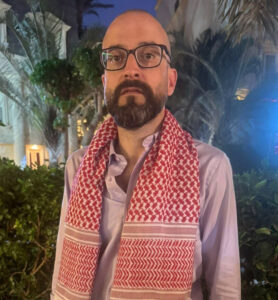
Bassem Khandaqji is a Palestinian novelist and poet born in Nablus in 1983. He spent twenty-one years in an Israeli prison, where he produced several creative works dealing primarily with themes of Palestinian history, memory, and resistance, shaped by the politics of incarceration. His novel A Mask the Colour of the Sky, written entirely in prison, won the International Prize for Arabic Fiction. Here he is seen in a photo taken at his hotel in Cairo on Oct. 17, 2025, just days after Israel freed him and other Palestinian prisoners in the Gaza ceasefire deal (courtesy NPR).