Select Other Languages Français.
In a world of vexing paradoxes and thundering invocations of end times, could this in the fact be the end, if only of one saga among many?
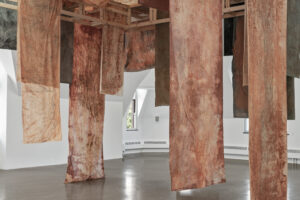
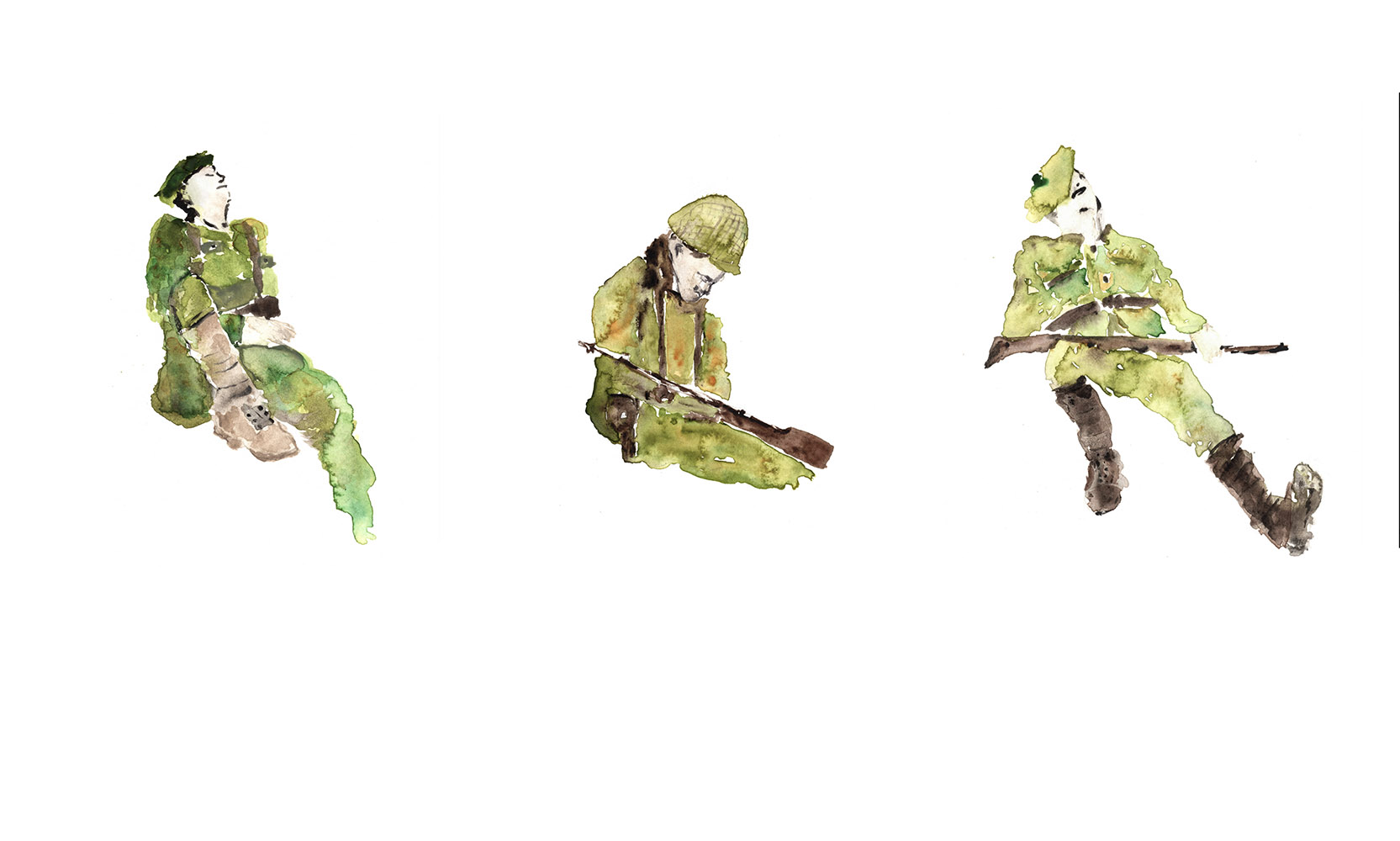
You’re looking at three works from “To Save What Can Be Saved” by Ali Cherri, the renowned Lebanese French artist. Cherri recently filed suit against Israel in the Paris Judicial Court’s Specialized Unit for Crimes against Humanity and War Crimes. On November 26, 2024, the Israeli army struck the apartment of Cherri’s parents in Barbour, Beirut, apparently mistaking it for the home of a Hezbollah official with the same last name. His parents and their housekeeper were killed in the strike, which occurred only hours before the ceasefire between Israel and Hezbollah took effect.
The watercolors adorn one of the walls of my sister’s house. I chose them for my column because they capture our eternal dilemma as we move helplessly from one war to another.
The Israelis must feel very proud. By any measure, their state has amassed an extraordinary tally of destruction across a region encompassing close to 130 million people. I am thinking only of the present moment, the last three years, and of those societies that have directly borne Israel’s fury: Gaza, the West Bank, East Jerusalem, Lebanon, Syria, and Iran. In Occupied Palestinian Territories, southern Syria, and southern Lebanon, Israel can also boast of its “defensive” conquests, or attempts thereof. I say attempts because it struggles still to capture the Lebanese south it has targeted for occupation.
Israel’s Ledger of Destruction
Defensive conquest is my coinage. True, it is an oxymoron, but Israel has always had a unique talent for normalizing oxymorons — Jewish democracy, for example. So I simply bow to the obvious: for special countries, special exceptions, and special terms. Admittedly, this privileged status is not Israel’s handiwork alone. In fact, the West can claim much of the credit for manufacturing the international consensus that sustains it. But to the intrepid Jewish state goes the glory for strategically harnessing this acquiescence into a standing writ of violence in the name of survival.
From this vantage point, all Israel’s wars could only be defensive. How else can a state’s army defend its conquests and settlements against those conquered, occupied, or evicted, if not by further conquest and subjugation? We have heard Zionist and Israeli leaders echo it through the ages: if only the native would submit, then this endless bloodletting would not be necessary.
This is political Zionism’s rationale distilled to its doctrinal essence. It was therefore inevitable that what applied in Palestine would also apply in the Levant and beyond. Zionist ambition, left to its own imperatives, became a trap for its children, a self-fulfilling prophecy: dominion or annihilation. In this dark universe of false dichotomies, the stakes are existential — it is do or die, kill or be killed. But would that they were trapped alone. We have been ensnared in this mental cage, with roles designated and the script carved in stone on landscapes that refuse to be tamed. The civilized and the barbarian, the heroic warrior and the fanatic, the returning native and the squatter, the Jew in the lone bastion of enlightenment heroically fending off the savage Muslim hordes at the gate.
There is something so utterly twisted about this logic. But for the longest time, it struck all the right civilizational notes embedded in the western colonial mindset — a mindset that, well into the twentieth century, looked upon the Jew in Europe with the same chauvinism it reserved for us in the brown colonies. That the West found common cause with the Israeli Jew in the East even as it harbored antisemitic sentiments on the home front is no less mean an irony than Israel fashioning itself as the western crusader in the East even as it bemoaned the West’s atavistic antisemitism on those shores.
Such vexing paradoxes, though, could easily be ignored. They were the details typically lost in epochal scripts. But as with all tightly wound constructs, Israel’s could not continue to rise to the demands of its own perfection. As Jacqueline Rose wrote in The Question of Zion, “The story of Zionism is too coherent, too seamless, too perfect to be true. Like all such narratives, it has to ward off what it cannot accommodate.” Alas, it also has to withstand time and the messy facts that will not yield.
Facts like the genocide you boastfully broadcast, the apartheid system you erect in the territories you occupy, the ethnic cleansing you carry out against their inhabitants, the pogroms your settlers commit weekly against them, the torture you gleefully inflict on their prisoners, the detainee rapes you celebrate, the capital punishment you codify only for them, the illiterate zealots you choose as ministers. When you stand proudly on this register of run-of-the-mill brutality and war crimes, it is hard to juxtapose yourself favorably against your enemies, let alone draw from so sullied a storyline a lofty war cry.
In mystified disbelief, we find ourselves listening to Israeli and American leaders invoking Armageddon, end-of-time combat, the Crusades, bombing the “bastards” into the Stone Age…
As I watch, truly bemused and aghast at the absurdities that suffuse today’s untold battles, I cannot but wonder: Is this how primeval sagas unspool in modern times? Are we witnessing ours finally breathing its last?
There was always something distinctly outlandish about Israel’s pretensions. Such a small country with such outsize expectations of itself and of the world that indulges it; such a wild belief in its exceptionalism and contempt for the people in whose midst it insisted on setting up house and then forever expanding. It wants its enemies’ total surrender and subservience, its tribe’s and friends’ political obedience, and all of this without regard for internal cost or external consequence.
Woe to those who have such little heed for history’s humbling lessons. Woe to us caught in their grip.
On Another Note
Many of us are intimately familiar with Palfest, the Palestine Festival of Literature, established in 2008 to bring together Palestinian and international writers in Palestine. Palfest has just launched The Key. Of course, I subscribed.
From it, I share Nasser Rabah’s poem “The Cage,” translated by Wiam Tamimi:
Open up this huge cage —
Open it, just a crack —
Let the children escape this trap
that life has laid —
Let them savor, for the first time,
the smell of electricity;
touch, with thin fingers,
the cinema’s shivering thrill;
ask with worried voices
what time the train will come in.
Let them meet themselves
outside these waking dreams —
step, for once in their lives, onto
a crosswalk; test their feet out
on the asphalt.
Open up this huge cage —
So that birds will understand the value of wings,
will know there are other languages to sing,
and endings more beautiful
than the ambulance.
That wayfaring is more blue
than the sea, and ports,
like love, are glittering green.
Leave this place.
Let your parents guard your absence.
Leave the roots in the darkness of the soil
so the flowers can reach up towards the sun.
Climb onto our shoulders, clamber out of the rubble
so you can see what we have never seen
and know what we have never known:
That cages are a crime,
and we are innocent.
Open up this huge cage!
Open it — blow it up —
Let the young ones out of here
To knead their dreams with the waters of astonishment;
To send their desires through the mail of experience;
To grow up away
from time’s torn limbs.
Let them scatter temptation, like candy,
in their loved ones’ palms:
tell us how they’ve dragged the ship
to the mountaintop by its horns!
We’ll let them lie, to sweeten this evening a little;
we’ll believe them, and ask about April’s fools.
They’ll be back, in any case, in a year of two —
they won’t be late, we’re sure —
nobody would miss their parents’ funeral.
In The Markaz Review, Nasser Rabah talks about his poetry in Arabic and presents two poems in the original with English translations, “Distorted Dreams” and “Meditations.”
Amal Ghandour’s biweekly column, “This Arab Life,” appears in The Markaz Review every other Friday, as well as in her Substack, and is syndicated in Arabic in Al Quds Al Arabi.
Opinions published in The Markaz Review reflect the perspective of their authors and do not necessarily represent TMR.
Select Other Languages Français.