Mona Hatoum has always framed the social and political experience of being Palestinian not as a singular event or period in time, but as an ongoing process of domination and subjugation of the body in space.
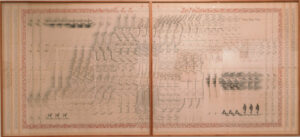
Decades ago, in a small notebook, Palestinian artist Mona Hatoum made a drawing of Swiss artist Alberto Giacometti’s work “The Cage” (1950-1951), which she had seen at a 1996 exhibition of his work at Kunsthalle Wien. The architectural device of the cage, a recurrent motif in Hatoum’s own work, was one of Giacometti’s central themes from the 1930s onwards, but it became more dominant during the period of World War II and the decade that followed. Cages and frames functioned in Giacometti’s oeuvre both symbolically and psychologically as a space of enclosure and confinement. One of the most prominent modern sculptors of the twentieth century, Giacometti is best-known for his tall and slender human figurines, partly inspired by prehistoric art but also conveying the hardship and alienation of the war years.
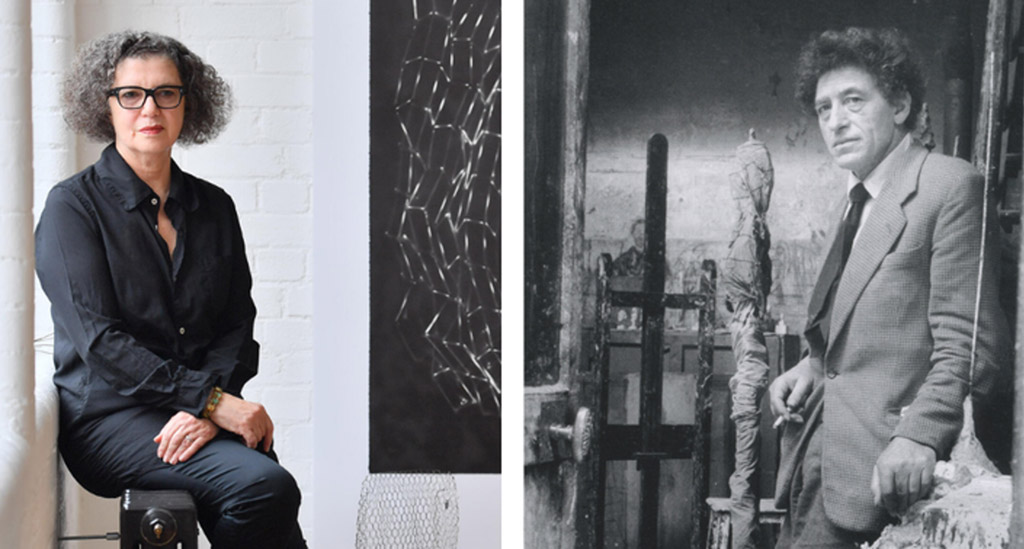
The recent exhibition “Encounters: Giacometti,” at the Barbican Art Gallery in London, features a dialogue between Mona Hatoum’s decades of artistic practice — reflecting on themes of displacement, confinement, surveillance, and the tension between the personal and the political — and Giacometti’s body of work, with its existential themes of isolation and fragility. While visiting the Giacometti Foundation in France, Hatoum selected another cage work of Giacometti for the show, the first version of “The Nose” (1950-1951): an irregularly modeled decapitated head, suspended at mid-height by a thread within the cage, with a long protruding nose that defies the enclosure, extending beyond the structure. Although in appearance humorous, the nose was inspired by a traumatic experience, witnessing the death of archivist Pieter van Meurs in 1921.
Hatoum had an unorthodox idea for an intervention — she wanted to remove the severed head from its cage, and hang it inside one of her most widely exhibited works, “Cube” (2006), which is constructed from interlaced wrought iron and uses an ancient technique for barring the windows of medieval buildings. Unlike Giacometti’s open-frame, Hatoum’s cage containing the head is a conceptually infinite structure without entrance or exit. When joined, Giacometti’s likeness of van Meurs’ carnivalesque death mask and Hatoum’s iron grids bring out a very contemporary experience of despair: never-ending cycles of witnessing death, and the structural conditions of oppression, abuse, and confinement. It is impossible here not to conjure up the real-life experiences of the Palestinian diaspora, torn between the grotesque spectacle of genocide in Gaza and the rapid shrinking of civil and personal freedoms everywhere.
For Hatoum, the most important Giacometti sculpture that she included in the Barbican show was an early Surrealist piece, the terrifying work “Woman with Her Throat Cut” (1932): a disemboweled body, opened up like a dissection model and laid on the ground, carrying the visual memory of a brutal assault. This work is juxtaposed with two of her own works. First, “Untitled (meat grinder)” (2005), a bronze cast of a kitchen utensil that the artist regarded with dread as a child, used to mince meat, which to Hatoum resembled human flesh. The artist has always avoided representing atrocities, because we are constantly assaulted by images of horror in our everyday lives, and instead, chooses to formulate suggestions through which the audience can bring about their own narratives and interpretations.
The second juxtaposed work is “Incommunicado” (1993), a sculpture in which the springs of a children’s cot are replaced with taut cheese wire, transforming a symbol of care and domestic protection into a hostile object, pregnant with potential danger and violence. The sculpture was completed more than twenty years ago, and first shown at the Centre Pompidou in Paris in 1994, but seeing it exhibited today alongside Giacometti’s sculpture of a dismembered body, one is haunted by the images of the more than 20,000 children murdered by Israel. Not unlike Hatoum, Giacometti’s work was deeply informed by the atrocities of war. During the German occupation, late in 1941, he fled Paris for Geneva, having abandoned Surrealism a decade earlier to focus on the human figure, which later came to embody the consciousness of the post-war era, having witnessed unspeakable horrors.
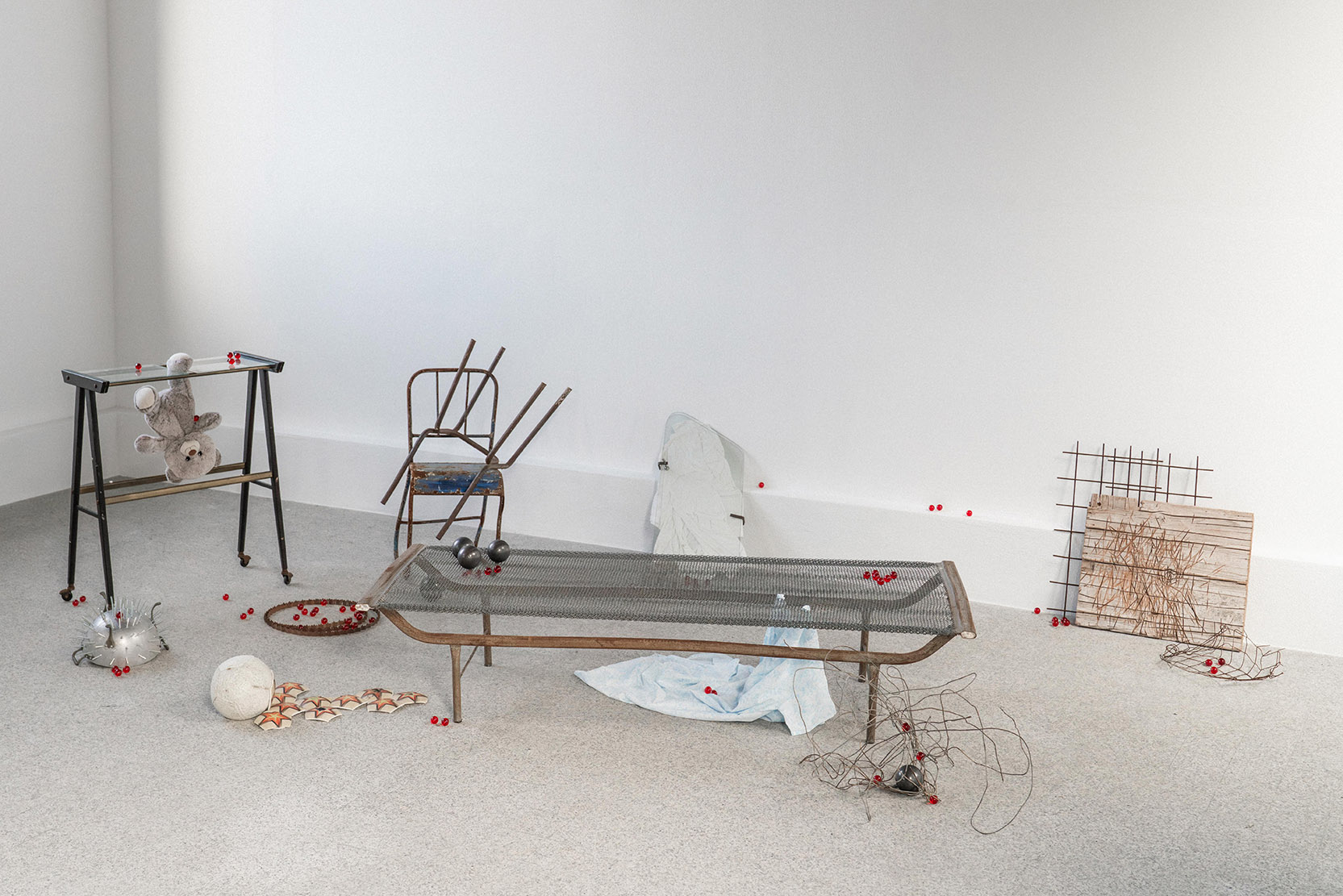
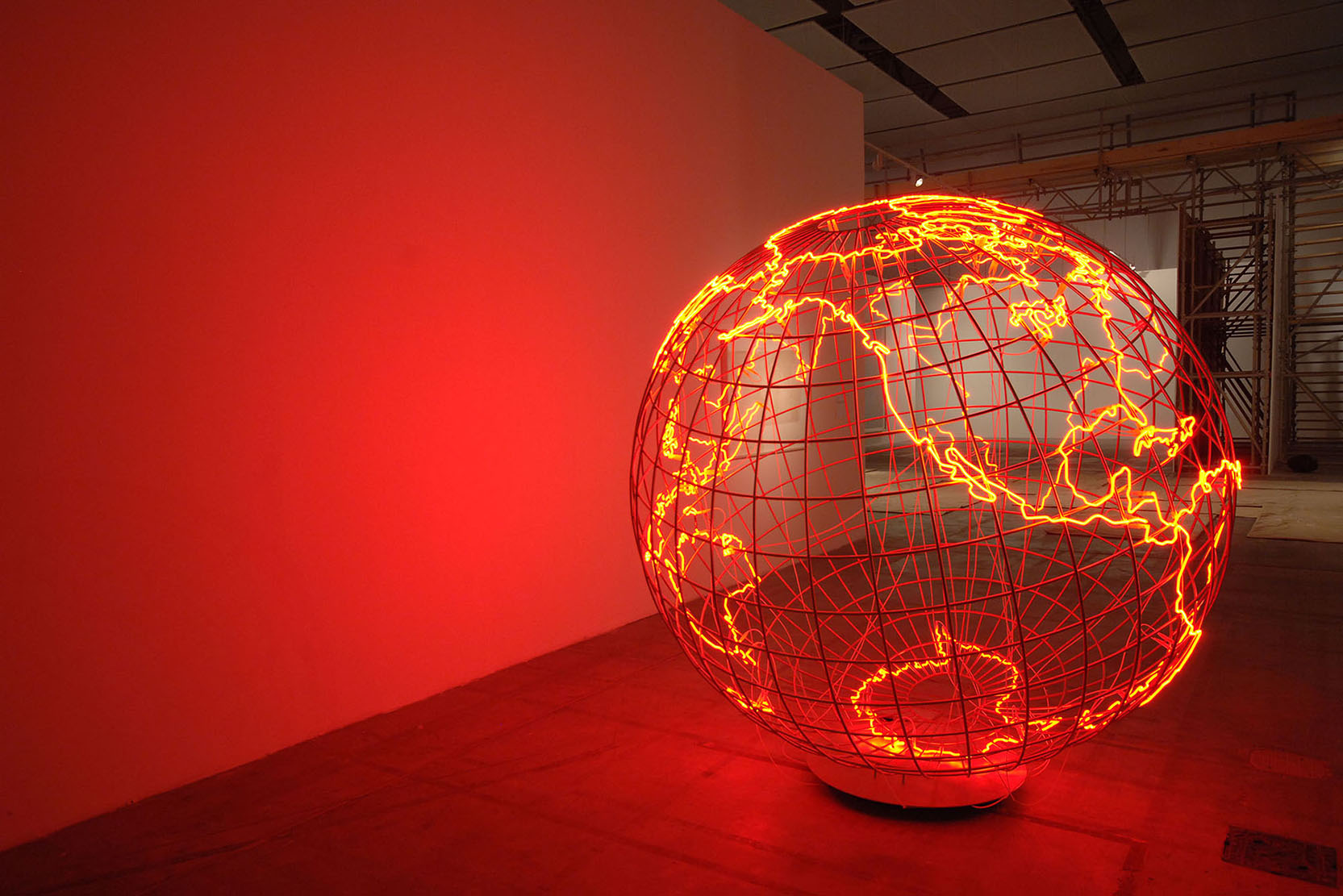
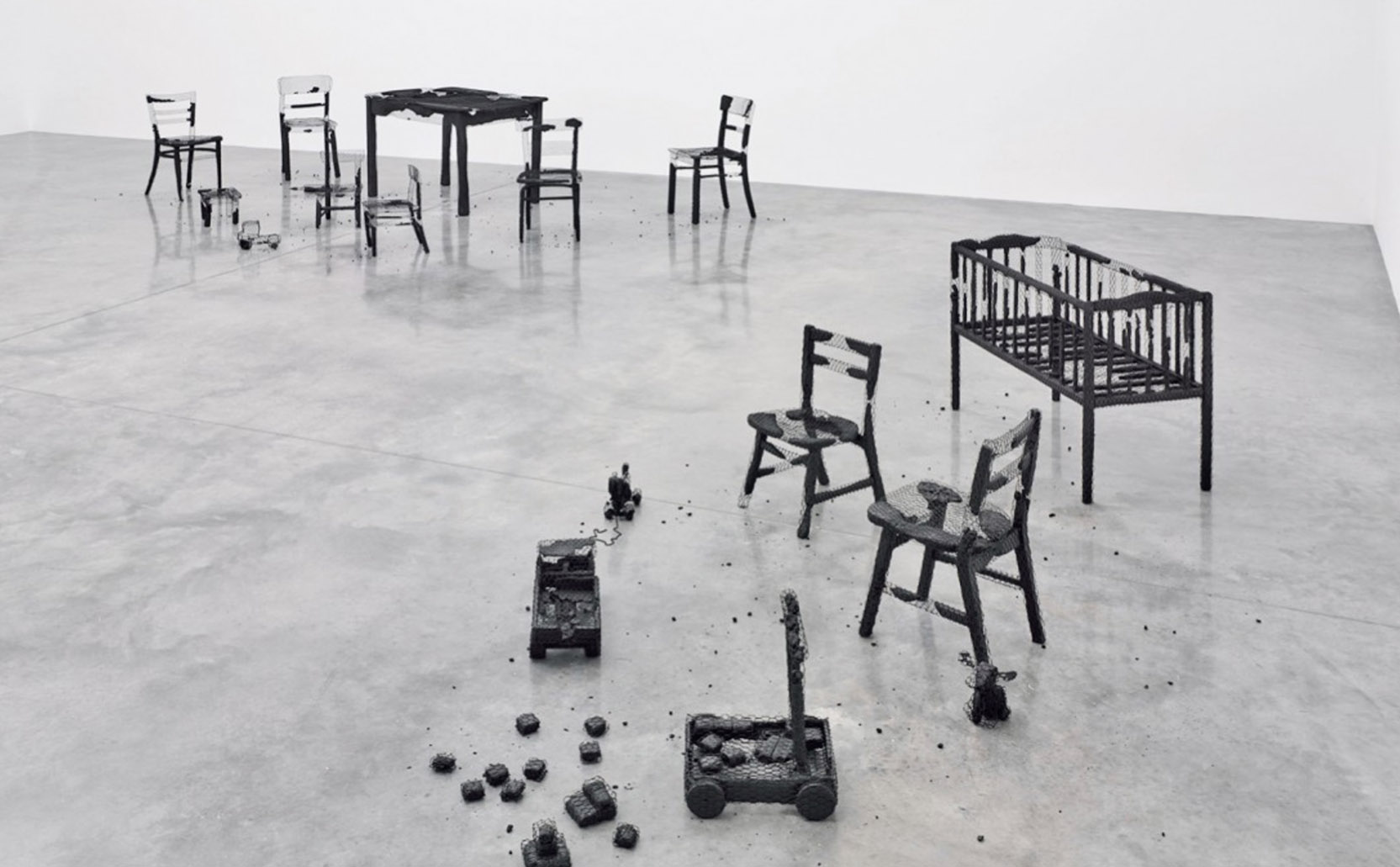 Mona Hatoum, installation views, “Remains to be Seen,” 2019, (courtesy White Cube Bermondsey London, photo Ollie Hammick).
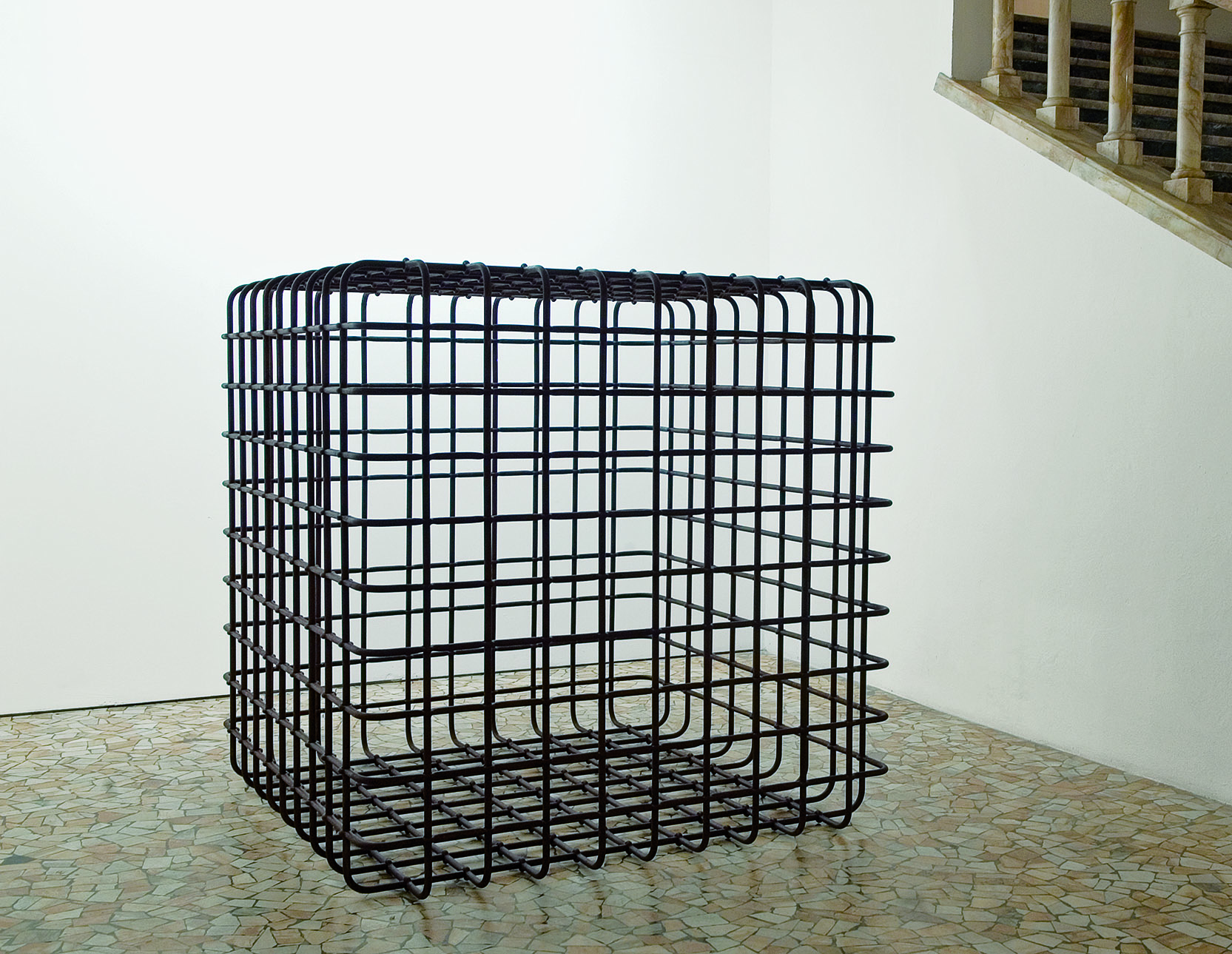 Mona Hatoum, “Cube,” 2006 (courtesy Galleria Continua, photo Ela Bialkowska).
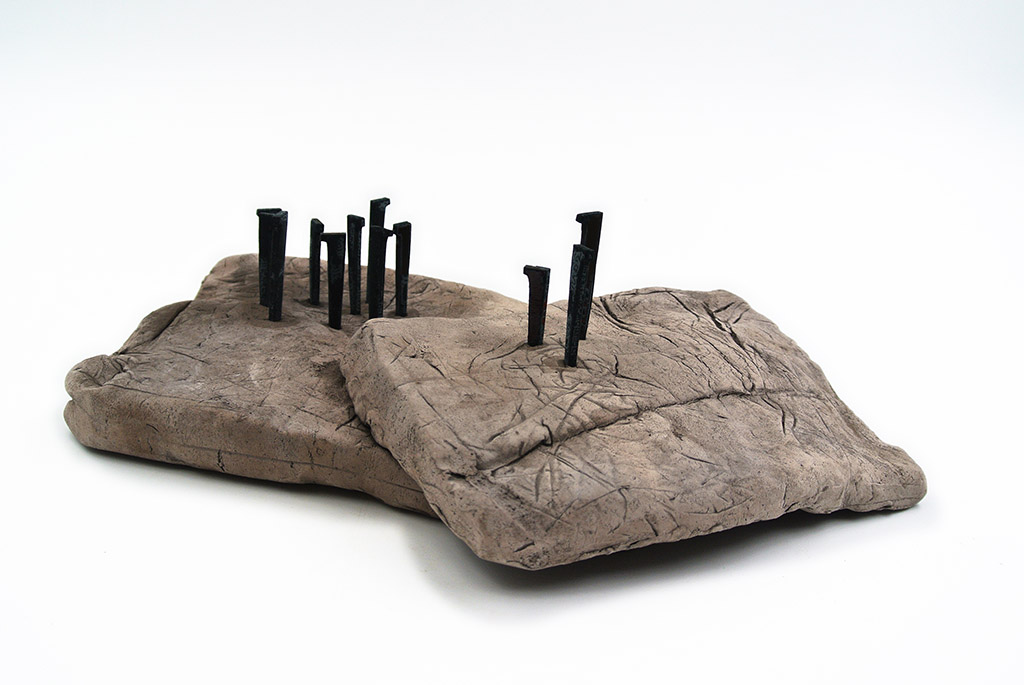 Mona Hatoum, “Gathering,” 2025 (Fondazione Nivola Museo Nivola, photo Terra Pintada).
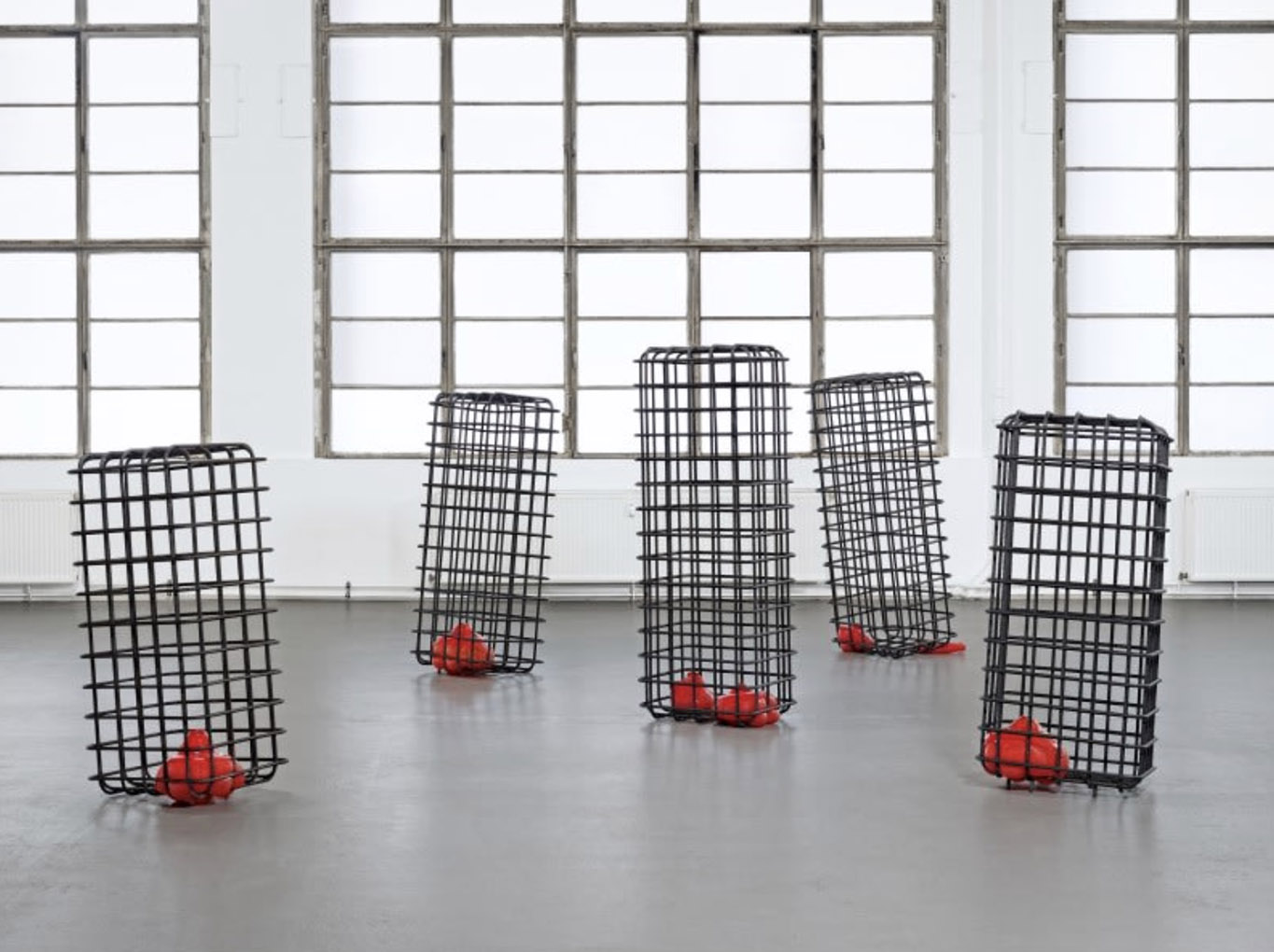 Mona Hatoum, “Kapan Iki,” 2012 (courtesy Galerie Max Hetzler).
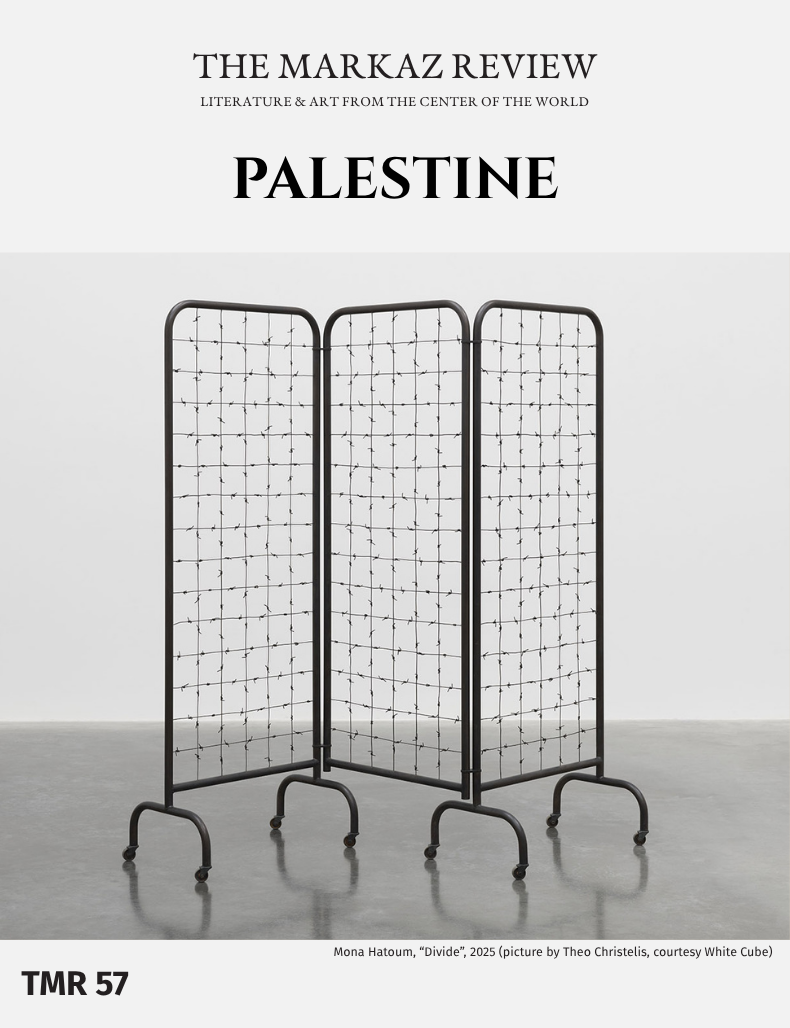
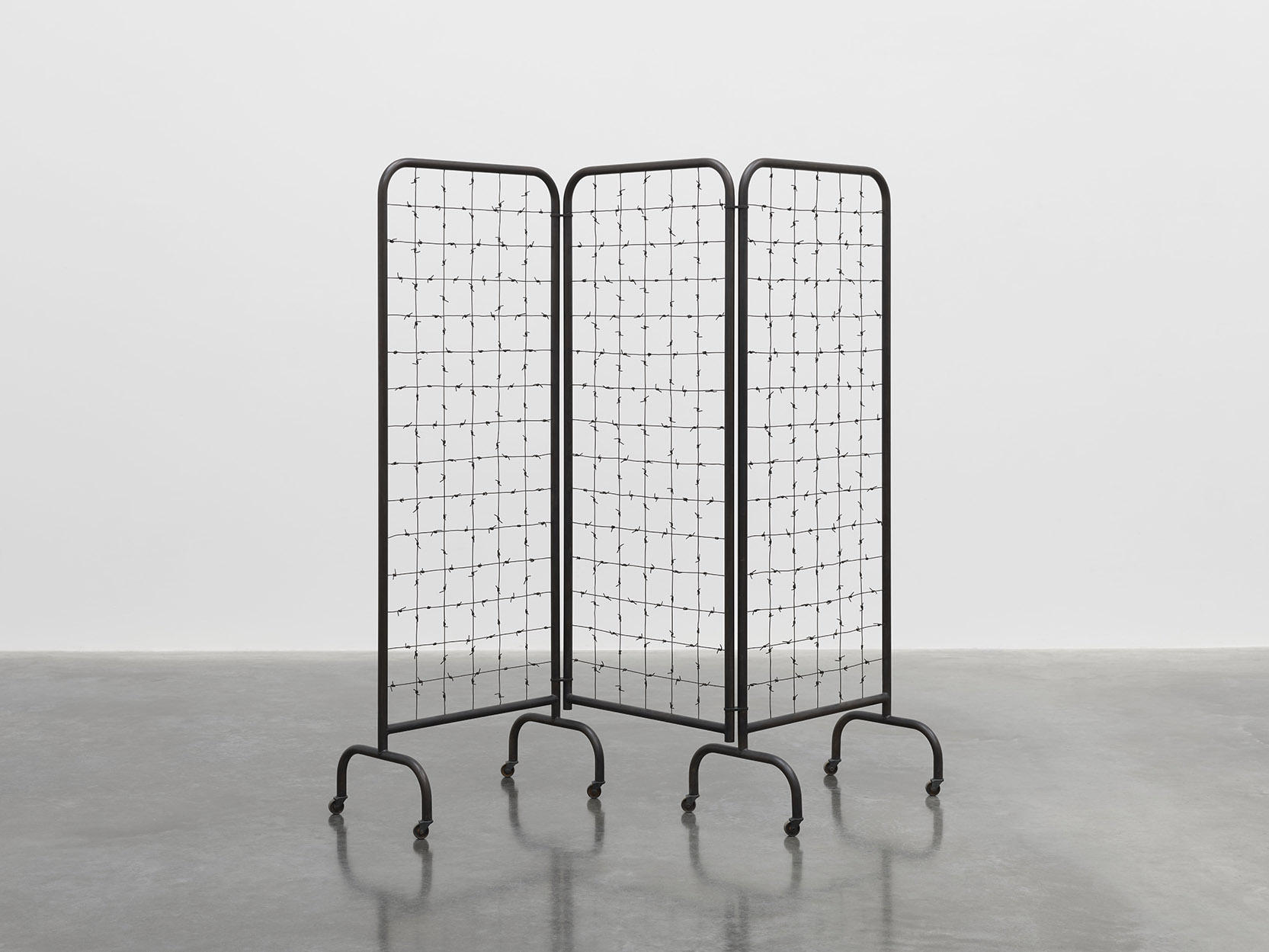 Mona Hatoum, “Divide,” 2025 (courtesy White Cube, photo Theo Christelis).
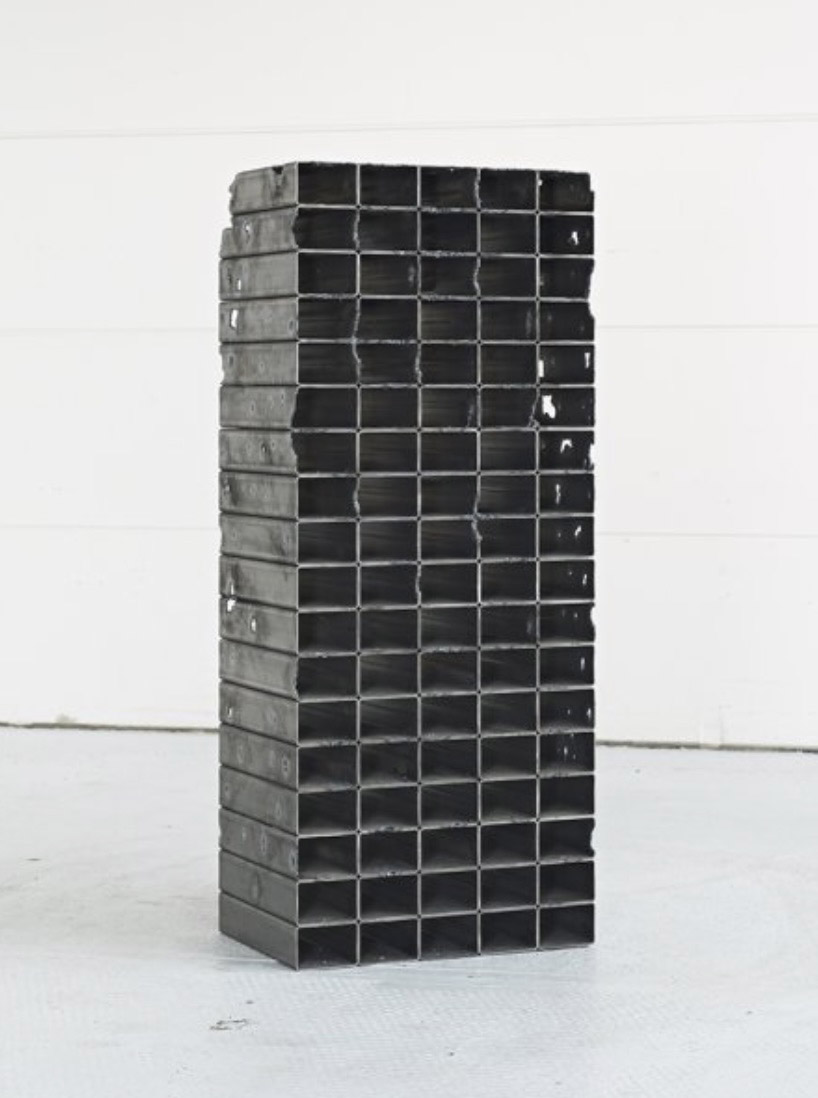 Mona Hatoum, “Bourj II,” 2011 (courtesy Galerie Max Hetzler).
In her subtle sculptural poetry, Mona Hatoum speaks transtemporally not only about the condition of violence, but also its lasting, physical traces. The aptly titled installation, “Remains of the Day” (2016-2018), is an assemblage of domestic furniture and items, including toys and kitchen utensils, completely charred as if the scene of a sudden, devastating disaster. And yet something still remains from the scorched objects, held together only by fragile wire mesh, one of Hatoum’s materials of choice to represent the vulnerability of objects and lives. The piece was first created for the Hiroshima Art Prize in 2017, established by the city of Hiroshima in 1989 with the premise of wishing for a peaceful world free of nuclear weapons. But charred furniture, imbued with the haunting feeling of a home being abandoned in haste, is not an image from the past. Exhibited at the Barbican in 2025 in the Giacometti exhibition, it reminds us of Gaza, Syria, Yemen, and Sudan.
Throughout her sculptural practice, from bars and grids to domestic objects turned into physical barriers and tools of violence, as well as maps of conflict zones that now encompass the entire globe, Hatoum has always framed the social and political experience of being Palestinian not as a singular event or period in time, but as an ongoing process of domination and subjugation of the body in space, extending far beyond the experience of war and occupation. For the artist, the genocide in Gaza isn’t simply something that might or might not affect one’s artistic practice as a whole, but rather, a human situation, a life-changing situation that has changed her entire outlook on the world and shaken her belief in the possibility of justice and human rights. Furthermore, this situation, which might take generations to process, cannot even be properly accounted for in terms of its wider implications for the life of a community while the atrocities are still ongoing.
In her 2022 speech for the Ada Louise Huxtable Prize, awarded by The Architectural Review, which recognizes individuals making significant contributions to architecture and the built environment, Mona Hatoum explained that although she began her career in the 1980s working with video and performance, and then later as a contemporary sculptor with a focus on displacement and the experience of alienation and fragmentation through violence or coercion, her work has been widely informed by the politics of space, the built environment, and the mechanisms of social control inherent to architecture. The format of the grid, one of the basic units of her artistic grammar, and the formal language of minimalism have become a way for her to expose and subvert systems of power underlying basic social infrastructures such as home, public space, or institutions.
As the quintessential language of modern Western architecture, minimalism is predicated on the neutrality of metrilinear space, and the endless repetition of modular units, expressing a tone-deaf functionalism that reduces the human being inside the space of dwelling to a series of operations that aim to order rational reality. For Mona Hatoum, these manufactured spaces are everything but neutral. Her iconic sculpture “Impenetrable” (2009), first exhibited at the Fondazione Querini Stampalia in Venice, is an imposing airy cube, three meters long and wide, floating in the air, but that on closer inspection reveals the textured surface of the real — it is made out of hundreds of wide barbed rods, dangling from fishing wire. There is an underlying tension between being delicate and threatening, and the sharp, pointed material often suggests architectural forms of control, such as fences, prisons, and camps.
The grid translates into the total mathematization of reality within a Cartesian plane, and one of the crucial colonial imaginaries, namely, the flattening of space. The apparent functionalism of these spaces doesn’t necessarily mean measurement for the sake of measurement, but rather, measurement as a tool of control, exclusion, and often erasure. For her 2012 exhibition “You Are Still Here” at the old ARTER in Istanbul, Hatoum produced the installation “Kapan Iki” (2012), meaning “trap two,” a series of cages of different heights, made from steel rebar, commonly used to fortify the structure of concrete buildings. At first sight, they looked austere and cruel, like prison cells, but the angle of inclination in each cage suggested instability and impermanence. Each of the cages contains a shapeless red glass object, perhaps blood, a human organ, or a formless body, trying to get away from the grid.
In one of the cages, the red glass object has somehow managed to escape, but it has been crushed by the weight of the structure. A number of earlier sculptures, also included in the recent Barbican show, reiterate Hatoum’s commitment to the politics of space, marking the invisible boundaries between an architecturally-shaped public domain and the historical experience of the individual. For instance, “Bourj” (2010), Arabic for tower, is made from stacked steel beams piled onto each other, welded, and burnt, intended to resemble the generic model of a modernist building but one bearing the scars of war. This tower could refer to the many buildings scarred by conflict in her birth-city, Beirut, during the long Lebanese Civil War, but it might as well refer generally to the link between modern architecture and the violent destruction inflicted by war in the global south, which has become a favorite motif of neo-orientalist imagery.
The 2006 piece “Cube” — the cage that contained the severed head from Giacometti’s “The Nose”— returned in Mona Hatoum’s most recent exhibition, Behind the Seen, currently on view at Museo Nivola, on the Italian island of Sardinia. Taking a more cautious phenomenological approach to the question of the relationship between body, matter, and geography, Hatoum returns in this exhibition to the fundamental questions of her decades-long grids project: How is space regulated, surveilled, and colonized? What remains concealed from the public eye in systems of power? A double-entendre between “scene” and “seen” invites us to look into the possibility of resistance to present times. The artist does not offer solutions or even comprehensive analyses, but rather explores whether certain interventions on everyday objects or narratives might somewhat reposition our gaze towards our own historical condition.
The new sculpture “Divide” (2025), in replicating the dimensions of a hospital screen, replaces, once again, a familiar everyday material, in this case with a grid of barbed wire. During the genocide in Gaza, hospitals have become battlefields not only for violence and the infamous double-tap attacks, but also for state propaganda, manipulation of information, and grotesque violations of human rights. Hatoum substitutes the soft textile of a hospital screen, meant to provide privacy and temporary comfort, with a see-through, web-like pattern of mesh associated with hostile architecture and the deprivation of privacy that comes with imprisonment and containment. The metaphor extends far beyond the hospital setting — it is about newly erected political borders and the many restrictions of movement that dispossessed peoples experience today more than ever, even in the countries that promised to provide them shelter from the violence of war.
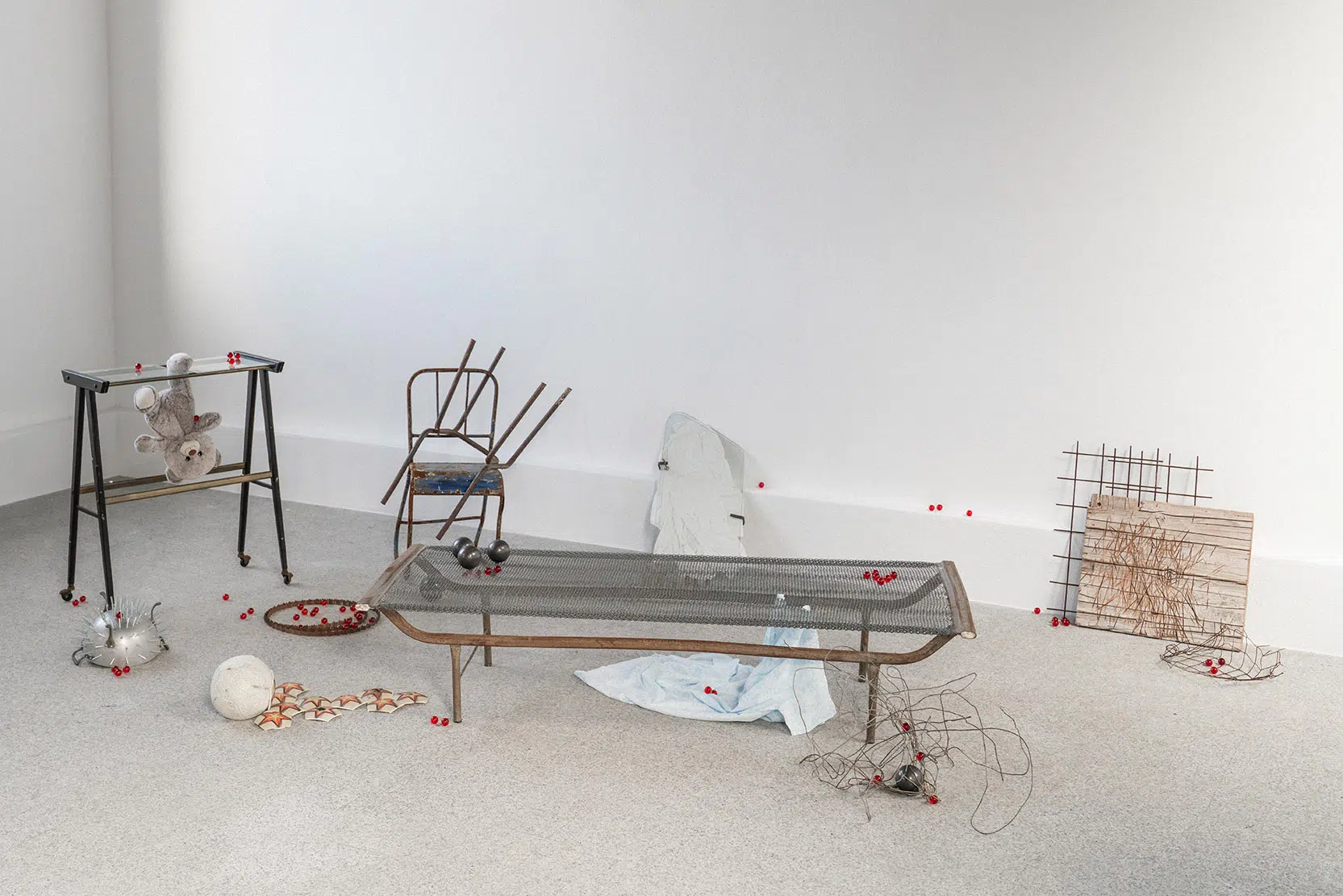
Recalling earlier iconic installations by Hatoum — such as the charred furniture in “Remains of the Day” (2016-2018) or the barren bed in “Interior Landscape” (2008), a room-size installation that also contains a hair-embroidered pillow depicting flight routes between the cities most visited by the artist — the eponymous installation in Behind the Seen (2025) brings together everyday objects into a moment of bare-bones decay and alienation: an empty bed without a mattress, a colander with spikes, an upside-down stuffed toy, a skinned soccer ball, and a chair in the process of disintegration. No specific details are added as to the situation depicted, but for the observer the sense of interrupted time becomes obvious and haunting. Has a family fled? Has their home been destroyed? Are they in hiding? All the answers are plausible at this point.
Imbued perhaps with more despair than any of her other previous room-size installations, often pointing ambiguously at the uncertainty and fragility of life, Behind the Seen is a completely fractured moment, without any chronological or thematic order, representing what happens to memory and consciousness after a situation of extreme violence — the elements can no longer be reordered or narrated linearly. It would be an exaggeration to say that a witness so skilled in storytelling and memory work as Mona Hatoum has given up on hope or resilience, yet the eerie and profoundly unsettling environment of this open-ended installation, not a closed world, but rather flanked on all sides by other temporalities, grid systems, and narratives, is an alarming reminder of the strong cognitive dissonance between our powerless visual representations of the present and the reckless experience of abysmal collapse in the lives of so many roaming without home, around the world.
Part of the exhibition Behind the Seen at Museo Nivola was produced during an artistic residency in Orani, a small Sardinian comune known for its traditional crafts such as stonework, carpentry, and metalwork. New sculptural works, grounding Hatoum’s research about space and politics in the local artisanal traditions of the island, were created on site in collaboration with local artists, allowing her sharp poetic eye to resurface from the despair of the present, through what art critic Walter Benjamin called a weak messianic power: the idea that things and events that never arrived or that have not been actualized yet remain within us not merely as missed possibility but as a sense of latency that might awaken at any time. Human time is still unfinished and replete with unknowns. An untitled work of painted clay birdcages, created with the ceramic atelier Terra Pintada, returns to her motif of the grid but this time, the severity of iron and rebar gives way to the fragility of earth materials, with bird cages that curve and bend, defying the linear measurements of minimalism. Moreover, the cages are empty — we cannot know if the bird has flown away, or perhaps it is still free.
The sculptures in the series “Shooting Star” (2025), a collaboration with blacksmith Emanuele Ziranu, are composed of what are presumably celestial bodies suspended from a ceiling, and yet we are unable to tell whether we are meant to feel wonder or danger — are they shooting stars or an air bombardment? The black spikey structures contrast with the white walls of the exhibition room, but it’s impossible to tell if they’re made from the same material as the cages, the hospital screen, or the nails in “Gathering” (2025), a pair of thick ceramic maps embedded with rusted nails that recall the Giacometti existential figures. Perhaps what we refer to here as material doesn’t necessarily have to be clay or iron or mesh but the debris of history itself.
From the outside of the Barbican in London, it is possible to see an enigmatic red glow emanating from the window of the second floor of the Hatoum and Giacometti exhibition. It is the sculpture Hot Spot (2018), a steel gridded globe, at the height of a person, tilting at 23.5 degrees, the actual axis of the Earth, with all the continents traced in red neon light. This cage-like structure and its fierce, buzzing glow present the entire world as one interconnected zone of geopolitical conflicts, border tensions, and global warming. It might have seemed pessimistic, although prescient, two decades ago, when the first version of the work was originally made. But here and now, in a world grappling with the demise of the fiction of the rules-based order, Hatoum’s globe is truer today than then. At present, it feels no longer necessary for us to state the obvious, in a moment of permanent crisis, but at the same time there still remains a political horizon for the poetry of images: the naked courage of never looking away.
•
Mona Hatoum’s exhibition Encounters: Giacometti was on view at the Barbican Center, London, September 3, 2025 through January 11, 2026. Her exhibition Behind the Seen runs at Museo Nivola, Orani, October 4, 2025 through March 2, 2026. Mona Hatoum’s work will be showcased in a solo presentation by Galerie Chantal Crousel, in the inaugural edition of Art Basel Qatar, February 3-7, 2026.