Select Other Languages French.
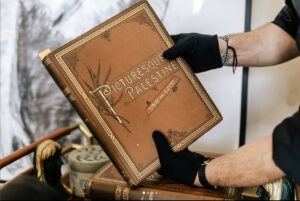
A foreigner reaches the village of Bir Saba, carrying strange equipment and auguring bad fortune.
Bir Saba, Palestine, 1899
The foreigner was upsetting their flock. With his every footfall, the animals scattered in the opposite direction of the white man hauling a wooden tripod and large box.
Dahab sucked her teeth at the spectacle. She refused to pose for this man, despite the silver coins he held out. Her husband Riyad, known as Abu Aziz, had been more cordial, offering the green-eyed ajnabee fresh water and bread. The man’s hair was as yellow as the fur of chickadees that her son loved to pet beneath the large fig tree beside their stone bayt. He declined the bread that Dahab had baked in the taboon, left cooling on a reed mat.
“Damn hot,” he said, dabbing at his brow. He pointed his brown hat to the sun then back at himself.
“Shawb,” Riyad said to Dahab, hooking his finger in the waist of his shirwal. He gave her a rueful grin.
She sucked her teeth again at such as a trite observation, then cupped a hand to her forehead and gazed into the distance. The wheat stalks had already absorbed the nighttime dew of the west winds. Alhamdullilah — the yield was plentiful this season despite a dry spring. To ensure abundant moisture, the clansmen had plowed the land through the previous winter months. The second season of rain in December and January had been profuse.
Dahab fingered a tubular amulet that hung around her neck, remembering a terrible drought from her childhood. She was seven years old and had watched her father’s silent and slumped body as he trudged across his field. The land was scorched by the khamsin — an unrelenting eastern wind from the desert. Her brothers, quickly wiping away their disheartened tears with the back of their hands, followed behind him. Dahab waited beneath a loquat tree, gripping a low branch. Its season had not yet arrived, and she wondered if the tree, too, would withhold its succulent bounty.
Outside their stone bayt, Dahab’s mother had not shed a single tear, her face a square slab of bronze, sharp eyes commanding young Dahab to silence at the slightest whimper. She had been secretly more afraid of her mother than her father. The woman seemed to possess many powers: patience, fortitude, fearlessness. While it was her father who provided for them, it was her mother who had always made Dahab feel safe.
She turned back to her husband and the ajnabee who had disrupted their day. He pulled a slim cigarette from a tin box in his coat and pressed it between two thin lips. He offered one to Riyad who held up a hand to politely decline. From inside his wool coat, he produced a brass lighter and sparked it, carefully guiding its tiny flame to the tip of his cigarette.
The early summer heat was steadily rising. Riyad had stepped away from the wheat field to receive the white man, carrying his goatskin flask of water. He was more tolerant than Dahab. The villagers often described him as possessing sabr ayyub — the patience of Job, upon whom God had reigned misery. Riyad never raised his voice, even as he asserted his rightful claims.
Her husband was often invited to mediate disputes among the clans. After the last olive harvest, there had been a serious offense committed: taqtee’ al-wijh, the cutting of the face. The first time Dahab heard the phrase as a little girl, she’d imagined a man carving the face of another with a sheep-horned dagger, same as the ones her brothers tucked into their belts. Only later would she understand it was a manner of speaking and not a literal act, but a shameful grievance one family had endured. Riyad had been one of a half-dozen men to mediate and oversee restitution of the family’s honor.
And he’d stood by Abu Hatim whose tobacco field was razed after he’d failed to disclose his yields to the local magistrate. An official proxy of the Atrak occupiers sat on his horse as the order was carried out by hired men. They’d all watched as the flames devoured the land. An angry brown-singed cloud filled the air with a pungent odor that lasted for days, like a heavy blanket thrown over the village. The proxy watched the scene without a word, his red tarboosh and the square-capped shoulders of his uniform casting a boxy shadow along safe ground. His horse trotted backwards, heeding the flames.
Except for pernicious acts of injustice like this, the a’thmani were largely indifferent to the villagers. And generations of clans had simply tolerated these reigning Ottoman lords who, at the very least, shared their faith.
Yet Dahab did not feel the same tolerance toward these white foreigners.
The two men continued their exchange of words and gestures, the foreigner pointing to the wooden tripod which he had set — without their permission — in front of their stone bayt. It faced the eastern hills mottled with thornbushes. Dahab had recognized the contraption, the outline of a large wooden box sitting on top, a black wool tarp draped over it.
Last spring, a caravan of white pilgrims rode through the village on route to al Quds, and had stopped to water their horses. One of the men had been carrying the same contraption. The children had gawked at the strangers from a distance and the man had gestured to them with beaded trinkets until they drew closer. He assembled them in front of an agitated flock of sheep and instructed the young girls to balance clay urns on top of their heads and the boys to hold carved staffs. His own head disappeared under a black tarp while his right hand pointed to the sky. Dahab had kept her own son, Aziz, from joining them.
Escorting the caravan was a man named Abu Saleem who came from al Sham, and had made the clan laugh and cringe as he revealed tales of poor habits of hygiene among the English pilgrims.
They asked me if I did not tire from washing five times a day, Abu Saleem joked.
And the clanswomen had concealed their giggles behind the edges of their black cotton veils.
Istaghfirallah, Dahab had muttered under her breath. Generations of believers had lived in peace with Christians and Jews, but she could not suffer these outsiders who trespassed their land, unsettling their daily lives.
Like this white man.
He was inviting her husband to peer through the folded layers of the box. Dahab saw the ajnabee wipe the spout of Riyad’s goatskin flask with his linen handkerchief before bringing it to his pale lips. He held his black hat with his other hand. Sweat glistened on his forehead and tiny rivulets streamed down his temples.
A barking pulled Dahab’s attention to her boy. He was playing with a scraggly dog that had appeared from somewhere beyond the hills.
Don’t feed it, she’d advised her son that morning. Or it will never leave.
Here was the boy offering the animal clandestine portions of leftover bones Dahab used for stock. She smiled to herself and said nothing. When she was a child, her family had several dogs. They were kept outside their quarters, for it was believed they were nijs — unclean creatures. One day a sandy-coated dog had snapped at a neighbor’s wife while she sheared ripened grapes from her vineyard, biting off a small chunk of flesh from her leg. To right the offense, Dahab’s father offered the woman’s husband a goat and two woven rugs. The latter was the toil of Dahab’s mother, who had insisted they be included in the recompense, for she and the woman were not only related by hamula, they were childhood companions.
After quenching his thirst, the foreigner held out a card to Riyad. Her husband politely accepted it though he could not read in any language. Dahab could read Quran and the land deed Riyad kept tightly rolled and tucked away in a leather satchel. This had deeply impressed Riyad, for Dahab had chosen to defy her mother’s warning to keep it to herself. In spite of her stony resolve, her mother, illiterate, had been married at the age of thirteen. Riyad had boasted of Dahab’s talent to the men of his hamula and several had brought various documents for her to read: a’thmani government decrees and military enlistment in their army. Or koshan for identifying property borders. And for the village women, she recited the calligraphic renderings of the ninety-nine names of Allah their elders brought back from hajj and which they immediately hung on the threshold of their homes.
You see here, she had told the women, tracing a line in her left palm that looked like a narrow tent. This is the number eighty-one. And then she showed them her right hand. And this is eighteen. Together — she posed one open palm on top of the other — the sum is ninety-nine, by the grace of the Lord, she declared.
Subhan Allah, they murmured.
And she had begun to teach her son. She poured rice over a wooden plate and traced the letters of his name: عزيز — Beloved One.
It was Dahab’s brothers who had taught her to read and, when they could not keep her from marriage, they gifted her a gold-plated pendant that contained a miniature scroll of Ayat al Kursi inside.
Gold on gold, they had smiled fondly at her for as her name suggested, she was their most precious treasure.
When she woke with a start in the middle of the night — a howl or screeching outside her bayt — her fingers immediately touched the tube-shaped amulet and she whispered supplication. Then she crawled to where her son slept soundly, unperturbed, and cupped his forehead before returning to lie beside her husband.
No other living children had been granted to them since Aziz. The midwife Um Aisha had promptly handed each stillborn to Riyad. He buried them at the edge of their small olive grove. Other deceased members lay there — Riyad’s parents and an unmarried sister.
The first time Dahab labored, the midwife was accompanied by an orphaned girl who boiled water in a copper cooking pot and brought it to Um Aisha’s side before it cooled. The midwife dipped her fingers inside the warm water and massaged Dahab’s lower region to minimize tearing. Dahab had moaned, her entire body clenching like a fist with each painful contraction of her womb. And then came an indignant shriek.
Her son’s face was round and puffy, unrecognizable until he opened his eyes and became real to Dahab. She stared at him for a long time, marveling at his bow-shaped lips and soft ears. Riyad wanted to hold his son immediately, much to the amusement of the midwife who showed him how to cradle his fragile skull in the crook of his arm. He smiled at Dahab, his eyes wet and tender.
Days later, she cried while holding him down as instructed, for his circumcision, surprised by how vulnerable he made her feel. Any whimper heightened her senses and only when he slept did Dahab relax, her thrumming nerves at last quieting. Legs folded, she sat beside his wooden cradle, canopied by a mosquito net. For his colic, she consumed a spoonful of cumin before Aziz suckled at her breast. And when he developed a scaly crust on the crown of his head, Dahab gently soaked it with olive oil, careful to avoid it leaking into his eyes. He loved to bathe and batted his eyelashes as water poured down his face, his fists pumping in sheer delight.
The second time she labored, the pain had come and gone much quicker, but no crying followed. There was only quiet, except for the sheep outside, bleating and kicking the dusty ground with their hooves.
Inna lillahi wa inna lillahi raji’un, Um Aisha had murmured.
As soon as Dahab heard the midwife’s supplication, she wept, but refused to turn away. She watched as the tiny creature was wrapped in a white cloth, oblivious to the orphan girl washing afterbirth from between her thighs, the metallic stench of blood and fluid slowly diminishing. The only evidence of a life once inside her was the deflated skin of her belly.
Um Aisha had come to Dahab’s side and held her hand, wiping her forehead with a clean damp cloth. Inshallah you will be gifted with another, she had said. Um Aisha was wearing a thawb that contained blue-stitched palms: the emblem of a widow. Bleary-eyed, Dahab stared at the blue feathers rising from the woman’s large bosom, stitched across the chest-panel of her thawb. Dahab had once worn blue to ward off the evil eye before she was married. Her trousseau prepared by her mother and paternal aunts contained red and purple-stitched dresses, marking her a married woman. Dahab had spent the first lonely days away from her family clutching her amulet and sweeping her fingertips over the patterns of feathers down the front of her thawb.
In her new village, Um Aisha had taught Dahab how to properly mend her husband’s qamees, pinching the hem of the tunic for Dahab to see. And how to sterilize cookware and clean sheared goatskin. These were things her own mother had tried to do, but Dahab had blithely scampered away, trailing behind her brothers in the valley of their village.
The third and last time Dahab had delivered, Um Aisha had stood over her, a golden shnaf glittering from her right nostril in the moonlight. She cupped Dahab’s forehead, her lips twitching du’aa.
Um Aisha had not said again, Inshallah you will be gifted with another.
For another never came and Dahab clung to her sweet son Aziz, who drank milk from her breasts intended only for him. And Dahab had learned not to complain or covet more than the Lord had deemed fit to bestow upon her and Riyad.
Dahab had avoided the burial mounds until one day when she was chasing after her son. Upon taking his first steps, Aziz had quickly discovered the magic of his legs. She swept him up before he could trample the graves. He squirmed in her arms as she whispered supplications for the dead. Subhan Allah, she marveled, how life had sprung from the womb of her body to the cradle of the earth. For the first time, she let herself imagine the dead mingling with the soil of the harvest and this gave her a sense of peace.
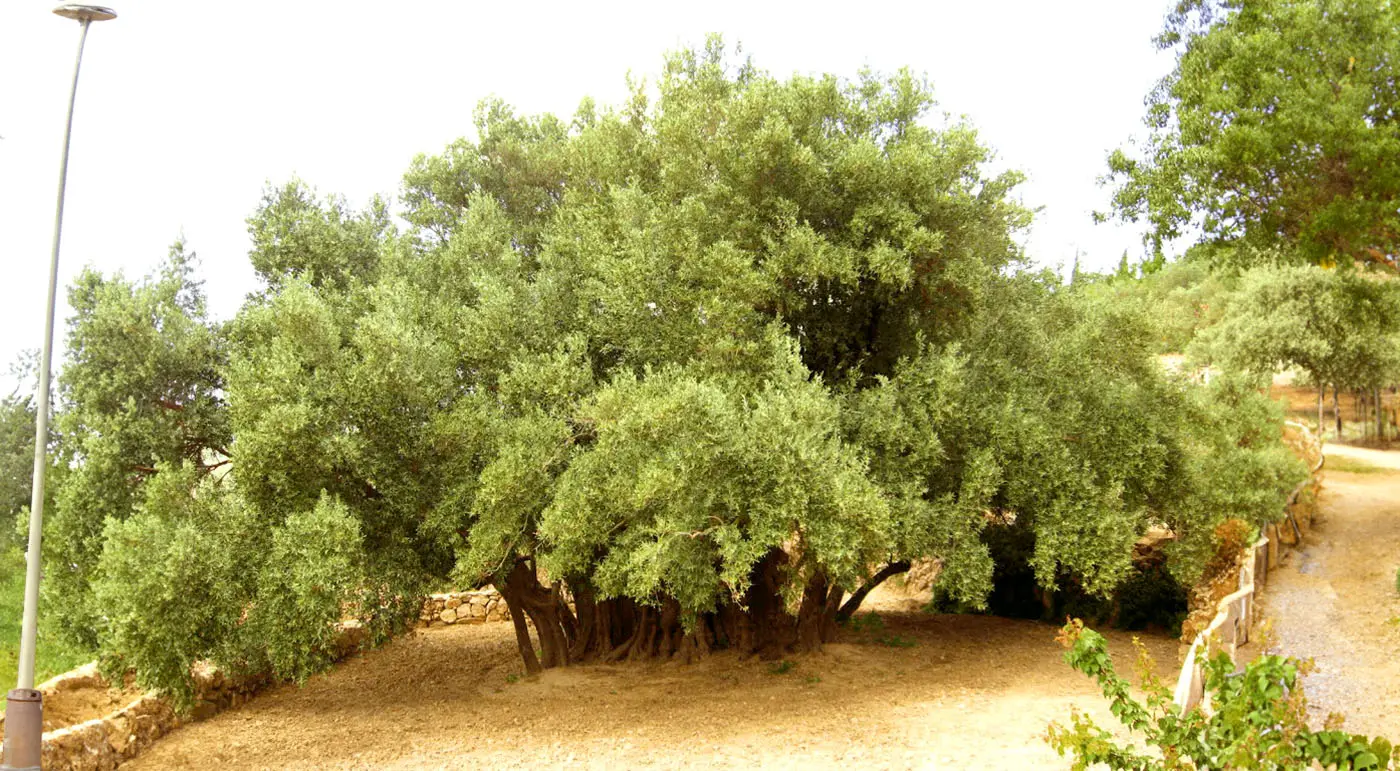
Twigs snapped behind her. The foreigner was walking through their olive grove.
“He’s harmless,” Riyad said to Dahab, catching the straight, disapproving line of her lips.
Dahab did not want him anywhere near their olive trees, or their home. But she did not argue with her husband. She lingered in her spot, twisting a wash rag, watching the interloper haul his equipment to the edge of their grove, a few paces from the mounds. Would he see the small stones she’d lain over each one, marked with purple dye?
“Abu Zayed will fetch him at sundown,” her husband was saying. He headed back to the wheat field, scythe in one hand, and his goatskin flask fastened across his back.
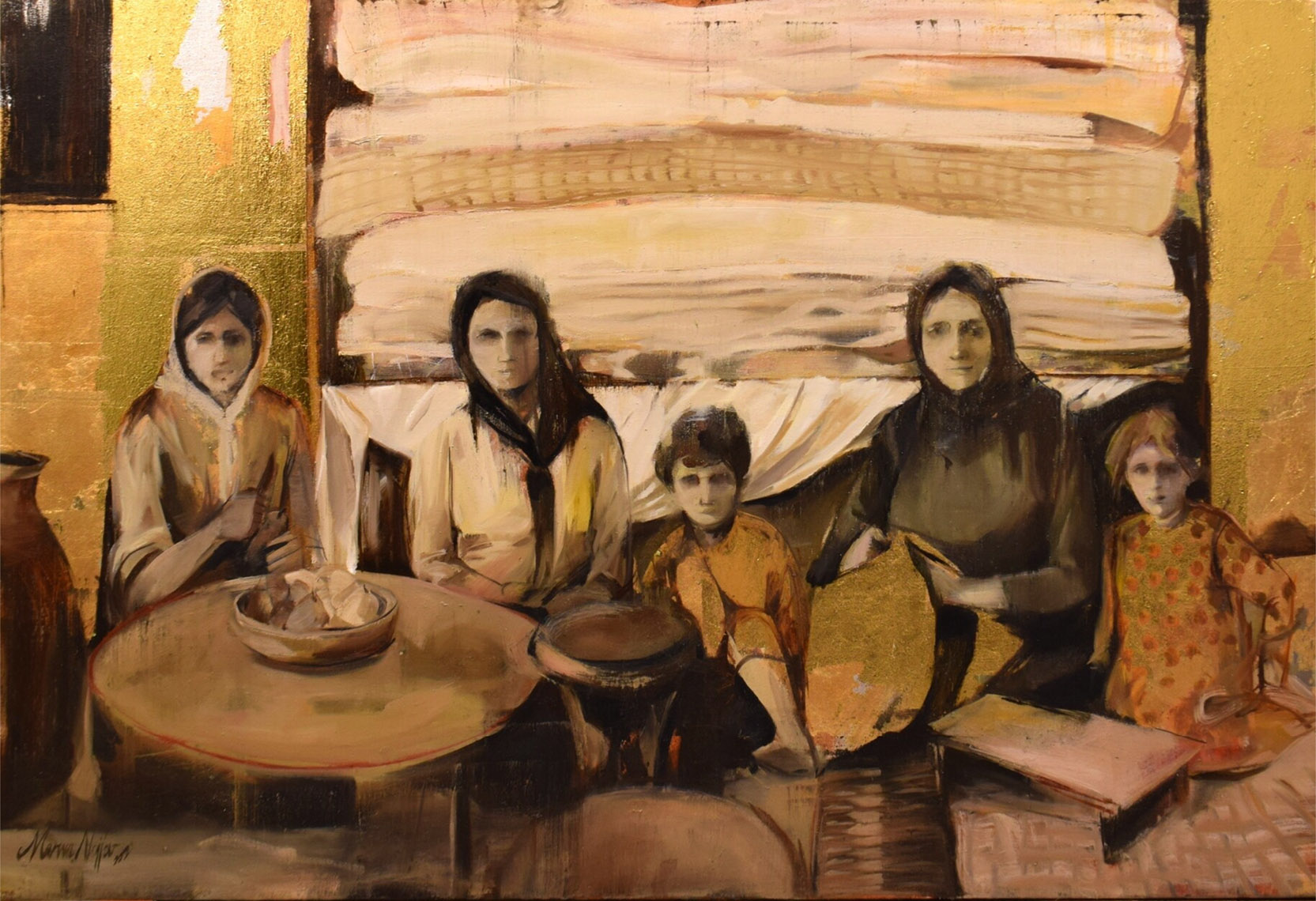
Dahab did not care for Abu Zayed whose obsequious manners made it difficult to rid the villagers of these foreigners. He was the son of the appointed mukhtar, a noble and wise man. Unlike his father, Abu Zayed hastily welcomed and boarded the ajanib, bartering the privacy of their village for silver coins and a rifle he slung over his shoulder.
It was difficult to concentrate on her chores while the white man hovered so close. She followed his movements as he stopped and pondered a direction before positioning the tripod. When she saw he hadn’t encroached the edge of the grove, she turned back to sifting flour over a large bowl. Her boy chased after the dog as long as he could before it disappeared over a hill.
The call of the late afternoon prayer echoed across the fields — the sonorous voice of Abu Raheem, whose father before him had served as the muezzin. Each family paused their labor and performed wudu at a communal well. They assembled wherever they stood, unrolling woven rugs before their feet. Dahab stood behind her husband on one such rug, eyes closed in solemnity. There was a tugging at the hem of her thawb. She gently extricated her son’s small fingers and resumed her prayer as he giggled and tugged again.
Before dusk, Abu Zayed came to fetch the foreigner and they went off together. She listened to their loud and deliberate voices trailing away outside her bayt, and she was relieved. She prepared a kettle of loose black shai. Riyad was playing with their son, raising Aziz in the air then back to his lap where he tickled the boy’s ribs. Later that night, her husband climbed on top of her and found her lips in the darkness. Afterwards, she found the curve of his arm where she would settle until fajr or the boy fussed, searching for Dahab. She would rub his belly, soothing him back to sleep.
She rose again the next day and performed fajr ablution. Before her husband began to stir, she stood in the threshold of their bayt, drawing a heavy cloak over her shoulders to keep the early morning chill from penetrating her bones. She watched dawn break over the hills, a magnificent display of red and orange announcing another day along with the muezzin’s call to prayer.
The foreigner returned. This time, he had a young boy called Issa from the village who carried his equipment and went where the white man directed, sometimes comprehending his quick, impatient gestures and the tone of his words, sometimes not. Dahab called to him and offered the boy two sour plums — one for him and one for the interloper.
“Zakee,” Issa said, nodding at the succulent plum, urging the white man to accept as if he were the child.
The man briefly examined the fruit then returned it to the boy. Issa shrugged before promptly pocketing it. Dahab watched the child chomp on the first plum while the man set up his wooden tripod.
Despite her stern protests — flicking her hand and vigorously shaking her head — the ajnabee ignored Dahab and positioned his contraption in the direction of her bayt. Her face flushed with anger, but she could not get rid of him. Riyad had returned to the fields to thresh wheat. That morning, he’d squeezed her shoulder. Pretend he’s not here, he’d smiled at Dahab.
But he was here. Every time she looked up from milking the sheep then washing goatskins before hanging them to dry, he was here. Or plucking jute mallow from their stalks before stewing it in a brass cauldron of boiling water over a coal pit. Only at noon did the man seek a new location. He detached the box, threw the tarp over it before carefully setting it on the ground. He then collapsed the tripod, which the boy Issa clumsily balanced over one shoulder, and trailed behind him.
Only then did Dahab’s body loosen and she felt relief rush her chest. She went to the well to gather water. And then she heard it.
A high-pitched squeak like that of a mouse Dahab had once cornered in their bayt. Aziz had watched wide-eyed as Dahab pierced it with a wooden staff to still the creature.
But this sound was a human one — her son’s cry for help. He had been napping after his morning jaunt with the dog, which had returned from the hills. Dahab dropped her pitcher and the water she’d drawn sloshed across the dusty ground. She grabbed the first large rock on her path and dashed toward her stone house.
“Khair! Khair!” Dahab cried, the rock poised above her head, ready to crash down on the perpetrator behind her son’s shrieks.
Aziz was seated on a floor mat, legs folded, a hand to his cheek. He was wide-eyed and breathing hard. She caught sight of the scorpion scuttling across the woven rugs. It paused in the middle of the dirt floor and turned toward Dahab, its pinchers open and tail curled up. She could see the stinger, an orange eye glaring at her like a tiny sun. She lunged at the scorpion and crushed it, its exoskeleton cracking against the surface of the rock.
Dahab dropped to her knees, grabbed her son’s head. A red, angry circle had formed on the boy’s cheek, wet from his stunned tears. She instinctively began to suck on the wound. From a distance, a villager might think she was kissing her child.
Her middle brother, Ibrahim, had been stung by a scorpion as a child. And Dahab’s mother had done the same thing except it had been on his ankle. Dahab had solemnly stood in the corner during this strange act, not quite understanding the magnitude of such love. Her brother had been beside their mother as she cooked, and she immediately pounced into action. The poison was still close to the surface of his skin and he had survived.
Dahab hoped the brassy and bitter taste on her tongue was proof she’d drawn out the poison. But her boy’s cheek began to swell and he vomited. She lifted Aziz from the floor and lay him across her own clean mat. Her shrieks brought neighbors to her threshold.
“Yalla! Yalla!” one of them ordered. “Send for Um Bakr!”
Dahab lay a damp cloth across her son’s small forehead. She held his warm and clammy hand, so small it disappeared inside both of hers. His breaths were coming in short bursts.
“Fear not,” the women told her. “Blessed be the Prophet.”
Tears rolled down Dahab’s cheeks and she pulled her shoulder up to absorb them, refusing to let go of her son’s hand.
“Make way, Sisters!” a voice crooned behind her. The women shuffled to let Um Bakr — another matriarch in the village — through. “Leave us!” she commanded the others. Despite her corpulent body, Um Bakr was as efficient as the midwife. She lowered herself to the floor and on one bended knee jutting beneath her thawb, she quickly arranged her tools beside the boy. Two short glasses. A vial of olive oil. Matches. Dahab tried to muster faith in the assembly of these things which the woman had used on other children to temper terrible chills and hacking coughs.
The noise in the bayt dimmed to the sounds of the boy’s raspy breathing, the thudding of Dahab’s heart in her ears, and Um Bakr’s supplications.
“La howla walla koowat illah billah,” the elder woman recited. “Say it with me, Um Aziz! There is no power or strength except in God! Say it!” She was attempting to distract Dahab, but Dahab could neither open her mouth to form these words nor suppress terrified uncontrollable sobs from rushing forth from her chest.
As the woman worked, Dahab watched, still clutching her son’s sweaty hand between hers. Um Bakr gently rubbed a few drops of the virgin olive oil into the wound. She measured one glass against his cheek then chose the other, slimmer one before striking a match inside until a smoky cloud filled the container. She suctioned this over the bite.
Aziz squirmed — surely a good sign. The odor of sulfur eased the bile rising in Dahab’s throat.
Soon her husband appeared in the threshold. “Khair inshallah,” he said, and she knew how much it took to keep his voice level. He knelt beside her on the mat, his fingers fanned across their son’s chest. It rose and fell beneath his father’s touch.
Dahab could smell mealy traces of threshed wheat mixed with Riyad’s sweat. He wrapped an arm around her shoulders and she wanted to collapse against him.
“There is no power or strength except in God,” Um Bakr repeated, holding the cup against her boy’s cheek. After what seemed an eternity to Dahab, she removed it, leaving a faint red ring around the wound. “Inshallah khair,” she said. “It is in the Lord’s hands now.”
Dahab caught the woman’s eyes signaling to her husband. Riyad followed her outside. She could not make out Um Bakr’s words, but guessed their message. It was too late: the poison had already taken hold of their son’s body. It had traveled a short distance to his precious heart.
At last, Dahab released an awful sob that wracked her torso and blurred her vision.
Through the night, the boy’s breathing grew shallow. Dahab refused to leave his side. A new dawn broke and the muezzin’s call echoed across the village. With every twitch of his limbs, she willed him to jerk awake, to sit upright and look at her. Riyad kept vigil with her, leaving the two of them at brief intervals and returning, eyes red-rimmed and nose sniffling.
“Wake, my beloved,” she whispered into the boy’s ear. “I promise you can keep a dog. Only if you wake. Yalla, my son. Wake now.” She bargained and bargained, but her son would not concede. She held him in her arms until his last breath.
The village faithful came and washed his body while the clanswomen tended to Dahab. They tried to hoist her to her feet, but her bones had turned liquid, like the anise-infused tea they coaxed her to sip. She was dragged between two women who sat her beneath a drying rack where sheep fleeces and goatskins, an earthy mustiness permeating her nostrils. She heaved.
“To Allah we belong, to Allah we return,” they all said.
When she caught sight of the small shrouded body departing their bayt, she sprang to her feet. But the women held her back. She watched the procession as it made its way to the edge of the olive grove, Riyad carrying their only son, a tender bundle in his arms.
Her heart iced over and she moaned. “Lay me down with my son!”
“Istaghfirallah!” the women chided her. “For shame! Blessed be the Prophet! May the Lord have mercy on his soul.”
Abu Abdullah, the village shaykh, walked among the men, his wooden staff steadying his gait.
The ceremony was muted by Dahab’s weeping until a horrible bellow broke out. Then an unrelenting series of cracking noises. Thwack! Thwack! Thwack! The sounds of wood fracturing.
Dahab punctured the net of women and ran through the grove, fear pounding against her skull. Clutching her amulet, she ran past trees Aziz would never climb, their fruit he would never taste again. She stumbled on the hem of her thawb and lifted herself up again, kicking off her sandals. She ran barefoot, numb to the jagged stones and thorns lancing her heels.
By the time she reached the edge of the grove, the white man’s contraption was in pieces, scattered on the ground. He, too, was on the ground, blue eyes wide and afraid. His black hat lay askew behind him. Blood trickled from a gash on his left temple.
And there was her husband Riyad standing above the foreigner, a wooden staff raised, ready to strike again. But then he saw Dahab and his arm went limp, the shaykh’s staff falling to the ground. Riyad let out a wail she had never heard before. A terrifying animal roar that seemed to shake his entire body until it collapsed.
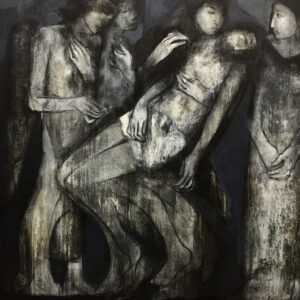
Dahab’s gaze traveled to the freshly broken earth and she staggered toward the open tomb. On her knees, she peered into the folds of linen protecting the boy’s face and limbs from the midday sun. And before the men could stop her, she peeled the layers away, revealing her sweet boy’s face. His cheeks were like dried clay, gray and lightly speckled. The scorpion’s sting had turned a dull red. She kissed his forehead before relinquishing him to the earth, the next steward of his flesh and bones.
Someone was helping the white man to his feet. He steadied his wobbly legs and blotted his wound with his white handkerchief. For a few moments, he stared incredulously at the red anemone blooming there. Then rage seized his milky face. He waved the soiled handkerchief at the pile of his tattered contraption before glaring at Dahab and the men surrounding her. Spittle gathered at the corner of his mouth as he shouted at them. His eyes and forehead blazed.
Dahab did not turn to look up at the ajnabee. She drew the shroud back over her beloved son’s face. Not a single clansman — including her weeping husband, on his knees — stirred from his spot around the open grave.
And the foreigner suddenly grew silent for neither Dahab nor any of the others understood a word he was saying.
THE END

















![Fady Joudah’s <em>[…]</em> Dares Us to Listen to Palestinian Words—and Silences](https://themarkaz.org/wp-content/uploads/2024/03/SAMAH-SHIHADI-DAIR-AL-QASSI-charcoal-on-paper-100x60-cm-2023-courtesy-Tabari-Artspace.jpg.webp)