Le bon et le mauvais flic, ou pourquoi les États-Unis soutiennent Israël

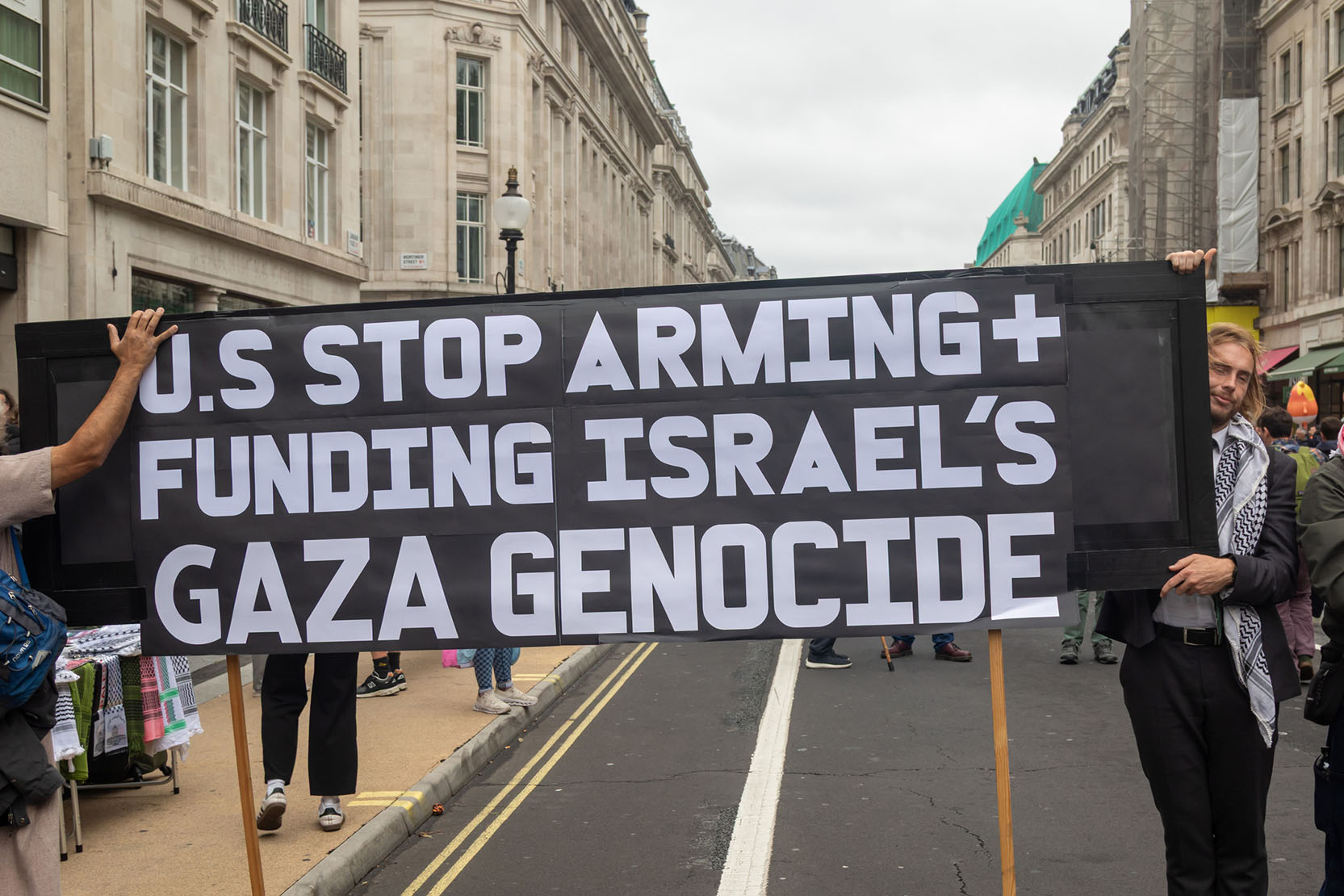
Une manifestation contre le soutien de l’administration Trump à Israël, Londres, le 17 septembre 2025 (photo: Ben Gingell).

3 APRIL 2026 • By Jason Hickel

Select Other Languages English.

Sommes-nous face à un cas de « bon flic / mauvais flic » ? Comment expliquer autrement le soutien aveugle des États-Unis à Israël, malgré une condamnation internationale accablante ?

Pour tenter d’expliquer la « relation privilégiée » entre Israël et les États-Unis, on invoque souvent le pouvoir de l’AIPAC dans les élections américaines, ou d’autres formes d’intervention politique israélienne dans le pays. C’est effectivement une force réelle qu’on ne doit pas ignorer, mais le fait est que si la classe dirigeante américaine soutient largement les actions d’Israël – dans un consensus bipartisan –, c’est parce qu’elle considère ces dernières conformes aux intérêts du capitalisme américain. Et la plupart des autres gouvernements occidentaux (le Royaume-Uni, l’Allemagne, etc.) adoptent cette même position, pour les mêmes raisons.

Selon l’UNICEF, en 2026, Israël était responsable de la mort de plus de 21 000 enfants à Gaza. Et depuis le 7 octobre, Israël a tué plus de 200 journalistes à Gaza et au Liban – soit davantage que l’ensemble des journalistes tués pendant la Seconde Guerre mondiale et la guerre du Vietnam réunies.

Ce qu’il faut comprendre, c’est que l’économie capitaliste est un système-monde, dans lequel la croissance et l’accumulation au cœur de l’empire (par exemple, les États-Unis et l’Europe occidentale) reposent largement sur l’appropriation d’une main-d’œuvre bon marché et de ressources provenant de la périphérie et de la semi-périphérie, autrement dit, du Sud global. Les États et les entreprises d’Occident ont besoin que les États du Sud leur restent subordonnés et continuent ainsi de leur fournir du travail à peu de coût, des matières premières et des biens de consommation au sein des chaînes de fabrication mondiales. 

Pour maintenir cet ordre, les États du centre doivent trouver des moyens d’empêcher le développement de la souveraineté économique dans les pays du Sud. Le développement souverain implique que les populations du Sud commencent à s’émanciper et que leurs salaires augmentent, qu’elles produisent davantage pour elles-mêmes et qu’elles consomment leur propre production. Une telle dynamique entraîne une hausse du prix des ressources et des importations pour le centre, ce qui se traduit ensuite par une limitation de la consommation et un frein au profit.

C’est là que tout se joue : la souveraineté économique en périphérie menace l’accumulation de capital au centre. Pour l’éviter, les États du centre doivent systématiquement intervenir afin d’entraver ou d’écraser tout mouvement et tout gouvernement de périphérie qui chercherait la libération nationale et la souveraineté économique.

Les États-Unis ont commencé à soutenir le projet sioniste dans les années 1960 car ils y voyaient un moyen de disposer d’un relais militaire en Asie occidentale, à partir duquel mener des opérations de contre-insurrection contre les mouvements socialistes arabes et les luttes de libération nationale, alors populaires dans la région. Les États-Unis ne pouvaient pas admettre la perspective d’un développement souverain dans une région qu’ils considèrent comme le centre du monde, au carrefour de l’Europe, de l’Afrique et de l’Asie, dans laquelle se concentrent nombre de ressources et de routes commerciales cruciales. Il leur fallait écraser ou déstabiliser les mouvements de libération, et Israël était un de leurs moyens de le faire. 

Que ce soit dans les pays arabes ou en Iran, Israël joue un rôle essentiel dans l’assassinat de leaders populaires (dont Yahya Sinwar, Hassan Nasrallah, Qassem Soleimani, et l’ayatollah Ali Khamenei sont les plus récents ajouts d’une liste bien plus longue) et permet l’ingérence dans la vie politique des pays arabes pour prévenir l’arrivée au pouvoir de partis nationalistes ou socialistes. Israël a un long historique d’attaques contre des États de la région – Liban, Irak, Syrie, Jordanie, Égypte, Yémen, etc. –, les déstabilisant et les contraignant à consacrer leurs ressources à des dépenses militaires plutôt qu’au développement industriel. Cela s’inscrit pleinement dans la stratégie américaine, tout en servant directement l’objectif israélien de lever les obstacles à la normalisation et à l’expansion territoriale.

Et pas seulement en Asie occidentale : Israël a une longue histoire de soutien militaire et de coopération en matière de renseignement avec des régimes de droite à travers le monde. Par exemple, Israël a armé et soutenu la junte militaire argentine, appuyée par les États-Unis, responsable de l’assassinat de 30 000 socialistes et opposants politiques. Il a également contribué au génocide au Guatemala, soutenu par les États-Unis, en armant et en formant des cadres militaires aux techniques de torture et de nettoyage ethnique.

Les États-Unis soutiennent Israël pour les mêmes raisons que celles qui, depuis les années 1950, les ont conduits à soutenir l’organisation d’assassinats et de coups d’État envers les dirigeants de mouvements de libération à travers tout le Sud global, lesquels ont renversé Mohammed Mossadegh (Iran), Patrice Lumumba (RDC), Kwame Nkrumah (Ghana), Salvador Allende (Chili), Jacobo Árbenz (Guatemala), Sukarno (Indonésie) et Thomas Sankara (Burkina Faso), entre autres. Ce sont exactement les mêmes raisons que celles pour lesquelles ils ont envahi le Vietnam, détruit la Libye et imposé des sanctions à Cuba. Le schéma est toujours le même, avec les mêmes objectifs.

C’est pourquoi Israël est si méprisé à travers le monde. Non seulement parce qu’il s’acharne à poursuivre le nettoyage ethnique en Palestine, mais aussi en raison de ses interventions visant à écraser les mouvements populaires et à semer le chaos et l’instabilité, qui sont intolérables.

Israël n’est donc pas un « allié » des États-Unis au sens classique du terme. C’est une force de relais, un chien d’attaque. Cette relation est particulièrement utile à l’élite politique américaine, car elle permet aux décideurs de maintenir une certaine distance vis-à-vis de leurs actions et de préserver une forme de déni plausible. Les États-Unis peuvent fournir des armes à Israël et coordonner directement leur stratégie militaire avec lui, puis prétendre ne pas être responsables des violences, des destructions et des crimes de guerre qu’il commet dans la région. Les deux dernières années témoignent de l’ampleur avec laquelle cette stratégie du « bon flic / mauvais flic » a été déployée.

Les États du centre ont fait un usage similaire de l’Afrique du Sud. La raison principale pour laquelle les puissances occidentales ont soutenu le régime d’apartheid en Afrique du Sud – là aussi malgré une vaste condamnation internationale – est que le pays constituait pour elles un avant-poste militaire colonial équipé pour mener des opérations contre-révolutionnaires, non seulement à l’intérieur du pays, notamment contre l’ANC et le Parti communiste (rappelons qu’aux États-Unis, Mandela est resté classé terroriste jusqu’en 2008), mais également en dehors, comme ce fut le cas en Angola, au Mozambique, au Zimbabwe, en Namibie, ou en RDC, entre autres, semant partout la violence et le chaos.

L’écrasante majorité du monde – ainsi que le droit international – soutient la libération de la Palestine, mais les États-Unis et leurs principaux alliés s’y opposent. Pourquoi ? Parce que la libération de la Palestine couperait le contact avec un important relais des États-Unis, en plus d’ouvrir la voie à d’autres mouvements de libération dans la région. Une Palestine libérée signifie une Asie occidentale libérée. Et une Asie occidentale libérée, capable de contrôler ses propres ressources et routes commerciales, capable de commercer dans la devise de son choix, est profondément contraire aux intérêts du capital occidental.

Voilà donc la situation. Les classes dirigeantes occidentales sont prêtes à tolérer une violence extrême à Gaza, au Liban et en Iran, et à piétiner les valeurs libérales qu’elles prétendent défendre – ce qui donne lieu, au passage, à de véritables démonstrations d’hypocrisie – afin de maintenir les conditions de l’accumulation du capital et de leur hégémonie géopolitique. C’est ainsi que se déploie la politique des États-Unis. Les gesticulations morales de Biden durant son mandat, les discours sur le « trop grand nombre de vies innocentes perdues », n’étaient en réalité qu’une mise en scène destinée à désamorcer l’indignation. Sous Trump, cette façade de préoccupation a disparu : on parle désormais ouvertement de subordonner les États d’Asie occidentale et de contrôler leurs ressources.

On ne peut pas s’adresser à une puissance impériale sur un registre moral. Les États-Unis ne cesseront d’armer, de financer et de soutenir le régime sioniste que si cela leur devient trop coûteux. Cela dépendra de la force de l’opposition politique et militaire régionale, de celle du Groupe de La Haye et du mouvement pour le boycott, le désinvestissement et les sanctions, ainsi que de l’application effective de véritables mesures punitives par les juridictions internationales.
Traduit de l’anglais par Alice Nalpas


Cette tribune a d’abord été publiée sous une forme légèrement différente, sous le titre « Why Does the US Support Israel’s Crimes? », sur le Substack de Jason Hickel.

Les opinions publiées dans The Markaz Review reflètent le point de vue de leurs auteurs et ne représentent pas nécessairement celui de TMR.

Jason Hickel

Jason Hickel is a political economist, author, and Fellow of the Royal Society of Arts. He is an ICREA Professor at the Institute for Environmental Science & Technology (ICTA), and at the Department of Political Science & Public Law at the Autonomous... Read more

Join Our Community

TMR exists thanks to its readers and supporters. By sharing our stories and celebrating cultural pluralism, we aim to counter racism, xenophobia, and exclusion with knowledge, empathy, and artistic expression.

Learn more

RELATED

Essays

The Art of Giving: Relief Efforts in Beirut

17 APRIL 2026 • By Jim Quilty
The Art of Giving: Relief Efforts in Beirut
Interviews

Creating Art in Times of War

10 APRIL 2026 • By TMR
Creating Art in Times of War
Columns

A Ledger of Destruction, A Sisterhood of Grief and Grievance

10 APRIL 2026 • By Amal Ghandour
A Ledger of Destruction, A Sisterhood of Grief and Grievance
Opinion

Apples and Oranges, or Why the US Supports Israel

3 APRIL 2026 • By Jason Hickel
Apples and Oranges, or Why the US Supports Israel
Essays

The Souls of War Folk

3 APRIL 2026 • By Ayça Çubukçu
The Souls of War Folk
Essays

“Iran After the Fire”—a Speculative Ethnography

3 APRIL 2026 • By Shahram Khosravi
“Iran After the Fire”—a Speculative Ethnography
Columns

A Fight to The Death (the Rest of Us In-Between)

27 MARCH 2026 • By Amal Ghandour
A Fight to The Death (the Rest of Us In-Between)
Columns

Dear Souseh: Distressed (& More) by War

27 MARCH 2026 • By Lina Mounzer
Dear Souseh: Distressed (& More) by War
Opinion

Iranian Visions of Democracy from the Ruins

20 MARCH 2026 • By Nojang Khatami
Iranian Visions of Democracy from the Ruins
Essays

The AI Struggle for Middle Earth in the U.S.-Israel War on Iran

13 MARCH 2026 • By Iason Athanasiadis
The AI Struggle for Middle Earth in the U.S.-Israel War on Iran
Columns

Lebanon’s Fate in Our Current World Calamity

13 MARCH 2026 • By Amal Ghandour
Lebanon’s Fate in Our Current World Calamity
Book Reviews

Two New Books Show How Gaza Changed the World

13 FEBRUARY 2026 • By Rebecca Ruth Gould
Two New Books Show How Gaza Changed the World
Columns

On Legal Victories and Human Healing

13 FEBRUARY 2026 • By Amal Ghandour
On Legal Victories and Human Healing
Columns

Small Moments and Their Much Larger Meaning

30 JANUARY 2026 • By Amal Ghandour
Small Moments and Their Much Larger Meaning
Essays

Jewish Supremacy and the Making of Genocide in Gaza

30 JANUARY 2026 • By Sheryl Ono
Jewish Supremacy and the Making of Genocide in Gaza
Art

Behind the Seen: Mona Hatoum on Art and Palestine

30 JANUARY 2026 • By Arie Amaya-Akkermans
<em>Behind the Seen</em>: Mona Hatoum on Art and Palestine
Essays

How Can Palestinians and Israelis Live Together?

30 JANUARY 2026 • By Raja Shehadeh
How Can Palestinians and Israelis Live Together?
Editorial

Why PALESTINE?

30 JANUARY 2026 • By TMR
Why PALESTINE?
Columns

Trump, The Liberator! (and the Fear Wagons)

16 JANUARY 2026 • By Amal Ghandour
Trump, The Liberator! (and the Fear Wagons)
Columns

Emm Kamel: The Future Is Here and So Is the Past

19 DECEMBER 2025 • By Amal Ghandour
<em>Emm Kamel</em>: The Future Is Here and So Is the Past
Book Reviews

White Collar Noir: How John Roberts Corrupted the U.S. Supreme Court

5 DECEMBER 2025 • By Stephen Rohde
White Collar Noir: How John Roberts Corrupted the U.S. Supreme Court
short story

“Tuesday”—a story from Palestine

5 DECEMBER 2025 • By Majd Aburrub
“Tuesday”—a story from Palestine
Columns

How Much Do We Miss Umm Khulthum?

7 NOVEMBER 2025 • By Amal Ghandour
How Much Do We Miss Umm Khulthum?
Centerpiece

The Grammar of Power: On Journalism, Grief, and the Stories That Break Us

7 NOVEMBER 2025 • By Adam Makary
The Grammar of Power: On Journalism, Grief, and the Stories That Break Us
Poetry Markaz

Adedayo Agarau presents The Years of Blood

1 NOVEMBER 2025 • By Adedayo Agarau
Adedayo Agarau presents <em>The Years of Blood</em>
Essays

Lament For My Dear Cousin and Friend in Tulkarm

3 OCTOBER 2025 • By Thoth
Lament For My Dear Cousin and Friend in Tulkarm
Fiction

War and War

26 SEPTEMBER 2025 • By Hussain A. Ayoub
War and War
Essays

Reading the Landscape: Cultural Clues and Regime Messages in Iran

12 SEPTEMBER 2025 • By Raha Nik-Andish
Reading the Landscape: Cultural Clues and Regime Messages in Iran
Editorial

Why Out of Our Minds?

5 SEPTEMBER 2025 • By Lina Mounzer
Why <em>Out of Our Minds</em>?
Centerpiece

Trauma After Gaza

5 SEPTEMBER 2025 • By Joelle Abi-Rached
Trauma After Gaza
Essays

“A Love That Endures”: How Tamer and Sabreen Defied War and Death

25 JULY 2025 • By Husam Maarouf
“A Love That Endures”: How Tamer and Sabreen Defied War and Death
TMR Interviews

Aida Šehović on the 30th Anniversary of the Srebrenica Genocide

18 JULY 2025 • By Claudia Mende
Aida Šehović on the 30th Anniversary of the Srebrenica Genocide
Essays

Syrian Asylees in the US Risk Everything Going Home

4 JULY 2025 • By Rana Alsoufi
Syrian Asylees in the US Risk Everything Going Home
Poetry

Nasser Rabah on Poetry and Gaza

4 JULY 2025 • By Nasser Rabah
Nasser Rabah on Poetry and Gaza
Essays

Unwritten Stories from Palestine

4 JULY 2025 • By Thoth
Unwritten Stories from Palestine
Essays

Life Under the Shadow of Missiles: the View From Iran

20 JUNE 2025 • By Amir
Life Under the Shadow of Missiles: the View From Iran
Columns

Afraid for Our Children’s Future, How Do We Talk About War?

20 JUNE 2025 • By Lina Mounzer
Afraid for Our Children’s Future, How Do We Talk About War?
Film Reviews

Contretemps, a Bold Film on Lebanon’s Crises

16 MAY 2025 • By Jim Quilty
Contretemps, a Bold Film on Lebanon’s Crises
Art

Neither Here Nor There

2 MAY 2025 • By Myriam Cohenca
Neither Here Nor There
Essays

Looking for a Job, Living and Dying in Iran: The Logistics of Going Back

2 MAY 2025 • By Raha Nik-Andish
Looking for a Job, Living and Dying in Iran: The Logistics of Going Back
Film

Gaza, Sudan, Israel/Palestine Documentaries Show in Thessaloniki

28 MARCH 2025 • By Iason Athanasiadis
Gaza, Sudan, Israel/Palestine Documentaries Show in Thessaloniki
Art & Photography

Afghanistan’s Histories of Conflict, Resistance & Desires

7 MARCH 2025 • By Jelena Sofronijevic
Afghanistan’s Histories of Conflict, Resistance & Desires
Art

Finding Emptiness: Gaza Artist Taysir Batniji in Beirut

21 FEBRUARY 2025 • By Jim Quilty
Finding Emptiness: Gaza Artist Taysir Batniji in Beirut
Book Reviews

Memories of Palestine through Contemporary Media

7 FEBRUARY 2025 • By Malu Halasa
Memories of Palestine through Contemporary Media
Poetry

Annahita Mahdavi West: Two Poems

19 DECEMBER 2024 • By Annahita Mahdavi West
Annahita Mahdavi West: Two Poems
Essays

A Fragile Ceasefire as Lebanon Survives, Traumatized

29 NOVEMBER 2024 • By Tarek Abi Samra, Lina Mounzer
A Fragile Ceasefire as Lebanon Survives, Traumatized
Essays

A Jewish Meditation on the Palestinian Genocide

15 NOVEMBER 2024 • By Sheryl Ono
A Jewish Meditation on the Palestinian Genocide
Editorial

The Editor’s Letter Following the US 2024 Presidential Election

8 NOVEMBER 2024 • By Jordan Elgrably
The Editor’s Letter Following the US 2024 Presidential Election
Film

The Haunting Reality of Beirut, My City

8 NOVEMBER 2024 • By Roger Assaf, Zeina Hashem Beck
The Haunting Reality of <em>Beirut, My City</em>
Art & Photography

The Palestinian Gazelle

1 NOVEMBER 2024 • By Manal Mahamid
The Palestinian Gazelle
Opinion

Should a Climate-Destroying Dictatorship Host a Climate-Saving Conference?

25 OCTOBER 2024 • By Lucine Kasbarian
Should a Climate-Destroying Dictatorship Host a Climate-Saving Conference?
Book Reviews

The Walls Have Eyes—Surveillance in the Algorithm Age

18 OCTOBER 2024 • By Iason Athanasiadis
<em>The Walls Have Eyes</em>—Surveillance in the Algorithm Age
Essays

Meta’s Community Standards as a Tool of Digital Settler Colonialism

6 SEPTEMBER 2024 • By Omar Zahzah
Meta’s Community Standards as a Tool of Digital Settler Colonialism
Essays

Forget Social Media—Government is the Real Threat to Freedom

6 SEPTEMBER 2024 • By Stephen Rohde
Forget Social Media—Government is the Real Threat to Freedom
Book Reviews

Israel’s Black Panthers by Asaf Elia-Shalev—a Review

19 JULY 2024 • By Ilan Benattar
<em>Israel’s Black Panthers</em> by Asaf Elia-Shalev—a Review
short story

“Deferred Sorrow”—fiction from Haidar Al Ghazali

5 JULY 2024 • By Haidar Al Ghazali, Rana Asfour
“Deferred Sorrow”—fiction from Haidar Al Ghazali
Book Reviews

Is Amin Maalouf’s Latest Novel, On the Isle of Antioch, a Parody?

14 JUNE 2024 • By Farah-Silvana Kanaan
Is Amin Maalouf’s Latest Novel, <em>On the Isle of Antioch</em>, a Parody?
Centerpiece

Dare Not Speak—a One-Act Play

7 JUNE 2024 • By Hassan Abdulrazzak
<em>Dare Not Speak</em>—a One-Act Play
Art & Photography

What Is Home?—Gazans Redefine Place Amid Displacement

31 MAY 2024 • By Nadine Aranki
What Is Home?—Gazans Redefine Place Amid Displacement
Opinion

Equating Critique of Israel with Antisemitism, US Academics are Being Silenced

12 APRIL 2024 • By Maura Finkelstein
Equating Critique of Israel with Antisemitism, US Academics are Being Silenced
Art & Photography

Will Artists Against Genocide Boycott the Venice Biennale?

18 MARCH 2024 • By Hadani Ditmars
Will Artists Against Genocide Boycott the Venice Biennale?
Essays

Israel’s Environmental and Economic Warfare on Lebanon

3 MARCH 2024 • By Michelle Eid
Israel’s Environmental and Economic Warfare on Lebanon
Columns

Genocide: “That bell can’t be unrung. That thought can’t be unthunk.”

3 MARCH 2024 • By Amal Ghandour
Genocide: “That bell can’t be unrung. That thought can’t be unthunk.”
Art

Issam Kourbaj’s Love Letter to Syria in Cambridge

12 FEBRUARY 2024 • By Sophie Kazan Makhlouf
Issam Kourbaj’s Love Letter to Syria in Cambridge
Editorial

Shoot That Poison Arrow to My Heart: The LSD Editorial

4 FEBRUARY 2024 • By Malu Halasa
Shoot That Poison Arrow to My Heart: The LSD Editorial
Featured article

Israel-Palestine: Peace Under Occupation?

29 JANUARY 2024 • By Laëtitia Soula
Israel-Palestine: Peace Under Occupation?
Poetry

Brian Turner: 3 Poems From Three New Books

14 JANUARY 2024 • By Brian Turner
Brian Turner: 3 Poems From Three New Books
Art & Photography

Cyprus: Return to Petrofani with Ali Cherri & Vicky Pericleous

8 JANUARY 2024 • By Arie Amaya-Akkermans
Cyprus: Return to Petrofani with Ali Cherri & Vicky Pericleous
Books

Inside Hamas: From Resistance to Regime

25 DECEMBER 2023 • By Paola Caridi
Inside <em>Hamas: From Resistance to Regime</em>
Columns

Messages From Gaza Now

11 DECEMBER 2023 • By Hossam Madhoun
Messages From Gaza Now
Editorial

Why Endings & Beginnings?

3 DECEMBER 2023 • By Jordan Elgrably
Why Endings & Beginnings?
TMR 37 • Endings & Beginnings

“The Summer They Heard Music”—a short story by MK Harb

3 DECEMBER 2023 • By MK Harb
“The Summer They Heard Music”—a short story by MK Harb
Fiction

“I, Hanan”—a Gazan tale of survival by Joumana Haddad

3 DECEMBER 2023 • By Joumana Haddad
“I, Hanan”—a Gazan tale of survival by Joumana Haddad
Art

Hanan Eshaq

3 DECEMBER 2023 • By Hanan Eshaq
Hanan Eshaq
Opinion

Gaza vs. Mosul from a Medical and Humanitarian Standpoint

27 NOVEMBER 2023 • By Ahmed Twaij
Gaza vs. Mosul from a Medical and Humanitarian Standpoint
Art & Photography

Palestinian Artists & Anti-War Supporters of Gaza Cancelled

27 NOVEMBER 2023 • By Nada Ghosn
Palestinian Artists & Anti-War Supporters of Gaza Cancelled
Book Reviews

The Fiction of Palestine’s Ghassan Zaqtan

13 NOVEMBER 2023 • By Cory Oldweiler
The Fiction of Palestine’s Ghassan Zaqtan
Opinion

Beautiful October 7th Art Belies the Horrors of War

13 NOVEMBER 2023 • By Mark LeVine
Beautiful October 7th Art Belies the Horrors of War
Opinion

Palestine’s Pen against Israel’s Swords of Injustice

6 NOVEMBER 2023 • By Mai Al-Nakib
Palestine’s Pen against Israel’s Swords of Injustice
Books

Domicide—War on the City

5 NOVEMBER 2023 • By Ammar Azzouz
<em>Domicide</em>—War on the City
Essays

On Fathers, Daughters and the Genocide in Gaza 

30 OCTOBER 2023 • By Deema K Shehabi
On Fathers, Daughters and the Genocide in Gaza 
Islam

October 7 and the First Days of the War

23 OCTOBER 2023 • By Robin Yassin-Kassab
October 7 and the First Days of the War
Editorial

Palestine and the Unspeakable

16 OCTOBER 2023 • By Lina Mounzer
Palestine and the Unspeakable
Essays

Forging Peace for Artsakh—The Debacle of Nagorno Karabagh

16 OCTOBER 2023 • By Seta Kabranian-Melkonian
Forging Peace for Artsakh—The Debacle of Nagorno Karabagh
Art & Photography

Adel Abidin, October 2023

1 OCTOBER 2023 • By TMR
Adel Abidin, October 2023
Poetry

Two Poems, Practicing Absence & At the Airport—Sholeh Wolpé

3 SEPTEMBER 2023 • By Sholeh Wolpé
Two Poems, Practicing Absence & At the Airport—Sholeh Wolpé
Essays

September 11, 1973 and Ariel Dorfman’s The Suicide Museum

3 SEPTEMBER 2023 • By Francisco Letelier
September 11, 1973 and Ariel Dorfman’s <em>The Suicide Museum</em>
Book Reviews

What’s the Solution for Jews and Palestine in the Face of Apartheid Zionism?

21 AUGUST 2023 • By Jonathan Ofir
What’s the Solution for Jews and Palestine in the Face of Apartheid Zionism?
Opinion

The Middle East is Once Again West Asia

14 AUGUST 2023 • By Chas Freeman, Jr.
The Middle East is Once Again West Asia
Poetry

Three Poems from Pantea Amin Tofangchi’s Glazed With War

3 AUGUST 2023 • By Pantea Amin Tofangchi
Three Poems from Pantea Amin Tofangchi’s <em>Glazed With War</em>
Book Reviews

Can the Kurdish Women’s Movement Transform the Middle East?

31 JULY 2023 • By Matt Broomfield
Can the Kurdish Women’s Movement Transform the Middle East?
Book Reviews

Why Isn’t Ghaith Abdul-Ahad a Household Name?

10 JULY 2023 • By Iason Athanasiadis
Why Isn’t Ghaith Abdul-Ahad a Household Name?
Opinion

The End of the Palestinian State? Jenin Is Only the Beginning

10 JULY 2023 • By Yousef M. Aljamal
The End of the Palestinian State? Jenin Is Only the Beginning
Fiction

STAMP ME—a monologue by Yussef El Guindi

2 JULY 2023 • By Yussef El Guindi
STAMP ME—a monologue by Yussef El Guindi
Editorial

EARTH: Our Only Home

4 JUNE 2023 • By Jordan Elgrably
EARTH: Our Only Home
Arabic

Arab Theatre Grapples With Climate Change, Borders, War & Love

4 JUNE 2023 • By Hassan Abdulrazzak
Arab Theatre Grapples With Climate Change, Borders, War & Love
Essays

Alien Entities in the Desert

4 JUNE 2023 • By Dror Shohet
Alien Entities in the Desert
Featured Artist

Nasrin Abu Baker: The Markaz Review Featured Artist, June 2023

4 JUNE 2023 • By TMR
Nasrin Abu Baker: The Markaz Review Featured Artist, June 2023
Islam

From Pawns to Global Powers: Middle East Nations Strike Back

29 MAY 2023 • By Chas Freeman, Jr.
From Pawns to Global Powers: Middle East Nations Strike Back
Book Reviews

How Bethlehem Evolved From Jerusalem’s Sleepy Backwater to a Global Town

15 MAY 2023 • By Karim Kattan
How Bethlehem Evolved From Jerusalem’s Sleepy Backwater to a Global Town
TMR Conversations

TMR CONVERSATIONS: Amal Ghandour Interviews Raja Shehadeh

11 MAY 2023 • By Amal Ghandour, Raja Shehadeh
TMR CONVERSATIONS: Amal Ghandour Interviews Raja Shehadeh
Opinion

Nurredin Amro’s Epic Battle to Save His Home From Demolition

24 APRIL 2023 • By Nora Lester Murad
Nurredin Amro’s Epic Battle to Save His Home From Demolition
Essays

When a Country is not a Country—the Chimera of Borders

17 APRIL 2023 • By Ara Oshagan
When a Country is not a Country—the Chimera of Borders
Essays

Artsakh and the Truth About the Legend of Monte Melkonian

17 APRIL 2023 • By Seta Kabranian-Melkonian
Artsakh and the Truth About the Legend of Monte Melkonian
Film Reviews

Yallah Gaza! Presents the Case for Gazan Humanity

10 APRIL 2023 • By Karim Goury
<em>Yallah Gaza!</em> Presents the Case for Gazan Humanity
Beirut

Tel Aviv-Beirut, a Film on War, Love & Borders

20 MARCH 2023 • By Karim Goury
<em>Tel Aviv-Beirut</em>, a Film on War, Love & Borders
Beirut

Interview with Michale Boganim, Director of Tel Aviv-Beirut

20 MARCH 2023 • By Karim Goury
Interview with Michale Boganim, Director of <em>Tel Aviv-Beirut</em>
Book Reviews

In Search of Fathers: Raja Shehadeh’s Palestinian Memoir

13 MARCH 2023 • By Amal Ghandour
In Search of Fathers: Raja Shehadeh’s Palestinian Memoir
Essays

Home Under Siege: a Palestine Photo Essay

5 MARCH 2023 • By Anam Raheem
Home Under Siege: a Palestine Photo Essay
Art & Photography

Becoming Palestine Imagines a Liberated Future

27 FEBRUARY 2023 • By Katie Logan
<em>Becoming Palestine</em> Imagines a Liberated Future
Book Reviews

Yemen War Survivors Speak in What Have You Left Behind?

20 FEBRUARY 2023 • By Saliha Haddad
Yemen War Survivors Speak in <em>What Have You Left Behind?</em>
Beirut

Arab Women’s War Stories, Oral Histories from Lebanon

13 FEBRUARY 2023 • By Evelyne Accad
Arab Women’s War Stories, Oral Histories from Lebanon
Poetry Markaz

Poet Mihaela Moscaliuc—a “Permanent Immigrant”

5 FEBRUARY 2023 • By Mihaela Moscaliuc
Poet Mihaela Moscaliuc—a “Permanent Immigrant”
Art

The Creative Resistance in Palestinian Art

26 DECEMBER 2022 • By Malu Halasa
The Creative Resistance in Palestinian Art
Book Reviews

Mohamed Makhzangi Despairs at Man’s Cruelty to Animals

26 DECEMBER 2022 • By Saliha Haddad
Mohamed Makhzangi Despairs at Man’s Cruelty to Animals
Essays

Conflict and Freedom in Palestine, a Trip Down Memory Lane

15 DECEMBER 2022 • By Eman Quotah
Art

Museums in Exile—MO.CO’s show for Chile, Sarajevo & Palestine

12 DECEMBER 2022 • By Jordan Elgrably
Museums in Exile—MO.CO’s show for Chile, Sarajevo & Palestine
Columns

Sudden Journeys: Israel’s Intimate Separations—Part 3

5 DECEMBER 2022 • By Jenine Abboushi
Sudden Journeys: Israel’s Intimate Separations—Part 3
Book Reviews

Fida Jiryis on Palestine in Stranger in My Own Land

28 NOVEMBER 2022 • By Diana Buttu
Fida Jiryis on Palestine in <em>Stranger in My Own Land</em>
Editorial

You Don’t Have to Be A Super Hero to Be a Heroine

15 OCTOBER 2022 • By TMR
You Don’t Have to Be A Super Hero to Be a Heroine
Columns

Sudden Journeys: Israel’s Intimate Separations—Part 1

26 SEPTEMBER 2022 • By Jenine Abboushi
Sudden Journeys: Israel’s Intimate Separations—Part 1
Film

Ziad Kalthoum: Trajectory of a Syrian Filmmaker

15 SEPTEMBER 2022 • By Viola Shafik
Ziad Kalthoum: Trajectory of a Syrian Filmmaker
Essays

Phoneless in Filthy Berlin

15 SEPTEMBER 2022 • By Maisan Hamdan, Rana Asfour
Phoneless in Filthy Berlin
Columns

Unapologetic Palestinians, Reactionary Germans

15 SEPTEMBER 2022 • By Abir Kopty
Unapologetic Palestinians, Reactionary Germans
Art & Photography

Photographer Mohamed Badarne (Palestine) and his U48 Project

15 SEPTEMBER 2022 • By Viola Shafik
Photographer Mohamed Badarne (Palestine) and his U48 Project
Opinion

Attack on Salman Rushdie is Shocking Tip of the Iceberg

15 AUGUST 2022 • By Jordan Elgrably
Attack on Salman Rushdie is Shocking Tip of the Iceberg
Art

Abundant Middle Eastern Talent at the ’22 Avignon Theatre Fest

18 JULY 2022 • By Nada Ghosn
Abundant Middle Eastern Talent at the ’22 Avignon Theatre Fest
Latest Reviews

American Theocracy and Failed States

15 JULY 2022 • By Ani Zonneveld
American Theocracy and Failed States
Film Reviews

War and Trauma in Yemen: Asim Abdulaziz’s “1941”

15 JULY 2022 • By Farah Abdessamad
War and Trauma in Yemen: Asim Abdulaziz’s “1941”
Opinion

Israel and Palestine: Focus on the Problem, Not the Solution

30 MAY 2022 • By Mark Habeeb
Israel and Palestine: Focus on the Problem, Not the Solution
Essays

We, Palestinian Israelis

15 MAY 2022 • By Jenine Abboushi
We, Palestinian Israelis
Latest Reviews

Palestinian Filmmaker, Israeli Passport

15 MAY 2022 • By Jordan Elgrably
Palestinian Filmmaker, Israeli Passport
Book Reviews

In East Jerusalem, Palestinian Youth Struggle for Freedom

15 MAY 2022 • By Mischa Geracoulis
Featured excerpt

Palestinian and Israeli: Excerpt from “Haifa Fragments”

15 MAY 2022 • By khulud khamis
Palestinian and Israeli: Excerpt from “Haifa Fragments”
Film

Art Film Depicts the Landlocked Drama of Nagorno-Karabakh

2 MAY 2022 • By Taline Voskeritchian
Art Film Depicts the Landlocked Drama of Nagorno-Karabakh
Opinion

Palestinians and Israelis Will Commemorate the Nakba Together

25 APRIL 2022 • By Rana Salman, Yonatan Gher
Palestinians and Israelis Will Commemorate the Nakba Together
Film Reviews

Palestine in Pieces: Hany Abu-Assad’s Huda’s Salon

21 MARCH 2022 • By Jordan Elgrably
Palestine in Pieces: Hany Abu-Assad’s <em>Huda’s Salon</em>
Opinion

U.S. Sanctions Russia for its Invasion of Ukraine; Now Sanction Israel for its Occupation of Palestine

21 MARCH 2022 • By Yossi Khen, Jeff Warner
U.S. Sanctions Russia for its Invasion of Ukraine; Now Sanction Israel for its Occupation of Palestine
Columns

Nowruz and The Sins of the New Day

21 MARCH 2022 • By Maha Tourbah
Nowruz and The Sins of the New Day
Art

Fiction: “Skin Calluses” by Khalil Younes

15 MARCH 2022 • By Khalil Younes
Fiction: “Skin Calluses” by Khalil Younes
Columns

“There’s Nothing Worse Than War”

24 FEBRUARY 2022 • By Jordan Elgrably
“There’s Nothing Worse Than War”
Fiction

Fiction from “Free Fall”: I fled the city as a murderer whose crime had just been uncovered

15 JANUARY 2022 • By Abeer Esber, Nouha Homad
Fiction from “Free Fall”: I fled the city as a murderer whose crime had just been uncovered
Book Reviews

Temptations of the Imagination: how Jana Elhassan and Samar Yazbek transmogrify the world

10 JANUARY 2022 • By Rana Asfour
Temptations of the Imagination: how Jana Elhassan and Samar Yazbek transmogrify the world
Essays

Syria Through British Eyes

29 NOVEMBER 2021 • By Rana Haddad
Syria Through British Eyes
Fiction

The Promotion (a short story from Saudi Arabia)

22 NOVEMBER 2021 • By Waqar Ahmed
The Promotion (a short story from Saudi Arabia)
Film Reviews

Victims of Discrimination Never Forget in The Forgotten Ones

1 NOVEMBER 2021 • By Jordan Elgrably
Victims of Discrimination Never Forget in <em>The Forgotten Ones</em>
Featured excerpt

Memoirs of a Militant, My Years in the Khiam Women’s Prison

15 OCTOBER 2021 • By Nawal Qasim Baidoun
Memoirs of a Militant, My Years in the Khiam Women’s Prison
Film Reviews

Will Love Triumph in the Midst of Gaza’s 14-Year Siege?

11 OCTOBER 2021 • By Jordan Elgrably
Will Love Triumph in the Midst of Gaza’s 14-Year Siege?
Columns

In Flawed Democracies, White Supremacy and Ethnocentrism Flourish

1 AUGUST 2021 • By Mya Guarnieri
In Flawed Democracies, White Supremacy and Ethnocentrism Flourish
Art

Malak Mattar — Gaza Artist and Survivor

14 JULY 2021 • By Jordan Elgrably
Malak Mattar — Gaza Artist and Survivor
Columns

The Semantics of Gaza, War and Truth

14 JULY 2021 • By Mischa Geracoulis
The Semantics of Gaza, War and Truth
Essays

Making a Film in Gaza

14 JULY 2021 • By Elana Golden
Making a Film in Gaza
Weekly

The Unfinished Presidency of Jimmy Carter

4 JULY 2021 • By Maryam Zar
The Unfinished Presidency of Jimmy Carter
Book Reviews

ISIS and the Absurdity of War in the Age of Twitter

4 JULY 2021 • By Jessica Proett
ISIS and the Absurdity of War in the Age of Twitter
Columns

The Diplomats’ Quarter: Wasta of the Palestinian Authority

14 JUNE 2021 • By Raja Shehadeh
The Diplomats’ Quarter: Wasta of the Palestinian Authority
Book Reviews

The Triumph of Love and the Palestinian Revolution

16 MAY 2021 • By Fouad Mami
Essays

The Wall We Can’t Tell You About

14 MAY 2021 • By Jean Lamore
The Wall We Can’t Tell You About
Art

The Murals of Yemen’s Haifa Subay

14 MAY 2021 • By Farah Abdessamad
The Murals of Yemen’s Haifa Subay

Leave a Comment

Your email address will not be published. Required fields are marked *

12 − 4 =

Scroll to Top