Six years into Lebanon’s collapse, with diminishing finances, Beirut struggles to cope with an unprecedented displacement crisis.
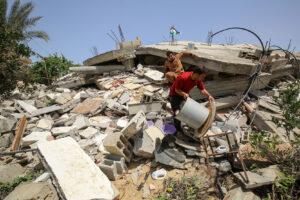
The state of Israel first occupied south Lebanon in 1948, the year of the Nakba. The Israeli military has assaulted and occupied Lebanese territory many times since then. The current conflict commenced after Hamas’ October 7, 2023 attacks on Israel and the Israeli army’s brutal campaign against Palestinian population centers and civilian infrastructure — homes, businesses, roads, bridges, power plants, hospitals, schools and universities, churches and mosques, cultural centers, agricultural land, wells.
Hezbollah joined the fight on October 8, largely containing the conflict to the border regions. In January 2024, Israel conducted the first of many aerial assassinations in Dahyeh (Beirut’s southern suburbs). Its forces dramatically escalated attacks throughout Lebanon in September 2024, and commenced Lebanon ground operations in October. Though a ceasefire agreement was signed in November 2024, in the months that followed, Israel continued to consolidate its hold over the south and to strike homes, agricultural land, and infrastructure throughout the Beqaa and southern Lebanon.
When U.S. and Israeli forces attacked Iran on February 28, 2026, killing Ayatollah Ali Khamenei, Hezbollah resumed attacks on Israel. War returned to Lebanon.
Lebanon’s current displacement crisis is worse than that of the 2023-24 phase of attacks because, firstly, more people have been dislocated. Three days after attacks resumed, on March 5, the Israeli army issued evacuation orders for the whole of Dahyeh, a line from the Gaza playbook unprecedented in Lebanon. By March 10, its south Lebanon evacuation zone extended from the UN Blue Line to the Litani River. Two days later, it was pushed 15 kms north, to the Zahrani River. New evacuation orders for different areas were issued daily.
When the provisional U.S.-Iran truce was announced on April 8, the Pakistani mediator, Prime Minister Shehbaz Sharif, explicitly stated that the agreement included Lebanon.
As expected, a few hours later Netanyahu declared that the ceasefire deal did not include Lebanon. That same day, Israeli forces launched over 150 strikes in Beirut, Dahyeh, the South, and Beqaa, hammering 100 targets in ten minutes. Several residential blocks across central Beirut were struck without warning. As this story is being edited, casualty estimates for the April 8 strikes are 357 dead and 1,223 wounded. A definitive death count is unavailable: bodies are still being pulled from the wreckage and the large number of body parts that have been recovered require DNA testing to confirm the numbers.
By the time the U.S.-Iran ceasefire was announced, Israeli forces had penetrated 5 to 9 km into Lebanon and taken the town of Khiam, though they were still facing resistance. Over a million people have been uprooted. The Israeli leadership has declared its army will remain in southern Lebanon until Hezbollah’s fighting force has been eradicated.
A ten-day Israeli-Lebanese ceasefire was announced in Washington on April 16. The same day Hezbollah demanded that Israel withdraw its forces to the Blue Line. Netanyahu declared they would remain in place. Based on Israel’s interpretation of the November 2024 ceasefire, it may be assumed that its army will use the cessation to take more land in the south.
Since Israel’s 2006 war, it has largely fallen to NGOs and grassroots initiatives to help the displaced, and cultural associations have played an important role in such relief work. What an association can contribute to mitigating a crisis depends on its financing. In a country where European-style state support for cultural organizations is absent and international funding streams have been drastically reduced in recent years, some must choose between giving and self-preservation.
The first impulse for most centers is to cease operations until the situation clarifies. Responding to public demand and a desire to sustain their staff and artists, some prominent Beirut institutions returned to programming on a reduced scale. Others have tried to balance core activities with relief work. In some cases, the lack of footfall has compelled some cultural workers to throw what limited resources they have into helping the displaced.
In March 2026, Barzakh, Ahla Fawda, Tiro Arts Association, Beirut Art Center, and Beit Aam were once again confronted with the question of how to operate during wartime. Despite their own precarious circumstances, all responded by turning their networks and resources over to relief work.
Culture to relief
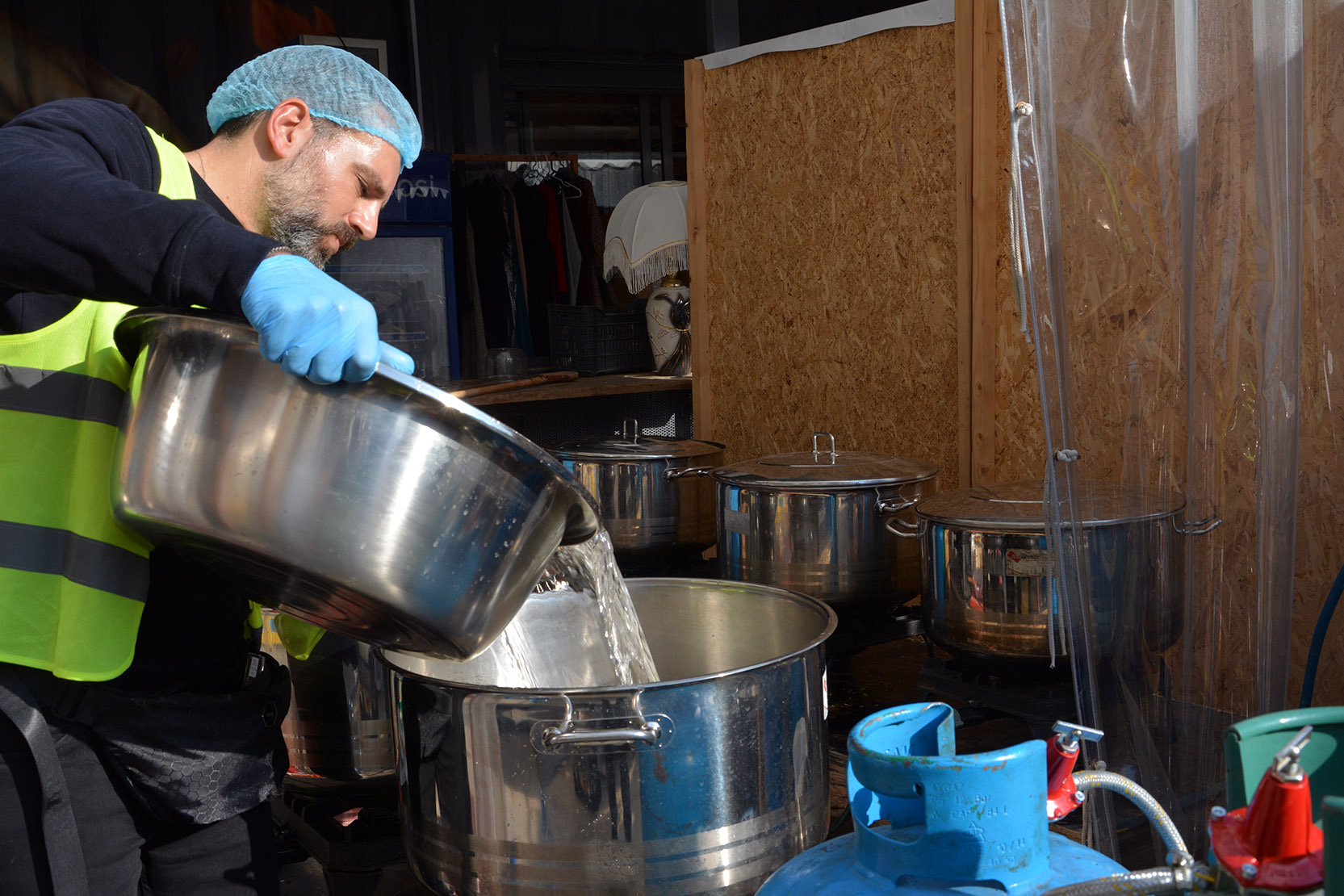
Chef Serena and her assistant are lugging a huge pot of vegetable stew from the kitchen of Barzakh café to the seating area. It’s Ramadan, and the pot will soon be part of iftar at the nearby Capuchin school, which is once again serving as a shelter for displaced families.
Crisis is in Barzakh’s genes. The cultural center was launched in the wake of Lebanon’s 2019 uprising, in the midst of the country’s financial collapse. It is one of several spaces opened over the years by journalist and impresario Mansour Aziz — who co-founded the project Sanayeh House (2008-2019) and the residency program 3 Studios in 2009. A minute away, on the other side of Hamra Street, Barzakh has an older sibling in Mezyan, Aziz’s restaurant-music venue.
Barzakh boasts a wide-ranging trilingual multidisciplinary library-bookshop, complemented by a café-bar. In better times, the space hosts a lively program of film screenings, poetry readings and book launches, talks, and concerts. Such events, and the footfall that sustains the space, tend to wane during wars and other disruptions.
When Israel escalated its attacks in September 2024 and families from southern Lebanon and Dahyeh fled north, Barzakh manager Khodor al Akhdar announced on social media that he and his staff would make 100 meals a day for displaced people at their own expense.
The post was widely shared, and private citizens, Lebanese and non-Lebanese, sent assistance — foodstuffs or money. The 100 meals became 800, then swelled beyond 2,000 a day. Over the course of 2024-25, Akhdar collaborated with other relief initiatives, notably MSF (Doctors Without Borders), who financed the creation and operation of a kitchen in downtown Beirut’s L’azarieh complex, part of which had become an ad hoc shelter.
Barzakh returned to more normal operations during the lull following the Nov. 2024 ceasefire, when Israel’s airstrikes and assassinations continued to target southern Lebanon and the Beqaa. When full-scale war resumed, a number of previous donors encouraged Akhdar to resume relief work.
“I wasn’t sure,” he recalls. “It’s a global problem now and I didn’t know if people would donate or not.”
Sustained donations did come in but began to fall off after a couple of weeks. Barzakh turned over 1,300 iftar meals a day during Ramadan. Since Eid, the kitchen has returned to making 2,600 meals a day, lunch and dinner.
Akhdar and his staff are preparing meals for families from Dahyeh and the south sheltering in three schools — Hamra’s College Saint Francois and Evangelical schools and Umar Faroukh School in Tariq El Jdideh. They also try to fill occasional requests in Beirut and beyond.
“We send whole pots to each school,” Akhdar explains. “If we send packaged meals, it’s gonna cost me an extra $85 a day for containers. I can get meat with that money.”
This stage of the war came in the midst of a winter that’s been unusually wet and cool in Lebanon, making the displaced a little more miserable. So Akhdar has also been distributing other materials when needed.
“It’s cold so I’m buying blankets,” he says. “Some people found places to stay but they’re not equipped. So I’m giving them money to buy kitchen utensils or cooking gas. I’m doing a few food parcels, so families can cook their own meals.”
*
Today the prospects of Lebanon’s displaced look particularly bleak. The principal structural factor is the Lebanese state’s institutional frailty. Seldom if ever equipped with effective contingency plans or personnel to manage disasters — whether Beirut’s 2020 port blast or Israel’s periodic assaults — the state has been particularly enfeebled since the financial crisis that bankrupted most of the country in 2019 and still weighs heavy in 2026.
Many displaced families who cannot be absorbed by the households of relatives and friends have likely ended up at schools — the default location for sheltering Lebanon’s unhoused — ensuring the disruption of Beirut’s education system. The state’s most conspicuous action in March was to open Camille Chamoun Stadium to displaced families so they could pitch their tents in a relatively covered area.
Such gestures are insufficient. Since the first week of Israel’s assault, ad hoc settlements have bloomed. One lines the sidewalk outside the southern and eastern walls of Horsh Beirut (Beirut’s pine forest and largest public park) — just north of the evacuation zone — while some families are sheltering in the park itself.
One sunny day, three weeks into the war, residents of a couple of tents were selling fruit on the sidewalk. Another fellow had improvised a fresh juice kiosk. For a time, there was a particularly picturesque cluster of tents and tarpaulin awnings before the western wall of the Résidence des Pins, the palatial Ottoman-era edifice that houses the French ambassador to Lebanon.
A timely resolution of this crisis seems unlikely. As this story is being written, the Israeli army continues razing all habitation and foliage adjacent the UN Blue Line (Lebanon’s de facto southern border) to clear its line of fire. Its political leadership has declared the army will re-occupy southern Lebanon until Hezbollah’s forces are destroyed, and that families will not be allowed to return before then. After the April 16 cessation was announced, the party asked the displaced not to return home until the situation is clarified.
As in Gaza, ethnic cleansing accompanies Israeli occupation, but in Lebanon the m.o. seeks to aggravate sectarian tensions more explicitly. Israel has assured residents of non-Shia Muslim villages in the south that evacuation orders do not apply to them but if they shelter displaced Shia families, they too will be targeted — a promise the Israelis have honored.
Though individual states have expressed outrage at Israeli-U.S. collusion in their illegal assaults on Iran and Lebanon, the consensus in the international community ranges from complicity to indifference.
Since 2024, Barzakh has been collaborating with the NGO Ahla Fawda. Activist Imane Assaf founded the organization around 2012, and in its early years it was known for the large-scale murals it commissioned from several young artists to adorn Beirut tower blocks, particularly around Hamra Street.
In the ensuing years, Ahla Fawda supplemented its arts activities with humanitarian and environmental projects. Since 2023, the NGO has been operating from its “EcoHub,” established on a plot of donated land on Emile Eddé Street, a few minutes’ walk from Barzakh.
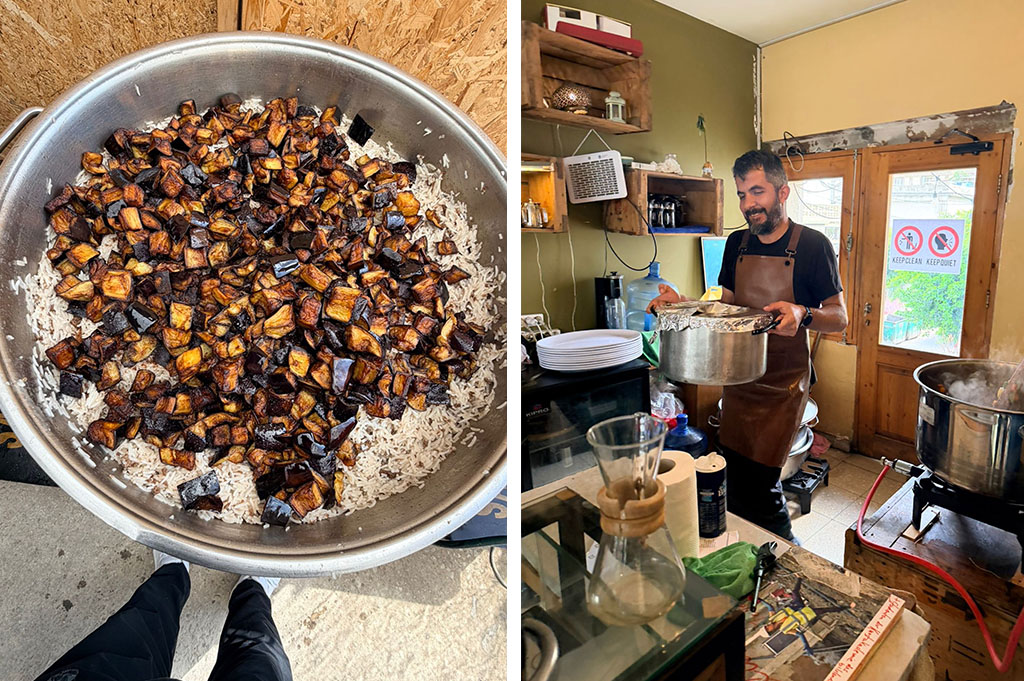
These days a relief kitchen has been set up beneath an awning. Chef Fouad and his assistant wear outfits with the logo of the We Deserve Better foundation emblazoned on their chests.
The EcoHub’s peacetime operating principle is to hitch assistance for dislocated people — a late-capitalist problem, aggravated by Lebanon’s 2019 collapse — to the worsening waste crisis. The hub’s cluster of buildings centers on the dukkan, a shop where people can access half-price tinned food and dry goods in exchange for recyclables. In wartime, foodstuffs are free, but displaced folks are encouraged to exchange recyclables for petty cash.
Assaf’s staff now includes people displaced from Dahyeh. Near the dukkan, some volunteers are cleaning glass bottles for reuse and re-filling scrubbed bottles with cleaning products and cooking oil. Others are filling bags with dry goods — rice, lentils, sugar, salt, etc.
The hub also has a shop stocked with donated clothing. Every 15 days, registered adults are free to select two items for themselves and three for each child. There is a waste unit, where people bring their recyclables for weighing and exchange. There is an upcycling center for plastics, glass bottles, wooden pallets, and such.
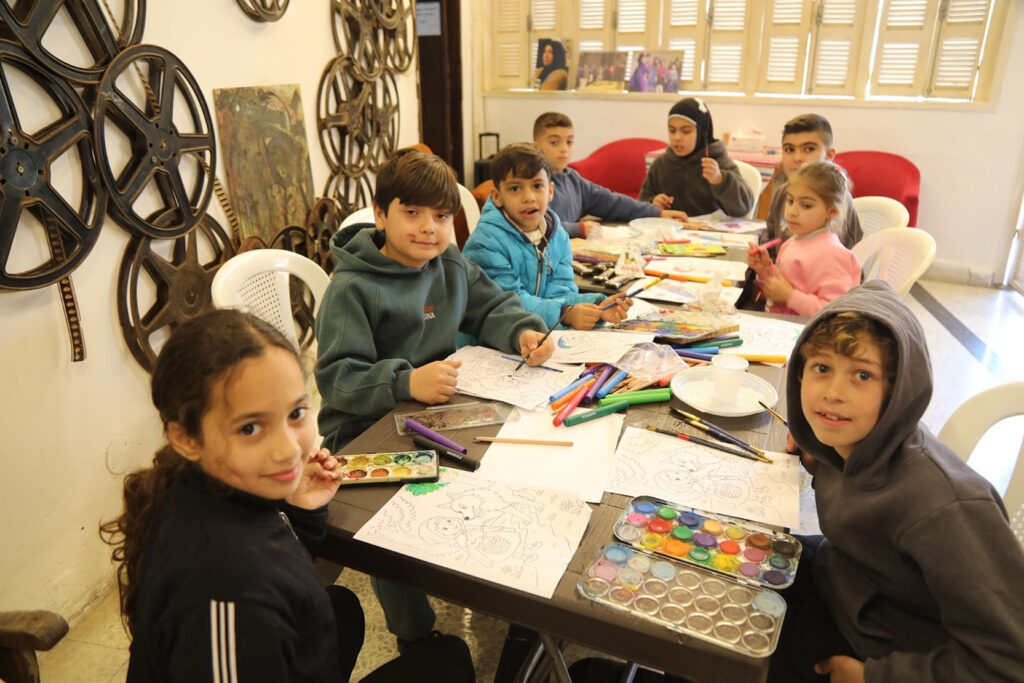
In addition, it hosts activities for children. Today a musician named Ziad has been showing displaced youngsters how lengths of PVC pipe (notoriously difficult to recycle) can be made into durable nay flutes.
On this day, the Eco Hub exudes an incongruous air of hope.
One of Assaf’s collaborators in this project is Design for Communities, an NGO based at AUB. “We support community projects by creating sustainable environments and with low-tech materials and limited budgeting,” explains architect Fatima Mourad.
Most of the structures here look improvised but for one stylish module that the NGO built for Eco Hub. “We have a full master plan for this lot,” Mourad says. “The aim is for the Hub to be a full community center.”
Space for the displaced
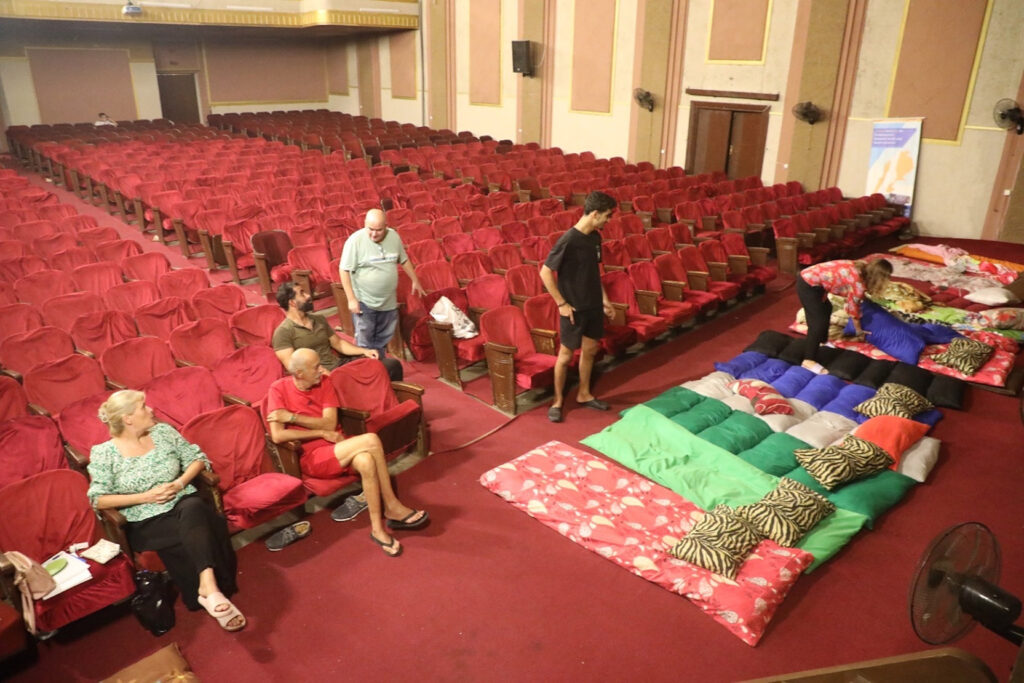
At Hamra’s Le Colisee cinema this Sunday afternoon, Qassem Istanbouli and his colleagues are holding an acting workshop with a dozen or so children and teenagers from displaced families. Journalists are in the terraces and onstage, filming the improvised movement for overseas television and print media, and buttonholing Istanbouli whenever administrative demands pull him offstage.
The youngsters are preparing for a play entitled “Returning,” in which the players interpret their experiences of war and displacement on stage. Istanbouli debuted the play at Le Colisee on March 27, World Theatre Day, and it has been performed several times since.
An actor-director, Istanbouli has been working to make the arts accessible to people outside Beirut since 2008. In 2014, he became the face of the Tiro Association for the Arts (TAA), an NGO dedicated to encouraging local communities to engage with arts and culture free of political and religious sectarianism.
Istanbouli has been reactivating derelict cinemas and retooling them as free cultural centers since 2014, when he relaunched Tyre’s Al-Hamra cinema (founded 1966). Today, the Colisee, Tyre’s Rivoli, and Empire cinema in the northern city of Tripoli, remain active. Collectively rebranded the Lebanese National Theater, they host workshops in handicrafts, storytelling, drawing, and theater. Tiro also brings its activities to outlying villages.
“We work a lot with kids, youth, and women,” Istanbouli says, nodding to the influence of the artist Bahiya Zayat, Tiro’s president. “We have a kiln in Tyre and many women are involved with making ceramics.”
Tiro also stages performances and hosts several festivals. In-house productions have been invited to European events and the NGO was shortlisted for the 2026 Mayor Pawel Adamowicz Prize, awarded for actively combatting intolerance, hate-speech, and xenophobia.
In a region where diversity is under attack, Tiro’s ecumenicalism is notable. Several Syrians and Palestinians are involved in the Tripoli and Tyre spaces, Istanbouli says, and Le Colisee’s staff includes Syrians and Sudanese.
Istanbouli says about 100 people are sheltering in Tiro’s three spaces, and here too a big-tent inclusivity is evident. “We have families from Ethiopia and Bangladesh,” as well as Lebanon, Istanbouli says. “They have no options.”
Nodding to the young people onstage for the acting workshop, he notes that their families are from Sudan, Egypt, Palestine, Syria, and Lebanon.
“In Beirut we have fewer displaced people than in Tripoli and Tyre,” he says. “Three families from the border region sleep in the loge [VIP boxes]. One of the sons is a barber, so he’s cutting the other residents’ hair.
“We also have families in the theater,” he adds. “Individuals are sleeping backstage. Someone else sleeps in my office.”
Istanbouli tends to use his trips between Tyre, Beirut, and Tripoli to run relief work errands. Holding a bag of pharmaceuticals, Istanbouli gestures to clothing donations neatly stacked in front of his desk, both destined for Tyre.
Many of Tiro’s peacetime partners are from overseas — like Drosos, UNESCO and UNIFIL. Since registering the cinemas as shelters, it has received some local assistance.
“Now we see some state support in Beirut and some NGOs bring food,” he says. “Not in Tyre, but we do get some support from the municipality. In Tripoli some NGOs are helping. If this war continues for a long time, we will need a lot of help from the community and the government.”
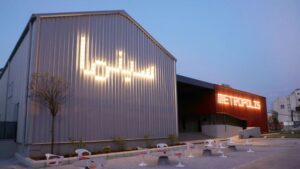
Before 2019, operations at Beirut Art Center were much like those of blue-chip institutions elsewhere in the world. The space in Jisr al-Wati hosted a wide range of contemporary art exhibitions featuring international, regional, and local artists. Its shows were complemented by a lively public program. BAC also commissioned work from local artists and staged a yearly emerging artists’ show.
When the Beirut port exploded in 2020, BAC opened its doors to the NGOs and grassroots initiatives working to secure and weatherproof the surviving portside structures. In the years before Israeli’s Gaza genocide and in the lull following the 2023-25 phase of the current conflict, the team has staged several significant exhibitions featuring Lebanese and regional artists. Such programming is now paused.
BAC’s operations head Boulos Saad says it made sense for the center to turn over much of its space to the relief effort. “As BAC is a big industrial space that’s easily accessible and in a safe area,” he says, “we decided our first responsibility is to support getting emergency materials to displaced people.”
BAC now has several organizations and initiatives using its spaces as a logistics hub.
The sewing machines of Deep Sleep, a family-run company specializing in high-end pillows and beanbag furniture, have taken over the back end of the central hall. Their volunteer initiative Pillows of Hope is producing handmade pillows for displaced families — useful when you’ve been bereft of all your furniture.
On this day, three weeks into the conflict, the front end of the central hall has been stacked high with an assortment of materials, including duvets and mattresses. These are being disbursed by Beit Aam, a community cultural space founded in 2023. Based in Badaro, southeast Beirut, it hosts associations concerned with social and environmental justice.
“Badaro is quite close to the evacuation area,” says a Beit Aam member who requested anonymity, “and we needed a warehouse. Also, we have some issues with our landlord about storing stuff for displaced people.”
She says Beit Aam has been at this work since before the November 2024 ceasefire. “We also helped people transition — returning to their homes and supporting them with their basic needs,” she says.
“We provide anything that comes in — food parcels, basic hygiene kits, hygiene for women, mattresses, blankets, pillows, diapers, baby milk. For Eid, we distributed around 700 boxes of sweets.”
During the early years of the collapse and COVID, 2019-2022, BAC’s team members chose to prioritize supporting the work of artists and arts writers over in-person exhibitions. Ibrahim Nehme, BAC’s current director, and his team are now following a similar course.
The center’s artist residency program, “Room for Practice,” will be open indefinitely so the six resident artists can mingle and collaborate with displaced artists and anyone else needing a space to work, or hold meetings.
Environmental themes, catastrophic and otherwise, are pervasive these days and BAC plans to put on a series of events inspired by the land that has endured so much violence during Israel’s decades of air assaults, invasion, and occupation.
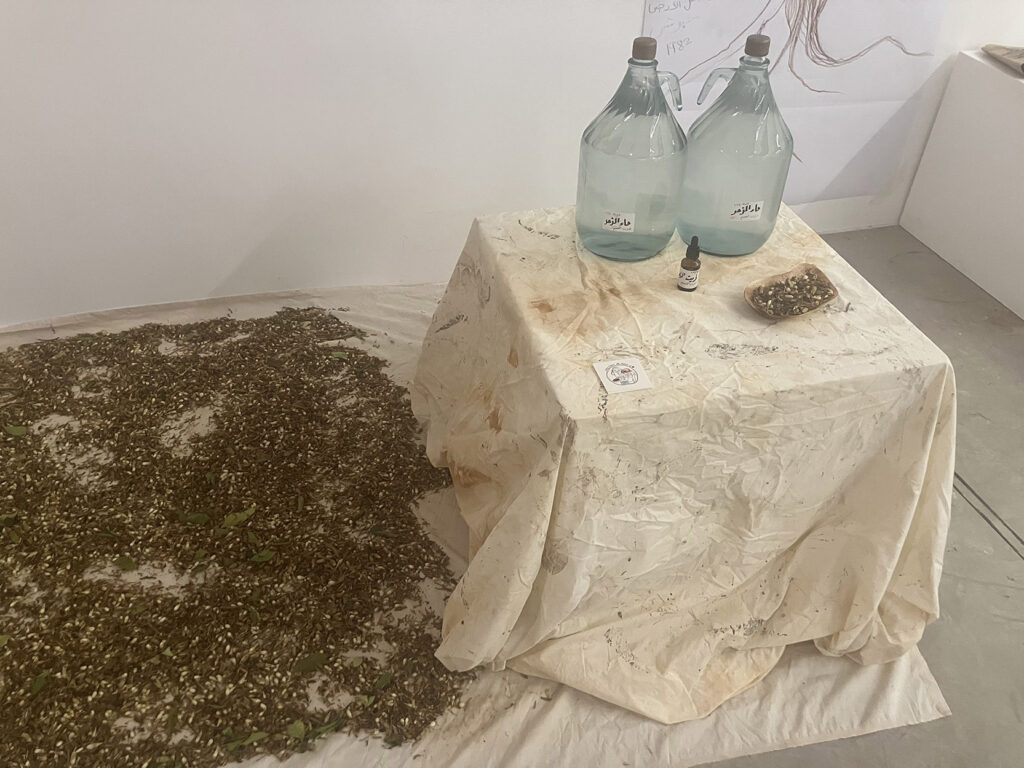
Staged during Eid (March 19 and 20), the first of these events was inspired by the disruption of the yearly distillation of orange blossoms. Nathalie Abikhalil oversaw the distillation, which drew on flowers from orange groves in the southern town of Darb El Sim and the Shouf town of Jadra. The orange blossom water was distributed among displaced families who ordinarily distill for their own home.
This project is highly gestural — not at act of provisioning but an expression of solidarity. The second day of the event was dedicated to stories arising from families’ experience of this traditional practice.
One dislocation after another
The weight of this displacement crisis is compounded by the fact that the violence of 2023-24 didn’t end in the south and east of the country.
“I was living in Braikeh [on the Litani River],” the Eco Hub’s Fatima Mourad says of the 2025 lull. “You’d be afraid that the car in front of you is gonna be bombed, or the one behind you, or else a road, or a building. You don’t know.”
When the conflict escalated again in March, the prevailing sense around Beirut was one of exhaustion.
“This is something we Lebanese always do. ‘Okay, the war’s finished. Go back to life,’” Akhdar says. “At Barzakh we were trying to build the business again, but we were still processing. Most of us lost people we know, but you didn’t have time to grieve. You really need this time.”
Some cultural institutions that stepped up to assist artists and dislocated communities — after the 2019 collapse, after the port blast and during the first phase of this war — have not been active since the 2024 “ceasefire.”
A staffer at one organization that threw itself into relief work in 2024 laid out the stark realities of the current climate. “We put in lots of effort,” providing meals for displaced families, she recalls. “After the financial loss of closing for two months, it took us almost a year to get back to a place where we can sustain ourselves as a cultural institution that gets no external support. Then the war started again.”
For Akhdar, the differences between the relief efforts of 2023-24 and those of 2026 are evident.
“Most of the displaced people from Dahyeh followed the evacuation route that the Israeli army gave them and went to the mountains. Those people are getting next to nothing because most of the relief work — the NGOs, the kitchens, the personal initiatives — is happening in Beirut.”
He’s received several calls asking for blankets for people sheltering in Mount Lebanon.
“The initiatives are also less than before,” Akhdar adds. “Many people who hosted displaced people before don’t want to do so now, either for political reasons or because they are just drained.”
“In 2024, it was chaos. We made meals for anyone who asked, so the staff were really exhausted. I don’t want to make that mistake again.
“Nobody knows how long this war’s gonna continue. I have to manage the funding that I’m getting. If I spend everything now, and the war continues for months, I have nothing to give anymore.”
Conflict increases costs. “I just bought 1,000 blankets,” Akhdar says. “Each blanket is $12.50. That’s $12,500. In 2023-24 a blanket would cost $7-8. Lebanon’s economic problems are now worldwide, so prices will skyrocket.”
Indeed, since oil and gas flows through the Strait of Hormuz entered the news feed, EDL (the state electrical utility, whose stations are oil-fired) has returned to rationing. Those who count on freelance generator operators to take up the slack face higher rates.
Assaf remains optimistic but Ahla Fawda’s expenses have increased. “We’re paying not less than $1,500 a day to resupply,” she says. “It’s more expensive but we are lucky that there are people who trust our operation and who donate. People’s kindness is Lebanon’s strength, I think.”
Some give. Others take. Relief workers reckon that Beirut rents have trebled since the conflict resumed.
Launched when the war broke out in 2023, the initiative Saqef Wahad (One Roof) was created to provide safe places for displaced families, compiling a contact list of landowners wanting to rent and families in need. Because NGOs are focusing on the big shelters, Saqef Wahad, now based in BAC, is distributing in-kind donations from other organizations and individuals among families sheltering in houses around Lebanon.
Saqef Wahad is no longer trying to find accommodations for the displaced because, for diverse reasons — ranging from insecurity and fear to opportunism — the supply of affordable locations has evaporated.
“People are becoming very greedy,” says Reem, a Saqef Wahad volunteer, “and the government doesn’t do anything to restrict or cap rents.
“A small, unfurnished room is being rented for $600-700,” she says. “Flats that used to cost $400 a month are now going for $1,200. Some families are sheltering in natour [concierge] rooms.”
The relief effort has been more challenging this time, she says, because of the lingering financial crisis. Suspicious of those seeking contributions, people are donating less, and volunteers themselves are strapped for cash.
Since hostilities resumed, negative attitudes towards the displaced have been evident among some Lebanese, which Reem finds ridiculous.
“For years these people have tried to stand their ground, to resist, to defend their land, their homes, their rights, their kids, their animals,” she says. “I don’t understand why others choose not to see this.”
“There’s a rejection this time,” Assaf reflects. “Last time, people’s attitude was, ‘We will help you. You’re one of us. We’re one community.’ This time it’s like, ‘Why did you bring this on us?’”
This rejection stems, in part, from emotional and financial exhaustion among host communities, as well as gouging. It also derives from Lebanese sectarianism, and the brazen energy with which Israel adjusts its tactics to take advantage of its adversaries’ weaknesses.
During the 2006 war, for instance, airstrikes were generally confined to regions assumed to host Hezbollah infrastructure — predominantly Shia Muslim southern Lebanon, Beqaa, and Dahyeh. Since attacks commenced in 2023, evacuation orders have been used to terrorize displaced and host communities alike as Israel has targeted displaced families all over Lebanon — including largely Christian north Lebanon, central Beirut’s mixed neighborhoods, and tents pitched at the seafront.
Military spokesmen claim that they are liquidating Hezbollah operatives, but these strikes more effectively target the anxieties and chauvinism of the country’s fragile, multifaceted society. It is an attack on Lebanon’s diversity.
“Many people are afraid,” says Akhdar, nodding in the direction of Mezyan. Earlier that day, the entire building had been shuttered because Israel had warned a sarraf (money changer), who’d recently opened an outlet next door to the restaurant, that his businesses would be targeted.
“That’s a minute’s walk from here,” he says.
“Many initiatives who led in 2024 had spaces where they could organize,” says BAC’s operations’ manger. “Now they’re facing difficulty finding spaces for logistics. Landowners have become afraid that if you’re receiving donations, you may become a target.”
Lebanon’s displaced are also in a different place. Assaf finds people more dispirited than in 2023-4.
“Last time they felt they would return,” she recalls, “that they would win this war. This time, there’s a real fear of occupation.
“I had some kids who volunteered with me last year. One of them, a young lady from the south, and a young man from the suburbs.”
“They lost everything last time, but they kept up their spirit,” Assaf smiles. “Even after they lost their scholarships [when Trump gutted USAID], it didn’t break them. This time, they’re here. They’re helping. But the mood, the atmosphere, is completely different. It’s one of defeat.”
Assaf says hello to a volunteer, then sighs. “Displaced people hear other Lebanese demean them and they’re hurt,” she says. “A lot of people who came are choosing to go back, even though it’s terribly dangerous. But they feel better off risking death rather than being rejected and humiliated.”
“I stayed with my family in the south for a couple of days when [the war] started again,” says Mourad. “I was crying when I left. I felt like I’m not coming back.
“That’s why some people don’t want to leave the south. They feel that if they leave, they’re not going to come back. We’re not going to leave our houses, our land, even if we have to die in our homes.”
By the third week of the conflict, donations to Barzakh had dropped off significantly. “I’ll be honest,” says Akhdar. “I’ll manage the funds as best I can, but the minute I’m out of funds, I’m gonna stop.”
“I have a place I need to survive. In these conditions, it won’t last more than two months. There’s no business. The number of people coming is less every day. People are worried.”
To participate in relief efforts, donate to any of the following:
Barzakh • Ahla Fawda • Tiro Arts Association • Beirut Art Center • Beit Aam