An innovative artist and self-described "Arab decolonial feminist from Mount Lebanon" reflects on the inspirations for and challenges within her work.
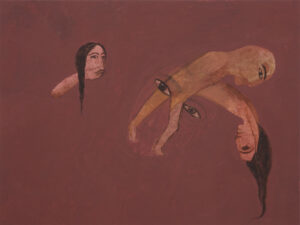
Figure 1. Displaced
Acrylic on cotton paper, 12.5 × 9.5 inches, print ¾, 2026.
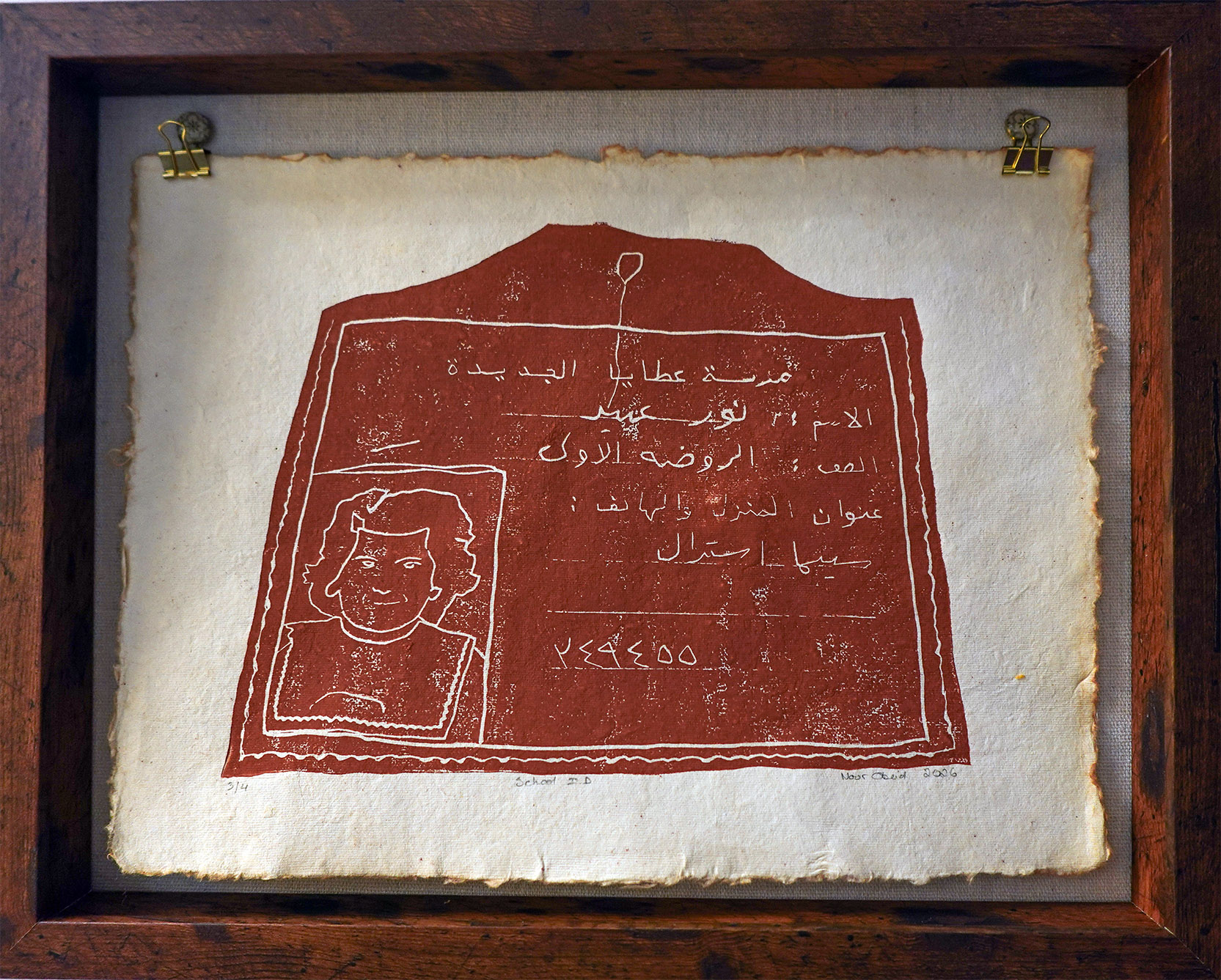
Encapsulated happy moments built on a tragic story. My first school I.D card. In the section where my mother should write down our address, it simply said: Cinema Estral. The days were fragmented; my uncle’s dark apartment above his cinema in Beirut, outside, massacres that intermittently stopped, walks with my older cousin (deceased now) on the corniche, eating roasted peanuts in paper cones… In my mind, none of these memories were ever indexed under the category of refugee or displaced, nor were they tainted by the fact that we were in the middle of a civil war, fatherless, and unhoused, yet this is the base upon which all of them stood.
Figure 2. Ceremonies Three
Acrylic on cotton paper, 6×4 inches each. Three prints. Ceremony 1: print 1/9; Ceremony 2: print 5/6; Ceremony 3: print 6/6, 2026.
Ceremony 1:”حبيبتي نور, ما تزغري. صخنيلي بريق المتي”
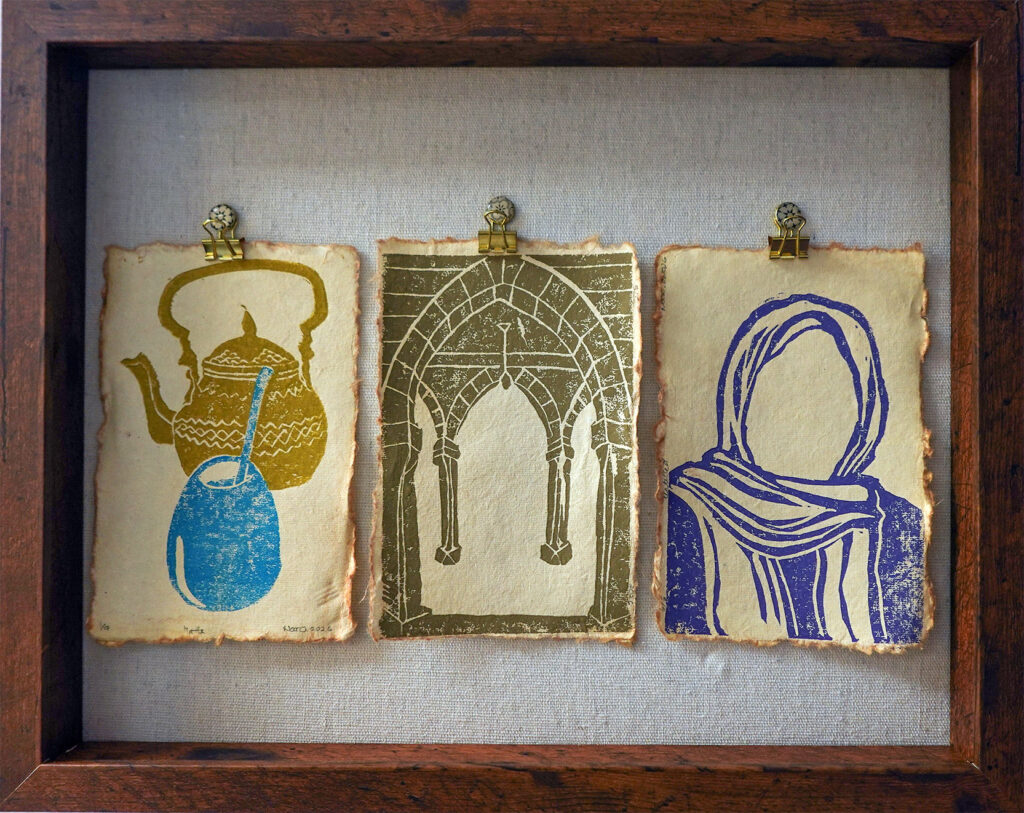
A cyclical sequence continues until all that needs to be said has been said. Until recently, I firmly believed it a beverage that could never be consumed individually… Like the sun, the designated ‘pourer’ has all the ingredients for the drink: The ‘2ar3a, the ‘Bombija,’ maté leaves, a lemon slice, and a pot of hot water. The rest of us sit around in anticipation: when you are handed the 2ar3a, you take a sip until it purrs, never let the 2ar3a touch the table… others are waiting… return to the pourer. They clean it so well with a piece of lemon peel, refill the 2ar3a, and pass it to the next participant… to the right, for good luck. And that’s all it took for us to enter Ceremony.
Ceremony 2: And here, I come to rest
Makam Al Amir Al Sayyid Abdallah Al Tannoukhi, nestled in one of Lebanon’s mountains, is where my mother and I bond on a deep spiritual level. We pilgrim and worship, I rest and absorb.
Ceremony 3: “ماما انت شاطرة بالتصوير، صوريني شي صورة حلوة لنعوتي بكرا بس موت”
I took the photo; she is beautiful, and I am terrified, so in repetition, I find solace; in repetition, my obsessiveness is quenched; in repetition, I decide who fades and who lives forever.
As an Arab decolonial feminist from Mount Lebanon, I draw on multiple threads in my scholarly and printmaking practice. I have lived through multiple wars, displacements, and a fully embracing intergenerational household. My life has seen many ruptures, refractions, and movements. I question the assumptions of the archive, build my own, and then call on a new repertoire of the archive to create a set of acrylic and handmade paper prints. I implode into the image-selecting, image-making process as a research practice. Along the way, I discuss transculturism, process, displacement, decision-making, and expression.
Theoretically, I draw on Taylor’s (2013) idea of the archive and J. Kēhaulanis’ invitation to examine how the elimination of the native is a key component of settler colonialism, and how to approach subjects locally (specific region/land/place), as felt knowledge.
Methodologically, my engagement with this project is rooted in archival analysis and an auto-ethnographic approach as a decolonial method that re-centers the “subject-as-researcher” (Augustus, 2022). I draw on feminist scholars such as Hartman (2008), who discuss the impossibility of finding voice where it has been lost. Engaging visual outputs as analytic tools also enabled a shift from attention to isolated details toward the apprehension of broader patterns, tonal resonances, and latent meanings. Through visual synthesis, the analysis moved beyond fragmentation toward a more integrative understanding of the data, allowing sensory, emotional, and symbolic dimensions to surface as central components of meaning-making (Holman Jones et al., 2013).
My archive is stitched from memories. The archive shows moving places, what it feels like living under the earth, moving over a mountain, looking into the future, being haunted by the loss of a matriarch, and sites of respite. I have been everywhere. Unwilling. Not a refugee, not a houseless person, but one who has been pushed and pulled, both by violence and by peace. My archive moves with me; it is horizontal and oblique, unfettered by indexes, untouched by experts. It speaks to a place unknown, simultaneously created by movement and practice.
Figure 3. Inhabited Abandoned Places
Upper Right, Lower Left: The Mountain.
Acrylic on cotton paper, 6×4 inches each. Two prints. Left to right: print 3/4; print 4/4, 2026.
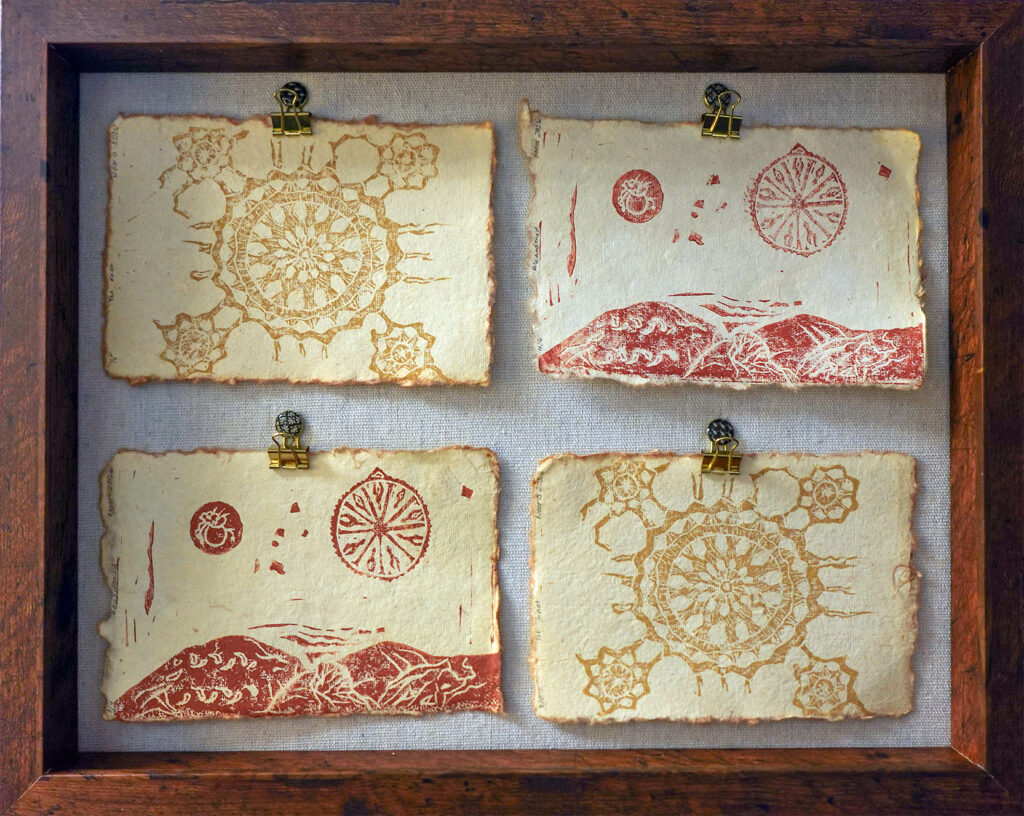
I summon back time when She was still around, her house always clean, the food warm, and a mountain breeze. At any time, one or more of my 37 cousins could be found there for one reason or another, matte, overbearing uncles playing Tawle; and a house brimming with animals.
“If the animals are hungry, they cannot tell you; you must be preemptive, Noor…”
“… يا نور ,الحوينات ما فيا تقلك انا جوعانين. لازم تستبقي حاجاتهن”
Let these memories be knit together into a formidable tablecloth that I never use. Hidden in my closet, as many precious things are; delicate, frayed, connected, precious, and useless.