


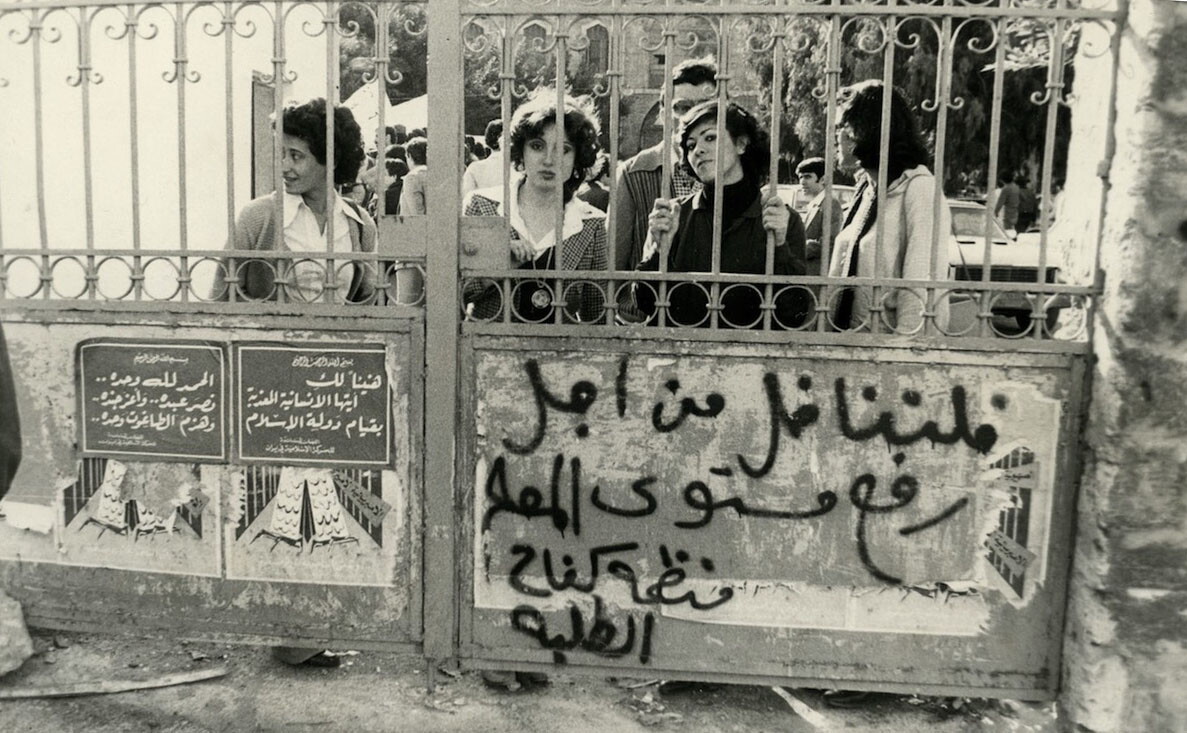
A look back at the tangled web of Arab politics—and a seemingly simple unifying cause—and the fault lines that remain.

By the late 1970s, open leftist agitation had run aground in the Arab world. Dictatorships were maturing into full-fledged police states. The game of politics was fast narrowing into a fabricated contest between political Islam and the so-called Arab order. Very soon, these two would define the only choice made available to us. As Annia Ciezadlo succinctly put it in a 2007 piece for The Nation titled “Sect Symbols”:
Once again, Lebanon is facing the oldest, saddest choice in the modern Arab world: between undemocratic religious militants and a greedy, corrupt elite whose biggest selling point is its dubious ability to keep those militants at bay.
But in faraway America, the 1980s were a time of ferment for Arab students. Every imaginable party, movement, group—small, large, mainstream, fringe, pro-this regime, anti-that regime—had a presence on campus. Practically every student found their voice in one of them. Palestine, of course, was the cause célèbre there, much as it was in the home country. It towered above us like a goddess—pure, sublime, noble. There could be only one sentiment that made sense, only one that was honorable, only one that was worthy of the cause: love. Boundless, unconditional, unyielding.
Palestine, Israel, and the colonizing West fueled practically every argument.
Nobody fought over this simple truth. But in the earthbound business of politics, rival custodians clashed over this mother of all causes, like mortal enemies across infernal battle lines. On their surface, the political divides seemed straightforward: for or against armed struggle; for or against two states; for or against revolution in the Arab world on the road to Palestinian liberation… But in their details lay the tangled web of Arab politics. And on that web stood countless camps. If you were a college student in the U.S., odds were that you belonged to one of them.
Palestine, Israel, and the colonizing West fueled practically every argument. The famous slogan from Gamal Abdel Nasser’s era—no voice rises above the call of battle, لا صوت يعلو فوق صوت المعركة—haunted every position. For one side, the fight took precedence over all other issues. To dwell on tyranny, corruption, incompetence, poverty… was to equivocate in a time of existential struggles, to misread priorities, and to locate the source of our failures outside our enemies’ sins against us. By default, those who didn’t subscribe to this battle cry were at best defeatist or useful idiots, at worst traitors. To these, in turn, the sloganeers were at best dogmatic and wooden, at worst apologists or enablers of Arab despotism.
History progressed, our troubles changed with it, but the fault lines stayed more or less the same. The 2011 Arab uprisings are a good illustration of the continuities that sustained them. If, say, the revolt in Syria was read as an Israeli- or American-sponsored conspiracy, then it lost all agency, if not all legitimacy. Bashar Assad’s brutal suppression of it became a defeat of the very conspiracy. If the rising masses were not in on the foreign intrigue, then they were certainly dupes of it. Once the revolt devolved into a civil war between Assad and an assortment of jihadi and Islamist armies, Ciezadlo’s stark choice reimposed itself with extraordinary alacrity.
Back in the ‘80s, I belonged nowhere in this contest. Values and principles were clear guideposts; all else was contingent. Commitment to a cause like Palestine was unwavering and non-negotiable, but it didn’t automatically dictate a position on any question.
I remain a political vagabond.
I simplify with extreme recklessness an unbearably fraught, epochal discourse in the hope of adequately responding to readers and friends who have reached out about my latest column, “Assailed and Abandoned in the Levant.” In it, I depicted a dilemma shared across countries: rage against Israel’s menace and resentment against national failure. I identified Lebanon as one of several theaters in the region where the Jewish state and Iran are wrestling for primacy, with the ruling elites of this chronically infirm state enthusiastically reprising their time-honored role as facilitators. I included Hezbollah among them.
“Are you not for the disarmament of Hezbollah as a necessary step on the path to state sovereignty? Is it not the first imbalance to address on that path? Do you not agree that theocracy is a totalitarian proposition?” some asked. Others cautioned that, by identifying Hezbollah as Iran’s forward defense, I was subscribing to American terminology. Comments and counterarguments took much the same form, as if to press for a clearer stand–for or against. Because, of course, in a time of existential struggle, one has to. To refuse to belong is to indulge in a luxury that we have yet to earn in this region.
Footage of Israeli settlers from the “Ury Tzafon” movement infiltrating the Hasbani River area in Lebanon.
They have a point. And yet to refuse to belong is itself a quest to belong—only somewhere in prohibited political territory, in that vast space outside a debate that is as contrived today as it was in the 1980s. In pondering my readers’ questions, I was reminded of Miranda Vidak’s very funny post on the World Cup.

In this spirit, I am for state sovereignty; alas, the state itself isn’t. I am for the disarmament of Hezbollah, but never as a precondition for Israeli withdrawal from the south. I have no issue with direct negotiations with Israel, but I have a very serious issue with dangerously mindless concessions to it. I think a constructive dialogue with Iran is at least as important, if not more so. I rank Israel as an enemy—a mortal one, at that. I do not rank Iran as one. The reasons are plain enough.
I am cognizant that Hezbollah’s susceptibility to Iran is very problematic for Lebanon in the same way that competing elites’ receptivity to foreign influence is. I register the party’s complicity in Lebanon’s defunct system. In my judgment, this complicity has immeasurably weakened the credibility and effectiveness of the resistance. But I know that the state and its army are utterly helpless before Israel’s occupation of the south, which leaves the movement as the only challenge to its presence. I call this one—just one—of our myriad Lebanese predicaments.
I stand with the Islamic Republic against Israel and the U.S., and stand with the Iranian people against the Republic. I think theocracy is perhaps the worst model of governance, be it Israeli or Iranian or any other variety (and yes, Israeli is deliberate). But I firmly believe apartheid, genocide, and ethnic cleansing tell an infinitely more damning story about their practitioners. I do not wish to live at the mercy of Iran or Israel, even though I note the qualitative difference between them. Yet another stark choice I reject wholeheartedly.
So I shall wander like the vagabond that I am for the rest of my life.
On Another Note
In the mid-18th century, Shaykh Muhammad al-Khalili, a prominent Jerusalem notable and a great forebear of renowned historian Rashid Khalidi, purchased a large piece of land in what is now West Jerusalem and consecrated it as the Khalili waqf, an Islamic endowment permanently shielded from sale or division. In 1948, Israel took possession of that land when it conquered Palestine.
In the 1990s, the Khalidis and other Palestinian families who owned property adjacent to the waqf joined forces under Walid Khalidi, longtime senior research fellow at Harvard’s Center for Middle Eastern Studies and one of the most distinguished historians of Palestine, who died this year at the age of 100. Their aim was to block plans to locate the U.S. embassy on that seized land, should Washington ever relocate its mission to Jerusalem.
Now, under the Trump administration, the U.S. is finally moving forward with exactly that plan—to build the embassy on this stolen property in violation of both private property law and international law. One very ironic twist: doing so also violates the rights of U.S. citizens, since Rashid and many other owners hold American citizenship.
+972 Magazine, an intrepid online investigative platform jointly run by a team of Israeli and Palestinian journalists, interviewed Rashid Khalidi to talk about his family’s decades-long legal fight.
But what Khalidi had to say about the trajectory of U.S. policy on Israel-Palestine was no less interesting. He ends by telling Ben-Gvir, Smotrich, and their ilk to “wake up and smell the hummus.” If Israel couldn’t get rid of the Palestinians in one hundred years of trying, it won’t succeed now.
Have a listen!
Amal Ghandour’s biweekly column, “This Arab Life,” appears in The Markaz Review every other Friday, as well as in her Substack, and is syndicated in Arabic in Al Quds Al Arabi.
Opinions published in The Markaz Review reflect the perspective of their authors and do not necessarily represent TMR.




It’s an excellent article that captures the narrative which more closer to truth compared to propoganda against Palestine and Arab poltics that is brewing enormously these days.
Thank you for writing this piece.