
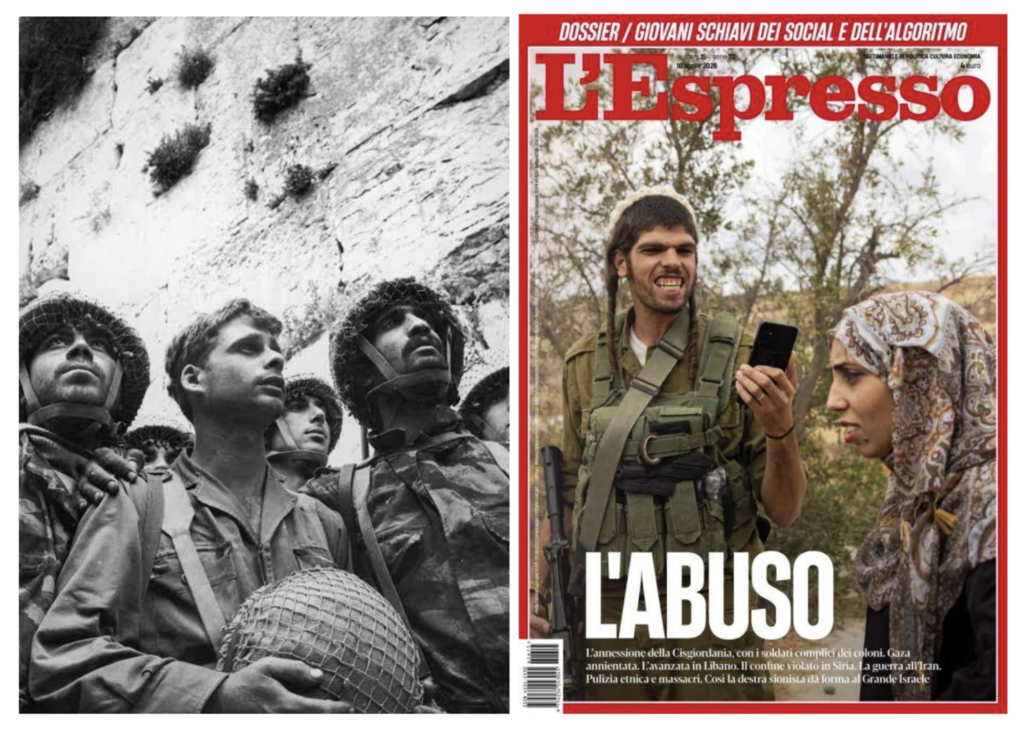
You’re looking at two photos that capture the journey of the Zionist narrative. The one to your left is the iconic snapshot of Israeli soldiers, after the 1967 conquest of the West Bank, East Jerusalem, and Gaza, standing by the Wailing Wall and looking towards the heavens as if in gratitude for God’s favor and choice. The other is of an Israeli soldier and settler, right out of central casting, taunting a Palestinian woman.
A journey that starts in myth and concludes where it always belonged, here in the real world.
“…The rest of the world can either recognize that Israel is this tiny little country that is standing up for civilization as we know it today, or they can go to hell.” This is the new Zionist fiat. It came recently to “the rest of the world” courtesy of one of Israel’s staunchest advocates, Bret Stephens, a current columnist at the New York Times and former editor in chief of the Jerusalem Post.
Since all sensible people are mortified by “civilization as we know it today,” it’s not surprising that Stephens identifies none other than Israel as its defender, since all sensible people are equally mortified by Israel. Besides, Stephens must surely know that his injunction threatens to flood the gates of hell, since a solid majority of humanity, including young Jews, also do not recognize Israel as this tiny little country standing up for any remotely standard definition of civilization.
All the same, I think the columnist has done very well in coining Israel’s new catchphrase. Not so long ago, it used to be the infinitely more elevated “Light Unto the Nations.” But that’s when “the rest of the world” subscribed to the Zionist narrative. Now they don’t, so Stephens and Israel are simply rolling with the times. To each era, its taglines.
How the Jewish state and its friends think they can recapture hearts and minds with this leering shibboleth is beyond me, which makes me wonder whether that might not be the point: they no longer care to. The times are a-changing, the plot has unraveled, the old narrative has foundered, and a new cast of actors has replaced the old one. So, I suppose, the blunt threat has to replace the noble calling. It feels like a millennium, but only a few decades separate Benjamin Netanyahu from Golda Meir and David Ben-Gurion, Israel Katz and Itamar Ben-Gvir from Moshe Dayan and Yitzhak Rabin, Bezalel Smotrich from Yisrael Galili, Gideon Sa’ar from Abba Eban, this column’s cover photo of Israeli soldiers in 1967 from the settler soldier in 2026. To each era, its stars, too.

But in all fairness to Bibi––in fact to Israel’s entire political class, whose members may differ in style but agree on substance––he didn’t veer off Zionism’s course, he stayed faithfully on it. He is not the wayward son of the ideology, he is its very embodiment. This Israel he leads is the Israel of Golda Meir and Ben-Gurion a couple of stations down history’s route. It is true they were better storytellers, but that’s because they had better material. You could purvey “beacon to the nations” in the aftermath of the horrors of the Holocaust; you cannot retail it in the presence of conquest, apartheid, mass slaughter, and ethnic cleansing. Well, actually you could in the good old days when you were better able to hush the dissenters, silence the victims, bury deep the evidence, and hog the airwaves. But you become a lousy fabulist when your own revisionist historians dig deep into your archives and set the record straight; when your victims find their voice, your filmmakers record your officers confessing to “genocide,” and your ideology breeds marauding settlers and soldiers goading the camera as they commit pogroms, loot and soil, and beat up American journalists and European diplomats on land you stole.
In 1947, in anticipation of Israel’s establishment, Ben-Gurion stated that “there can be no stable and strong Jewish state as long as it has a Jewish majority of only 60 percent.” I think we can safely say that he also read the future rather well. In numbers alone, the space between the river and the sea, where Israel reigns supreme, is just as much Palestinian as it is Jewish. The former are split between terrorized subjects and hounded citizens; the latter fall mainly into two groups, those who hate Netanyahu but love Netanyahuism, and those who just can’t have enough of him. In the latest Knesset elections, the first group won 48 seats; the second 53. They just can’t beat the man, unless—and here’s the sting in the tail—they join with the Palestinian Israeli parties that racked up a historic 19 seats in the teeth of violent intimidation and anti-Palestinian demonization, or maybe because of them. But how to work with the Palestinians and stay racist? Or as the Israeli musician Yali Sobol memorably put it to the so-called opposition: “If you stop being racist two amazing things will happen to you. First, you will stop being racist. Second, you will discover you have won.”
So, what should Gadi Eisenkot, the presumptive leader of the alleged opposition, do, a visiting American friend asked a group of us Lebanese the other day? It was one of those lunches. He should take up Sobol’s advice, I said, and then I started to run wild with my imagination. To avoid pariah status, he will then have to quickly redeploy fundamentalist and terrorist officers and soldiers behind the Green Line, disband Ben-Gvir’s armed militias, disarm all settlers… and then I stopped. “What a happy coincidence! Eisenkot, in fact, has to do in Israel essentially what Israel demands of the Lebanese state,” I chuckled.
Then we all went home.
On Another Note
I normally stay within the bounds of the Middle East, but since Elon Musk and Muskism should command our full attention, I found Ezra Klein’s conversation with Quinn Slobodian, the author of Globalists and Hayek’s Bastards, very helpful in deconstructing Musk and his End Game. When I finished listening, I went for a very long walk to calm my nerves. It didn’t work.
But now that Musk has lost the U.S. midterms, especially in Texas, after spending a howling $450 million, I am feeling a tad less jittery.
Have a listen and then head for the gym!
Amal Ghandour’s biweekly column, “This Arab Life,” appears in The Markaz Review every other Friday, as well as in her Substack, and is syndicated in Arabic in Al Quds Al Arabi.
Opinions published in The Markaz Review reflect the perspective of their authors and do not necessarily represent TMR.