Select Other Languages French.
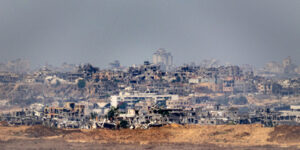
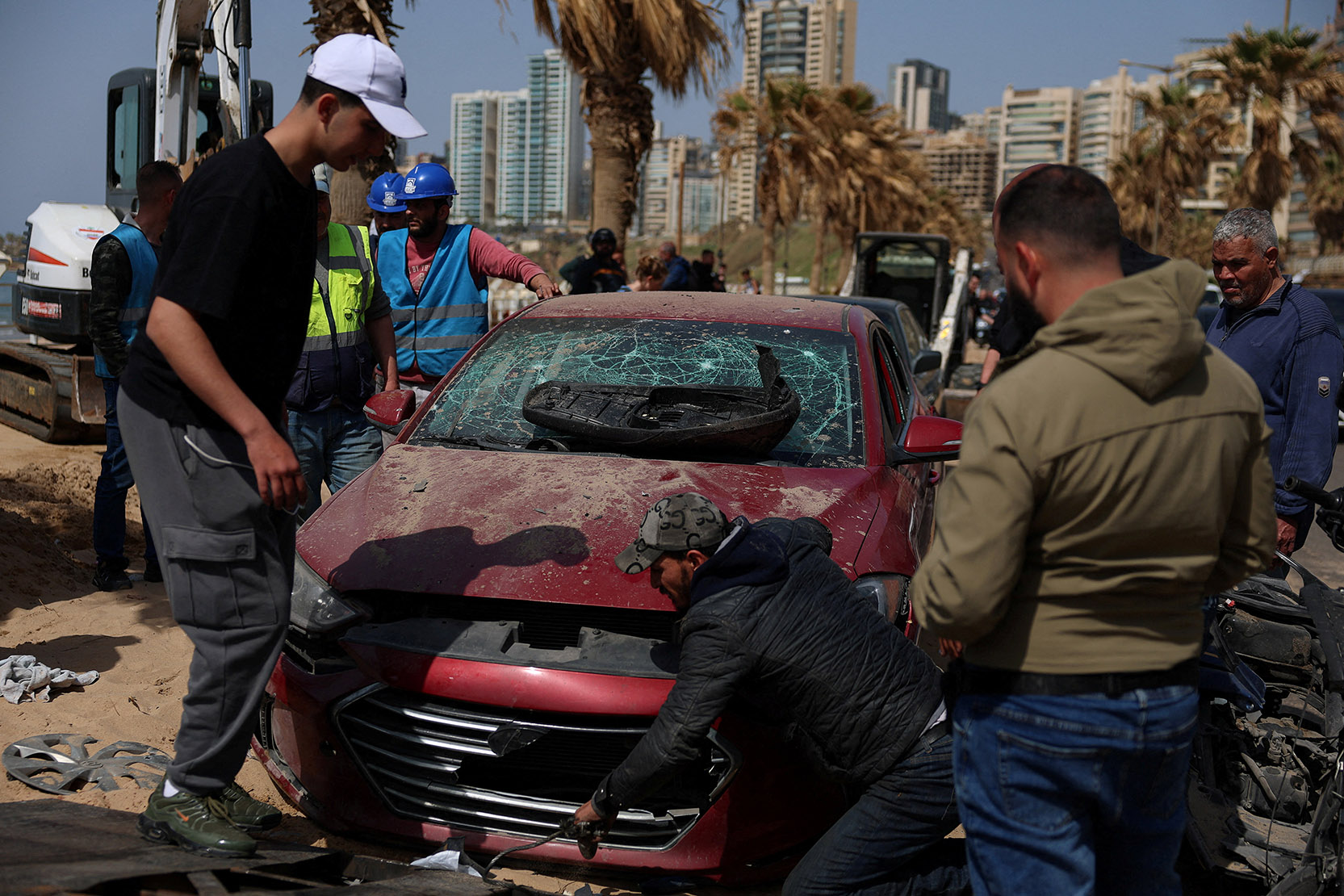
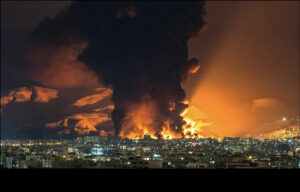
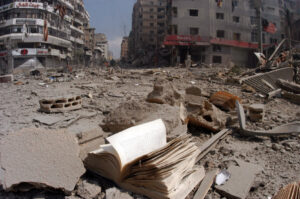
Even as U.S.-Israel forces carpet bomb Tehran, Israel has bombed Aisheh Bakkar and Rawche, heavily Sunni areas in the heart of Beirut. They have also emptied Christian villages in the south. The official number of the displaced in Lebanon now stands at 700,000, in a country of five million.
In the reckoning that followed the 2023–2024 war between Israel and Hezbollah, stories began to circulate in private settings. The raconteurs were people close to the resistance movement, among them highly respected Palestinian field commanders of the old generation. There were more of them than one might think.
One particular account I heard concerned a conversation between Hassan Nassrallah, the leader of Hezbollah, and Ibrahim Aqil, the head of the elite Radwan Unit, the resistance’s “samurai.” As the story has it, Aqil urged Nassrallah to reconsider the tit-for-tat strategy against Israel. His reasoning was straightforward: the resistance movement was not built for low-grade warfare. Its military doctrine rested on two pillars: a thunderbolt invasion and capture of the Galilee and stealth ground defense.
Nassrallah had been the architect of Hezbollah’s Rolodex of identities. Under him, Hezbollah grew from a Lebanese resistance movement into a regional military force, a local political party, a non-state actor with a formidable presence within the state, and a social-services juggernaut. He thought the movement’s deterrence capabilities were strong and the risks manageable. In the end they clearly were not, and Hezbollah suffered a backbreaking defeat whose enormous costs were human, organizational, political, social, and material. Nothing gave more resonance to the devastating rout than the assassination of Nassrallah and his entire cohort of senior leaders and commanders, including Aqil and his team.
Over the past fifteen months, since the formal end of the war, the sprawling movement that Nassrallah built has struggled to cope with myriad vulnerabilities. Local politics have grown antagonistic, the regional map distinctly hostile. Once-abundant financial resources have dwindled. Assets and cadres have had to withstand almost daily Israeli assaults in clear violations of the ceasefire. Internal fractures have surfaced in awkward, often embarrassingly amateurish conduct. Entire communities across swathes of towns and cities have had neither respite nor even a semblance of normalcy since the end of 2024, most starkly in the wrecked south.
This is the backdrop against which Hezbollah decided to strike northern Israel in the early hours of March 2. It had neither military deterrence, nor political cover; neither social goodwill, nor official acquiescence. More poignant still for its people, there was neither warning, nor protection; neither insulation, nor shelter.
The timing of the attacks, which broke a year of silence, was revealing. They came only after Israel and the US had assassinated Iran’s Supreme Leader, Ayatollah Ali Khamenei, and forced an existential war on the Islamic Republic. Hezbollah’s strikes were timid in their reach and impact, but very bold in the Israeli reaction they meant to elicit. Negligible physical damage in the Galilee, in exchange for a formidable barrage of firepower unleashed on our south, our north, and our southern suburbs. A child could have predicted this Israeli response.
Tehran had given the nod. Such is the nature of the relationship between the Islamic Revolutionary Guard Corps (IRGC) and Hezbollah, especially in the aftermath of the latest war and Nassrallah’s demise. The movement’s action, which may yet be judged a blunder, has nonetheless positioned it where it has always felt ideologically most at home. For it has long been understood that when the hour was upon it, the party would rise to its ultimate mission. That it attacked the Jewish state in support of Iran at the most precarious moment for these two allies seems, at first glance, puzzling, but it may well be the point. Such is the age-old Karbala’i ethos: martyrdom and sacrifice in the face of injustice and existential peril.
It must be said, however, that the Islamic Republic and Hezbollah were dragged into this potentially ruinous decision kicking and screaming. This was not their war of choice, but Israel and America’s. Ironically, they are the revisionist powers seeking to overturn the region’s existing accommodations — accommodations in which the republic and the resistance were consenting, even if quarrelsome, participants. And what has been unfolding in the Middle East is of a piece with what has been playing out across the international system.
Eskandar Sadegh Boroujerdi gives eloquent expression to the trends in the London Review of Books:
The certainties of the United States’ hegemonic stewardship of the “international rules-based order” have been deformed beyond recognition by the Gaza genocide, but no alternative architecture has cohered in their place. Instead there is a politics of gangster imperialism that has neither international nor domestic consent.
There are now four belligerents in this war: one superpower, two hegemons, and the region’s largest non-state actor. The stakes for each side by turns converge and diverge. So do the definitions of victory and defeat. The weakest player is Hezbollah. The risks it faces carry the highest cost, including the breakup of its military apparatus and political diminishment in Lebanon. This would likely remain the case even if the Iranian regime were to survive intact, which is very likely and would amount to a form of defeat for the United States and Israel.
The sacrifice, though, is not that of the resistance alone. The fact is, the people — especially their own folks — will bear the brunt of this war’s cost, even if they wanted none of it to begin with. What kind of costs depends entirely on the Mephistophelean designs Israel has for the party and for Lebanon at large. The Jewish state’s predation has always been the most persuasive argument for Hezbollah’s existence. Likewise, the meager capabilities of the Lebanese army. Where the party’s ideology and method alienate and divide, Israel’s viciousness and territorial ambitions have worked to unite. For the longest time, this was in fact Hezbollah’s most powerful proposition: in the absence of a credible Lebanese defense, the resistance is the only buffer and deterrent against a malevolent Israeli enemy.
But that’s a proposition that is now meaningless to many of us Lebanese. Once upon a time, Hezbollah could boast of an achievement that was singular in the Arab world: the modest gap between rhetoric and deed, between promise and feat. In the shadow of the 2024 defeat, it no longer can.
I do not know what awaits us. I live in Ras Beirut, near al-Wasat, the heart of the capital. As I write, hundreds of thousands of people have been forced to evacuate their homes in the south and in Dahiyeh. In an unprecedented move, Israel sent out forced evacuation orders to a large part of southern Lebanon and the entirety of the southern suburbs of Beirut. Nearly half a million people have been displaced over the course of a single week. Dahiyeh is a little more than ten minutes away by car on a quiet Sunday, and yet it feels a world away. As I write, panic continues to spread, families continue to scatter, seeking shelter in different, safer parts of the country — meeting with welcome in some neighborhoods and hostility in others. As I write, the government has declared Hezbollah’s military wing illegal. The armed resistance is now, for all intents and purposes, rogue. As I write, Israel has begun land incursions and heliborne insertions. And Hezbollah fights back.
As I write, we are entering a new era whose contours, even in the vaguest sense, elude us and yet seem so utterly familiar.
On Another Note
In view of the exceptionally hazardous state of the Middle East, I thought I would share two papers and a podcast that offer lucid contextual analysis of unfolding events.
This is not the first time I share a podcast featuring Aslı Ü. Bâli, the Howard M. Holtzmann Professor of Law at Yale Law School. In the realm of international law, hers is a razor-sharp mind and a very compelling voice. Recently, she was in conversation with Peter Beinart about the topic of the moment, America’s Threat to the World, on the Jewish Currents podcast, On the Nose.
To further illuminate Bâli’s argument on the Trump administration’s doctrine, I am sharing the piece she coauthored with Aziz Rana for the Boston Review.
Finally, The New Left Review’s interview with historian Ervand Abrahamian is a studied dissection of the modern history of Iran and the Islamic Republic.
If you need access to the interview, please email me, and I will be happy to gift it to you.
Amal Ghandour’s biweekly column, “This Arab Life,” appears in The Markaz Review every other Friday, as well as in her Substack, and is syndicated in Arabic in Al Quds Al Arabi.
Opinions published in The Markaz Review reflect the perspective of their authors and do not necessarily represent TMR.











![Ali Cherri’s show at Marseille’s [mac] Is Watching You](https://themarkaz.org/wp-content/uploads/2025/09/Ali-Cherri-22Les-Veilleurs22-at-the-mac-Musee-dart-contemporain-de-Marseille-photo-Gregoire-Edouard-Ville-de-Marseille-300x200.jpg)