Le destin du Liban au cœur des calamités de notre monde

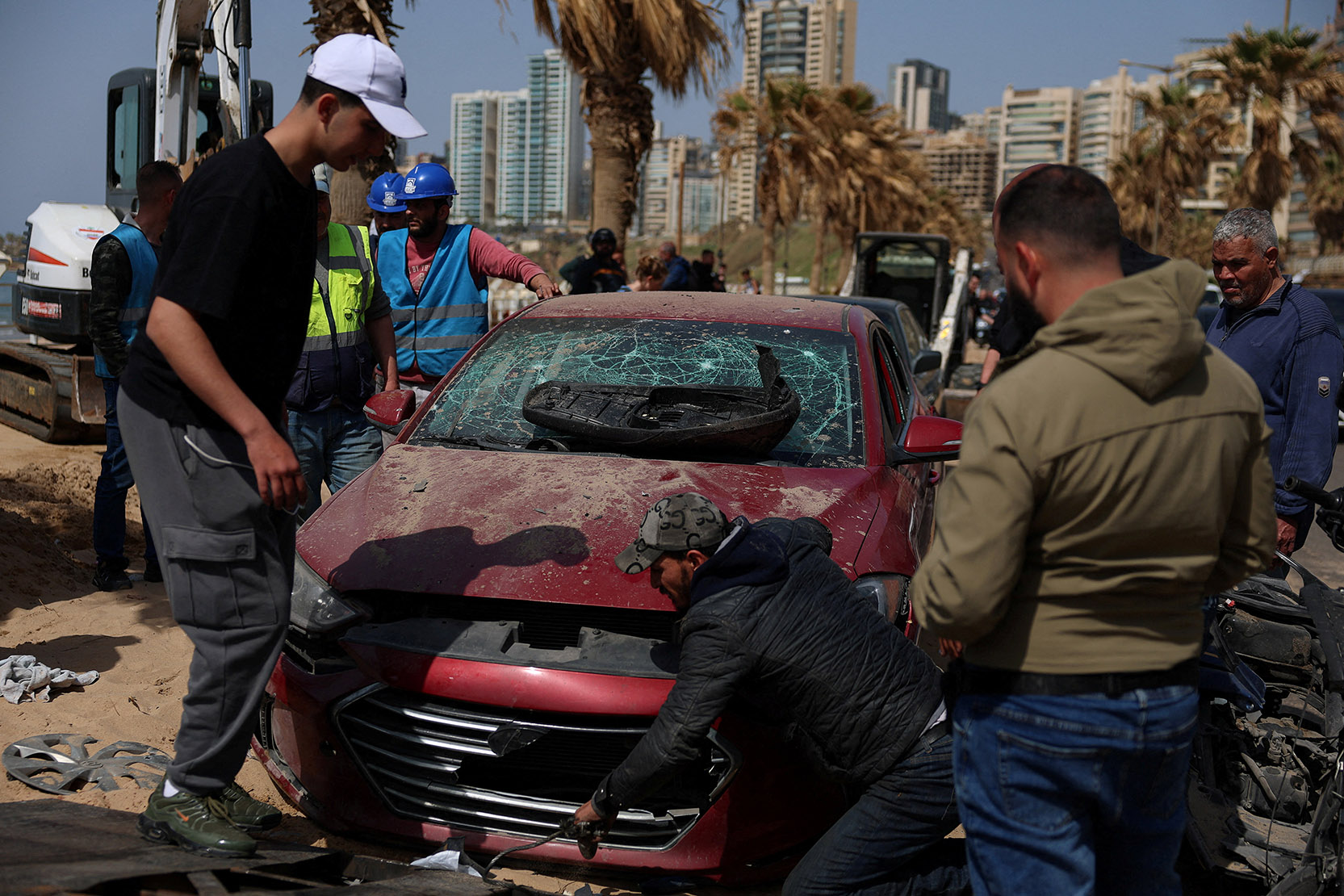
Des Beyrouthins inspectent une voiture endommagée à la suite d'une frappe israélienne qui a tué huit personnes déplacées sur la plage de Ramlet al-Baida, sur la Corniche, alors que le conflit américano-israélien contre l’Iran continue, le 12 mars 2026 (photo Claudia Greco/REUTERS).

13 MARCH 2026 • By Amal Ghandour

Select Other Languages English.

Alors même que les forces américano-israéliennes pilonnent Téhéran, Israël a bombardé Aïcha Bakkar et Raouché, des quartiers à majorité sunnite situés au cœur de Beyrouth. Elles ont également conduit au départ des habitants des villages chrétiens du sud. Le nombre officiel de personnes déplacées au Liban s'élève désormais à 700 000, dans un pays qui compte cinq millions d'habitants.

Au lendemain de la guerre de 2023–2024 entre Israël et le Hezbollah, des récits ont commencé à circuler en privé. Leurs narrateurs étaient des proches du mouvement de résistance, parmi lesquels figuraient de très respectés commandants palestiniens de terrain de l’ancienne génération. Ils étaient plus nombreux qu’on ne pourrait le croire.

L’un des récits que j’ai entendus portait sur une conversation entre Hassan Nassrallah, le chef du Hezbollah, et Ibrahim Aqil, le chef de l’unité d’élite Radwan, les « samouraïs » de la résistance. Selon cette histoire, Aqil aurait exhorté Nassrallah à reconsidérer la stratégie de représailles contre Israël. Son raisonnement était simple : le mouvement de résistance n’avait pas été conçu pour une guerre de faible intensité. Sa doctrine militaire reposait sur deux piliers : une invasion éclair suivie de la prise de la Galilée, ainsi qu’une défense terrestre furtive.

Nasrallah a été l’architecte de la mise en place de la grande variété d’identités du Hezbollah. Sous sa direction, le Hezbollah est passé d’un mouvement de résistance libanais à une force militaire régionale, un parti politique local, un acteur non étatique doté d’une présence redoutable au sein de l’État, et un géant des services sociaux. Il estimait que les capacités de dissuasion du mouvement étaient solides et les risques entrepris gérables. Ce n’était, en fin de compte, visiblement pas le cas, et le Hezbollah a subi une défaite écrasante dont les coûts ont été énormes tant sur le plan humain qu’organisationnel, politique, social et matériel. Rien n’a donné plus d’écho à cette déroute dévastatrice que l’assassinat de Nassrallah et de toute sa cohorte de hauts dirigeants et de commandants, y compris Aqil et son équipe.

Au cours des quinze mois écoulés depuis la fin officielle de la guerre, le mouvement tentaculaire que Nassrallah avait bâti peine à surmonter ses multiples vulnérabilités. La politique locale lui est devenue antagoniste, la carte régionale nettement hostile. Les ressources financières, autrefois abondantes, se sont amenuisées. Les actifs et les cadres ont dû résister à des assauts israéliens quasi quotidiens, en violation flagrante du cessez-le-feu. Des tensions internes ont fait surface, se traduisant par des comportements maladroits, souvent d’un amateurisme embarrassant. Des communautés entières, dans de vastes zones couvrant villes et villages, n’ont connu ni répit ni même un semblant de normalité depuis la fin de 2024, ce qui est particulièrement flagrant dans le sud dévasté.

C’est dans ce contexte que le Hezbollah a décidé de frapper le nord d’Israël aux premières heures du 2 mars. Il ne disposait ni de force de dissuasion militaire, ni de couverture politique ; ni de soutien populaire, ni d’approbation officielle. Plus troublant encore pour la population de sa région, il n’y a eu ni avertissement, ni refuge ; ni protection, ni abri.

Le moment choisi pour ces attaques, qui ont rompu un an de silence, était révélateur. Elles n’ont eu lieu qu’après qu’Israël et les États-Unis ont assassiné le Guide suprême iranien, l’ayatollah Ali Khamenei, et imposé une guerre visant l’existence même de la République islamique. Les frappes du Hezbollah étaient timides dans leur portée et leur impact, mais très audacieuses dans la réaction israélienne qu’elles visaient à provoquer. Des dégâts matériels négligeables en Galilée, en échange d’un formidable barrage de puissance de feu déchaîné sur notre sud, notre nord et nos banlieues sud. Un enfant aurait pu anticiper cette réponse israélienne.

Téhéran avait donné son feu vert. Telle est la nature de la relation entre le Corps des gardiens de la révolution islamique (CGRI) et le Hezbollah, surtout au lendemain de la dernière guerre et de la mort de Nassrallah. L’action du mouvement, qui pourrait encore être jugée comme une erreur, l’a néanmoins positionné là où il s’est toujours senti le plus à l’aise idéologiquement. Car il est depuis longtemps admis que, lorsque l’heure serait venue, le parti se montrerait à la hauteur de sa mission ultime. Le fait qu’il ait attaqué l’État hébreu pour soutenir l’Iran au moment le plus précaire pour les deux alliés semble, à première vue, déroutant, mais c’est peut-être bien là le but recherché. Telle est l’éthique séculaire de Karbala : le martyre et le sacrifice face à l’injustice et au péril existentiel.

Il nous faut toutefois préciser que la République islamique et le Hezbollah ont été entraînés de force dans cette décision potentiellement désastreuse. Ce n’était pas la guerre qu’ils avaient choisie, mais celle d’Israël et des États-Unis. Ironiquement, ce sont eux les puissances révisionnistes qui cherchent à renverser les arrangements existants dans la région — des arrangements auxquels la République et la Résistance adhéraient, même si c’était au prix de quelques querelles. Et ce qui se déroule au Moyen-Orient s’inscrit dans la continuité de ce qui se passe à l’échelle du système international.

Eskandar Sadegh Boroujerdi exprime avec éloquence la tendance actuelle dans la London Review of Books :

Les certitudes relatives à la gestion hégémonique par les États-Unis de « l’ordre international fondé sur des règles » ont été déformées par le génocide de Gaza au point d’être méconnaissables, mais aucune architecture alternative n’a été mise en place pour les remplacer. Au lieu de cela, il existe une politique d’impérialisme gangster qui ne bénéficie ni du consentement international ni de celui de la population nationale.

Il y a désormais quatre belligérants dans cette guerre : une superpuissance, deux hégémonies et le plus grand acteur non étatique de la région. Les enjeux pour chaque camp convergent et divergent tour à tour. Il en va de même pour les définitions de la victoire et de la défaite. L’acteur le plus faible est le Hezbollah. Les risques auxquels il est confronté ont le coût le plus élevé, notamment l’effondrement de son appareil militaire et son affaiblissement politique au Liban. Cela resterait probablement le cas même si le régime iranien venait à survivre en restant intact, ce qui est très probable et équivaudrait à une forme de défaite pour les États-Unis et Israël.

Le sacrifice, cependant, n’est pas celui de la résistance seule. Le fait est que ce sont les populations — en particulier les concitoyens du mouvement de résistance lui-même — qui supporteront le poids du coût de cette guerre, même si elles n’en voulaient pas au départ. La nature de ces coûts dépend entièrement des desseins méphistophéliques qu’Israël nourrit à l’égard du parti et du Liban dans son ensemble. La prédation de l’État hébreu a toujours été l’argument le plus convaincant en faveur de l’existence du Hezbollah. Il en va de même pour les maigres capacités de l’armée libanaise. Là où l’idéologie et la méthode du parti aliènent et divisent, la cruauté et les ambitions territoriales d’Israël ont contribué à unir. Pendant très longtemps, cela a en fait constitué l’argument plus puissant du Hezbollah : en l’absence d’une défense libanaise crédible, la résistance est le seul rempart et la seule force de dissuasion contre un ennemi israélien malveillant.

Mais c’est là une affirmation qui n’a plus aucun sens pour bon nombre d’entre nous, Libanais. Il fut un temps où le Hezbollah pouvait se targuer d’une réussite unique dans le monde arabe : le fossé minime entre ses discours et ses actes, entre ses promesses et ses exploits. Mais, dans l’ombre de la défaite de 2024, il ne le peut plus.

Je ne sais pas ce qui nous attend. Je vis à Ras-Beyrouth, près d’al-Wasat, au cœur de la capitale. Au moment où j’écris ces lignes, des centaines de milliers de personnes ont été contraintes d’évacuer leurs foyers dans le sud et à Dahiyeh. Dans une démarche sans précédent, Israël a émis des ordres d’évacuation forcée pour une grande partie du sud du Liban et l’ensemble de la banlieue sud de Beyrouth. Près d’un demi-million de personnes ont été déplacées en l’espace d’une seule semaine. Dahiyeh se trouve à un peu plus de dix minutes en voiture par un dimanche tranquille, et pourtant, on a l’impression que c’est à des années-lumière. Au moment où j’écris ces lignes, la panique continue de se propager, les familles continuent de se disperser, cherchant refuge dans différentes régions plus sûres du pays — accueillies chaleureusement dans certains quartiers et avec hostilité dans d’autres. Au moment où j’écris ces lignes, le gouvernement a déclaré illégale la branche militaire du Hezbollah. La résistance armée est désormais, à tous égards, hors-la-loi. Au moment où j’écris ces lignes, Israël a lancé des incursions terrestres et des opérations d’infiltration par hélicoptère. Et le Hezbollah riposte.

Au moment où j’écris ces lignes, nous entrons dans une nouvelle ère dont les contours, à peine discernables, nous échappent et semblent pourtant si familiers.

Sur un autre sujet

Compte tenu de la situation exceptionnellement périlleuse au Moyen-Orient, j’ai pensé bon de vous partager deux articles et un podcast qui proposent une analyse contextuelle lucide des événements en cours.

Ce n’est pas la première fois que je partage un podcast mettant en vedette Aslı Ü. Bâli, titulaire de la chaire Howard M. Holtzmann à la faculté de droit de Yale. Dans le domaine du droit international, elle fait preuve d’un esprit acéré et d’une voix très convaincante. Récemment, elle s’est entretenue avec Peter Beinart sur le sujet du moment, America’s Threat to the World, dans le podcast On the Nose de Jewish Currents.

Pour éclairer davantage l’argumentation de Bâli sur la doctrine de l’administration Trump, je partage l’article qu’elle a coécrit avec Aziz Rana pour le Boston Review.

Enfin, l’interview de l’historien Ervand Abrahamian par la New Left Review est une analyse approfondie de l’histoire moderne de l’Iran et de la République islamique.

Si vous souhaitez accéder à cette interview, envoyez-moi un e-mail et je me ferai un plaisir de vous l’offrir.


La chronique bimensuelle d’Amal Ghandour, « This Arab Life », paraît tous les deux vendredis dans The Markaz Review, ainsi que sur son Substack, et est publiée en arabe dans Al Quds Al Arabi.

Les opinions publiées dans The Markaz Review reflètent le point de vue de leurs auteurs et ne représentent pas nécessairement celui de TMR.


 Traduit de l’anglais par Marion Beauchamp-Levet

Amal Ghandour

Amal Ghandour ’s career spans more than three decades in the fields of research, communication, and community development. She is an author (About This Man Called Ali; This Arab Life, A Generation’s Journey Into Silence) and a blogger (This Arab Life on... Read more

Join Our Community

TMR exists thanks to its readers and supporters. By sharing our stories and celebrating cultural pluralism, we aim to counter racism, xenophobia, and exclusion with knowledge, empathy, and artistic expression.

Learn more

RELATED

Columns

A Fight to The Death (the Rest of Us In-Between)

27 MARCH 2026 • By Amal Ghandour
A Fight to The Death (the Rest of Us In-Between)
Columns

Dear Souseh: Distressed (& More) by War

27 MARCH 2026 • By Lina Mounzer
Dear Souseh: Distressed (& More) by War
Opinion

Iranian Visions of Democracy from the Ruins

20 MARCH 2026 • By Nojang Khatami
Iranian Visions of Democracy from the Ruins
Essays

The AI Struggle for Middle Earth in the U.S.-Israel War on Iran

13 MARCH 2026 • By Iason Athanasiadis
The AI Struggle for Middle Earth in the U.S.-Israel War on Iran
Columns

Lebanon’s Fate in Our Current World Calamity

13 MARCH 2026 • By Amal Ghandour
Lebanon’s Fate in Our Current World Calamity
Poetry

“How to Erase an Armenian Accent in Junior High”

27 FEBRUARY 2026 • By Shahé Mankerian
“How to Erase an Armenian Accent in Junior High”
Book Reviews

Two New Books Show How Gaza Changed the World

13 FEBRUARY 2026 • By Rebecca Ruth Gould
Two New Books Show How Gaza Changed the World
Columns

On Legal Victories and Human Healing

13 FEBRUARY 2026 • By Amal Ghandour
On Legal Victories and Human Healing
Art

Behind the Seen: Mona Hatoum on Art and Palestine

30 JANUARY 2026 • By Arie Amaya-Akkermans
<em>Behind the Seen</em>: Mona Hatoum on Art and Palestine
TMR 57 • PALESTINE

Edward Said: Prophet, Symphonist, Exemplar

30 JANUARY 2026 • By Mark LeVine
<em>Edward Said</em>: Prophet, Symphonist, Exemplar
Book Reviews

Controlled Demolition: an Epistolary Review

16 JANUARY 2026 • By Lina Mounzer
<em>Controlled Demolition</em>: an Epistolary Review
Book Reviews

Rewriting Beirut’s “Bad Boy Architect” Bernard Khoury

9 JANUARY 2026 • By Bridget Peak
Rewriting Beirut’s “Bad Boy Architect” Bernard Khoury
Columns

Two Spectacles: A Lebanese Farce, an American Fault Line

2 JANUARY 2026 • By Amal Ghandour
Two Spectacles: A Lebanese Farce, an American Fault Line
Columns

Emm Kamel: The Future Is Here and So Is the Past

19 DECEMBER 2025 • By Amal Ghandour
<em>Emm Kamel</em>: The Future Is Here and So Is the Past
Film

10 Noir Films from the Arab world, Iran, and Turkey

5 DECEMBER 2025 • By TMR
10 Noir Films from the Arab world, Iran, and Turkey
Beirut

In Lebanon, It’s Business as Usual

21 NOVEMBER 2025 • By Amal Ghandour
In Lebanon, It’s Business as Usual
Columns

How Much Do We Miss Umm Khulthum?

7 NOVEMBER 2025 • By Amal Ghandour
How Much Do We Miss Umm Khulthum?
Fiction

Sultana to the Rescue

7 NOVEMBER 2025 • By MK Harb
Sultana to the Rescue
Essays

The Absent Homeland

7 NOVEMBER 2025 • By Maysaa Alajjan
The Absent Homeland
Poetry Markaz

Adedayo Agarau presents The Years of Blood

1 NOVEMBER 2025 • By Adedayo Agarau
Adedayo Agarau presents <em>The Years of Blood</em>
Columns

Dear Souseh: Stuck Between Families

24 OCTOBER 2025 • By Lina Mounzer
Dear Souseh: Stuck Between Families
Essays

You Want Your Friends to See Who You Really Are

3 OCTOBER 2025 • By Christina Adranly
You Want Your Friends to See Who You Really Are
Fiction

War and War

26 SEPTEMBER 2025 • By Hussain A. Ayoub
War and War
Editorial

Why Out of Our Minds?

5 SEPTEMBER 2025 • By Lina Mounzer
Why <em>Out of Our Minds</em>?
Centerpiece

Trauma After Gaza

5 SEPTEMBER 2025 • By Joelle Abi-Rached
Trauma After Gaza
Art & Photography

Ali Cherri’s show at Marseille’s [mac] Is Watching You

15 AUGUST 2025 • By Naima Morelli
Ali Cherri’s show at Marseille’s [mac] Is Watching You
Art

Architectural Biennale Confronts Brutality of Climate Change

1 AUGUST 2025 • By Iason Athanasiadis
Architectural Biennale Confronts Brutality of Climate Change
Essays

“A Love That Endures”: How Tamer and Sabreen Defied War and Death

25 JULY 2025 • By Husam Maarouf
“A Love That Endures”: How Tamer and Sabreen Defied War and Death
TMR Interviews

Aida Šehović on the 30th Anniversary of the Srebrenica Genocide

18 JULY 2025 • By Claudia Mende
Aida Šehović on the 30th Anniversary of the Srebrenica Genocide
Poetry

Nasser Rabah on Poetry and Gaza

4 JULY 2025 • By Nasser Rabah
Nasser Rabah on Poetry and Gaza
Columns

Afraid for Our Children’s Future, How Do We Talk About War?

20 JUNE 2025 • By Lina Mounzer
Afraid for Our Children’s Future, How Do We Talk About War?
Film

From A World Not Ours to a Land Unknown

13 JUNE 2025 • By Jim Quilty
From A World Not Ours to a <em>Land Unknown</em>
Art

About to Erupt: A Snapshot of Contemporary Art in Istanbul

6 JUNE 2025 • By Naima Morelli
About to Erupt: A Snapshot of Contemporary Art in Istanbul
Essays

Imagining Ghanem—My Return to Lebanon

6 JUNE 2025 • By Amelia Izmanki
Imagining Ghanem—My Return to Lebanon
Book Reviews

An Intimate History of Violence: Beirut Under Siege in Nejmeh Khalil Habib’s A Spring that Did Not Blossom 

30 MAY 2025 • By Rebecca Ruth Gould
An Intimate History of Violence: Beirut Under Siege in Nejmeh Khalil Habib’s <em>A Spring that Did Not Blossom</em> 
Arabic

Jawdat Fakreddine Presents Three Poems

20 MAY 2025 • By Jawdat Fakhreddine, Huda J. Fakhreddine
Jawdat Fakreddine Presents Three Poems
Film Reviews

Contretemps, a Bold Film on Lebanon’s Crises

16 MAY 2025 • By Jim Quilty
Contretemps, a Bold Film on Lebanon’s Crises
Art

Going Home to South Lebanon: Abdel Hamid Baalbaki

2 MAY 2025 • By Karina El Helou
Going Home to South Lebanon: Abdel Hamid Baalbaki
Essays

A Letter To My Cruel Lover: Tripoli

2 MAY 2025 • By Lara Kassem
A Letter To My Cruel Lover: Tripoli
Art

Between Belief and Doubt: Ramzi Mallat’s Suspended Disbelief

11 APRIL 2025 • By Marta Mendes
Between Belief and Doubt: Ramzi Mallat’s Suspended Disbelief
Book Reviews

Insurrection of the Spirit: Algeria’s Resistance Poet Anna Gréki

21 MARCH 2025 • By Jordan Elgrably
Insurrection of the Spirit: Algeria’s Resistance Poet Anna Gréki
Art & Photography

Afghanistan’s Histories of Conflict, Resistance & Desires

7 MARCH 2025 • By Jelena Sofronijevic
Afghanistan’s Histories of Conflict, Resistance & Desires
Art

Finding Emptiness: Gaza Artist Taysir Batniji in Beirut

21 FEBRUARY 2025 • By Jim Quilty
Finding Emptiness: Gaza Artist Taysir Batniji in Beirut
Book Reviews

Memories of Palestine through Contemporary Media

7 FEBRUARY 2025 • By Malu Halasa
Memories of Palestine through Contemporary Media
Poetry

Annahita Mahdavi West: Two Poems

19 DECEMBER 2024 • By Annahita Mahdavi West
Annahita Mahdavi West: Two Poems
Books

“The Spirit of Mutiny”—speculative fiction

6 DECEMBER 2024 • By Radhika Singh
“The Spirit of Mutiny”—speculative fiction
Essays

A Jewish Meditation on the Palestinian Genocide

15 NOVEMBER 2024 • By Sheryl Ono
A Jewish Meditation on the Palestinian Genocide
Editorial

The Editor’s Letter Following the US 2024 Presidential Election

8 NOVEMBER 2024 • By Jordan Elgrably
The Editor’s Letter Following the US 2024 Presidential Election
Film

The Haunting Reality of Beirut, My City

8 NOVEMBER 2024 • By Roger Assaf, Zeina Hashem Beck
The Haunting Reality of <em>Beirut, My City</em>
Art & Photography

Beyond Our Gaze: Rethinking Animals in Contemporary Art

1 NOVEMBER 2024 • By Naima Morelli
Beyond Our Gaze: Rethinking Animals in Contemporary Art
TMR 45 • From Here, One Year On

Witnessing Catastrophe: a Painter in Lebanon

4 OCTOBER 2024 • By Ziad Suidan
Witnessing Catastrophe: a Painter in Lebanon
Opinion

Everything Has Changed, Nothing Has Changed

4 OCTOBER 2024 • By Amal Ghandour
Everything Has Changed, Nothing Has Changed
Fiction

The Last Millefeuille in Beirut

4 OCTOBER 2024 • By MK Harb
The Last Millefeuille in Beirut
Opinion

Lebanon’s Holy Gatekeepers of Free Speech

6 SEPTEMBER 2024 • By Joumana Haddad
Lebanon’s Holy Gatekeepers of Free Speech
Essays

Meditations on Palestinian Exile and Return

16 AUGUST 2024 • By Dana El Saleh
Meditations on Palestinian Exile and Return
short story

“Deferred Sorrow”—fiction from Haidar Al Ghazali

5 JULY 2024 • By Haidar Al Ghazali, Rana Asfour
“Deferred Sorrow”—fiction from Haidar Al Ghazali
Books

Ripped from Memoirs of a Lebanese Policeman

5 JULY 2024 • By Fawzi Zabyan, Lina Mounzer
Ripped from <em>Memoirs of a Lebanese Policeman</em>
Columns

Creating Community with Community Theatre

21 JUNE 2024 • By Victoria Lupton
Creating Community with Community Theatre
Book Reviews

Is Amin Maalouf’s Latest Novel, On the Isle of Antioch, a Parody?

14 JUNE 2024 • By Farah-Silvana Kanaan
Is Amin Maalouf’s Latest Novel, <em>On the Isle of Antioch</em>, a Parody?
Centerpiece

Dare Not Speak—a One-Act Play

7 JUNE 2024 • By Hassan Abdulrazzak
<em>Dare Not Speak</em>—a One-Act Play
Essays

Wajdi Mouawad’s “Controversial” Wedding Day

7 JUNE 2024 • By Elie Chalala
Wajdi Mouawad’s “Controversial” <em>Wedding Day</em>
Theatre

What Kind Of Liar Am I?—a Short Play

7 JUNE 2024 • By Mona Mansour
<em>What Kind Of Liar Am I?</em>—a Short Play
Essays

Omar Naim Exclusive: Two Films on Beirut & Theatre

7 JUNE 2024 • By Omar Naim
Omar Naim Exclusive: Two Films on Beirut & Theatre
Books

Palestine, Political Theatre & the Performance of Queer Solidarity in Jean Genet’s Prisoner of Love

7 JUNE 2024 • By Saleem Haddad
Palestine, Political Theatre & the Performance of Queer Solidarity in Jean Genet’s <em>Prisoner of Love</em>
Art & Photography

What Is Home?—Gazans Redefine Place Amid Displacement

31 MAY 2024 • By Nadine Aranki
What Is Home?—Gazans Redefine Place Amid Displacement
Essays

A Small Kernel of Human Kindness: Some Notes on Solidarity and Resistance

24 MAY 2024 • By Nancy Kricorian
A Small Kernel of Human Kindness: Some Notes on Solidarity and Resistance
Fiction

“I, Mariam”—a story by Joumana Haddad

26 APRIL 2024 • By Joumana Haddad
“I, Mariam”—a story by Joumana Haddad
Book Reviews

Man Is a Cause: Wisam Rafeedie & the Palestinian Revolutionary Novel

19 APRIL 2024 • By Rebecca Ruth Gould
Man Is a Cause: Wisam Rafeedie & the Palestinian Revolutionary Novel
Art

Paris, Abstraction and the Art of Yvette Achkar

1 APRIL 2024 • By Arie Amaya-Akkermans
Paris, Abstraction and the Art of Yvette Achkar
Essays

Israel’s Environmental and Economic Warfare on Lebanon

3 MARCH 2024 • By Michelle Eid
Israel’s Environmental and Economic Warfare on Lebanon
Columns

Genocide: “That bell can’t be unrung. That thought can’t be unthunk.”

3 MARCH 2024 • By Amal Ghandour
Genocide: “That bell can’t be unrung. That thought can’t be unthunk.”
Art & Photography

New Palestinian Poster Art Responds to War and Apartheid

26 FEBRUARY 2024 • By Nadine Aranki
New Palestinian Poster Art Responds to War and Apartheid
Art

Issam Kourbaj’s Love Letter to Syria in Cambridge

12 FEBRUARY 2024 • By Sophie Kazan Makhlouf
Issam Kourbaj’s Love Letter to Syria in Cambridge
Editorial

Shoot That Poison Arrow to My Heart: The LSD Editorial

4 FEBRUARY 2024 • By Malu Halasa
Shoot That Poison Arrow to My Heart: The LSD Editorial
Featured article

Israel-Palestine: Peace Under Occupation?

29 JANUARY 2024 • By Laëtitia Soula
Israel-Palestine: Peace Under Occupation?
Poetry

Brian Turner: 3 Poems From Three New Books

14 JANUARY 2024 • By Brian Turner
Brian Turner: 3 Poems From Three New Books
Art & Photography

Cyprus: Return to Petrofani with Ali Cherri & Vicky Pericleous

8 JANUARY 2024 • By Arie Amaya-Akkermans
Cyprus: Return to Petrofani with Ali Cherri & Vicky Pericleous
Books

Inside Hamas: From Resistance to Regime

25 DECEMBER 2023 • By Paola Caridi
Inside <em>Hamas: From Resistance to Regime</em>
Editorial

Why Endings & Beginnings?

3 DECEMBER 2023 • By Jordan Elgrably
Why Endings & Beginnings?
TMR 37 • Endings & Beginnings

“The Summer They Heard Music”—a short story by MK Harb

3 DECEMBER 2023 • By MK Harb
“The Summer They Heard Music”—a short story by MK Harb
Fiction

“I, Hanan”—a Gazan tale of survival by Joumana Haddad

3 DECEMBER 2023 • By Joumana Haddad
“I, Hanan”—a Gazan tale of survival by Joumana Haddad
Art

Hanan Eshaq

3 DECEMBER 2023 • By Hanan Eshaq
Hanan Eshaq
Art & Photography

Palestinian Artists & Anti-War Supporters of Gaza Cancelled

27 NOVEMBER 2023 • By Nada Ghosn
Palestinian Artists & Anti-War Supporters of Gaza Cancelled
Art & Photography

War and Art: A Lebanese Photographer and His Protégés

13 NOVEMBER 2023 • By Nicole Hamouche
War and Art: A Lebanese Photographer and His Protégés
Opinion

Beautiful October 7th Art Belies the Horrors of War

13 NOVEMBER 2023 • By Mark LeVine
Beautiful October 7th Art Belies the Horrors of War
Opinion

Palestine’s Pen against Israel’s Swords of Injustice

6 NOVEMBER 2023 • By Mai Al-Nakib
Palestine’s Pen against Israel’s Swords of Injustice
Books

Domicide—War on the City

5 NOVEMBER 2023 • By Ammar Azzouz
<em>Domicide</em>—War on the City
Featured Artist

Mohamed Al Mufti, Architect and Painter of Our Time

5 NOVEMBER 2023 • By Nicole Hamouche
Mohamed Al Mufti, Architect and Painter of Our Time
Essays

On Fathers, Daughters and the Genocide in Gaza 

30 OCTOBER 2023 • By Deema K Shehabi
On Fathers, Daughters and the Genocide in Gaza 
Book Reviews

The Refugee Ocean—An Intriguing Premise

30 OCTOBER 2023 • By Natasha Tynes
<em>The Refugee Ocean</em>—An Intriguing Premise
Islam

October 7 and the First Days of the War

23 OCTOBER 2023 • By Robin Yassin-Kassab
October 7 and the First Days of the War
Essays

Forging Peace for Artsakh—The Debacle of Nagorno Karabagh

16 OCTOBER 2023 • By Seta Kabranian-Melkonian
Forging Peace for Artsakh—The Debacle of Nagorno Karabagh
Fiction

I, SOUAD or the Six Deaths of a Refugee From Aleppo

9 OCTOBER 2023 • By Joumana Haddad
I, SOUAD or the Six Deaths of a Refugee From Aleppo
Theatre

Hartaqât: Heresies of a World with Policed Borders

9 OCTOBER 2023 • By Nada Ghosn
<em>Hartaqât</em>: Heresies of a World with Policed Borders
Theatre

Lebanese Thespian Aida Sabra Blossoms in International Career

9 OCTOBER 2023 • By Nada Ghosn
Lebanese Thespian Aida Sabra Blossoms in International Career
Fiction

“Kaleidoscope: In Pursuit of the Real in a Virtual World”—fiction from Dina Abou Salem

1 OCTOBER 2023 • By Dina Abou Salem
“Kaleidoscope: In Pursuit of the Real in a Virtual World”—fiction from Dina Abou Salem
Art & Photography

Adel Abidin, October 2023

1 OCTOBER 2023 • By TMR
Adel Abidin, October 2023
Amazigh

World Picks: Festival Arabesques in Montpellier

4 SEPTEMBER 2023 • By TMR
World Picks: Festival Arabesques in Montpellier
Books

“Sadness in My Heart”—a story by Hilal Chouman

3 SEPTEMBER 2023 • By Hilal Chouman, Nashwa Nasreldin
“Sadness in My Heart”—a story by Hilal Chouman
Book Reviews

Laila Halaby’s The Weight of Ghosts is a Haunting Memoir

28 AUGUST 2023 • By Thérèse Soukar Chehade
Laila Halaby’s <em>The Weight of Ghosts</em> is a Haunting Memoir
Book Reviews

Ilan Pappé on Tahrir Hamdi’s Imagining Palestine

7 AUGUST 2023 • By Ilan Pappé
Ilan Pappé on Tahrir Hamdi’s <em> Imagining Palestine</em>
Film

The Soil and the Sea: The Revolutionary Act of Remembering

7 AUGUST 2023 • By Farah-Silvana Kanaan
<em>The Soil and the Sea</em>: The Revolutionary Act of Remembering
Poetry

Three Poems from Pantea Amin Tofangchi’s Glazed With War

3 AUGUST 2023 • By Pantea Amin Tofangchi
Three Poems from Pantea Amin Tofangchi’s <em>Glazed With War</em>
Book Reviews

Can the Kurdish Women’s Movement Transform the Middle East?

31 JULY 2023 • By Matt Broomfield
Can the Kurdish Women’s Movement Transform the Middle East?
Books

Words of Resistance: Nasim Marashi, Syaman Rapongan & Isabelle Sorente

17 JULY 2023 • By Lou Heliot
Words of Resistance: Nasim Marashi, Syaman Rapongan & Isabelle Sorente
Book Reviews

Why Isn’t Ghaith Abdul-Ahad a Household Name?

10 JULY 2023 • By Iason Athanasiadis
Why Isn’t Ghaith Abdul-Ahad a Household Name?
Opinion

The End of the Palestinian State? Jenin Is Only the Beginning

10 JULY 2023 • By Yousef M. Aljamal
The End of the Palestinian State? Jenin Is Only the Beginning
Arabic

Inside the Giant Fish—excerpt from Rawand Issa’s graphic novel

2 JULY 2023 • By Rawand Issa, Amy Chiniara
Inside the Giant Fish—excerpt from Rawand Issa’s graphic novel
Editorial

EARTH: Our Only Home

4 JUNE 2023 • By Jordan Elgrably
EARTH: Our Only Home
Arabic

Arab Theatre Grapples With Climate Change, Borders, War & Love

4 JUNE 2023 • By Hassan Abdulrazzak
Arab Theatre Grapples With Climate Change, Borders, War & Love
Beirut

The Saga of Mounia Akl’s Costa Brava, Lebanon

1 MAY 2023 • By Meera Santhanam
The Saga of Mounia Akl’s <em>Costa Brava, Lebanon</em>
Opinion

Nurredin Amro’s Epic Battle to Save His Home From Demolition

24 APRIL 2023 • By Nora Lester Murad
Nurredin Amro’s Epic Battle to Save His Home From Demolition
Essays

When a Country is not a Country—the Chimera of Borders

17 APRIL 2023 • By Ara Oshagan
When a Country is not a Country—the Chimera of Borders
Essays

Artsakh and the Truth About the Legend of Monte Melkonian

17 APRIL 2023 • By Seta Kabranian-Melkonian
Artsakh and the Truth About the Legend of Monte Melkonian
Beirut

Tel Aviv-Beirut, a Film on War, Love & Borders

20 MARCH 2023 • By Karim Goury
<em>Tel Aviv-Beirut</em>, a Film on War, Love & Borders
Beirut

Interview with Michale Boganim, Director of Tel Aviv-Beirut

20 MARCH 2023 • By Karim Goury
Interview with Michale Boganim, Director of <em>Tel Aviv-Beirut</em>
Fiction

“Counter Strike”—a story by MK HARB

5 MARCH 2023 • By MK Harb
“Counter Strike”—a story by MK HARB
Fiction

“Mother Remembered”—Fiction by Samir El-Youssef

5 MARCH 2023 • By Samir El-Youssef
“Mother Remembered”—Fiction by Samir El-Youssef
Book Reviews

Yemen War Survivors Speak in What Have You Left Behind?

20 FEBRUARY 2023 • By Saliha Haddad
Yemen War Survivors Speak in <em>What Have You Left Behind?</em>
Beirut

The Curious Case of Middle Lebanon

13 FEBRUARY 2023 • By Amal Ghandour
The Curious Case of Middle Lebanon
Beirut

Arab Women’s War Stories, Oral Histories from Lebanon

13 FEBRUARY 2023 • By Evelyne Accad
Arab Women’s War Stories, Oral Histories from Lebanon
Book Reviews

Mohamed Makhzangi Despairs at Man’s Cruelty to Animals

26 DECEMBER 2022 • By Saliha Haddad
Mohamed Makhzangi Despairs at Man’s Cruelty to Animals
Art

Museums in Exile—MO.CO’s show for Chile, Sarajevo & Palestine

12 DECEMBER 2022 • By Jordan Elgrably
Museums in Exile—MO.CO’s show for Chile, Sarajevo & Palestine
Book Reviews

Fida Jiryis on Palestine in Stranger in My Own Land

28 NOVEMBER 2022 • By Diana Buttu
Fida Jiryis on Palestine in <em>Stranger in My Own Land</em>
Columns

Sudden Journeys: Israel’s Intimate Separations—Part 2

31 OCTOBER 2022 • By Jenine Abboushi
Sudden Journeys: Israel’s Intimate Separations—Part 2
Columns

For Electronica Artist Hadi Zeidan, Dance Clubs are Analogous to Churches

24 OCTOBER 2022 • By Melissa Chemam
For Electronica Artist Hadi Zeidan, Dance Clubs are Analogous to Churches
Editorial

You Don’t Have to Be A Super Hero to Be a Heroine

15 OCTOBER 2022 • By TMR
You Don’t Have to Be A Super Hero to Be a Heroine
Fiction

“Ride On, Shooting Star”—fiction from May Haddad

15 OCTOBER 2022 • By May Haddad
“Ride On, Shooting Star”—fiction from May Haddad
Book Reviews

Zoulikha, Forgotten Freedom Fighter of the Algerian War

15 OCTOBER 2022 • By Fouad Mami
Zoulikha, Forgotten Freedom Fighter of the Algerian War
Film

Ziad Kalthoum: Trajectory of a Syrian Filmmaker

15 SEPTEMBER 2022 • By Viola Shafik
Ziad Kalthoum: Trajectory of a Syrian Filmmaker
Film

The Mystery of Tycoon Michel Baida in Old Arab Berlin

15 SEPTEMBER 2022 • By Irit Neidhardt
The Mystery of Tycoon Michel Baida in Old Arab Berlin
Art & Photography

16 Formidable Lebanese Photographers in an Abbey

5 SEPTEMBER 2022 • By Nada Ghosn
16 Formidable Lebanese Photographers in an Abbey
Music Reviews

Hot Summer Playlist: “Diaspora Dreams” Drops

8 AUGUST 2022 • By Mischa Geracoulis
Hot Summer Playlist: “Diaspora Dreams” Drops
Art

Abundant Middle Eastern Talent at the ’22 Avignon Theatre Fest

18 JULY 2022 • By Nada Ghosn
Abundant Middle Eastern Talent at the ’22 Avignon Theatre Fest
Editorial

Editorial: Is the World Driving Us Mad?

15 JULY 2022 • By TMR
Editorial: Is the World Driving Us Mad?
Film Reviews

War and Trauma in Yemen: Asim Abdulaziz’s “1941”

15 JULY 2022 • By Farah Abdessamad
War and Trauma in Yemen: Asim Abdulaziz’s “1941”
Book Reviews

Leaving One’s Country in Mai Al-Nakib’s “An Unlasting Home”

27 JUNE 2022 • By Rana Asfour
Leaving One’s Country in Mai Al-Nakib’s “An Unlasting Home”
Columns

Why I left Lebanon and Became a Transitional Citizen

27 JUNE 2022 • By Myriam Dalal
Why I left Lebanon and Became a Transitional Citizen
Featured excerpt

Joumana Haddad: “Victim #232”

15 JUNE 2022 • By Joumana Haddad, Rana Asfour
Joumana Haddad: “Victim #232”
Book Reviews

Fragmented Love in Alison Glick’s “The Other End of the Sea”

16 MAY 2022 • By Nora Lester Murad
Fragmented Love in Alison Glick’s “The Other End of the Sea”
Film

Art Film Depicts the Landlocked Drama of Nagorno-Karabakh

2 MAY 2022 • By Taline Voskeritchian
Art Film Depicts the Landlocked Drama of Nagorno-Karabakh
Beirut

Fairouz is the Voice of Lebanon, Symbol of Hope in a Weary Land

25 APRIL 2022 • By Melissa Chemam
Fairouz is the Voice of Lebanon, Symbol of Hope in a Weary Land
Columns

Nowruz and The Sins of the New Day

21 MARCH 2022 • By Maha Tourbah
Nowruz and The Sins of the New Day
Columns

Music in the Middle East: Bring Back Peace

21 MARCH 2022 • By Melissa Chemam
Music in the Middle East: Bring Back Peace
Essays

“Gluttony” from Abbas Beydoun’s “Frankenstein’s Mirrors”

15 MARCH 2022 • By Abbas Baydoun, Lily Sadowsky
“Gluttony” from Abbas Beydoun’s “Frankenstein’s Mirrors”
Art

Fiction: “Skin Calluses” by Khalil Younes

15 MARCH 2022 • By Khalil Younes
Fiction: “Skin Calluses” by Khalil Younes
Columns

“There’s Nothing Worse Than War”

24 FEBRUARY 2022 • By Jordan Elgrably
“There’s Nothing Worse Than War”
Film

“The Translator” Brings the Syrian Dilemma to the Big Screen

7 FEBRUARY 2022 • By Jordan Elgrably
“The Translator” Brings the Syrian Dilemma to the Big Screen
Fiction

Fiction from “Free Fall”: I fled the city as a murderer whose crime had just been uncovered

15 JANUARY 2022 • By Abeer Esber, Nouha Homad
Fiction from “Free Fall”: I fled the city as a murderer whose crime had just been uncovered
Book Reviews

Temptations of the Imagination: how Jana Elhassan and Samar Yazbek transmogrify the world

10 JANUARY 2022 • By Rana Asfour
Temptations of the Imagination: how Jana Elhassan and Samar Yazbek transmogrify the world
Columns

My Lebanese Landlord, Lebanese Bankdits, and German Racism

15 DECEMBER 2021 • By Tariq Mehmood
My Lebanese Landlord, Lebanese Bankdits, and German Racism
Fiction

Three Levantine Tales

15 DECEMBER 2021 • By Nouha Homad
Three Levantine Tales
Comix

How to Hide in Lebanon as a Western Foreigner

15 DECEMBER 2021 • By Nadiyah Abdullatif, Anam Zafar
How to Hide in Lebanon as a Western Foreigner
Art

Etel Adnan’s Sun and Sea: In Remembrance

19 NOVEMBER 2021 • By Arie Amaya-Akkermans
Etel Adnan’s Sun and Sea: In Remembrance
Columns

Burning Forests, Burning Nations

15 NOVEMBER 2021 • By Hadani Ditmars
Burning Forests, Burning Nations
Book Reviews

Diary of the Collapse—Charif Majdalani on Lebanon’s Trials by Fire

15 NOVEMBER 2021 • By A.J. Naddaff
<em>Diary of the Collapse</em>—Charif Majdalani on Lebanon’s Trials by Fire
Book Reviews

The Vanishing: Are Arab Christians an Endangered Minority?

15 NOVEMBER 2021 • By Hadani Ditmars
The Vanishing: Are Arab Christians an Endangered Minority?
Featured excerpt

Memoirs of a Militant, My Years in the Khiam Women’s Prison

15 OCTOBER 2021 • By Nawal Qasim Baidoun
Memoirs of a Militant, My Years in the Khiam Women’s Prison
Editorial

Why COMIX? An Emerging Medium of Writing the Middle East and North Africa

15 AUGUST 2021 • By Aomar Boum
Why COMIX? An Emerging Medium of Writing the Middle East and North Africa
Latest Reviews

Rebellion Resurrected: The Will of Youth Against History

15 AUGUST 2021 • By George Jad Khoury
Rebellion Resurrected: The Will of Youth Against History
Latest Reviews

Women Comic Artists, from Afghanistan to Morocco

15 AUGUST 2021 • By Sherine Hamdy
Women Comic Artists, from Afghanistan to Morocco
Weekly

World Picks: August 2021

12 AUGUST 2021 • By Lawrence Joffe
World Picks: August 2021
Columns

Remember 18:07 and Light a Flame for Beirut

4 AUGUST 2021 • By Jordan Elgrably
Remember 18:07 and Light a Flame for Beirut
Art

Malak Mattar — Gaza Artist and Survivor

14 JULY 2021 • By Jordan Elgrably
Malak Mattar — Gaza Artist and Survivor
Columns

The Semantics of Gaza, War and Truth

14 JULY 2021 • By Mischa Geracoulis
The Semantics of Gaza, War and Truth
Book Reviews

ISIS and the Absurdity of War in the Age of Twitter

4 JULY 2021 • By Jessica Proett
ISIS and the Absurdity of War in the Age of Twitter
Weekly

War Diary: The End of Innocence

23 MAY 2021 • By Arie Amaya-Akkermans
War Diary: The End of Innocence
Art

The Murals of Yemen’s Haifa Subay

14 MAY 2021 • By Farah Abdessamad
The Murals of Yemen’s Haifa Subay
Essays

Reviving Hammam Al Jadeed

14 MAY 2021 • By Tom Young
Reviving Hammam Al Jadeed
Art

The Labyrinth of Memory

14 MAY 2021 • By Ziad Suidan
The Labyrinth of Memory
Weekly

Hanane Hajj Ali, Portrait of a Theatrical Trailblazer

14 FEBRUARY 2021 • By Nada Ghosn
Hanane Hajj Ali, Portrait of a Theatrical Trailblazer
Film Reviews

Muhammad Malas, Syria’s Auteur, is the subject of a Film Biography

10 JANUARY 2021 • By Rana Asfour
Muhammad Malas, Syria’s Auteur, is the subject of a Film Biography
TMR 4 • Small & Indie Presses

Children of the Ghetto, My Name Is Adam

14 DECEMBER 2020 • By Elias Khoury
Children of the Ghetto, My Name Is Adam
TMR 3 • Racism & Identity

I am the Hyphen

15 NOVEMBER 2020 • By Sarah AlKahly-Mills
I am the Hyphen
Beirut

Wajdi Mouawad, Just the Playwright for Our Dystopian World

15 SEPTEMBER 2020 • By Melissa Chemam
Wajdi Mouawad, Just the Playwright for Our Dystopian World
Beirut

Beirut In Pieces

15 SEPTEMBER 2020 • By Jenine Abboushi
Beirut In Pieces
Book Reviews

Salvaging the shipwreck of humanity in Amin Maalouf’s Adrift

15 SEPTEMBER 2020 • By Sarah AlKahly-Mills
Salvaging the shipwreck of humanity in Amin Maalouf’s <em>Adrift</em>

Leave a Comment

Your email address will not be published. Required fields are marked *

10 − eight =

Scroll to Top