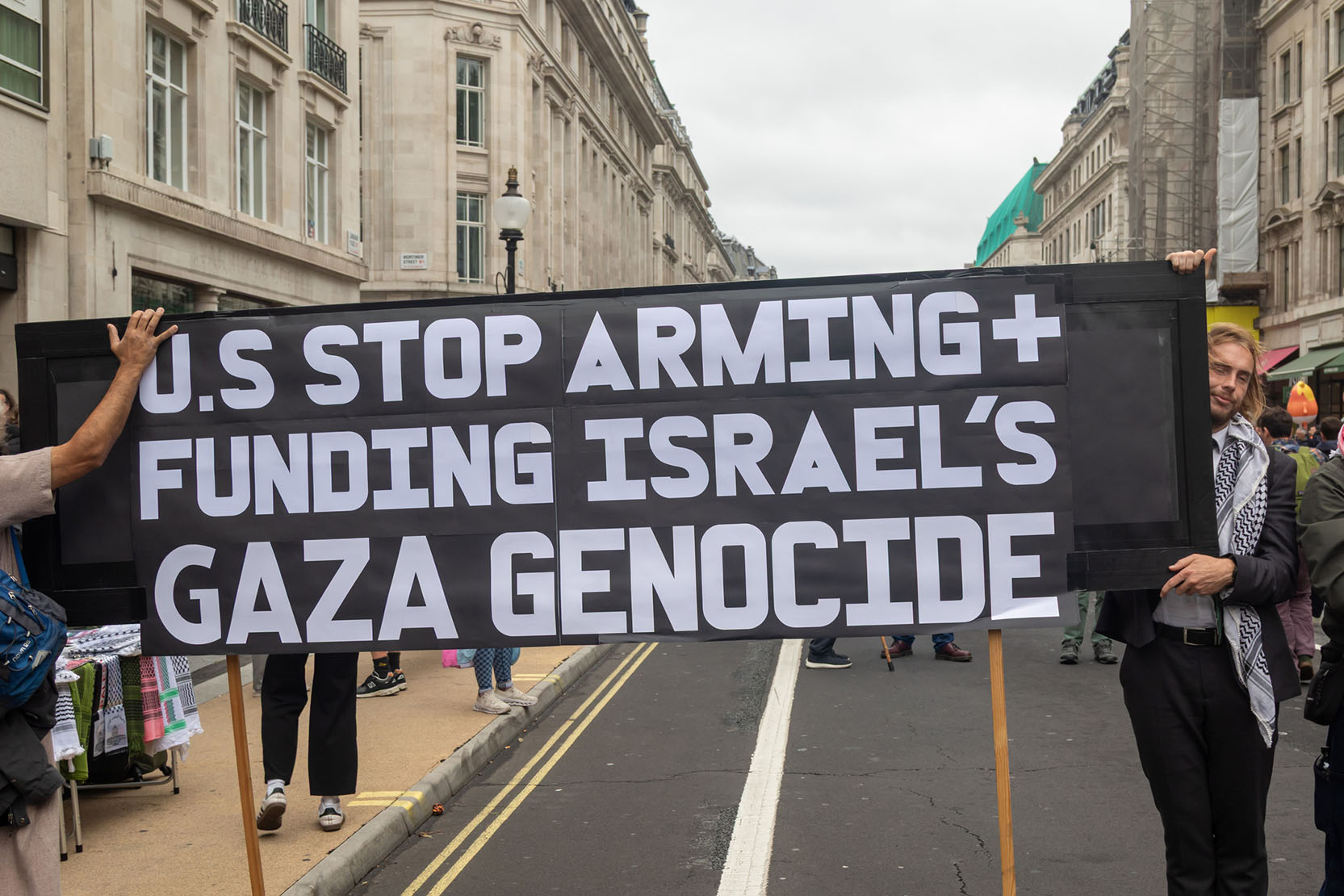
Is this a case of good cop/bad cop? How else to explain blind U.S. support for Israel even in the face of overwhelming international condemnation.
In attempting to explain the “special relationship” between Israel and the U.S., people tend to fall back on narratives about the power of AIPAC in U.S. elections and other forms of Israeli political intervention in the U.S. That’s a real force and cannot be ignored, but the reality is that the U.S. ruling class broadly supports Israel’s actions — with bipartisan consensus — because they see this as aligned with the interests of U.S. capitalism. And most other Western governments (Britain, Germany, etc.) hold the same position for much the same reason.
The important thing to understand is that the capitalist economy is a world–system, where growth and accumulation in the imperial core (e.g, the U.S. and Western Europe) relies heavily on the appropriation of cheap labor and resources from the periphery and semi-periphery, or the global South. Western states and firms need Southern states to remain subordinated suppliers of cheap labor, raw materials, and consumer goods within global commodity chains.
In order to maintain this arrangement, the core states must find ways to suppress sovereign economic development in the South. Sovereign development means Southerners begin to escape their subordination, produce more for themselves, increase their wages, and consume their own output. This makes resources and inputs more expensive for the core, which constrains their consumption and makes it more difficult for them to realize profits.
This is the key point: economic sovereignty in the periphery threatens capital accumulation in the core. To avoid this, the core states must constantly intervene to prevent or crush any movement or government in the periphery that seeks national liberation and economic sovereignty.
The U.S. started to support the Zionist project in the 1960s, because they saw this as a way to have a military proxy in West Asia, where they could stage counter-insurgency operations against the Arab socialist movements and national liberation struggles that were popular across the region at that time. The US could not accept the prospect of sovereign development in this region, which the U.S. military itself considers the center of the world, at the hinge of Europe, Africa and Asia, comprising critical resources and trade routes. The liberation movements had to be crushed or destabilized, and they used Israel to help them do it.
Israel has been instrumental in assassinating popular leaders in the larger Arab-Persian region (recently adding Yahya Sinwar, Hassan Nasrallah, Qassem Soleimani, and Ayatollah Ali Khamenei to their long list of targets), and interfering in the political processes of Arab countries to prevent nationalist and socialist parties from coming to power. It has a long history of attacking regional states — Lebanon, Iraq, Syria, Jordan, Egypt, Yemen, etc. — destabilizing them and forcing them to divert resources toward defensive spending instead of industrial development. This is in full alignment with U.S. strategy, while also directly contributing to Israel’s goal of removing obstacles to normalization and territorial expansion.
Not only in West Asia: Israel has a long history of providing military and intelligence support to right-wing regimes around the world. For example, Israel armed and supported Argentina’s U.S.-backed military junta, which murdered 30,000 socialists and political dissidents. And Israel armed and assisted the U.S.-backed genocide in Guatemala, training military cadres in techniques of torture and ethnic cleansing.
The U.S. supports Israel for the exact same reasons that they have backed the plotters of assassinations and coups against liberation leaders across the global South since the 1950s, which deposed Mohammed Mossadegh (Iran), Patrice Lumumba (DRC), Kwame Nkrumah (Ghana), Salvador Allende (Chile), Jacobo Arbenz (Guatemala), Sukarno (Indonesia), Thomas Sankara (Burkina Faso), etc. They do it for the same reason they invaded Vietnam, destroyed Libya, and imposed sanctions on Cuba. It is always the same pattern with the same objectives.
This is why Israel is so despised around the world. Not only because Israel is hell-bent on ethnically cleansing Palestine, but because it intervenes everywhere to crush popular movements and create chaos and instability, and this is intolerable.
So Israel is not an “ally” of the U.S. in the conventional sense of the term. It is a proxy force — an attack dog. This relationship is particularly useful to the U.S. political elite, because it allows decision makers to have a degree of distance from their actions and maintain plausible deniability. The U.S. can send weapons to Israel and directly coordinate military strategy with their proxy, and then claim it is not responsible for the violence, destruction, and war crimes that Israel perpetrates in the region. One has only to look at the last two years to see how extensively this good-cop/bad-cop strategy has been deployed.
The core states used South Africa in the same way. The key reason that Western powers supported the apartheid regime in South Africa — also against overwhelming international condemnation — was because it served as a highly militarized Western colonial outpost that was geared up to run counter-revolutionary operations, not only within South Africa (against the African National Congress and the Communist Party; remember the U.S. listed Mandela as a “terrorist” until 2008), but also in Angola, Mozambique, Zimbabwe, Namibia, the DRC, etc., sowing immense violence and chaos.
The vast majority of the world — and international law itself — supports Palestinian liberation, but the U.S. and its main allies reject this. Why? Because Palestinian liberation would remove a key U.S. proxy, and would open the way to liberation movements elsewhere in the region. A liberated Palestine means a liberated West Asia. And a liberated West Asia — which could control its own resources and trade routes, and sell in whatever currency it likes — is strongly antithetical to the interests of Western capital.
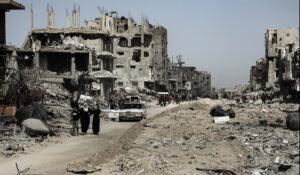
So this is the situation we are in. The Western ruling classes are willing to back obscene violence in Gaza, Lebanon, and Iran, and shred the liberal values they claim to believe in — resulting in breathtaking displays of hypocrisy — because they want to maintain the conditions for capital accumulation and geopolitical hegemony. This is U.S. policy. All the handwringing by Biden in the previous administration, the discourse about “too many innocent lives lost,” was theatre designed to defuse our outrage. Under Trump that veneer of concern is gone; they speak openly of subordinating West Asian states and controlling their resources.
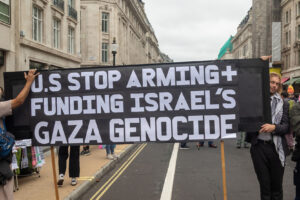
You cannot appeal to imperial power in moral terms. The only way the U.S. will stop arming, funding and propping up the Zionist regime is when it becomes too costly for them to do so. This will come down to the strength of regional political and military opposition, together with the strength of the Hague Group and the movement for boycotts, divestment, and sanctions, as well as real punitive measures that can be applied by international courts.
Opinions published in The Markaz Review reflect the perspective of their authors and do not necessarily represent TMR.