« L’Iran après les flammes » – une ethnographie spéculative

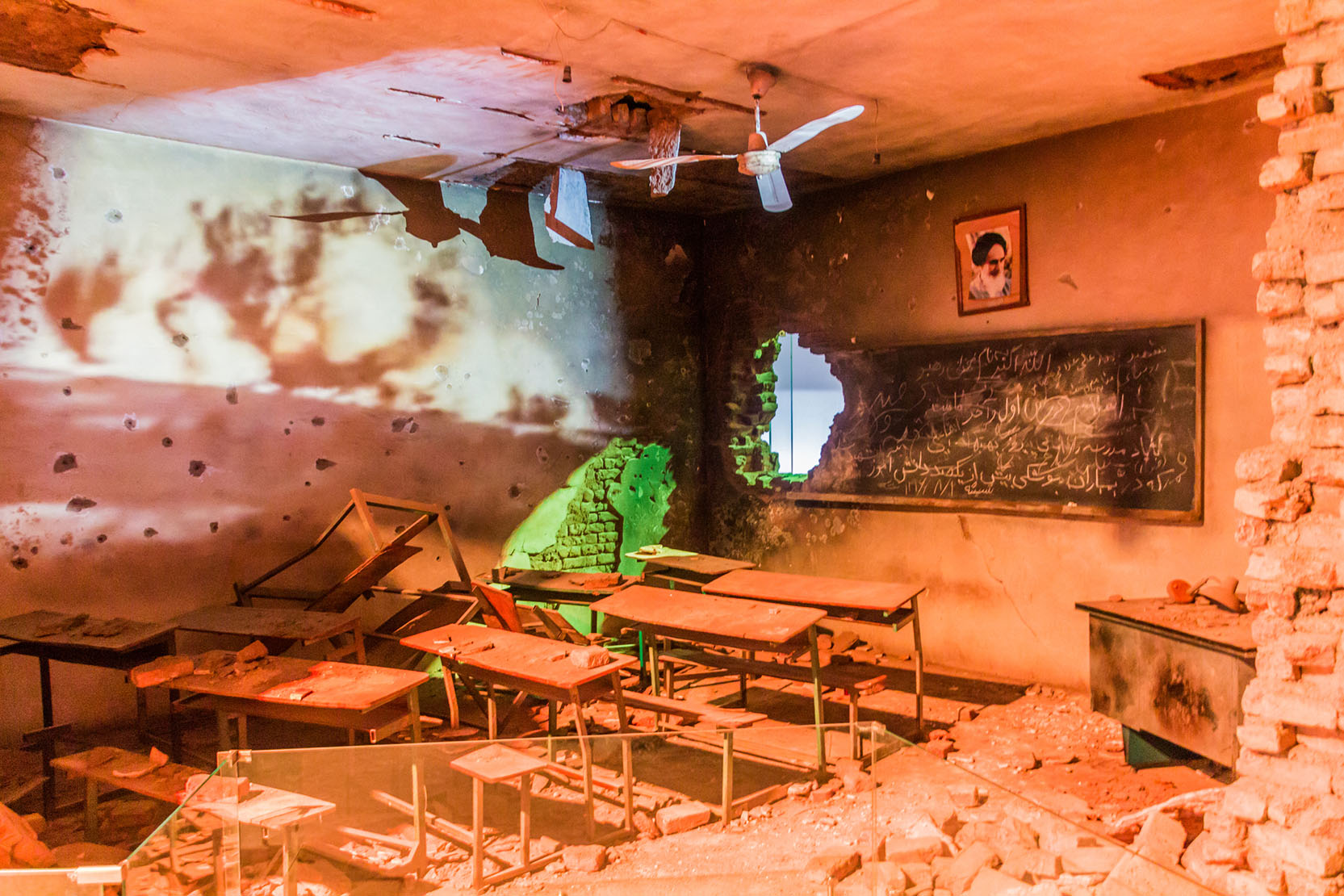
Exposition d’une salle de classe bombardée, au Musée de la révolution islamique et de la défense sacrée à Téhéran, en Iran (photo : Matyas Rehak).

3 APRIL 2026 • By Shahram Khosravi

Select Other Languages English.

Un écrivain imagine l’Iran après la guerre, dans un an.


Été 2027

1.

Au moment où M. Mardani arrive le matin, le couloir devant son bureau est déjà bien rempli. Des hommes et des femmes sont assis épaule contre épaule le long des murs, en attendant qu’on les appelle. Les gardes les font avancer par petits groupes. Les noms sont vérifiés, puis revérifiés. Les dossiers s’accumulent plus vite qu’ils ne sont traités.

 La guerre n’est pas terminée – elle a seulement changé de forme.

Avant la guerre, M. Mardani avait prévu de prendre sa retraite. Dans son esprit, l’avenir était simple : une petite maison près de la mer Caspienne, les matinées passées au jardin et les après-midi avec sa femme, la disparition progressive d’une vie passée au service de l’État. Au lieu de ça, un an après la guerre, ses journées n’ont jamais été aussi longues.

Mais l’officier sous les ordres duquel il a servi pendant plus de vingt ans a été tué dès la première semaine de la guerre, dans une frappe israélienne sur le bâtiment central de l’Organisation du renseignement. Mardani n’avait pas postulé pour ce poste, mais il ne l’a pas refusé non plus.

Pendant les premiers mois après le cessez-le-feu, la priorité a été de traquer les infiltrés. Des listes circulaient, les noms de collaborateurs présumés, d’informateurs, de personnes accusées de contacts avec des services de renseignement étrangers. Certains dossiers étaient fondés. La plupart ne l’étaient pas. On a enregistré des aveux, dont certains ont été diffusés à la télévision par la suite.

Plus tard, on a changé de cible. Les manifestants, les étudiants, tous ceux qui avaient été visibles dans les rues pendant les derniers mois avant que les bombes israéliennes et américaines ne se mettent à tomber. Leurs dossiers étaient plus minces, plutôt constitués d’images, d’extraits de publications sur les réseaux sociaux. Mais la directive était claire. Mardani l’a entendue lui-même, prononcée par le ministre du Renseignement avant sa mort soudaine dans une attaque nocturne :  la dissidence ne relevait plus du civil, elle était assimilée à une menace pour la nation et devait être traitée en conséquence.

Mardani ne remet pas cette affirmation en question. Il a rejoint les Gardiens de la révolution à dix-sept ans, en 1981, au plus fort de la guerre contre l’Irak. Il a passé sept ans au front. Il se remémore ces années avec un brin de nostalgie.

Depuis la mort du Guide suprême dans les premiers jours de la guerre, il a l’impression que quelque chose lui échappe. Il l’a vu en personne à plusieurs reprises au fil des ans, dans des contextes officiels. Il se souvient des détails de ses discours, de son éloquence, de son érudition à propos de l’histoire et de l’islam. De temps à autre, M. Mardani écoute un discours de l’ayatollah Khamenei pour y puiser un peu d’inspiration. Ses paroles, ses harangues passionnées sur la nécessité d’écraser l’estekbar-e Amrika – les politiques oppressives des États-Unis à l’égard de l’Iran –, ses affirmations qu’il ne fallait faire preuve d’aucune clémence envers ceux qu’il appelait les « séditieux » en janvier et février 2026, lorsque les rues des villes iraniennes s’étaient transformées en scènes de révolte, où des jeunes hommes et des jeunes femmes scandaient des slogans de liberté. S’ils n’avaient pas protesté, s’ils n’avaient pas provoqué les affrontements qui ont conduit à la mort de milliers de personnes, alors Trump et Netanyahu n’auraient pas pu s’en servir comme prétexte pour attaquer l’Iran. Il est désormais temps qu’ils soient punis pour avoir fait entrer l’ennemi dans la maison.

Mardani respecte le nouveau gouvernement, mais il a l’impression que ce n’est plus comme avant. Ils sont trop jeunes. Ils sont nés après la Révolution. Ils n’étaient pas là pendant la guerre Iran-Irak. Parfois, il se dit qu’ils ne parlent pas la même langue.

Enfin, l’essentiel, c’est la continuité. Le régime doit tenir. Cette guerre, comme celle des années 1980, n’est pas seulement à subir : elle est porteuse d’un sens, de ce que l’ayatollah Khamenei appelait autrefois une « bénédiction divine ».

2.

Raha travaille dans un café, dans un centre commercial du nord de Téhéran. Après la guerre et l’effondrement de la République islamique, sa vie a radicalement changé. Avant la guerre, elle était en dernière année de son doctorat en sociologie à l’Université de Téhéran. Lorsque le mouvement Femme, Vie, Liberté a commencé à l’automne 2022, elle venait tout juste de commencer son travail de terrain dans un quartier ouvrier du sud de Téhéran. Elle a rejoint le mouvement, elle rêvait d’un Iran libre et d’une structure politique démocratique avec une approche féministe de la société.

Aujourd’hui, elle ne doit plus porter le voile obligatoire. Le nouveau gouvernement répète que les femmes sont libres, qu’elles peuvent s’habiller comme elles le veulent, qu’elles ont les mêmes droits que les hommes. Le nouveau dirigeant, qui se présente comme un « simple médiateur temporaire » jusqu’à l’instauration d’un nouvel ordre politique, a nommé une jeune femme au poste de vice‑présidente.

Mais Raha ne se sent pas libre. L’université est fermée, et il n’y a pas de perspective de réouverture dans un avenir proche. Pas de sécurité de l’emploi non plus. Depuis la fin de la guerre, elle passe d’une situation précaire à une autre. Toutes les ressources et l’attention du nouveau gouvernement sont concentrées sur les conflits militaires dans différentes parties du pays. Une guerre civile se poursuit entre les nouvelles autorités et certaines factions des Gardiens de la révolution, qui contrôlent encore des zones du sud-ouest de l’Iran – la région la plus stratégique du pays, où se trouvent les principaux champs pétrolifères et les ports les plus importants.

Raha est née après la Révolution. En un peu plus de trente ans, elle a connu une succession de mouvements, passant de défaite en défaite : la période dite des réformes, puis le Mouvement vert, puis le mouvement Femme, Vie, Liberté et enfin, le soulèvement de janvier 2026. Tous écrasés. Mais la défaite la plus dure est venue avec la guerre.

Avant la guerre, malgré les risques, il y avait des réseaux militants et des groupes de lecture, des traductions d’œuvres féministes essentielles, des publications critiques. Tout ça a disparu. La guerre a changé les structures politiques du pays, mais elle a aussi touché quelque chose de plus profond.

Téhéran n’est plus la même ville. Il ne reste que quelques-unes des jeunes femmes avec qui elle travaillait auparavant. Elle ne sait pas ce qui est arrivé aux autres. Peut-être que certaines d’entre elles ont quitté le pays pour demander l’asile en Europe.

Elle a du mal avec l’idée de quitter le pays. Qu’est-ce qui lui reste, ici ? Les promesses du nouveau dirigeant ne l’intéressent pas. Elle sait bien que terminer son doctorat est irréaliste, qu’il n’y a que des jobs précaires qui l’attendent. Mais elle n’est toujours pas convaincue de partir. Pas parce que quelque chose la retient en Iran, mais parce que la diaspora iranienne le rebute.

Pendant la troisième semaine de la guerre, alors que les bombardements de Téhéran étaient au plus fort, tous les habitants de son immeuble se sont réfugiés dans la cave. Elle tenait dans ses bras la fille de ses voisins, une petite fille de neuf ans seulement. Raha la serrait fort contre elle. La petite ne pouvait pas s’arrêter de trembler. Quand une bombe s’était écrasée non loin d’eux, tout l’immeuble a vibré. La petite fille s’est fait pipi dessus. Plus tard, la mère a raconté à Raha que ça arrivait toutes les nuits. Le soir du jour où la petite fille s’est fait pipi dessus dans ses bras, Raha a reçu un message d’une amie. C’était une vidéo.

Sheida.

Sa meilleure amie du lycée – celle avec qui elle avait rejoint les manifestations de Femme, Vie, Liberté. Soir après soir, elles avaient fui la police, elles s’étaient réfugiées ensemble, avaient pleuré ensemble. Sheida avait quitté le pays pour continuer à lutter de l’extérieur. Elles se parlaient tous les jours sur WhatsApp. Puis la guerre a commencé, et l’accès à internet a été coupé. Ça faisait trois semaines qu’elles n’arrivaient pas à se parler. Dans la vidéo, Sheida dansait. Elle agitait un drapeau israélien. Elle avait l’air heureuse.

Raha a regardé la vidéo une nouvelle fois. Et encore une autre. Ce qu’elle a vu ce soir-là a brisé quelque chose en elle, bien plus que les bombes à l’extérieur.

3.

Reza est assis devant sa maison à Bouchehr, une ville portuaire sur la côte du golfe Persique. Ce jour-là, comme tous les jours depuis la fin de la guerre, il prend son téléphone et regarde ses messages. Rien de ce qu’il espérait. L’entreprise pour laquelle il travaillait auparavant est injoignable depuis l’année dernière.

Pendant plus de quinze ans, Reza a travaillé à Assalouyeh, loin de sa famille. Assalouyeh a été le plus grand centre de l’industrie pétrolière et gazière sur la côte du golfe Persique. Aux côtés de plein d’autres jeunes hommes venus de tout le pays, il travaillait dans des conditions difficiles – des étés très chauds, une chaleur insupportable, l’air pollué – pour réussir à faire quelque chose de sa vie. Il a été un membre actif du syndicat. Pendant une grève, alors que ça faisait plus de six mois que les salaires n’avaient pas été versés, il était devenu une figure importante du mouvement. Les forces de police sont intervenues, et il a été arrêté avec quelques autres. Il est resté en prison pendant presque un an. Une rage inconnue a surgi en lui. Il s’est peu à peu mis à souhaiter un changement de régime, même si ça impliquait une invasion étrangère.

Il était content quand Israël et les États-Unis ont attaqué l’Iran. Plein d’espoir, il avait regardé Trump promettre que « l’aide était en route » – « Help is on the way ». Il répétait à ses collègues que seule une intervention militaire pouvait sauver les Iraniens de ce régime brutal. « On a tout essayé, et on a échoué. C’est notre seul moyen. »

Mais quand il s’est rendu compte que tout ce pour quoi il avait travaillé si dur était parti en fumée dès les premières semaines de la guerre, son sourire a disparu. Les infrastructures de pétrole et de gaz ont été fortement endommagées, et il faudra encore des années avant que l’Iran puisse prétendre revenir à sa pleine capacité de production et d’exportation. Personne n’a l’air de savoir comment gérer l’économie du pays. Quand il a compris que les promesses d’investissements étrangers après la guerre étaient vaines, il a acheté du matériel de soudure pour réparer des clôtures, des portails, des tuyaux et des pièces de voiture. Mais les clients se font rares. Le carburant est trop cher. Personne ne construit rien, et personne ne répare rien non plus.

Jour après jour, il s’assied sur sa chaise devant la maison et observe l’ombre du mur se déplacer avec le soleil jusqu’en fin d’après-midi. Puis il prend sa chaise et rentre à l’intérieur.

4.

Bahar se tient dans un coin de la cour et se hisse sur la pointe des pieds pour apercevoir le sommet de la montagne. Un sourire se dessine sur son visage. C’est le meilleur moment de la journée – celui où elle trouve un peu de paix.

Elle ferme les yeux et se dit que depuis ses treize ans, elle a été dans les rues à crier et scander des slogans. Les premiers étaient contre la monarchie, pendant la Révolution de 1979. À l’époque, elle n’avait que treize ans et criait pour la démocratie. Puis sont venus les slogans pour les droits citoyens sous la République islamique. Ensuite, ceux pour les droits des femmes. Quand les bombes ont commencé à tomber, elle est descendue dans la rue pour scander : « Ne tuez pas les enfants ». Lorsque la République islamique est tombée et qu’un nouveau monarque est arrivé au pouvoir, elle s’est jointe à beaucoup d’autres pour protester avec des slogans contre le retour de la monarchie.

Ses pieds deviennent douloureux. Elle ne voit plus la montagne. Rien que les murs. La prison d’Evin se dresse au pied des montagnes de l’Alborz, dans le nord de Téhéran.

Le nouveau shah n’a pas modifié la structure de l’organisation du renseignement. Nombre de ceux qui travaillaient pour la République islamique travaillent désormais pour lui.

Bahar a été arrêtée en fin d’après-midi, juste après avoir terminé de donner son cours de sociologie féministe à l’Université de Téhéran. On lui a dit qu’elle était considérée comme une menace pour la sécurité nationale. Bahar savait parfaitement que cette arrestation faisait suite à une conférence qu’elle avait donnée une semaine plus tôt. Elle y avait parlé de l’étymologie des mots révolution et enqelab. Elle se souvient de chaque mot :

« Révolution, dans son étymologie latine, signifie “retour en arrière”. En Iran, nous utilisons le mot enqelab pour dire révolution. Mais enqelab ne renvoie pas seulement à un retour. Il s’agit d’une transformation. Il s’agit de devenir monqaleb, d’une transformation intérieure. Les promesses de la révolution peuvent être confisquées. L’avant et l’après peuvent être exactement la même chose. L’avenir peut n’être qu’une répétition du passé. C’est ce que nous avons appris. Devenir monqaleb, ce n’est pas attendre un futur autre, mais rompre avec la logique qui a fait que tous les futurs sont semblables. C’est créer, dans le présent, les conditions de quelque chose qui n’existe pas encore. Imaginer l’avenir comme déjà vaincu, ce n’est pas une reddition. C’est une manière de révéler les limites de ce qui a été possible jusqu’à présent. La politique, dès lors, n’est pas seulement une lutte pour le pouvoir. C’est une lutte pour l’imaginaire, pour ce qui peut être pensé, ce qui peut être désiré, et ce qui peut encore devenir réalité. »

Le haut-parleur au mur annonce que le temps de promenade est terminé et que tout le monde doit revenir à l’intérieur.

5.

Je suis rentré en Iran après des années d’exil.

Malgré le cessez-le-feu, des bombardements sporadiques de sites industriels se poursuivent, mais ils sont désormais intégrés à la vie quotidienne. Le pays est profondément meurtri.

Je suis dans le village de mon enfance, au Bakhtiari, dans les montagnes du Zagros, où je donne cours à des enfants dans ce qu’il reste de la maison de mes parents. Pendant de nombreuses années, la maison a été laissée à l’abandon. À mon retour, j’ai passé un mois à en restaurer une partie. Je suis revenu pour réaliser un rêve qui m’a nourri pendant mes années d’exil : ouvrir une école pour les enfants de mon village.

Et là, j’y suis. J’enseigne l’anglais, l’histoire et la rédaction. Les enfants adorent. Ils n’ont pas d’école où aller. Celle du village n’a jamais rouvert après le début de la guerre. Il n’y a plus de budget pour l’éducation.

Certains jours, nous marchons jusqu’aux collines, un peu en dehors du village, et nous regardons la vallée s’étendre devant nous. Des champs de blé d’un jaune doré, de luzerne verte à côté, et des parcelles déjà moissonnées, couleur de terre. Rien n’a été épargné par la guerre – ni le sol, ni l’air. Après le bombardement de la centrale nucléaire de Bouchehr, sur le golfe Persique, la nouvelle d’une fuite de radiation dans la nature a semé la panique.

Sur la colline, le vent joue dans les longs cheveux des enfants. Mon cœur se serre d’angoisse. Le vent vient-il du sud ?

Je m’assieds sur une pierre, un peu à l’écart, et je les regarde jouer. Les enfants sont bruyants. Certains s’amusent à se poursuivre. D’autres partagent des morceaux de pain et rient. Ils rient fort. Ça me fait rire aussi.


Note de l’auteur :

Dans ce texte, je me déplace entre le futur et le présent. Un an s’est écoulé depuis que les bombes ont cessé de tomber sur le sol iranien. Un cessez-le-feu fragile entre les États-Unis, Israël et l’Iran tient encore, mais la guerre n’est pas terminée. Ce texte propose une projection du paysage politique et social de l’Iran dans le contrecoup de la guerre. Les personnes décrites ici existent réellement, mais leur nom et les éléments permettant de les identifier ont été modifiés. Ce texte est spéculatif, mais il s’ancre dans des décennies de recherche sur la société iranienne. Il a été inspiré par After Liberation, une fiction spéculative de Sami Hermez. Je tiens à remercier Abdelrahman ElGendy et Alisse Waterston pour leurs commentaires sur une version antérieure de ce texte.

Traduit de l’anglais par Alice Nalpas

Shahram Khosravi

Shahram Khosravi is professor of Anthropology at Stockholm University. His research interests include anthropology of Iran, forced displacement, border studies, and temporality. Khosravi is the author of several books such as : Young and Defiant in Tehran (2008); The Illegal Traveler: an... Read more

Join Our Community

TMR exists thanks to its readers and supporters. By sharing our stories and celebrating cultural pluralism, we aim to counter racism, xenophobia, and exclusion with knowledge, empathy, and artistic expression.

Learn more

RELATED

Interviews

Creating Art in Times of War

10 APRIL 2026 • By TMR
Creating Art in Times of War
Opinion

Apples and Oranges, or Why the US Supports Israel

3 APRIL 2026 • By Jason Hickel
Apples and Oranges, or Why the US Supports Israel
Essays

The Souls of War Folk

3 APRIL 2026 • By Ayça Çubukçu
The Souls of War Folk
Essays

“Iran After the Fire”—a Speculative Ethnography

3 APRIL 2026 • By Shahram Khosravi
“Iran After the Fire”—a Speculative Ethnography
Columns

A Fight to The Death (the Rest of Us In-Between)

27 MARCH 2026 • By Amal Ghandour
A Fight to The Death (the Rest of Us In-Between)
Columns

Dear Souseh: Distressed (& More) by War

27 MARCH 2026 • By Lina Mounzer
Dear Souseh: Distressed (& More) by War
Opinion

Iranian Visions of Democracy from the Ruins

20 MARCH 2026 • By Nojang Khatami
Iranian Visions of Democracy from the Ruins
Essays

The AI Struggle for Middle Earth in the U.S.-Israel War on Iran

13 MARCH 2026 • By Iason Athanasiadis
The AI Struggle for Middle Earth in the U.S.-Israel War on Iran
Columns

Lebanon’s Fate in Our Current World Calamity

13 MARCH 2026 • By Amal Ghandour
Lebanon’s Fate in Our Current World Calamity
Book Reviews

Two New Books Show How Gaza Changed the World

13 FEBRUARY 2026 • By Rebecca Ruth Gould
Two New Books Show How Gaza Changed the World
Art

Behind the Seen: Mona Hatoum on Art and Palestine

30 JANUARY 2026 • By Arie Amaya-Akkermans
<em>Behind the Seen</em>: Mona Hatoum on Art and Palestine
Columns

Beyond Black and White: Notes from Tehran

23 JANUARY 2026 • By M. Nateqnuri
Beyond Black and White: Notes from Tehran
Opinion

What Shirin Neshat Taught Me About Iran

16 JANUARY 2026 • By Hassan Abdulrazzak
What Shirin Neshat Taught Me About Iran
Columns

Trump, The Liberator! (and the Fear Wagons)

16 JANUARY 2026 • By Amal Ghandour
Trump, The Liberator! (and the Fear Wagons)
Film Reviews

If You See Something—an Iraqi Film on Asylum

12 DECEMBER 2025 • By Alex Demyanenko
<em>If You See Something</em>—an Iraqi Film on Asylum
Fiction

“Tahmina”—a story from Iran

5 DECEMBER 2025 • By Abdollah Nazari
“Tahmina”—a story from Iran
Film

10 Noir Films from the Arab world, Iran, and Turkey

5 DECEMBER 2025 • By TMR
10 Noir Films from the Arab world, Iran, and Turkey
Film Reviews

The Woman Who Wouldn’t Break—Cutting Through Rocks’ Sara Shahverdi

28 NOVEMBER 2025 • By Alex Demyanenko
The Woman Who Wouldn’t Break—<em>Cutting Through Rocks’</em> Sara Shahverdi
Book Reviews

Contemporary Kurdish Writers in the Diaspora

14 NOVEMBER 2025 • By Matt Broomfield
Contemporary Kurdish Writers in the Diaspora
Poetry Markaz

Adedayo Agarau presents The Years of Blood

1 NOVEMBER 2025 • By Adedayo Agarau
Adedayo Agarau presents <em>The Years of Blood</em>
Fiction

War and War

26 SEPTEMBER 2025 • By Hussain A. Ayoub
War and War
Essays

Reading the Landscape: Cultural Clues and Regime Messages in Iran

12 SEPTEMBER 2025 • By Raha Nik-Andish
Reading the Landscape: Cultural Clues and Regime Messages in Iran
Essays

Remaining in Light: Iranians Search for Solace and Well-Being

5 SEPTEMBER 2025 • By Malu Halasa
Remaining in Light: Iranians Search for Solace and Well-Being
Editorial

Why Out of Our Minds?

5 SEPTEMBER 2025 • By Lina Mounzer
Why <em>Out of Our Minds</em>?
Centerpiece

Trauma After Gaza

5 SEPTEMBER 2025 • By Joelle Abi-Rached
Trauma After Gaza
Essays

“A Love That Endures”: How Tamer and Sabreen Defied War and Death

25 JULY 2025 • By Husam Maarouf
“A Love That Endures”: How Tamer and Sabreen Defied War and Death
TMR Interviews

Aida Šehović on the 30th Anniversary of the Srebrenica Genocide

18 JULY 2025 • By Claudia Mende
Aida Šehović on the 30th Anniversary of the Srebrenica Genocide
Book Reviews

Hope Without Hope: Rojava and Revolutionary Commitment

11 JULY 2025 • By Arie Amaya-Akkermans
Hope Without Hope: Rojava and Revolutionary Commitment
Poetry

Nasser Rabah on Poetry and Gaza

4 JULY 2025 • By Nasser Rabah
Nasser Rabah on Poetry and Gaza
Essays

Life Under the Shadow of Missiles: the View From Iran

20 JUNE 2025 • By Amir
Life Under the Shadow of Missiles: the View From Iran
Columns

Afraid for Our Children’s Future, How Do We Talk About War?

20 JUNE 2025 • By Lina Mounzer
Afraid for Our Children’s Future, How Do We Talk About War?
Book Reviews

The Evin Prison Bakers’ Club — Review

6 JUNE 2025 • By Hannah Kaviani
The Evin Prison Bakers’ Club — Review
Film Reviews

Contretemps, a Bold Film on Lebanon’s Crises

16 MAY 2025 • By Jim Quilty
Contretemps, a Bold Film on Lebanon’s Crises
Editorial

For Our 50th Issue, Writers Reflect on Going Home

2 MAY 2025 • By TMR
For Our 50th Issue, Writers Reflect on Going Home
Essays

Leaving Abdoh, Finding Chamran

2 MAY 2025 • By Salar Abdoh
Leaving Abdoh, Finding Chamran
Essays

Looking for a Job, Living and Dying in Iran: The Logistics of Going Back

2 MAY 2025 • By Raha Nik-Andish
Looking for a Job, Living and Dying in Iran: The Logistics of Going Back
Centerpiece

Love and Resistance in Online Persian Dating Shows

7 MARCH 2025 • By Malu Halasa
Love and Resistance in Online Persian Dating Shows
Art & Photography

Afghanistan’s Histories of Conflict, Resistance & Desires

7 MARCH 2025 • By Jelena Sofronijevic
Afghanistan’s Histories of Conflict, Resistance & Desires
Art

Finding Emptiness: Gaza Artist Taysir Batniji in Beirut

21 FEBRUARY 2025 • By Jim Quilty
Finding Emptiness: Gaza Artist Taysir Batniji in Beirut
Art & Photography

Mostafa Nodeh: Featured Artist Interview

7 FEBRUARY 2025 • By Mostafa Nodeh
Mostafa Nodeh: Featured Artist Interview
Film Reviews

My Favorite Cake, Iranian Cinema’s Bittersweet Ode to Love

17 JANUARY 2025 • By Karim Goury
<em>My Favorite Cake</em>, Iranian Cinema’s Bittersweet Ode to Love
Book Reviews

In Killing Gilda Yahya Gharagozlou Tells an Intriguing Iranian Tale

10 JANUARY 2025 • By Azadeh Moaveni
In <em>Killing Gilda</em> Yahya Gharagozlou Tells an Intriguing Iranian Tale
Poetry

Annahita Mahdavi West: Two Poems

19 DECEMBER 2024 • By Annahita Mahdavi West
Annahita Mahdavi West: Two Poems
Editorial

Escapism in Times of War — on Genre Fiction

6 DECEMBER 2024 • By Malu Halasa
Escapism in Times of War — on Genre Fiction
Essays

A Jewish Meditation on the Palestinian Genocide

15 NOVEMBER 2024 • By Sheryl Ono
A Jewish Meditation on the Palestinian Genocide
Editorial

The Editor’s Letter Following the US 2024 Presidential Election

8 NOVEMBER 2024 • By Jordan Elgrably
The Editor’s Letter Following the US 2024 Presidential Election
Film

The Haunting Reality of Beirut, My City

8 NOVEMBER 2024 • By Roger Assaf, Zeina Hashem Beck
The Haunting Reality of <em>Beirut, My City</em>
Essays

The Felines that Leave Us, and the Humans that Left

1 NOVEMBER 2024 • By Farnaz Haeri, Salar Abdoh
The Felines that Leave Us, and the Humans that Left
Film

Freedom is a Combat Sport: On Tatami

11 OCTOBER 2024 • By Karim Goury
Freedom is a Combat Sport: On <em>Tatami</em>
Editorial

A Year of War Without End

4 OCTOBER 2024 • By Lina Mounzer
A Year of War Without End
Book Reviews

Tragic Consequences — On Western Meddling in the Middle East

13 SEPTEMBER 2024 • By Dina Rezk
Tragic Consequences — On Western Meddling in the Middle East
Poetry

Hafez, Iran’s Revered Poet, trans. Erfan Mojib & Gary Gach

15 JULY 2024 • By Erfan Mojib, Gary Gach
Hafez, Iran’s Revered Poet, trans. Erfan Mojib & Gary Gach
Fiction

“Firefly”—a short story by Alireza Iranmehr

5 JULY 2024 • By Alireza Iranmehr, Salar Abdoh
“Firefly”—a short story by Alireza Iranmehr
Books

The Mourning Diaries of Atash Shakarami

5 JULY 2024 • By Poupeh Missaghi
The Mourning Diaries of Atash Shakarami
short story

“Deferred Sorrow”—fiction from Haidar Al Ghazali

5 JULY 2024 • By Haidar Al Ghazali, Rana Asfour
“Deferred Sorrow”—fiction from Haidar Al Ghazali
Book Reviews

Is Amin Maalouf’s Latest Novel, On the Isle of Antioch, a Parody?

14 JUNE 2024 • By Farah-Silvana Kanaan
Is Amin Maalouf’s Latest Novel, <em>On the Isle of Antioch</em>, a Parody?
Poetry

Three Poems by Somaia Ramish

12 JUNE 2024 • By Somaia Ramish
Three Poems by Somaia Ramish
Centerpiece

Dare Not Speak—a One-Act Play

7 JUNE 2024 • By Hassan Abdulrazzak
<em>Dare Not Speak</em>—a One-Act Play
Interviews

Nothing is Normal, Nothing Is What it Seems (Underground Theatre in Iran After the Woman, Life, Freedom Movement)

7 JUNE 2024 • By Mehrnaz Daneshvar, Salar Abdoh
Nothing is Normal, Nothing Is What it Seems (Underground Theatre in Iran After the Woman, Life, Freedom Movement)
Art & Photography

What Is Home?—Gazans Redefine Place Amid Displacement

31 MAY 2024 • By Nadine Aranki
What Is Home?—Gazans Redefine Place Amid Displacement
Featured Artist

Bani Khoshnoudi: Featured Artist for PARIS

1 APRIL 2024 • By TMR, Jordan Elgrably
Bani Khoshnoudi: Featured Artist for PARIS
Essays

Israel’s Environmental and Economic Warfare on Lebanon

3 MARCH 2024 • By Michelle Eid
Israel’s Environmental and Economic Warfare on Lebanon
Columns

Genocide: “That bell can’t be unrung. That thought can’t be unthunk.”

3 MARCH 2024 • By Amal Ghandour
Genocide: “That bell can’t be unrung. That thought can’t be unthunk.”
Book Reviews

Eyeliner: A Cultural History by Zahra Hankir—A Review

19 FEBRUARY 2024 • By Nazli Tarzi
<em>Eyeliner: A Cultural History</em> by Zahra Hankir—A Review
Art

Issam Kourbaj’s Love Letter to Syria in Cambridge

12 FEBRUARY 2024 • By Sophie Kazan Makhlouf
Issam Kourbaj’s Love Letter to Syria in Cambridge
Editorial

Shoot That Poison Arrow to My Heart: The LSD Editorial

4 FEBRUARY 2024 • By Malu Halasa
Shoot That Poison Arrow to My Heart: The LSD Editorial
short story

“Water”—a short story by Salar Abdoh

4 FEBRUARY 2024 • By Salar Abdoh
“Water”—a short story by Salar Abdoh
Essays

A Treatise on Love

4 FEBRUARY 2024 • By Maryam Haidari, Salar Abdoh
A Treatise on Love
Featured article

Israel-Palestine: Peace Under Occupation?

29 JANUARY 2024 • By Laëtitia Soula
Israel-Palestine: Peace Under Occupation?
Books

Illuminated Reading for 2024: Our Anticipated Titles

22 JANUARY 2024 • By TMR
Illuminated Reading for 2024: Our Anticipated Titles
Book Reviews

An Iranian Novelist Seeks the Truth About a Plane Crash

15 JANUARY 2024 • By Sepideh Farkhondeh
An Iranian Novelist Seeks the Truth About a Plane Crash
Poetry

Brian Turner: 3 Poems From Three New Books

14 JANUARY 2024 • By Brian Turner
Brian Turner: 3 Poems From Three New Books
Art & Photography

Cyprus: Return to Petrofani with Ali Cherri & Vicky Pericleous

8 JANUARY 2024 • By Arie Amaya-Akkermans
Cyprus: Return to Petrofani with Ali Cherri & Vicky Pericleous
Books

Inside Hamas: From Resistance to Regime

25 DECEMBER 2023 • By Paola Caridi
Inside <em>Hamas: From Resistance to Regime</em>
Film

Religious Misogyny Personified in Ali Abbasi’s Holy Spider

11 DECEMBER 2023 • By Bavand Karim
Religious Misogyny Personified in Ali Abbasi’s <em>Holy Spider</em>
Editorial

Why Endings & Beginnings?

3 DECEMBER 2023 • By Jordan Elgrably
Why Endings & Beginnings?
TMR 37 • Endings & Beginnings

“The Summer They Heard Music”—a short story by MK Harb

3 DECEMBER 2023 • By MK Harb
“The Summer They Heard Music”—a short story by MK Harb
Fiction

“The Waiting Bones”—an essay by Maryam Haidari

3 DECEMBER 2023 • By Maryam Haidari, Salar Abdoh
“The Waiting Bones”—an essay by Maryam Haidari
Fiction

“I, Hanan”—a Gazan tale of survival by Joumana Haddad

3 DECEMBER 2023 • By Joumana Haddad
“I, Hanan”—a Gazan tale of survival by Joumana Haddad
Art

Hanan Eshaq

3 DECEMBER 2023 • By Hanan Eshaq
Hanan Eshaq
Book Reviews

First Kurdish Sci-Fi Collection is Rooted in the Past

28 NOVEMBER 2023 • By Matt Broomfield
First Kurdish Sci-Fi Collection is Rooted in the Past
Art & Photography

Palestinian Artists & Anti-War Supporters of Gaza Cancelled

27 NOVEMBER 2023 • By Nada Ghosn
Palestinian Artists & Anti-War Supporters of Gaza Cancelled
Fiction

Bahar: 22 years in the Life of a Compulsory Hijabi in Teheran

20 NOVEMBER 2023 • By Joumana Haddad
Bahar: 22 years in the Life of a Compulsory Hijabi in Teheran
Art & Photography

Iranian Women Photographers: Life, Freedom, Music, Art & Hair

20 NOVEMBER 2023 • By Malu Halasa
Iranian Women Photographers: Life, Freedom, Music, Art & Hair
Opinion

Beautiful October 7th Art Belies the Horrors of War

13 NOVEMBER 2023 • By Mark LeVine
Beautiful October 7th Art Belies the Horrors of War
Opinion

Palestine’s Pen against Israel’s Swords of Injustice

6 NOVEMBER 2023 • By Mai Al-Nakib
Palestine’s Pen against Israel’s Swords of Injustice
Books

Domicide—War on the City

5 NOVEMBER 2023 • By Ammar Azzouz
<em>Domicide</em>—War on the City
Essays

On Fathers, Daughters and the Genocide in Gaza 

30 OCTOBER 2023 • By Deema K Shehabi
On Fathers, Daughters and the Genocide in Gaza 
Islam

October 7 and the First Days of the War

23 OCTOBER 2023 • By Robin Yassin-Kassab
October 7 and the First Days of the War
Essays

Forging Peace for Artsakh—The Debacle of Nagorno Karabagh

16 OCTOBER 2023 • By Seta Kabranian-Melkonian
Forging Peace for Artsakh—The Debacle of Nagorno Karabagh
Book Reviews

Reza Aslan’s An American Martyr in Persia Argues for US-Iranian Friendship

1 OCTOBER 2023 • By Dalia Sofer
Reza Aslan’s <em>An American Martyr in Persia</em> Argues for US-Iranian Friendship
Art & Photography

Adel Abidin, October 2023

1 OCTOBER 2023 • By TMR
Adel Abidin, October 2023
Art

Special World Picks Sept 15-26 on TMR’s Third Anniversary

14 SEPTEMBER 2023 • By TMR
Special World Picks Sept 15-26 on TMR’s Third Anniversary
Essays

A Day in the Life with Forugh Farrokhzad (and a Tortoise)

3 SEPTEMBER 2023 • By Fargol Malekpoosh
A Day in the Life with Forugh Farrokhzad (and a Tortoise)
Poetry

Three Poems from Pantea Amin Tofangchi’s Glazed With War

3 AUGUST 2023 • By Pantea Amin Tofangchi
Three Poems from Pantea Amin Tofangchi’s <em>Glazed With War</em>
Book Reviews

Can the Kurdish Women’s Movement Transform the Middle East?

31 JULY 2023 • By Matt Broomfield
Can the Kurdish Women’s Movement Transform the Middle East?
Book Reviews

Why Isn’t Ghaith Abdul-Ahad a Household Name?

10 JULY 2023 • By Iason Athanasiadis
Why Isn’t Ghaith Abdul-Ahad a Household Name?
Opinion

The End of the Palestinian State? Jenin Is Only the Beginning

10 JULY 2023 • By Yousef M. Aljamal
The End of the Palestinian State? Jenin Is Only the Beginning
Fiction

Arrival in the Dark—fiction from Alireza Iranmehr

2 JULY 2023 • By Alireza Iranmehr, Salar Abdoh
Arrival in the Dark—fiction from Alireza Iranmehr
Fiction

“Here, Freedom”—fiction from Danial Haghighi

2 JULY 2023 • By Danial Haghighi, Salar Abdoh
“Here, Freedom”—fiction from Danial Haghighi
Essays

Zahhāk: An Etiology of Evil

2 JULY 2023 • By Omid Arabian
Zahhāk: An Etiology of Evil
Fiction

“The Long Walk of the Martyr”—fiction from Salar Abdoh

2 JULY 2023 • By Salar Abdoh
“The Long Walk of the Martyr”—fiction from Salar Abdoh
Editorial

EARTH: Our Only Home

4 JUNE 2023 • By Jordan Elgrably
EARTH: Our Only Home
Arabic

Arab Theatre Grapples With Climate Change, Borders, War & Love

4 JUNE 2023 • By Hassan Abdulrazzak
Arab Theatre Grapples With Climate Change, Borders, War & Love
Photography

Iran on the Move—Photos by Peyman Hooshmandzadeh

1 MAY 2023 • By Peyman Hooshmandzadeh, Malu Halasa
Iran on the Move—Photos by Peyman Hooshmandzadeh
Book Reviews

Hard Work: Kurdish Kolbars or Porters Risk Everything

1 MAY 2023 • By Clive Bell
Hard Work: Kurdish <em>Kolbars</em> or Porters Risk Everything
Opinion

Nurredin Amro’s Epic Battle to Save His Home From Demolition

24 APRIL 2023 • By Nora Lester Murad
Nurredin Amro’s Epic Battle to Save His Home From Demolition
Essays

When a Country is not a Country—the Chimera of Borders

17 APRIL 2023 • By Ara Oshagan
When a Country is not a Country—the Chimera of Borders
Essays

Artsakh and the Truth About the Legend of Monte Melkonian

17 APRIL 2023 • By Seta Kabranian-Melkonian
Artsakh and the Truth About the Legend of Monte Melkonian
Beirut

Tel Aviv-Beirut, a Film on War, Love & Borders

20 MARCH 2023 • By Karim Goury
<em>Tel Aviv-Beirut</em>, a Film on War, Love & Borders
Cities

The Odyssey That Forged a Stronger Athenian

5 MARCH 2023 • By Iason Athanasiadis
The Odyssey That Forged a Stronger Athenian
Book Reviews

Yemen War Survivors Speak in What Have You Left Behind?

20 FEBRUARY 2023 • By Saliha Haddad
Yemen War Survivors Speak in <em>What Have You Left Behind?</em>
Book Reviews

White Torture Prison Interviews Condemn Solitary Confinement

13 FEBRUARY 2023 • By Kamin Mohammadi
<em>White Torture</em> Prison Interviews Condemn Solitary Confinement
Beirut

Arab Women’s War Stories, Oral Histories from Lebanon

13 FEBRUARY 2023 • By Evelyne Accad
Arab Women’s War Stories, Oral Histories from Lebanon
Columns

Letters From Tehran: Braving Tehran’s Roundabout, Maidan Valiasr

30 JANUARY 2023 • By TMR
Letters From Tehran: Braving Tehran’s Roundabout, Maidan Valiasr
Book Reviews

Editor’s Picks: Magical Realism in Iranian Lit

30 JANUARY 2023 • By Rana Asfour
Editor’s Picks: Magical Realism in Iranian Lit
Book Reviews

Mohamed Makhzangi Despairs at Man’s Cruelty to Animals

26 DECEMBER 2022 • By Saliha Haddad
Mohamed Makhzangi Despairs at Man’s Cruelty to Animals
Featured article

Don’t Be a Stooge for the Regime—Iranians Reject State-Controlled Media!

15 DECEMBER 2022 • By Malu Halasa
Don’t Be a Stooge for the Regime—Iranians Reject State-Controlled Media!
Columns

Siri Hustvedt & Ahdaf Souief Write Letters to Imprisoned Writer Narges Mohammadi

15 DECEMBER 2022 • By TMR
Siri Hustvedt & Ahdaf Souief Write Letters to Imprisoned Writer Narges Mohammadi
Music

Revolutionary Hit Parade: 12+1 Protest Songs from Iran

15 DECEMBER 2022 • By Malu Halasa
Revolutionary Hit Parade: 12+1 Protest Songs from Iran
Film

Imprisoned Director Jafar Panahi’s No Bears

15 DECEMBER 2022 • By Clive Bell
Imprisoned Director Jafar Panahi’s <em>No Bears</em>
Art

Museums in Exile—MO.CO’s show for Chile, Sarajevo & Palestine

12 DECEMBER 2022 • By Jordan Elgrably
Museums in Exile—MO.CO’s show for Chile, Sarajevo & Palestine
Opinion

Historic Game on the Horizon: US Faces Iran Once More

28 NOVEMBER 2022 • By Mireille Rebeiz
Opinion

Fragile Freedom, Fragile States in the Muslim World

24 OCTOBER 2022 • By I. Rida Mahmood
Fragile Freedom, Fragile States in the Muslim World
Opinion

Letter From Tehran: On the Pain of Others, Once Again

24 OCTOBER 2022 • By Sara Mokhavat
Letter From Tehran: On the Pain of Others, Once Again
Poetry

The Heroine Forugh Farrokhzad—”Only Voice Remains”

15 OCTOBER 2022 • By Sholeh Wolpé
The Heroine Forugh Farrokhzad—”Only Voice Remains”
Editorial

You Don’t Have to Be A Super Hero to Be a Heroine

15 OCTOBER 2022 • By TMR
You Don’t Have to Be A Super Hero to Be a Heroine
Art

#MahsaAmini—Art by Rachid Bouhamidi, Los Angeles

15 OCTOBER 2022 • By Rachid Bouhamidi
#MahsaAmini—Art by Rachid Bouhamidi, Los Angeles
Art & Photography

Homage to Mahsa Jhina Amini & the Women-Led Call for Freedom

15 OCTOBER 2022 • By TMR
Homage to Mahsa Jhina Amini & the Women-Led Call for Freedom
Art

Defiance—an essay from Sara Mokhavat

15 OCTOBER 2022 • By Sara Mokhavat, Salar Abdoh
Defiance—an essay from Sara Mokhavat
Film

Ziad Kalthoum: Trajectory of a Syrian Filmmaker

15 SEPTEMBER 2022 • By Viola Shafik
Ziad Kalthoum: Trajectory of a Syrian Filmmaker
Art & Photography

Shirin Mohammad: Portrait of an Artist Between Berlin & Tehran

15 SEPTEMBER 2022 • By Noushin Afzali
Shirin Mohammad: Portrait of an Artist Between Berlin & Tehran
Columns

Salman Rushdie, Aziz Nesin and our Lingering Fatwas

22 AUGUST 2022 • By Sahand Sahebdivani
Salman Rushdie, Aziz Nesin and our Lingering Fatwas
Art

Abundant Middle Eastern Talent at the ’22 Avignon Theatre Fest

18 JULY 2022 • By Nada Ghosn
Abundant Middle Eastern Talent at the ’22 Avignon Theatre Fest
Editorial

Editorial: Is the World Driving Us Mad?

15 JULY 2022 • By TMR
Editorial: Is the World Driving Us Mad?
Centerpiece

Big Laleh, Little Laleh—memoir by Shokouh Moghimi

15 JULY 2022 • By Shokouh Moghimi, Salar Abdoh
Big Laleh, Little Laleh—memoir by Shokouh Moghimi
Film Reviews

War and Trauma in Yemen: Asim Abdulaziz’s “1941”

15 JULY 2022 • By Farah Abdessamad
War and Trauma in Yemen: Asim Abdulaziz’s “1941”
Columns

World Refugee Day — What We Owe Each Other

20 JUNE 2022 • By Jordan Elgrably
World Refugee Day — What We Owe Each Other
Film

Art Film Depicts the Landlocked Drama of Nagorno-Karabakh

2 MAY 2022 • By Taline Voskeritchian
Art Film Depicts the Landlocked Drama of Nagorno-Karabakh
Columns

Not Just Any Rice: Persian Kateh over Chelo

15 APRIL 2022 • By Maryam Mortaz, A.J. Naddaff
Not Just Any Rice: Persian Kateh over Chelo
Book Reviews

Abū Ḥamza’s Bread

15 APRIL 2022 • By Philip Grant
Abū Ḥamza’s Bread
Columns

Nowruz and The Sins of the New Day

21 MARCH 2022 • By Maha Tourbah
Nowruz and The Sins of the New Day
Art

Fiction: “Skin Calluses” by Khalil Younes

15 MARCH 2022 • By Khalil Younes
Fiction: “Skin Calluses” by Khalil Younes
Latest Reviews

Three Love Poems by Rumi, Translated by Haleh Liza Gafori

15 MARCH 2022 • By Haleh Liza Gafori
Three Love Poems by Rumi, Translated by Haleh Liza Gafori
Columns

“There’s Nothing Worse Than War”

24 FEBRUARY 2022 • By Jordan Elgrably
“There’s Nothing Worse Than War”
Fiction

Fiction from “Free Fall”: I fled the city as a murderer whose crime had just been uncovered

15 JANUARY 2022 • By Abeer Esber, Nouha Homad
Fiction from “Free Fall”: I fled the city as a murderer whose crime had just been uncovered
Columns

Getting to the Other Side: a Kurdish Migrant Story

15 JANUARY 2022 • By Iason Athanasiadis
Getting to the Other Side: a Kurdish Migrant Story
Art & Photography

Refugees of Afghanistan in Iran: a Photo Essay by Peyman Hooshmandzadeh

15 JANUARY 2022 • By Peyman Hooshmandzadeh, Salar Abdoh
Refugees of Afghanistan in Iran: a Photo Essay by Peyman Hooshmandzadeh
Book Reviews

Meditations on The Ungrateful Refugee

15 JANUARY 2022 • By Rana Asfour
Meditations on <em>The Ungrateful Refugee</em>
Book Reviews

Temptations of the Imagination: how Jana Elhassan and Samar Yazbek transmogrify the world

10 JANUARY 2022 • By Rana Asfour
Temptations of the Imagination: how Jana Elhassan and Samar Yazbek transmogrify the world
Interviews

The Fabulous Omid Djalili on Good Times and the World

15 DECEMBER 2021 • By Jordan Elgrably
The Fabulous Omid Djalili on Good Times and the World
Art & Photography

Hasteem, We Are Here: The Collective for Black Iranians

15 SEPTEMBER 2021 • By Maryam Sophia Jahanbin
Hasteem, We Are Here: The Collective for Black Iranians
Essays

Why Resistance Is Foundational to Kurdish Literature

15 SEPTEMBER 2021 • By Ava Homa
Why Resistance Is Foundational to Kurdish Literature
Featured excerpt

The Harrowing Life of Kurdish Freedom Activist Kobra Banehi

15 SEPTEMBER 2021 • By Kobra Banehi, Jordan Elgrably
The Harrowing Life of Kurdish Freedom Activist Kobra Banehi
Latest Reviews

Women Comic Artists, from Afghanistan to Morocco

15 AUGUST 2021 • By Sherine Hamdy
Women Comic Artists, from Afghanistan to Morocco
Art

Malak Mattar — Gaza Artist and Survivor

14 JULY 2021 • By Jordan Elgrably
Malak Mattar — Gaza Artist and Survivor
Columns

The Semantics of Gaza, War and Truth

14 JULY 2021 • By Mischa Geracoulis
The Semantics of Gaza, War and Truth
Weekly

The Unfinished Presidency of Jimmy Carter

4 JULY 2021 • By Maryam Zar
The Unfinished Presidency of Jimmy Carter
Book Reviews

ISIS and the Absurdity of War in the Age of Twitter

4 JULY 2021 • By Jessica Proett
ISIS and the Absurdity of War in the Age of Twitter
Art

The Murals of “Education is Not a Crime”

14 MAY 2021 • By Saleem Vaillancourt
The Murals of “Education is Not a Crime”
Art

The Murals of Yemen’s Haifa Subay

14 MAY 2021 • By Farah Abdessamad
The Murals of Yemen’s Haifa Subay
TMR 7 • Truth?

The Crash, Covid-19 and Other Iranian Stories

14 MARCH 2021 • By Malu Halasa
The Crash, Covid-19 and Other Iranian Stories
TMR 6 • Revolutions

The Revolution Sees its Shadow 10 Years Later

14 FEBRUARY 2021 • By Mischa Geracoulis
The Revolution Sees its Shadow 10 Years Later

Leave a Comment

Your email address will not be published. Required fields are marked *

nineteen + 2 =

Scroll to Top