A writer imagines Iran one year from now...
Summer 2027
1.
By the time Mr. Mardani arrives in the morning, the corridor outside his office is already occupied. Men and women sit shoulder to shoulder along the walls, waiting to be called. The guards move them in small groups. Names are checked, then checked again. Files accumulate faster than they can be processed.
The war has not ended; it has only changed form.
Before the war Mr. Mardani had planned to retire. In his mind, the future had been simple: a small house near the Caspian Sea, mornings in the garden, afternoons with his wife, the slow fading of a life spent in service. Instead, one year after the war, he works longer hours than at any point in his career.
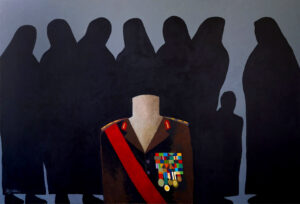
But the officer he had served under for more than two decades was killed in the first week of the war, when an Israeli strike hit the central building of the Intelligence Organization. Mardani did not ask for the position, but neither did he refuse it.
In the first months after the ceasefire, the priority was chasing the infiltrators. Lists circulated, names of suspected collaborators, informants, those accused of contact with foreign intelligence. Some cases were substantiated. Many were not. Confessions were recorded, and some later appeared on television.
Later, the focus shifted. Protesters, students, those who had been visible in the streets during the final months before the Israeli and U.S. bombs began to fall. Their files were thinner, often consisting of images, fragments of social media posts. Still, the directive was clear enough. Mardani had heard it himself, delivered by the Intelligence Minister before he was killed in an overnight attack: dissent was no longer a civil matter; it was an enemy of the country and should be treated accordingly.
Mardani does not question the premise. He joined the Revolutionary Guard at seventeen, in 1981, at the height of the war with Iraq. He spent seven years at the front. He remembers those year with a sense of nostalgia.
Since the death of the Supreme Leader in the opening days of the war, something has been harder to locate. Mardani had seen him in person several times over the years in formal settings. He remembers the details of his eloquent speeches, his knowledge of history and Islam. From time to time, Mr. Mardani listens to speeches of Ayatollah Khamenei to get some inspiration. His words, his passionate speeches about how to crush estekbar-e Amrika, describing the U.S.’s oppressive policies toward Iran, and how not to show mercy toward those he called “seditionists” during January and February 2026, when the streets of Iranian cities were turned into scenes of rebellion by young men and women who chanted for freedom. If they had not protested, if they had not created the confrontations that resulted in the killing of thousands of people, then Trump and Netanyahu could not have used it as an excuse to attack Iran. Now it is time for them to be punished for inviting the enemy home.
Mr. Mardani has respect for the new leadership, but he feels that it is not the same as before. They are too young. They were born after the Revolution. They did not take part in the Iran–Iraq War. Sometimes, he thinks they do not speak the same language.
What matters, however, is continuity. The regime must hold. The war, like the one in the 1980s, is not only endured but given meaning, what Ayatollah Khomeini once called a “divine blessing.”
2.
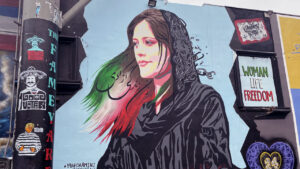
Raha works in a coffee shop in a shopping mall in northern Tehran. After the war and the collapse of the Islamic Republic, her life changed drastically. Before the war, she was in the last year of her PhD program in sociology at Tehran University. When the Woman Life Freedom movement started in the fall of 2022, she had just begun her fieldwork in a working-class neighborhood in the south of Tehran. She joined the movement, dreaming of a free Iran, a democratic political structure with a feminist approach to society.
Now she does not need to wear the compulsory veil. The new leadership repeatedly announces that women are free, that they can wear what they want and have the same legal rights as men. The new leader, who calls himself “only a temporary mediator” until a new political order is established, has appointed a young woman as his deputy.
But Raha does not feel free. The university is closed, and there is no prospect of reopening in the near future. There are no secure jobs, either. Since the war ended, she has gone from one precarious situation to another. All resources and attention of the new leadership are on the military conflicts in different parts of the country. A civil war continues between the new authorities and sections of the Revolutionary Guard, which still control parts of southwestern Iran — the country’s most strategic region, where its main oil fields and key ports are located.
Raha was born after the Revolution. In a little more than three decades, she has moved from one defeated movement to another: the so-called Reform Era; the Green Movement; Woman Life Freedom; and the January 2026 uprising. All defeated. But the harshest defeat came with the war.
Before the war and despite risks, there were networks of activism and reading groups, forms of networking, translations of crucial feminist thinkers, and critical essays. All are gone. The war changed the political structure, but something deeper changed too.
Tehran is not the same city. Of all the young women she worked with, only a couple are still there. She does not know what happened to the others. Perhaps some left the country to try to seek asylum in Europe.
She also struggles with the thought of migrating. What is here for her? She is untouched by the promises of the new leader. She knows that finishing her PhD is unrealistic, and that precarious jobs are all that await her. But she is still not convinced to leave the country. Not because there is something keeping her in Iran, but because the Iranian diaspora repels her.
During the third week of the war, when the bombardment of Tehran was at its worst, all the neighbors in her building gathered in the basement. The daughter of the family next door, only nine years old, was in her arms. Raha held her tight. The girl would not stop shaking. When a bomb struck the ground not far from them, the building trembled. The girl urinated on herself. Later, her mother told Raha it had been happening every night. That night the girl urinated on herself in Raha’s arms she received a message from a friend. There was a video clip.
Sheida.
Her best friend from high school — the one she had joined the Woman Life Freedom protests with. Every night they ran from the police, took shelter together, cried together. Sheida had left the country to continue the struggle abroad. They used to speak every day on WhatsApp. Then the war began, and the internet was cut. Raha has not been able to speak with her in three weeks. In the video, Sheida was dancing. She was waving an Israeli flag. She looked happy.
Raha watched it again. And again. What she saw broke something in her more than the bombs outside.
3.
Reza sits outside his house in Bushehr, a port city on the Persian Gulf coast. This day, as every day since the war ended. He opens his cellphone and look at messages. None he had hoped for. The company he had worked for has been unreachable since last year.
For more than fifteen years, Reza had worked in Assaluyeh, far from his family. Assaluyeh was the largest hub for the oil and gas industry on the Persian Gulf coast. Along with many other young men from across the country, they worked under harsh conditions — hot summers, unbearable heat, toxic air — to build something. He was an active member of the labor union. Once, when salaries went unpaid for more than six months, he became a leading figure in the strike. The police forces came, and he, along with several others, was arrested. He spent almost a year in detention. An unfamiliar rage surged within him. He began to wish for regime change, even if it came through a foreign invasion.
He was happy when Israel and the United States attacked Iran. He watched, hopeful, when Trump promised that “help is on the way.” He used to say to his colleagues that only a military intervention could rescue Iranians from the brutal regime: “We have tried everything and failed. This is the only way.”
But when he saw that everything he had worked so hard to build was gone in the first weeks of the war, he no longer smiled. The oil and gas infrastructure was largely damaged during the war, and it will take years before Iran can return to full capacity in production and export. No one seems to know how the country’s economy will be managed. When he realized that the promises of foreign investment after the war had proved empty, he bought welding equipment to repair fences, gates, pipes, and car parts. But customers are rare. Fuel is too expensive. No one is building anything, not even repairing anything.
Day after day he sits on a chair outside the house and watches the shadow of the wall move with the sun until late afternoon. Then he takes his chair and walks back inside.
4.
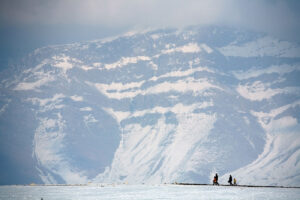
Bahar stands in the corner of the yard, rising on her tiptoes to catch a glimpse of the top of the mountain. A smile appears on her face. This is the highlight of her day — the moment when she finds a fragment of peace.
She closes her eyes and thinks: since the age of thirteen, she has been in the streets, chanting slogans. The first slogans were against the monarchy, during the 1979 Revolution. She was only thirteen then, chanting for democracy. Then came slogans for citizenship rights under the Islamic Republic. Later, slogans for women’s rights. When the bombs started falling, she went to the streets to chant, “Do not kill children.” When the Islamic Republic fell and a new monarch came to power, she joined many others and chanted against the return of the monarchy.
Her feet begin to ache. She can no longer see the mountain. Only walls. Evin prison stands at the foothills of the Alborz Mountains, in northern Tehran.
The new Shah did not change the structure of the intelligence organization. Many of those who had worked for the Islamic Republic now work for him.
Bahar was arrested one late afternoon, just after she had finished teaching her class on feminist sociology at Tehran University. She was told that she was considered a threat to national security. Bahar knew well that the arrest was because of a lecture she had given a week earlier. She had spoken about the etymology of the words “revolution” and enqelab. She remembers every word:
“Revolution its Latin etymology, means ‘rolling back.’ In Iran, we use the word enqelab for revolution. But enqelab is not only about return. It is about transformation. It is about becoming monqaleb, an inner transformation. The promises of revolution can be stolen. Before and after the revolution may not differ. The future can become only a repetition of the past. This is what we have learned. To become monqaleb is not to wait for a different future, but to break with the logic that has made every future look the same. It is to create, within the present, the conditions for something that does not yet exist. Imagining the future as already defeated is not surrender. It is a way of exposing the limits of what has been possible so far. Politics, then, is not only a struggle over power. It is a struggle over imagination, over what can be thought, what can be desired, and what can still be made possible.”
The speaker on the wall announced that yard time was over and that everyone should return inside.
5.
I returned to Iran after years of exile.
Despite the ceasefire, sporadic bombings of industrial sites continue but they have become normalized in everyday life. The country is deeply wounded.
I am in my childhood village in Bakhtiari, in the Zagros Mountains, teaching children in what remains of my parents’ house. For many years, the house stood abandoned. When I returned, I spent a month restoring part of it. I came back to realize a dream that sustained me through exile: to open a school for the children of my village.
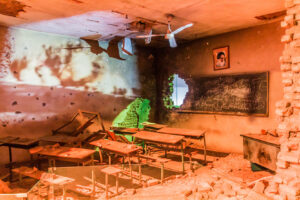
Now I am here. I teach English, history, and how to write essays. The children love it. They have no school to go to. The only one in the village has never reopened since the war began. There is no longer any budget for education.
Some days we walk to the hills next to the village and look out over the valley. Wheat fields in golden yellow, next to green lucerne fields, and patches of land already harvested, in the color of soil. Nothing is left untouched by the war — not the soil, not the air. After the Bushehr nuclear power plant on the Persian Gulf was bombed, news of radiation leaking into the environment spread panic.
On the hill, the wind plays with the children’s long hair. My heart tightens with fear. Is the wind coming from the south?
I sit on a stone a little distance from them and watch them play. The children are noisy. Some run after each other. Others share loaves of bread and laugh. Their laughter is loud. It makes me laugh too.
Author’s Note:
In this essay, I move between the future and the present. It has been a year since the bombs stopped falling on Iranian soil. A fragile ceasefire between the United States, Israel, and Iran has held, but the war has not ended. What follows imagines the political and social landscape of Iran in its aftermath. The people portrayed here are real. Their names and identifying details have been changed. The essay is speculative, yet it emerges from decades of research engagement with Iranian society. This essay was inspired by Sami Hermez’s speculative fiction After Liberation. I would like to thank Abdelrahman ElGendy and Alisse Waterston for their comments on an earlier draft.