Two poems explore the generational trauma experienced by immigrants and war refugees of Arab heritage, while also emphasizing hope and healing.
The Markaz Review: What inspired these poems? Could you share your personal journey or motivations behind them, especially those dedicated to, or inspired by, famous writers and scholars?
Hajer Requiq: I wrote these poems as a reflection on the underlying mechanics of language and the question of how identities are verbally constructed and deconstructed. The speaker in “Sorry about the Typos in Hayati” is trapped in a space of ambivalence and liminality, unable to disentangle herself from her native heritage, and simultaneously struggles to fully integrate into the host culture. From her standpoint, English is devoid of the lyrical quality and emotional density typically associated with Arabic, whereas Arabic eludes her and fails to provide her with a solid sense of self and selfhood.
In “Rhetoric Reconstruction,” the speaker’s linguistic disposition is inextricably tied to her spiritual crisis. Language seems to carry a dual nature, signalling both exit and impasse. On the one hand, the speaker resorts to Arabic as a means of resurrecting her ravaged reality and that of her grandfather. On the other hand, this process of rhetorically rebuilding herself and her ancestral past proves illusory and unattainable. All in all, I think my main motivation behind these two poems is to investigate the myriad dichotomies and contradictions inherent to our speech, and how our mode of being and experience of the world are continually shaped and unshaped by the language(s) we subscribe to.
TMR: You write poetry in Arabic and English, and sometimes in an amalgamation of the two. Or at least you include Arabic references in your English poems. In this fluid movement between languages, which do you consider your mother tongue as a poet? And when your work appears in English, do you see it as a translation of an original Arabic impulse, or are the poems conceived and constructed independently within each language?
HR: Arabic is undoubtedly my mother tongue, English my father tongue, maybe? It is nearly impossible for me to conceive of a world in which I do not write in both languages, whether separately or together. I have been an active speaker of English for a very long time, and so I find myself naturally inclined to “think” and “perceive” the world in English. English acts almost as the lesser-known cousin or relative of Arabic; that is, to me, it is just as accessible as my native tongue. This is why I do not consider my English writing to be a mere translation or paraphrasing of a pre-existing Arabic scripture. However, this should not rule out the fact that the axes of Arabic and English often intersect in my writing in a way that is both intentional and functional to the content of the poem.
In “Sorry about the Typos in Hayati,” for instance, the fragmented Arabic speech of the speaker is a mirror-reflection of her split self and fractured psyche. The way she wrestles with forming Arabic words echoes the same difficulty that she encounters in identifying with her roots. Somehow, she seems to straddle two opposing cultures, never quite able to step beyond either threshold, bound to experience both belonging and alienation at the same time. In “Rhetoric Reconstruction,” as the title suggests, Arabic is a kind of dysfunctional “time machine” that the speaker relies on to retrieve a lost world. The inserted Arabic words are primarily of a religious register, making the point that the journey back home is geographical as much as it is spiritual, and that the quest for self inevitably follows the trajectory of an entire belief system. Whatever might be the reason for this amalgamation of Arabic and English in my writing, it is invariably governed by the concepts of intentionality and functionality as dictated by each individual poem.
Rhetoric Reconstruction
(after Laurel Faye)
My grandfather came back from Iraq with no teeth.
h I saw him string his ridge with rosary beads,
a misbaha more useful than syntax.
h He opens his mouth
and utters a temporary Mosul to which we can cross
h and where we know kilometres are measured out by tongue.
“Wa lam yaqul-lahu kufuwan ahad” is a six-block neighborhood
h to which my grandfather walks us with every recitation,
shaking his beard from cobblestones and carob leaves.
h If prayer has a purpose, then this is it ―
to roll out a carpet on which we can clean our feet from longing.
h I follow the ayat to a country held in place
solely by my grandfather’s lips,
h a whole populace sliding from the hollow
of his pressed palms.
h I say “ya rab”
like it’s the quickest way to sail back home,
h hoard letters in my knapsack in case they do form a coast.
“Arrive” is a verb that grinds our gums into gravel
h before we could understand its meaning.
I don’t know which makes me more the Muslim:
h Prayer or the loss I am praying against.
I bring back sand from “Subhan-Allah,”
h water from “Allahu Akber,”
dredge up a jazira from the slow surges of my jaw.
h If you phrase it well enough,
the length of a sentence is the same length as the Tigris River.
h Still, I open my mouth and watch my grandfather
sieve the silt and the seagrass from my syllables,
h wondering in his sad voice “Are we there yet?”
All I remember being taught about salah
h is that it abolishes the distance between God and his people.
I cannot help but wonder why it hasn’t abolished the distance
h between me and Iraq: my grieving grandeur,
my Grammar and my God.
Notes:
Misbaha: Translates from Arabic to “prayer beads.”
Wa lam yaqul-lahu kufuwan ahad: Verse from the Quran which translates to “Nor is there to Him (God) any equivalent.”
Ayat: Verse of the Quran.
Ya Rab: The standard way to summon God in Arabic dialects.
Subhan-Allah: Translates from Arabic to “Glory be to God.”
Allahu Akber: Translates from Arabic to “God is great” or “God is the greatest.”
Jazira: Translates from Arabic to “island.”
Salah: The ritual prayer of Islam, performed five times a day and has a specific sequence of physical movements.
Sorry about the Typos in Hayati
(after Jannah Yusuf Al-Jamil)
I never thought my Arabic could last this long against the beatbox backdrop of “byes” and “babes” and “Bath & Body Works.” Never thought I could blueprint “bayt” and “masjid” and “Jannah” with the sole engineering of my mouth. Today, I’ve decided that “house” – “mosque” – “heaven” lack the architectural ingenuity of my mother’s ululations and my father’s whimpers at dinner. Mas-jid, mas-jid, moas, moas, mos, mos, mos-jid, mos-jid, mos-que, mosque, que, que, que. If coughing up carcasses of native ancestors is part of any speech, then I am doing it well. So well, I am looking through translation websites for phrases fit for the funeral service of my dying dialect. Again: Mas-jid, mas-jid, mas, mas, mas-ses, masses of Muslims throng my tongue like a mosque with not enough rugs to pray. Today, I refuse to find myself and my life and the keys to my New Jersey apartment in the wrong language again. It should be easy to tear down the tiles between my teeth, to hammer at the hardwood floor on my ridge that God refuses to tread, to unfold a sajjada large enough to cover the crevices in my Arabic. Enter here, Allah (pointing at my mouth). Enter here, Prophet. Enter here the missed years of bismillahs and belonging. I’ll be mad if you don’t come in and seat yourselves between the pop lyrics and the ayat. I am laying a welcome mat at the doorstep of your favorite language. I am pouring shai bil hyl and plating baklava for the “Alif-Laam-Meem” I am calling my people now. Riddle me this though: How can I be homesick for a home that has always been mine? I’m terrified my guardian angel hasn’t studied the English alphabet. I’m terrified my guardian angel comes from the southern village of Bekka and is only fluent in pistachio trees and pine mountain-tops. Will Heaven hang a “marhaban” sign for the stammering immigrants like us? Will it let us in if we don’t share its Levantine accent and get its inside jokes? I can only pray in my low-cut crop top, supplicate with the A-B-C sheet pressed between my palms like pages of the Quran. I’m sorry my body isn’t covered like my mother and my aunts and the thousand women with shame blind-hem-stitched into their kaftans. I’m sorry the words are spreading their legs, doing lunges and stretches in skin-tight spandex leggings. I don’t know what else to close my eyes to and say “Ameen” except the Taylor Swift songs or the Starbucks’ Super Bowl commercial. Ana assifa this is the only way I can speak: with scandal splayed across syllables and sounds. Listen to me now: Mas, mas, mas, jid, jid, jid, mas-jid, mas-jid, masjid, masjid, masjid! Tell me honestly, God: How was that? Am I as much Arab as you want me yet?
Notes:
Hayati: Translates from Arabic to “my life.”
Bayt: Translates from Arabic to “house.”
Masjid: Translates from Arabic to “mosque.”
Jannah: Translates from Arabic to “heaven.”
Sajjada: Translates from Arabic to “prayer rug.”
Bismillah: Translates from Arabic to “In the name of God.”
Ayat: Verse of the Quran.
Shai bil hyl: Translates from Arabic to “cardamon tea.”
Baklava: A Middle Eastern dessert made from filo pastry, stuffed with nuts and soaked in honey.
Alif-Laam-Meem: Verse of the Quran which translates to the letters “A-L-M,” indicating God’s greatness.
Marhaban: Translates from Arabic to “welcome.”
Kaftan: A long, loose-fitting garment, commonly worn by women in the Middle East.
Ana assifa: Translates from Arabic to “I am sorry.”
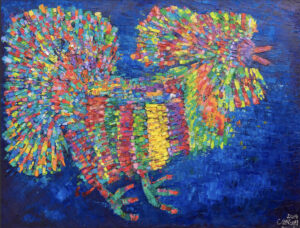
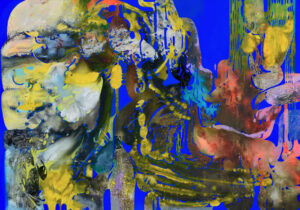
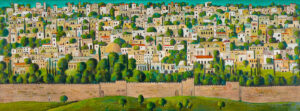
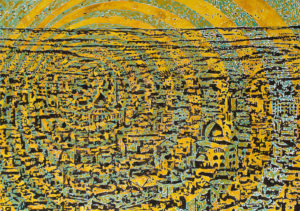
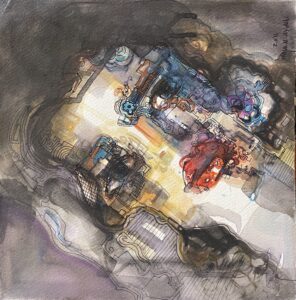
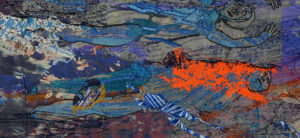
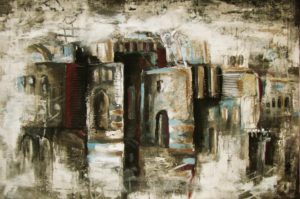
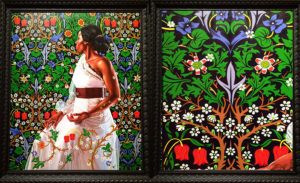
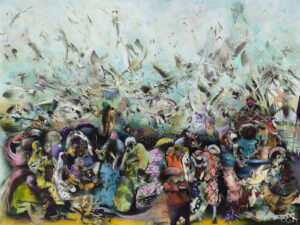
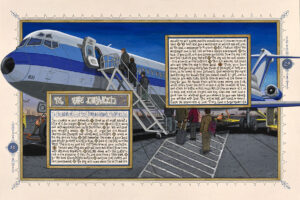
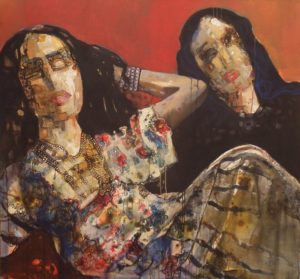
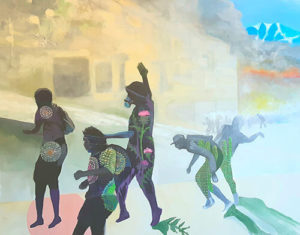
See more artwork by Yasmina Nysten.