<em>Empty Cages</em>  explore brutalement mais honnêtement les tabous

Mohamed Khedr, "Women at the Café," mixed media, 2016 (courtesy of the artist).

8 AUGUST 2025 • By Ahmed Naji

Select Other Languages French.

« Empty Cages illustre le fait que le sujet féminin ne se forme pas seulement en étant désiré, il se forme aussi dans des moments de refus, de retournements et par le poids de la honte dont il hérite. Le corps devient un champ de bataille, où la dignité et l’effondrement s’affrontent pour être le vainqueur. »

Empty Cages, un roman de Fatma Qandil
AUC Press 2025
ISBN 9781649033208


Une mère et sa fille sont assises ensemble dans leur jardin au Caire dans les années 1960. La fille commence l’école le lendemain matin, son tout premier jour. La mère lui recommande gentiment de ne laisser personne toucher son corps. La fillette rit et se remémore un souvenir : quand elle avait quatre ans, elle rendait visite à leur jeune voisin, qui était étudiant à l’université, s’allongeait à côté de lui et ils exploraient leurs corps respectifs. Des décennies plus tard, la fillette, alors âgée d’une soixantaine d’années, se souviendra et écrira : « Je ne me sentais ni honteuse ni bouleversée. Il était gentil et doux. » Mais ce n’est pas la réaction de la mère lorsqu’elle entend cette histoire pour la première fois ; elle tremble, maudit le garçon et jure de le tuer. Sans se démonter, la fille continue : tante Fatima, qui aidait à la maison, l’emmenait dans la chambre et la touchait aussi. Alors que sa mère est au bord de la crise cardiaque, la fille continue de rire, insistant sur le fait qu’elle aimait ça.
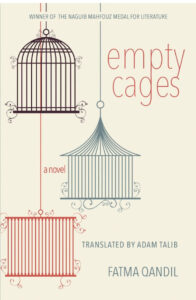
Empty Cages is published by AUC Press.

Cette scène est tirée du roman Empty Cages, récemment publié par AUC Press et traduit par Adam Talib. Ce livre, d’abord publié en arabe, a remporté le prestigieux prix littéraire Naguib Mahfouz dans la catégorie roman. Cependant, de nombreux lecteurs l’ont abordé comme s’il s’agissait d’un mémoire, ou à tout le moins, d’une autofiction de Fatma Qandil, poète, critique, provocatrice littéraire et professeure de critique littéraire contemporaine à la Faculté des arts de l’Université Helwan.

Fatma Qandil est surtout connue pour sa poésie. Ses recueils, The Silence of Wet Cotton (1995) et Means Hanging Like Slaughtered Animals (2008), sont considérés comme des jalons de la littérature arabe contemporaine, leur influence étant visible chez toute une génération de jeunes poètes. Parallèlement à son travail créatif, Fatma Qandil a joué un rôle important dans le développement de la critique littéraire arabe au cours des deux dernières décennies.

Mais c’est son autofiction Empty Cages, publiée en 2021, qui a retenu l’attention des cercles littéraires. Célébrée pour son écriture exceptionnelle et son exploration brutale et honnête de sujets tabous, cette œuvre, à l’instar d’autres autofictions, crée une illusion qui donne au lecteur l’impression d’être en train de s’immiscer dans la vie privée de l’auteur, pour tenter de déchiffrer l’identité des personnages, alors qu’au fond, le livre cherche à reconstruire lentement l’image du « moi » à partir d’un miroir brisé, en assemblant les morceaux ébréchés, tout en luttant contre la douleur et le sang qui coule.

L’un des aspects les plus troublants, mais aussi les plus brutaux et les plus honnêtes, de Empty Cages est la façon dont Fatma Qandil raconte ses premières expériences sexuelles, non seulement sans honte, mais avec un sentiment surprenant de plaisir et de pouvoir. Elle décrit comment, enfant, elle se sentait « choisie », au centre du désir, celle autour de laquelle toute l’attention se tournait. Plutôt que de s’enfermer dans le rôle de victime, elle écrit avec une compréhension absolue des émotions complexes que sont la confusion, le plaisir et la fierté.

Dans son livre The Bond of Love, Jessica Benjamin soutient que les filles confondent souvent le fait d’être désirées avec le fait d’être vues, et le fait d’être vues avec le fait d’être puissantes. Dans une société où l’on enseigne aux filles que leur valeur réside dans le fait d’être l’objet de l’attention, le regard abusif peut initialement être perçu comme une forme de reconnaissance. Empty Cages peut être vu sous cet angle, dépeignant une fille solitaire dans une maison remplie d’hommes, son espace constamment envahi par les amis de son frère, avec lesquels elle aime jouer et s’embrasser dans la cuisine. Cependant, alors que les féministes traditionnelles comme Benjamin pourraient considérer ce désir comme un « conflit », l’écriture de Qandil insiste sur le fait que les désirs de la vie sont plus complexes que la hiérarchie linéaire simpliste typique du féminisme occidental. Qandil n’excuse pas ce qui lui est arrivé, mais elle refuse de mentir sur ce qu’elle a ressenti. La force de son livre ne réside pas dans la présentation de la maltraitance comme une leçon de morale, mais dans la transmission de la complexité émotionnelle associée à la tendresse et au sérieux moral.

Empty Cages n’est pas seulement un mémoire personnel, mais reflète également les courants politiques et sociaux qui ont façonné l’Égypte et sa région depuis les années 1960 jusqu’à aujourd’hui. La désintégration progressive de la famille, enveloppée dans le silence, le déni, la migration et la pauvreté, reflète la disparition du rêve postcolonial égyptien. Ce qui avait commencé comme une promesse de libération et de dignité a finalement sombré dans une réalité marquée par la surveillance, l’exil et la déception.

La description de la petite enfance de Qandil dans le roman reflète l’espoir et le potentiel de l’ère nassérienne en Égypte dans les années 1960. La scène dans le jardin symbolise l’état d’esprit national de l’époque, en capturant un pays débordant d’espoir et nourrissant de grands rêves de progrès et de liberté. Mais tout comme la vie paradisiaque de la famille se désagrège lentement, il en va de même pour le récit national égyptien, qui commence par la défaite écrasante de la guerre de 1967. Israël bombarde la ville de Qandil, ce qui oblige la famille à fuir et à se réfugier dans l’ouest du Caire. La dépression nerveuse du frère aîné, marquée par la haine de soi, le ressentiment familial et l’aliénation, reflète le traumatisme et la déception plus larges vécus par toute sa génération, dont l’idéalisme s’est effondré à la suite des bombardements israéliens qui ont visé leurs écoles pendant la guerre.

La décision soudaine du père de travailler en Arabie saoudite reflète le changement de dynamique régionale. Alors que l’Égypte était autrefois à l’avant-garde des mouvements idéologiques et culturels, le centre de gravité économique et politique s’est déplacé vers l’est, vers la monarchie saoudienne. Contrairement à beaucoup de ses pairs qui ont choisi de s’installer définitivement en Arabie saoudite, le père insiste pour rentrer après seulement un an passé dans le pays.

Quand il illustre avec soin ces parallèles sans pour autant les exagérer : plutôt que de présenter un manifeste politique, le récit offre un compte rendu vivant d’expériences vécues à travers lesquelles les lecteurs sont témoins des vestiges du projet nassérien, de l’érosion de la classe moyenne et de la normalisation de la violence. Le récit est profondément politique, mais sans que cela ne soit ostentatoire. 

Dans les années 1980, le projet de libération postcoloniale de l’Égypte s’est complètement effondré, ouvrant la voie aux politiques de libéralisation économique de Sadate et à sa volonté d’accepter l’influence américaine. Parallèlement à cet effondrement, la famille sombre dans la pauvreté, ses relations et ses réseaux de soutien se désagrègent dans le chaos et l’isolement. Plutôt que de poursuivre des études supérieures ou une carrière, la fille se retrouve piégée dans une relation clandestine et abusive avec un homme riche et marié, qui lui rend visite occasionnellement, seulement pour son propre plaisir à lui, tout en subvenant aux besoins médicaux de son frère et aux besoins fondamentaux du foyer. Cet arrangement reflète de manière frappante la soumission politique et la dépendance économique généralisées qui se sont développées en Égypte pendant cette période, où les aspirations à l’autonomie ont été éclipsées par la dure réalité des compromis et la nécessité de survivre.


Les cages sont ce qui reste après que tous ont pris ce dont ils avaient besoin à la femme qui les a construites


Lorsque j’ai lu Empty Cages pour la première fois en arabe, j’ai pleuré deux fois et j’ai failli fondre en larmes une troisième fois, non pas parce que le roman m’a rendu triste, mais à cause de la beauté et de la puissance de la langue. Quatre ans plus tard, en lisant la traduction magistrale d’Adam Talib, je n’ai pas pleuré, mais je me suis surpris à retenir mon souffle à certains moments, lorsque Qandil prononçait l’une de ses nombreuses phrases incisives. Sa voix narrative vient directement de ses blessures, elle refuse de les dissimuler alors qu’elle résume son parcours lorsque sa mère souffrait de sa dernière maladie : 

« J’ai ramené maman au lit et l’ai allongée sur un oreiller que j’ai posé sur mes jambes, la berçant comme un bébé pendant qu’elle pleurait. »

Dans le roman, la narratrice laisse entendre que son écriture sera publiée sous forme de fiction, afin de se protéger d’éventuelles poursuites en diffamation intentées par sa famille et les filles de son frère.

Qandil raconte la vie d’une Égyptienne qui passe de l’enfance à l’âge adulte, à travers un récit clair et chronologique qui met en lumière la vulnérabilité, la cupidité et la cruauté qui imprègnent les relations humaines, en particulier au sein de la famille, dont les membres sont consciemment ou inconsciemment guidés par leurs propres désirs narcissiques. Tout au long du roman, la mère se distingue comme une figure rare, s’élevant parfois au-dessus de la mêlée tout en maintenant un lien délicat entre la narratrice et le reste de la famille.

La plupart des hommes du roman apparaissent opportunistes ou vaincus, ayant gâché leurs rêves et déçu leur entourage. Le père de la narratrice est un enseignant à la retraite et alcoolique dont les rêves de jeunesse ont été brisés lorsqu’il a dû abandonner ses études d’ingénieur à cause de la faillite de l’entreprise de son père. Ragy, le frère aîné qui vit illégalement en Allemagne, est en proie à des difficultés scolaires et professionnelles, ainsi qu’à une grave dépression, tout en nourrissant un sentiment injustifié de supériorité envers sa famille et sa culture. Ramzy, le frère cadet, est un médecin brillant, mais il reste émotionnellement détaché, incapable d’empathie, d’amour ou de responsabilité morale, même envers ses proches.

La mère et la fille ont traversé des périodes où l’amour et le désir n’ont cessé de remodeler leur relation, depuis l’âge de six ans où la fille disait à sa mère combien elle aimait être touchée, puis après le décès prématuré du père, suivi par le départ du fils aîné pour l’Allemagne, tandis que le plus jeune fils s’isole des deux femmes et les utilise pour son ascension personnelle.

Plus tard dans le livre, Qandil revient sur son père, non plus comme un symbole distant d’autorité, mais comme un homme déchu, ivre, malade, exposé. Dans une scène, elle le voit ivre dans la rue, il l’appelle par son nom. Au lieu de répondre, elle passe silencieusement devant lui, faisant semblant de ne pas le connaître.

Le rapport de force s’inverse : le patriarche autrefois dominant est désormais humilié en public, et la fille choisit le détachement. Dans un autre moment bouleversant, alors qu’il est malade et incapable d’uriner seul, elle doit l’aider. Il résiste, submergé par la honte d’être vu nu par sa fille, jusqu’à ce que la mère finisse par dire : « Ce n’est pas grave. C’est ta fille. » Et c’est ainsi que les filles sont façonnées par des moments où reconnaissance et soumission s’effondrent l’une dans l’autre. Ici, la fille ne cherche plus la reconnaissance de son père. Elle devient sa gardienne, son témoin, voire son juge.

En fin de compte, Empty Cages de Qandil illustre le fait que le sujet féminin ne se forme pas seulement en étant désiré, il se forme aussi dans des moments de refus, de retournements et par le poids de la honte dont il hérite. Le corps devient un champ de bataille, où la dignité et l’effondrement s’affrontent pour être le vainqueur. 

Les « cages vides » du roman de Qandil sont des espaces construits à partir de soins, de sacrifices et de travail émotionnel. Mais elles sont vides. Et pourtant, des femmes y vivent. L’auteure élargit ainsi la critique féministe au-delà du traumatisme pour l’étendre à l’architecture de l’empathie. Les cages sont belles et tristes. Elles sont ce qui reste après que tous ont pris ce dont ils avaient besoin à la femme qui les a construites.


Traduit de l’anglais par Marion Beauchamp-Levet 


Ahmed Naji

Ahmed Naji is a bilingual writer, journalist, documentary filmmaker, and official criminal from Egypt. His novels are Rogers (2007), Using Life (2014), And Tigers to My Room (2020), Happy Endings (2023), and most recently, a memoir, Rotten Evidence: Reading and Writing in... Read more

Join Our Community

TMR exists thanks to its readers and supporters. By sharing our stories and celebrating cultural pluralism, we aim to counter racism, xenophobia, and exclusion with knowledge, empathy, and artistic expression.

Learn more

RELATED

Books

The End of the Sahara—an excerpt

5 DECEMBER 2025 • By Saïd Khaitibi
<em>The End of the Sahara</em>—an excerpt
Book Reviews

The Price of Freedom: Prison Writings from Post-Revolutionary Egypt

5 DECEMBER 2025 • By Rebecca Ruth Gould
The Price of Freedom: Prison Writings from Post-Revolutionary Egypt
Film

10 Noir Films from the Arab world, Iran, and Turkey

5 DECEMBER 2025 • By TMR
10 Noir Films from the Arab world, Iran, and Turkey
Columns

How Much Do We Miss Umm Khulthum?

7 NOVEMBER 2025 • By Amal Ghandour
How Much Do We Miss Umm Khulthum?
Music

Youssra El Hawary’s Taraddud — Sound as Survival

17 OCTOBER 2025 • By Salma Harland
Youssra El Hawary’s <em>Taraddud</em> — Sound as Survival
Book Reviews

Reading The Orchards of Basra

12 SEPTEMBER 2025 • By Jacob Wirtschafter
Reading <em>The Orchards of Basra</em>
Poetry

Mai Serhan on the poems in CAIRO: the undelivered letters

31 AUGUST 2025 • By Mai Serhan
Mai Serhan on the poems in <em>CAIRO: the undelivered letters</em>
Book Reviews

Palestinian Cartographies—a review of Mapping My Return

29 AUGUST 2025 • By Mai Al-Nakib
Palestinian Cartographies—a review of <em>Mapping My Return</em>
Book Reviews

Egyptian Novelist Skewers British Bureaucracy with Black Humor

15 AUGUST 2025 • By Valeria Berghinz
Egyptian Novelist Skewers British Bureaucracy with Black Humor
Book Reviews

Without Women, the 2011 Revolution Might Have Never Been

8 AUGUST 2025 • By Jasmin Attia
Without Women, the 2011 Revolution Might Have Never Been
Book Reviews

Brutally Honest Exploration of Taboo Subjects in Empty Cages

8 AUGUST 2025 • By Ahmed Naji
Brutally Honest Exploration of Taboo Subjects in <em>Empty Cages</em>
Art

Architectural Biennale Confronts Brutality of Climate Change

1 AUGUST 2025 • By Iason Athanasiadis
Architectural Biennale Confronts Brutality of Climate Change
Fiction

“Waving at the Sky”—a story by Nahla Karam

4 JULY 2025 • By Nahla Karam, Nada Faris
“Waving at the Sky”—a story by Nahla Karam
Fiction

“Space Imam”—a story by Hassan Blasim

4 JULY 2025 • By Hassan Blasim, Hassan Abdulrazzak
“Space Imam”—a story by Hassan Blasim
Art & Photography

Cairo: A Downtown in Search of Lost Global City Status

13 JUNE 2025 • By Iason Athanasiadis
Cairo: A Downtown in Search of Lost Global City Status
Fiction

Always Beware of Dogs by Samir Kacimi — An Excerpt

6 JUNE 2025 • By Samir Kacimi, Rana Asfour
<em>Always Beware of Dogs</em> by Samir Kacimi — An Excerpt
Essays

Doaa: From a Dreamworld to the Ashes of Displacement

30 MAY 2025 • By Taqwa Ahmed Al-Wawi
Doaa: From a Dreamworld to the Ashes of Displacement
Essays

Looking for a Job, Living and Dying in Iran: The Logistics of Going Back

2 MAY 2025 • By Raha Nik-Andish
Looking for a Job, Living and Dying in Iran: The Logistics of Going Back
Essays

The Closed Door — Return to Syria

7 FEBRUARY 2025 • By Odai Al Zoubi, Rana Asfour
The Closed Door — Return to Syria
short story

Baxtyar Hamasur: “A Strand of Hair Shaped Like the Letter J”

7 FEBRUARY 2025 • By Baxtyar Hamasur, Jiyar Homer, Hannah Fox
Baxtyar Hamasur: “A Strand of Hair Shaped Like the Letter J”
Book Reviews

Radwa Ashour’s Classic Granada Now in a New English Edition

17 JANUARY 2025 • By Guy Mannes-Abbott
Radwa Ashour’s Classic <em>Granada</em> Now in a New English Edition
Centerpiece

“Not a Picture, a Precise Kick”—metafiction

6 DECEMBER 2024 • By Mansoura Ez-Eldin, Fatima El-Kalay
“Not a Picture, a Precise Kick”—metafiction
Fiction

“The Small Clay Plate”—a Siwa folk tale

6 DECEMBER 2024 • By Bel Parker
“The Small Clay Plate”—a Siwa folk tale
Books

“Ghosts of Farsis” — a cyberpunk story

6 DECEMBER 2024 • By Hussein Fawzy, Rana Asfour
“Ghosts of Farsis” — a cyberpunk story
Books

The Time-Travels of the Man who Sold Pickles and Sweets — an Excerpt

6 DECEMBER 2024 • By Khairy Shalaby, Michael Cooperson
<em>The Time-Travels of the Man who Sold Pickles and Sweets</em> — an Excerpt
Essays

Liberation Cosplay: on the Day of the Imprisoned Writer

15 NOVEMBER 2024 • By Abdelrahman ElGendy
Liberation Cosplay: on the Day of the Imprisoned Writer
Editorial

Animal Truths

1 NOVEMBER 2024 • By Malu Halasa
Animal Truths
Interviews

The Conversation: Arabic-English Translators maia tabet & Yasmeen Hanoosh

25 OCTOBER 2024 • By Yasmeen Hanoosh, maia tabet
The Conversation: Arabic-English Translators maia tabet & Yasmeen Hanoosh
Book Reviews

Courage and Compassion, a Memoir of War and its Aftermath

18 OCTOBER 2024 • By Nektaria Anastasiadou
<em>Courage and Compassion</em>, a Memoir of War and its Aftermath
Film

Freedom is a Combat Sport: On Tatami

11 OCTOBER 2024 • By Karim Goury
Freedom is a Combat Sport: On <em>Tatami</em>
Art

Photographer Mohamed Mahdy—Artist at Work

27 SEPTEMBER 2024 • By Marianne Roux
Photographer Mohamed Mahdy—Artist at Work
Book Reviews

Tragic Consequences — On Western Meddling in the Middle East

13 SEPTEMBER 2024 • By Dina Rezk
Tragic Consequences — On Western Meddling in the Middle East
Centerpiece

Mohammad Hafez Ragab: Upsetting the Guards of Cairo

6 SEPTEMBER 2024 • By Maha Al Aswad, Rana Asfour
Mohammad Hafez Ragab: Upsetting the Guards of Cairo
Book Reviews

Egypt’s Gatekeeper — President or Despot?

6 SEPTEMBER 2024 • By Elias Feroz
Egypt’s Gatekeeper — President or Despot?
Book Reviews

All That Rage: On Comma Press’ Egypt +100

2 AUGUST 2024 • By Alex Tan
All That Rage: On Comma Press’ <em>Egypt +100</em>
Art

Deena Mohamed

5 JULY 2024 • By Katie Logan
Deena Mohamed
Essays

The Butcher’s Assistant—a true story set in Alexandria

5 JULY 2024 • By Bel Parker
The Butcher’s Assistant—a true story set in Alexandria
Fiction

“Certainty”—a short story by Nora Nagi

5 JULY 2024 • By Nora Nagi, Nada Faris
“Certainty”—a short story by Nora Nagi
Book Reviews

Upheavals of Beauty and Oppression in The Oud Player of Cairo

28 JUNE 2024 • By Tala Jarjour
Upheavals of Beauty and Oppression in <em>The Oud Player of Cairo</em>
Essays

Laughing for Change—Activist Theatre Tours Egypt

7 JUNE 2024 • By Nada Sabet
Laughing for Change—Activist Theatre Tours Egypt
Editorial

Why FORGETTING?

3 MAY 2024 • By Malu Halasa, Jordan Elgrably
Why FORGETTING?
Essays

A Proustian Alexandria

3 MAY 2024 • By Mohamed Gohar
A Proustian Alexandria
Essays

The Elephant in the Box

3 MAY 2024 • By Asmaa Elgamal
The Elephant in the Box
Fiction

“Cotton Flower”—a short story by Areej Gamal

3 MAY 2024 • By Areej Gamal, Manal Shalaby
“Cotton Flower”—a short story by Areej Gamal
Film

Human Rights Films on Ownership of History, Women’s Bodies & Paintings

11 MARCH 2024 • By Malu Halasa
Human Rights Films on Ownership of History, Women’s Bodies & Paintings
Essays

The Fires of Shame; the Burn of Desire

3 MARCH 2024 • By Joumana Haddad
The Fires of Shame; the Burn of Desire
Books

Four Books to Revolutionize Your Thinking

3 MARCH 2024 • By Rana Asfour
Four Books to Revolutionize Your Thinking
Book Reviews

Do or Despair: Political Action in My Great Arab Melancholy

3 MARCH 2024 • By Katie Logan
Do or Despair: Political Action in <em>My Great Arab Melancholy</em>
Book Reviews

Rotten Evidence: Ahmed Naji Writes About Writing in Prison

12 FEBRUARY 2024 • By Lina Mounzer
<em>Rotten Evidence</em>: Ahmed Naji Writes About Writing in Prison
Essays

LSD in the Arab World: Porn, Sade, and the Next-Door Flasher

4 FEBRUARY 2024 • By Joumana Haddad
LSD in the Arab World: Porn, Sade, and the Next-Door Flasher
Art & Photography

The Body, Intimacy and Technology in the Middle East

4 FEBRUARY 2024 • By Naima Morelli
The Body, Intimacy and Technology in the Middle East
Essays

Tears of the Patriarch

4 FEBRUARY 2024 • By Dina Wahba
Tears of the Patriarch
Essays

Don’t Ask me to Reveal my Lover’s Name لا تسألوني ما اسمهُ حبيبي

4 FEBRUARY 2024 • By Mohammad Shawky Hassan
Don’t Ask me to Reveal my Lover’s Name لا تسألوني ما اسمهُ حبيبي
Poetry

Four Poems by Alaa Hassanien from The Love That Doubles Loneliness

4 FEBRUARY 2024 • By Alaa Hassanien, Salma Moustafa Khalil
Four Poems by Alaa Hassanien from <em>The Love That Doubles Loneliness</em>
Featured excerpt

Almost Every Day—from the novel by Mohammed Abdelnabi

3 DECEMBER 2023 • By Mohammed Abdelnabi, Nada Faris
<em>Almost Every Day</em>—from the novel by Mohammed Abdelnabi
Fiction

Huda Fakhreddine’s A Brief Time Under a Different Sun

3 DECEMBER 2023 • By Huda J. Fakhreddine, Rana Asfour
Huda Fakhreddine’s <em>A Brief Time Under a Different Sun</em>
Poetry

Home: New Arabic Poems in Translation

11 OCTOBER 2023 • By Sarah Coolidge
<em>Home</em>: New Arabic Poems in Translation
Books

Edward Said: Writing in the Service of Life 

9 OCTOBER 2023 • By Layla AlAmmar
Edward Said: Writing in the Service of Life 
Essays

The Vanishing of the Public Intellectual

1 OCTOBER 2023 • By Moustafa Bayoumi
The Vanishing of the Public Intellectual
Fiction

“Supplication”—a short story by Hisham Bustani

1 OCTOBER 2023 • By Hisham Bustani, Thoraya El-Rayyes
“Supplication”—a short story by Hisham Bustani
Essays

Why Fawwaz Traboulsi?

1 OCTOBER 2023 • By Amal Ghandour
Why Fawwaz Traboulsi?
Essays

Alaa Abd El-Fattah: Political Prisoner and Public Intellectual

1 OCTOBER 2023 • By Yasmine El Rashidi
Alaa Abd El-Fattah: Political Prisoner and Public Intellectual
Book Reviews

The Mystery of Enayat al-Zayyat in Iman Mersal’s Tour de Force

25 SEPTEMBER 2023 • By Selma Dabbagh
The Mystery of Enayat al-Zayyat in Iman Mersal’s Tour de Force
Amazigh

World Picks: Festival Arabesques in Montpellier

4 SEPTEMBER 2023 • By TMR
World Picks: Festival Arabesques in Montpellier
Fiction

“A Dog in the Woods”—a short story by Malu Halasa

3 SEPTEMBER 2023 • By Malu Halasa
“A Dog in the Woods”—a short story by Malu Halasa
Essays

They and I, in Budapest

3 SEPTEMBER 2023 • By Nadine Yasser
They and I, in Budapest
Essays

A Day in the Life of a Saturday Market Trawler in Cairo

3 SEPTEMBER 2023 • By Karoline Kamel, Rana Asfour
A Day in the Life of a Saturday Market Trawler in Cairo
Book Reviews

Laila Halaby’s The Weight of Ghosts is a Haunting Memoir

28 AUGUST 2023 • By Thérèse Soukar Chehade
Laila Halaby’s <em>The Weight of Ghosts</em> is a Haunting Memoir
Opinion

The Middle East is Once Again West Asia

14 AUGUST 2023 • By Chas Freeman, Jr.
The Middle East is Once Again West Asia
Books

Books That Will Chase me in the Afterlife

14 AUGUST 2023 • By Mohammad Rabie
Books That Will Chase me in the Afterlife
A Day in the Life

A Day in the Life: Cairo

24 JULY 2023 • By Sarah Eltantawi
A Day in the Life: Cairo
Cities

In Shahrazad’s Hammam—fiction by Ahmed Awadalla

2 JULY 2023 • By Ahmed Awadalla
In Shahrazad’s Hammam—fiction by Ahmed Awadalla
Fiction

Abortion Tale: On Our Ground

2 JULY 2023 • By Ghadeer Ahmed, Hala Kamal
Abortion Tale: On Our Ground
Fiction

Genesis and East Cairo—fiction from Shady Lewis Botros

2 JULY 2023 • By Shady Lewis Botros, Salma Moustafa Khalil
Genesis and East Cairo—fiction from Shady Lewis Botros
Book Reviews

Youssef Rakha Practices Literary Deception in Emissaries

19 JUNE 2023 • By Zein El-Amine
Youssef Rakha Practices Literary Deception in <em>Emissaries</em>
TMR Interviews

The Markaz Review Interview—Leila Aboulela, Writing Sudan

29 MAY 2023 • By Yasmine Motawy
The Markaz Review Interview—Leila Aboulela, Writing Sudan
Books

Cruising the Abu Dhabi International Book Fair

29 MAY 2023 • By Rana Asfour
Cruising the Abu Dhabi International Book Fair
Islam

From Pawns to Global Powers: Middle East Nations Strike Back

29 MAY 2023 • By Chas Freeman, Jr.
From Pawns to Global Powers: Middle East Nations Strike Back
Book Reviews

Radius Recounts a History of Sexual Assault in Tahrir Square

15 MAY 2023 • By Sally AlHaq
<em>Radius</em> Recounts a History of Sexual Assault in Tahrir Square
Book Reviews

A Debut Novel, Between Two Moons, is set in “Arabland” Brooklyn

15 MAY 2023 • By R.P. Finch
A Debut Novel, <em>Between Two Moons</em>, is set in “Arabland” Brooklyn
Book Reviews

Kafka in Tangier is a Brooding Homage to Metamorphosis

8 MAY 2023 • By Rula Khateeb Jarallah
<em>Kafka in Tangier</em> is a Brooding Homage to <em>Metamorphosis</em>
Cities

In Luxor, Egypt Projects Renewed Tourism Economy

10 APRIL 2023 • By William Carruthers
In Luxor, Egypt Projects Renewed Tourism Economy
Fiction

“The Stranger”—a Short Story by Hany Ali Said

2 APRIL 2023 • By Hany Ali Said, Ibrahim Fawzy
“The Stranger”—a Short Story by Hany Ali Said
Arabic

The Politics of Wishful Thinking: Deena Mohamed’s Shubeik Lubeik

13 MARCH 2023 • By Katie Logan
The Politics of Wishful Thinking: Deena Mohamed’s <em>Shubeik Lubeik</em>
Fiction

“Raise Your Head High”—new fiction from Leila Aboulela

5 MARCH 2023 • By Leila Aboulela
“Raise Your Head High”—new fiction from Leila Aboulela
Cities

The Odyssey That Forged a Stronger Athenian

5 MARCH 2023 • By Iason Athanasiadis
The Odyssey That Forged a Stronger Athenian
Cities

Coming of Age in a Revolution

5 MARCH 2023 • By Lushik Lotus Lee
Coming of Age in a Revolution
Art

Art World Picks: Albraehe, Kerem Yavuz, Zeghidour, Amer & Tatah

12 DECEMBER 2022 • By TMR
Film

The Chess Moves of Tarik Saleh’s Spy Thriller, Boy From Heaven

15 NOVEMBER 2022 • By Karim Goury
The Chess Moves of Tarik Saleh’s Spy Thriller, <em>Boy From Heaven</em>
Essays

Stadiums, Ghosts & Games—Football’s International Intrigue

15 NOVEMBER 2022 • By Francisco Letelier
Stadiums, Ghosts & Games—Football’s International Intrigue
Art

An Interview with with Graphic Memoirist Malaka Gharib

15 NOVEMBER 2022 • By Rushda Rafeek
An Interview with with Graphic Memoirist Malaka Gharib
Essays

Nawal El-Saadawi, a Heroine in Prison

15 OCTOBER 2022 • By Ibrahim Fawzy
Nawal El-Saadawi, a Heroine in Prison
Book Reviews

Cassette Tapes Once Captured Egypt’s Popular Culture

10 OCTOBER 2022 • By Mariam Elnozahy
Cassette Tapes Once Captured Egypt’s Popular Culture
Book Reviews

The Egyptian Revolution and “The Republic of False Truths”

26 SEPTEMBER 2022 • By Aimee Dassa Kligman
The Egyptian Revolution and “The Republic of False Truths”
Centerpiece

“What Are You Doing in Berlin?”—a short story by Ahmed Awny

15 SEPTEMBER 2022 • By Ahmed Awny, Rana Asfour
“What Are You Doing in Berlin?”—a short story by Ahmed Awny
Fiction

“Another German”—a short story by Ahmed Awadalla

15 SEPTEMBER 2022 • By Ahmed Awadalla
“Another German”—a short story by Ahmed Awadalla
Art

My Berlin Triptych: On Museums and Restitution

15 SEPTEMBER 2022 • By Viola Shafik
My Berlin Triptych: On Museums and Restitution
Essays

Kairo Koshary, Berlin’s Egyptian Food Truck

15 SEPTEMBER 2022 • By Mohamed Radwan
Kairo Koshary, Berlin’s Egyptian Food Truck
Essays

Exile, Music, Hope & Nostalgia Among Berlin’s Arab Immigrants

15 SEPTEMBER 2022 • By Diana Abbani
Exile, Music, Hope & Nostalgia Among Berlin’s Arab Immigrants
Opinion

Attack on Salman Rushdie is Shocking Tip of the Iceberg

15 AUGUST 2022 • By Jordan Elgrably
Attack on Salman Rushdie is Shocking Tip of the Iceberg
Featured excerpt

Libyan Stories from the novel “Bread on Uncle Milad’s Table”

18 JULY 2022 • By Mohammed Alnaas, Rana Asfour
Libyan Stories from the novel “Bread on Uncle Milad’s Table”
Editorial

Editorial: Is the World Driving Us Mad?

15 JULY 2022 • By TMR
Editorial: Is the World Driving Us Mad?
Fiction

“The Devil’s Waiting List”—a story by Ahmed Salah Al-Mahdi

15 JULY 2022 • By Ahmed Salah Al-Mahdi, Rana Asfour
“The Devil’s Waiting List”—a story by Ahmed Salah Al-Mahdi
Book Reviews

Poetry as a Form of Madness—Review of a Friendship

15 JULY 2022 • By Youssef Rakha
Poetry as a Form of Madness—Review of a Friendship
Book Reviews

Alaa Abd El-Fattah—the Revolutionary el-Sissi Fears Most?

11 JULY 2022 • By Fouad Mami
Alaa Abd El-Fattah—the Revolutionary el-Sissi Fears Most?
Book Reviews

Traps and Shadows in Noor Naga’s Egypt Novel

20 JUNE 2022 • By Ahmed Naji
Traps and Shadows in Noor Naga’s Egypt Novel
Fiction

“Godshow.com”—a short story by Ahmed Naji

15 JUNE 2022 • By Ahmed Naji, Rana Asfour
“Godshow.com”—a short story by Ahmed Naji
Fiction

“The Suffering Mother of the Whole World”—a story by Amany Kamal Eldin

15 JUNE 2022 • By Amany Kamal Eldin
“The Suffering Mother of the Whole World”—a story by Amany Kamal Eldin
Art

Book Review: “The Go-Between” by Osman Yousefzada

13 JUNE 2022 • By Hannah Fox
Book Review: “The Go-Between” by Osman Yousefzada
Book Reviews

Fragmented Love in Alison Glick’s “The Other End of the Sea”

16 MAY 2022 • By Nora Lester Murad
Fragmented Love in Alison Glick’s “The Other End of the Sea”
Book Reviews

Siena and Her Art Soothe a Writer’s Grieving Soul

25 APRIL 2022 • By Rana Asfour
Siena and Her Art Soothe a Writer’s Grieving Soul
Book Reviews

Egyptian Comedic Novel Captures Dark Tale of Bedouin Migrants

18 APRIL 2022 • By Saliha Haddad
Egyptian Comedic Novel Captures Dark Tale of Bedouin Migrants
Essays

Zajal — the Darija Poets of Morocco

11 APRIL 2022 • By Deborah Kapchan
Zajal — the Darija Poets of Morocco
Book Reviews

Mohamed Metwalli’s “A Song by the Aegean Sea” Reviewed

28 MARCH 2022 • By Sherine Elbanhawy
Mohamed Metwalli’s “A Song by the Aegean Sea” Reviewed
Essays

“Gluttony” from Abbas Beydoun’s “Frankenstein’s Mirrors”

15 MARCH 2022 • By Abbas Baydoun, Lily Sadowsky
“Gluttony” from Abbas Beydoun’s “Frankenstein’s Mirrors”
Essays

The Alexandrian: Life and Death in L.A.

15 FEBRUARY 2022 • By Noreen Moustafa
The Alexandrian: Life and Death in L.A.
Film

“The Translator” Brings the Syrian Dilemma to the Big Screen

7 FEBRUARY 2022 • By Jordan Elgrably
“The Translator” Brings the Syrian Dilemma to the Big Screen
Art & Photography

Mapping an Escape from Cairo’s Hyperreality through informal Instagram archives

24 JANUARY 2022 • By Yahia Dabbous
Mapping an Escape from Cairo’s Hyperreality through informal Instagram archives
Essays

Taming the Immigrant: Musings of a Writer in Exile

15 JANUARY 2022 • By Ahmed Naji, Rana Asfour
Taming the Immigrant: Musings of a Writer in Exile
Fiction

“Turkish Delights”—fiction from Omar Foda

15 DECEMBER 2021 • By Omar Foda
“Turkish Delights”—fiction from Omar Foda
Columns

Sudden Journeys: The Villa Salameh Bequest

29 NOVEMBER 2021 • By Jenine Abboushi
Sudden Journeys: The Villa Salameh Bequest
Book Reviews

The Vanishing: Are Arab Christians an Endangered Minority?

15 NOVEMBER 2021 • By Hadani Ditmars
The Vanishing: Are Arab Christians an Endangered Minority?
Essays

The Complexity of Belonging: Reflections of a Female Copt

15 SEPTEMBER 2021 • By Nevine Abraham
The Complexity of Belonging: Reflections of a Female Copt
Latest Reviews

Shelf Life: The Irreverent Nadia Wassef

15 SEPTEMBER 2021 • By Sherine Elbanhawy
Shelf Life: The Irreverent Nadia Wassef
Weekly

Reading Egypt from the Outside In, Youssef Rakha’s “Baraa and Zaman”

24 AUGUST 2021 • By Sherifa Zuhur
Reading Egypt from the Outside In, Youssef Rakha’s “Baraa and Zaman”
Editorial

Why COMIX? An Emerging Medium of Writing the Middle East and North Africa

15 AUGUST 2021 • By Aomar Boum
Why COMIX? An Emerging Medium of Writing the Middle East and North Africa
Latest Reviews

Rebellion Resurrected: The Will of Youth Against History

15 AUGUST 2021 • By George Jad Khoury
Rebellion Resurrected: The Will of Youth Against History
Latest Reviews

Women Comic Artists, from Afghanistan to Morocco

15 AUGUST 2021 • By Sherine Hamdy
Women Comic Artists, from Afghanistan to Morocco
Book Reviews

Egypt Dreams of Revolution, a Review of “Slipping”

8 AUGUST 2021 • By Farah Abdessamad
Egypt Dreams of Revolution, a Review of “Slipping”
Weekly

Heba Hayek’s Gaza Memories

1 AUGUST 2021 • By Shereen Malherbe
Heba Hayek’s Gaza Memories
Essays

Making a Film in Gaza

14 JULY 2021 • By Elana Golden
Making a Film in Gaza
Weekly

The Unfinished Presidency of Jimmy Carter

4 JULY 2021 • By Maryam Zar
The Unfinished Presidency of Jimmy Carter
Weekly

Midnight in Cairo: The Divas of Egypt’s Roaring 20s

16 MAY 2021 • By Selma Dabbagh
Midnight in Cairo: The Divas of Egypt’s Roaring 20s
Art & Photography

Walls, Graffiti and Youth Culture in Egypt, Libya & Tunisia

14 MAY 2021 • By Claudia Wiens
Walls, Graffiti and Youth Culture in Egypt, Libya & Tunisia
TMR 6 • Revolutions

Revolution in Art, a review of “Reflections” at the British Museum

14 FEBRUARY 2021 • By Malu Halasa
Revolution in Art, a review of “Reflections” at the British Museum
TMR 6 • Revolutions

The Revolution Sees its Shadow 10 Years Later

14 FEBRUARY 2021 • By Mischa Geracoulis
The Revolution Sees its Shadow 10 Years Later
Weekly

Cairo 1941: Excerpt from “A Land Like You”

27 DECEMBER 2020 • By TMR
Cairo 1941: Excerpt from “A Land Like You”
Book Reviews

Egypt—Abandoned but not Forgotten

4 OCTOBER 2020 • By Ella Shohat
Egypt—Abandoned but not Forgotten
World Picks

World Art, Music & Zoom Beat the Pandemic Blues

28 SEPTEMBER 2020 • By Malu Halasa
World Art, Music & Zoom Beat the Pandemic Blues

Leave a Comment

Your email address will not be published. Required fields are marked *

two × 3 =

Scroll to Top