Select Other Languages Français.
After years of searching, an Afghan American journalist finds long-lost poet Kawa Jobran, living in exile in Paris.
I came across news of Kawa Jobran by chance; the Afghan poet was living in exile in Paris, far from the dust and terror of his former home. Our acquaintance was long, if one-sided: we’d both endured Afghanistan’s civil war of the 1990s, a fact I discovered only later. For years, I kept one of his early poems in my journal, an ode to a girl in a yellow dress. Even then, as a young girl, I recognized in it a refusal to look away, drawn to this writing that conveyed intimacy without offering consolation.
Kawa, like me, carried images of war: his, of a basement sheltering two young men with freshly amputated limbs, both in search of books; mine, of my younger self caught in rocket shelling, hiding behind a wall as a passerby collapsed into a pool of his own blood, shattering like a scarlet fish. I waited so long behind that wall that my feet, clad in tattered slippers, burned in the snow.
Trauma, bearing witness, loss — all recurring themes in Kawa’s writing, and also in my own world. By the time his debut collection, One Day, Until the End of Love (2008), came out, I had already attempted to end my life twice, haunted by war, poverty, and a city so devastated that, at one point, its dogs had grown accustomed to feeding on the flesh of those caught in the crossfire. My life, ensnared in such violence, with no path forward, didn’t feel worth living.
I hadn’t forgotten him after all these years, but now I carried him differently.
Kawa wrote about this profound sense of meaninglessness, but also attested to the presence of love even where living seemingly left no room for it; his poems did not offer passage into that love but rather measured the distance between such tenderness and my own life.
شب به رسم عادتش در چشم هایت خواب شد
ماه می تابید و آمد قطره قطره آب شد
دست هایم را به محض رفتنت آتش زدم
.چهره ات برگشت روی شعله هایش قاب شد
Night, as was its habit, fell asleep in your eyes.
The moon was shining and came, turning drop by drop into water.
The moment you left, I set my hands on fire.
Your face returned, framed upon its flames.
(A Ballad and a Terrorist, 2009)
While in Kabul, I wanted to seek out Kawa, to tell him that his poems, for a moment, let me forget that I was condemned to being born into endless wars and poverty, into a world run by militants, and believe that something good might still be possible. If Kawa could imagine love, why couldn’t I? But I never did, paralyzed by the fear of recognition, of standing too close to someone who carried the same war.
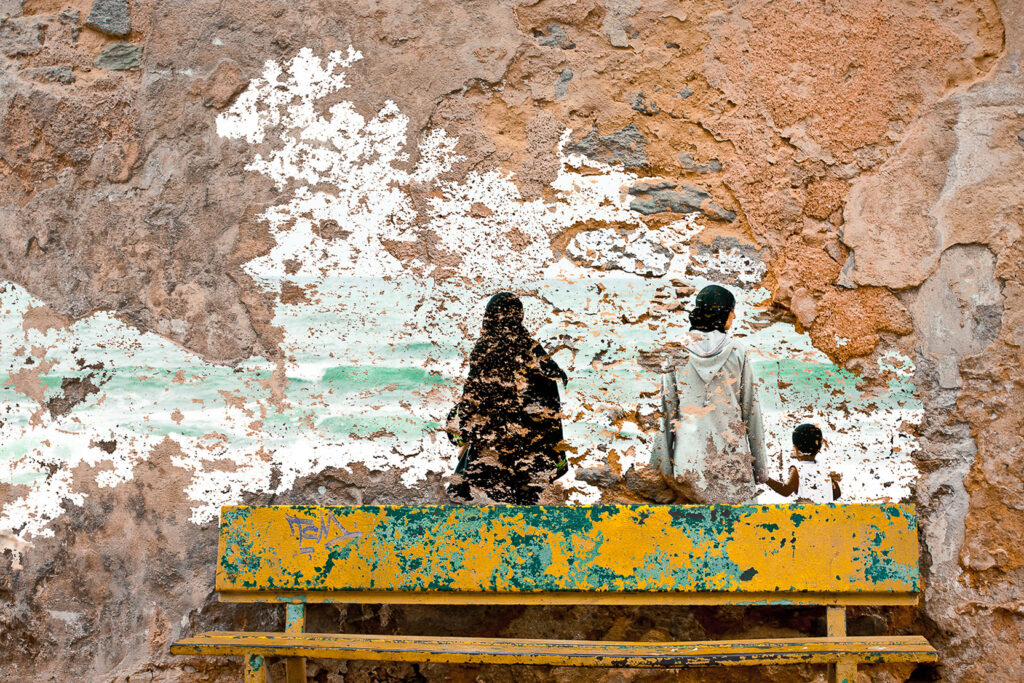
Edges of Kabul
Our city transformed rapidly after the arrival of U.S. and NATO forces in 2001. Foreigners arrived in unprecedented numbers: journalists, aid workers, tourists, and soldiers in military vehicles were soon roaming our streets. Schools and universities reopened. Women could work and were no longer subjected to public lashings. Music, once banned, returned to our neighborhoods. In this time of deceptive freedom, I joined a local radio broadcaster. Walking the very streets where women had been publicly stoned only a short time before, and speaking to them about their views on the future, notepad in hand, was both engrossing and liberating. The experience felt surreal, and I truly wanted to believe that this fragile new reality would endure. But I still carried the past: the fallen staircase to my home, cement and metal dangling after a rocket strike, the random graves scattered across our neighborhood where passersby had been shot — all constant reminders.
How could anyone ignore that many of the men installed as new rulers were former warlords who had torn the city and our lives apart? And yet our new western allies, in their rush, propelled by the strategic imperatives of the “war on terror” and the rhetoric of democratic state-building for Afghans, prosecuted a war within our borders while leaving largely unaddressed the cross-border sanctuaries that sustained the conflict (Pakistan, in other words). In that same haste, they also overlooked another consequential truth: by restoring much of the feared civil-war old guard to positions of power, entrusted with securing a freer and better future for Afghans, they failed to break the cycle of violence that has long haunted Kabul.
ز گور ها بگیرید اینک سراغ ما را
ما مرده ایم و دانیا دانسته ماجرا را
دیروز عینکم را دادم به پیر مردی
تا خوب تر ببیند در برف نقش پا را
Look for us now among the graves
We are dead, and the world knows the story well
Yesterday I gave my glasses to an old man
so he might better see footprints in the snow
(A Ballad and a Terrorist, 2009)
I did not feel safe. I worked under a pen name and moved cautiously through my city, trying to remain unseen until the time came for me to leave. Kabul, however, did not leave me; throughout my years as a journalist based in Eastern Europe, I kept the city with me, on my laptop, writing about the war that continued in Afghanistan.
Carrying Stones
Last October, Kawa Jobran randomly appeared on my laptop screen. He was being interviewed by the BBC. Wearing a longish beard and glasses, he closed his eyes, tilting his head, and began to speak quietly about something I knew all too well. He described how his mother had gripped his younger sisters’ hands while they fled to safety, rockets falling around them. “I cannot forget that moment,” he said. “Watching them run was painful.” I realized I hadn’t forgotten him after all these years, but that now I carried him differently: as a witness folded into my own narrative of Kabul and its wars. Together, our stories formed a shared account of suffering and survival that, I believed, neither of us could fully tell alone. I wrote about this on X, explaining how shared misery could outweigh all faults and bring us closer like nothing else. Unexpectedly, he responded. A few days later, when he called me, there were no formalities or hesitations, only an opening of hearts, like finding a childhood friend lost in a crowd. I, on the East Coast of the United States, and Kawa, in Paris at the edge of a sleepless night, slipped effortlessly into an hours-long conversation, time zones dissolving between us. We spoke, among many things, of Kabul and his escape.
In August 2021, the pro-western government in Afghanistan had collapsed, and the Taliban, shortly after taking control, began house-to-house searches across most of Kabul, targeting those they viewed as adversaries. Many artists, writers, and journalists, including Kawa, believed they were at risk because the Taliban associated their work with the previous regime and foreign governments.
I picked a handful of stones from my street, and that was all I carried with me.
In the initial days of the collapse, Kawa had abandoned his home and stayed with a friend until he could leave, evading possible searches that might come for him. He had little time to prepare. And how does one prepare to leave a life so stubbornly defended? I told him I had left Kabul believing I could always return, so I took little with me and left much behind — including my journals, and with them, the poem he had written for the girl in the yellow dress. Kawa didn’t have it either. His escape came through the infamous Kabul airlift: a desperate throng fleeing the Taliban’s return surged toward the airport, some waiting for days and nights before boarding a plane. “It was around noon when I left for the airport,” Kawa told me. “My mother said that I shouldn’t return home ‘even if you cannot make it to the airport.’ I was told that I could only take five kilos with me, including my backpack, so I picked my notebooks. A few other small things were already heavy, so I picked a handful of stones from my street, and that was all I carried with me.”
Kawa was relocated to France through a combination of different groups, agencies, and individuals, including Afghan and French writers, filmmakers, activists based in France, and of course the French government. He eventually settled in the tenth arrondissement of Paris, where most Afghan refugees live. “I chose this neighborhood because it evokes the feeling of Afghanistan, the smell of bread, the noise, the spices, and the aromas of small eateries.” He told me it is the closest he has come to feeling at home.
من خسته از تمام جهان خسته از خودم
آخر به سیم آخر این زندگی زدم
I am tired of the whole world, tired of myself
At last, I have cut the last wire of this life
(“Delirium” from The Sun is Suspended, 2010)
For over four years, he has paced the Parisian boulevards where Édith Piaf once sang of no regrets, struggling to forget the past. The city offers him freedom without belonging, safety without familiarity, and culture without the language needed to fully enter it.
“It is hard for a wounded person to fit into a city designed for those who feel at home,” Kawa said, emphasizing that it is not Paris he indicts, but the distance between the man he once was and the man his survival now demands he become. He has written no poems since leaving Kabul, explaining that he hasn’t felt sufficiently cut off from Afghanistan to fully write about the experience of exile: “I do not think you can write about exile in its true sense unless you are fully immersed in the feeling.”
The Afghan Question
From our first conversation, one of several, it was clear that Kawa was haunted by regret, not only for himself but for his generation, many of whom came of age during the twenty-year war. “We were too young, too inexperienced to change the course when Afghanistan had its chance,” he said. While he and I share this grief, we disagree on a question that has shaped much of Afghanistan’s political life: the Afghan identity.
For Kawa, that identity is inseparable from power. He believes it has long been conflated with Pashtun rule — Pashtuns, Afghanistan’s largest ethnic group, have historically been prominent in state leadership — and that this historical pattern has helped entrench injustice and fuel resentment.
I understand the history he invokes, but differ on the interpretation. Yes, Pashtun dynasties founded the modern Afghan state in the eighteenth century, and Pashtun figures frequently occupied the apex of authority. But visible rule did not always translate into collective empowerment. Ordinary Pashtuns, like members of other ethnic communities, were often mobilized for wars driven by elite rivalry, ideology, or foreign intervention; wars that devastated Pashtun communities across the country.
Afghanistan’s tragedies cannot be reduced to a single ethnic narrative. For example, during the civil war in Kabul, militias from multiple ethnic groups committed heinous abuses; power shifted, alliances fractured, and civilians across ethnic lines paid the price. And what appeared as ethnic dominance at times was often a fragile state manipulated by competing factions, both domestic and foreign.
Ethnic and religious identities did not create Afghanistan’s collapse; they hardened as institutions failed. When rule of law disintegrated, people retreated into narrower solidarities. Identity became protection in the absence of governance.
Kawa’s own life reflects this complexity. Born of mixed heritage, he remembers his Pashtun grandmother coloring his hands with henna during Eid in a household guided by his non-Pashtun mother. Now, living abroad, his concern for Afghanistan no longer centers on which identity might prevail, but on preserving the country as a shared home for all. Perhaps exile clarified what home could not.
Kawa has been learning French, studying, and working, but fears that the man he used to be — a lecturer at Kabul University, a celebrated poet, and a political thinker — is gone, perhaps forever. “Can I get back the life I worked for years to create for myself?” he asked me. I stayed silent, unwilling, or unable perhaps, to confirm the loss he already feared.
Kawa told me his father remained silent as he left; he offered up no pleas, no protests. The same man who had refused to abandon his homeland countless times. But then, after Kawa left, his father finally did too, searching for a life beyond the Kabul that had chased out his son. He also became a refugee in Europe. As Kawa said, “My father did not leave even during the worst of the civil war, but he left after me.”
The Boy in the Basement
Jilani Jobran, Kawa’s father, was a member of the People’s Democratic Party of Afghanistan (PDPA), the Soviet-aligned Marxist party that seized power in a 1978 coup that included the assassination of the country’s first self-proclaimed president. It was followed by the assassinations of two leftist heads of the newly established state, a full-scale Soviet invasion, and the subsequent rise of Afghan resistance militias, known as the Mujahedeen: Islamic resistance militias backed by the United States and its western allies. From an early age, the Cold War — a conflict that left a million Afghans dead, according to the UN — along with his father’s political legacy, had shaped Kawa’s worldview and sense of self.
The PDPA government fell in 1992, its downfall hastened by the collapse of the Soviet Union and driven by resistance militias battle-hardened by years of relentless fighting. Its fall unleashed a wave of fear throughout Kabul, especially among intellectuals, academics, and artists, many of whom were seen as allies of the fallen regime and thus feared prosecution, imprisonment, or worse.
If reading is the foundation of writing, then he was born as a writer in that basement.
In response, people hurriedly stripped their homes of any evidence linking them to the fallen regime: books, journals, albums, and other objects, even those only remotely connected, were cast out. I remember heavy thuds resounding through my neighborhood as these objects hit the ground. Pages turned to ash as volumes by Lenin, Stalin, Marx, Engels, Gorky, and Dostoyevsky, alongside other texts on communism and socialism, were set ablaze in courtyards and alleys throughout the city. Kawa’s father, too, set fire to their family library.
Soon after, Afghanistan’s ruling militias turned against one another, fiercely battling it out for control, influence, and wealth, and plunging Kabul into a brutal civil war that lasted until 1996. A mass exodus followed, with millions fleeing as refugees. For those who remained, hunger and fear became constant, and much of their daily lives were confined to dark basements, waiting for the shelling to cease, uncertain if it ever would.
The Jobran basement became a refuge for relatives and neighbors, including two young men, one Kawa’s cousin, each with a recently amputated leg. These men could not move, but they could read, so Kawa brought them books, becoming, as he calls himself, their “carrier boy.” They asked for novels, which was how he began reading novels — by accident, through proximity to suffering, by the strange alchemy wherein catastrophe becomes curriculum. It was also, though he did not yet realize it, the beginning of his vocation. If reading is the foundation of writing, then he was born as a writer in that basement.
Two Exiles Reading in the Dark
Kawa’s home in Kulola Pushta, an affluent, historic residential area, was less than an hour’s walk from my neighborhood in Microyon, a Soviet-built residential complex in northeast Kabul that, before the war, housed mostly high-ranking officials, academics, and artists. When he was carrying books to the amputees in his family basement, I was tracing stories onto the soot-stained walls of our basement with a piece of burned oak, or reading scraps of pages torn from books repurposed as fuel for cooking food or for heating ovens made of mud. Two future exiles learning to read and endure at the same time, finding fragile refuge in a paragraph, a line break, a verse.
Decades have passed since we hid in basements, yet those memories continue to shape who we are; Kawa is now in his forties, and I stubbornly dye my creeping white hair. I, too, wear glasses.
He sees himself as too broken to change. But I see survival as a purpose, not a waste. I have spent a lifetime moving from one war to the next — first as a subject, then as a journalist, bearing witness to both suffering and fortitude, and I believe that documenting what I have seen, giving shape to stories that might otherwise be lost to oblivion, is an act of defiance against erasure.
Kawa tells me he longs to return to Kabul, to the home where he built a library to replace the one lost to fire decades prior, but I’m not convinced either of us will ever make that journey, not in the near future, and not while Afghanistan continues to struggle with extreme poverty, its government recognized only by Russia and largely isolated internationally, and millions of girls barred from attending school beyond sixth grade.
In that sense, Kawa’s exile is more than a personal loss; it embodies a nation’s fracture and the ongoing fight to reclaim what war and displacement have tried to erase. His poetry, memories, and resilience remind us that survival is not just about physical return but about carrying a home within us, even when the world we knew is irrevocably changed. This burden of memory is both collective and deeply personal. In the course of our phone calls, I realized that the poem about the girl in the yellow dress might be forever lost — my copy in a journal left behind, and any published versions lost to time, fire, or oblivion. From memory, the poem goes like this: a girl wears a yellow dress, again and again, and becomes unbearably beautiful, deliberately tormenting the poet. When I asked Kawa if he could recite it, he paused and then, melancholic, said, “You find it and read it to yourself.”
In our most recent conversation, I told Kawa I’d like to meet in person, though I’m not entirely sure that’s true. For if I were to come face to face with this beloved poet, how could I not see Kabul, the war, a county that no longer welcomes me? Though perhaps he could say the same of me. He suggested coffee, if ever I find myself in Paris. I wonder if we would meet as two exiles, two writers even, or simply as two children hiding in basements, reading in the dark.
Select Other Languages Français.