Select Other Languages Français.
Karim Goury interviews the Franco-Tunisian director on her latest, a powerhouse tale about an unexpected blended family that explores the lives of sub-Saharan African migrant women in Tunisia.
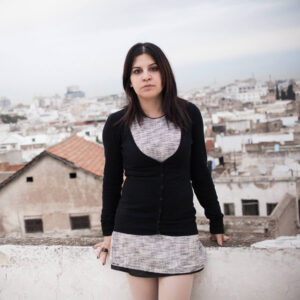
While Erige Sehiri was intrigued by cinema from girlhood, it wasn’t until she moved to Tunisia in 2011 during the revolution that she truly turned to filmmaking. Her early work consisted of short documentaries, including Family Albums and Le Facebook de mon père (2012), but it was her 2018 film Railway Men, about Tunisian railway workers, that put her on the map. Sehiri’s early work underscored her interest in the lives of workers, migrants, and marginalized peoples. Her breakthrough feature was Under the Fig Trees in 2022, which premiered in the Cannes Film Festival Directors’ Fortnight and was selected as Tunisia’s entry for the Academy Awards. Under the Fig Trees followed young agricultural workers over the course of a single day, using non-professional actors in a documentary style. She followed this with Promised Sky, whose subjects are three African migrant women and an African girl, living in Tunisia. The film screened in last year’s Cannes’ Un Certain Regard. Sehiri has developed a style that, like her antecedent Agnès Varda, blurs the boundaries between documentary and fiction.
Sehiri is a prominent member of a small group of North African women filmmakers that includes Kaouther Ben Hania (The Voice of Hind Rajab) and Maryam Touzani (The Blue Caftan). Although born in France, she is a key player in contemporary Tunisian cinema, and part of a broader movement that is bringing North African and African stories to the screen.
Promised Sky (or Promis le ciel, in the original French title) evokes redemption and faith, but also disappointment and impossibility through the unusual reversal of its words. Promis le ciel derives from the title of a song by the band Delgres (named after a nineteenth century Caribbean anti-slavery hero), which Erige Sehiri borrowed for her film and then uses in the closing sequence as a tribute, a semantic layering that offers us multiple entry points into film, on several levels of interpretation. And yet, from the very start, the film plunges us into a world where the infinite promise made to us by the sky cannot be kept.
The film opens with a long bathing scene featuring a four-year-old Black girl, Kenza (“gift” in Arabic), who survived a shipwreck while attempting to cross the Mediterranean with her parents, who were likely lost at sea. Kenza is surrounded by Marie (Aïssa Maïga), Naney (Debora Lobe Naney), and Jolie (Laetitia Ky), all three of whom are sub-Saharan African refugees. They debate whether to keep the child with them or hand her over to the Tunisian authorities.
Kenza’s unexpected arrival in their lives will not drive the film’s central conflict, but marks the beginning and the end of a journey that Marie, Naney, and Jolie will undertake despite themselves, simply through the child’s radiant presence. The idea is all the more beautiful because Erige Sehiri manages to free Kenza from the burden of pathos into which she could easily tip the film, through realistic staging and naturalistic direction of the actors.
The little girl’s lightness, joy, and carefree spirit allow her to soar above the story and the tensions that constantly plague the characters. Kenza, without any self-awareness, may be the redemptive figure evoked by the film’s title. And yet the film’s deeper subject is not Kenza’s fate.
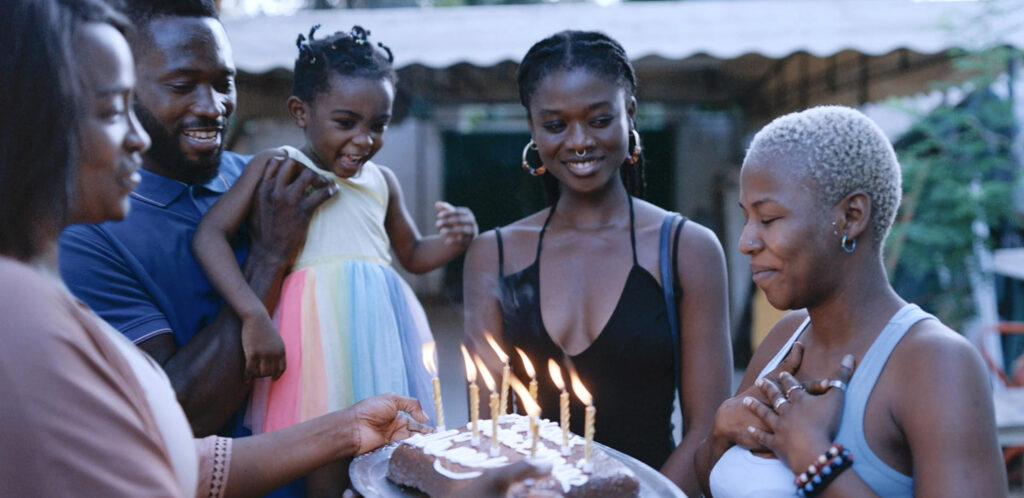
The film’s subsequent scene takes us outdoors, to an unidentified Arab-Muslim country in the Maghreb. Knowing Sehiri’s origins, the viewer quite naturally places the film’s action in Tunisia.
Marie has abandoned her real first name, Aminata, perhaps out of fear of stigmatization as an African migrant, or because of her Christian faith: she is a pastor and carries out her ministry clandestinely in the house she rents from an unscrupulous landlord. She helps her community survive by bending a few rules, but refuses to engage in any illegal trafficking. She knows the risks all too well. At 50, her future lies nowhere else but here.
Naney, in her thirties, is stuck halfway between Abidjan — where a difficult life awaits her, along with her teenage daughter whom she hasn’t seen in three years — and Europe, where she hopes to build a better life (Naney is about to embark on the crossing but is scrambling to collect the money owed to her). Jolie, on the other hand, is a young student, and therefore in the country legally. Yet she is vulnerable.
Brought together by fate under the same roof (Marie’s) in what we assume is a working-class suburb of Tunis, each woman tries to survive according to her means and beliefs, despite the growing hostility and harassment from Tunisian authorities.
A particularly shocking scene in the film shows young Tunisians attacking young Black Africans their own age in the street and stealing their shoes: in the Tunis depicted here, a veritable hunt for Black immigrants is creating insecurity within this already structurally fragile community.
A leaden gloom inevitably descends upon Marie, Naney, and Jolie as their attempts to escape their hopeless daily lives fail. This tension contrasts with the beauty of the lighting by cinematographer Frida Marzouk. Often shot at twilight, the imagery evokes the warmth of Terrence Malick’s films: low sun, backlit characters, warm light with blue reflections, silhouettes shimmering in the setting sun. The film’s cinematography is not beautiful for its own sake, but tells us something: that Hell and Heaven exist on this earth and that they lie side by side, intertwined. The Tunis of Promised Sky is a Purgatory where lives are upended based on one’s origin or skin color.
The shallow depth of field, the scarcity of outdoor scenes, and the understated performances of the actresses accentuate a sense of claustrophobia. Like these sub-Saharan Africans, we are trapped within the image — as alluring as it may be — going round and round in these circles of hell with the same characters, through the same settings, facing the same problems of money, survival, and danger. Through this circular motion, Sehiri powerfully conveys the silent violence of being a foreigner trapped in a hostile country, where anti-migrant authoritarianism, administrative arbitrariness, and widespread racism reign.
Marie, Naney, and Jolie therefore have no choice but to rely on their community and minimize the risk of being arrested and deported. In a recent Afrique Magazine interview, Sehiri explained, “In the face of adversity, they build themselves a fortress: the community.”

It is important to note that Promised Sky deconstructs the pejorative connotation of the idea of community as it is often perceived in France or Europe — as if it were a space of self-withdrawal, and rejection of the host country (which it can also be in many cases, of course). Here, it is clear that the community serves as a point of reference, a shelter, a place of respite. In every scene, we understand that it is the only place where the characters feel safe.
To show the brutality faced by sub-Saharan migrants in Tunisia, Sehiri films only one violent sequence, when Jolie — despite having a student ID card that is supposed to protect her — is rounded up by the Tunisian police. Sehiri explained the significance in Le Courrier de l’Atlas, “Migration pressure and the responses to it have exploited resentment toward migrants, but there is undeniable racism in the Maghreb toward the Black community. I chose to show a raid scene where the police, who have received orders, no longer distinguish between people with legal status and those without. It’s just the color of their skin that matters.”
While Erige Sehiri could not have anticipated the ICE atrocities committed by the Trump administration in Minneapolis at the time she was writing and then shooting the film, she nonetheless implicitly evokes those terrible images now familiar to us of ICE agents conducting unconstitutional raids against people of color on the streets of Minneapolis. So, when Jolie is taken to the police station, the haunting repetition of state violence — from Tunis to Minneapolis — unfolds, without the film even having to show it. This phenomenon of involuntary foreshadowing gives Promised Sky its universal dimension, and an evocative power.
Through the refraction of images from social media and TV, we sense that what affects sub-Saharan migrants in Tunis is similar to the violence against Hispanics or Arabs in the U.S. and Europe. We are frightened by the (inevitable?) authoritarian drift of liberal democracies as we watch, stunned, what awaits us — this proto-fascism that a large portion of citizens around the world are calling for, and with which they seem ready to collaborate.
Coming from a background in documentary filmmaking, the director knows exactly what cinema owes to reality and chooses to trust it. The sequence of realistic scenes showing the characters’ often fruitless journeys is enough to convey the impossibility of building a decent life when one is in a precarious and illegal situation. That is the film’s true subject.
The development of Promised Sky followed a unique process. The director began writing based on journalistic interviews with young migrants. She met people who later became characters in the film, notably Marie, a real-life journalist and pastor who, until three weeks before filming began, was supposed to play herself. The filmmaker’s work leading up to the shoot thus takes place within the conceptual hybridization of fiction, journalism, and documentary. All of this infuses the film. In doing so, Sehiri implies that the inhumanity to which some reduce migrants — or more generally, foreigners — when speaking of masses, tidal waves, or migratory waves, for example, is clearly reflected back onto the political establishment and its complicit population.
Without any moralizing discourse, through the editing and the naturalistic performances of the actresses, Promised Sky is an eminently political film that speaks to us about humanity with honesty and sincerity. It sets the clock of humanism back on track, so to speak. In one of the film’s most beautiful final shots, Marie drives Kenza to her final destination. The long, static sequence shot places Marie and Kenza — that is, humanity — at the center of the narrative. The silent simplicity of this magnificent shot encapsulates all the film’s emotion. Promised Sky can be experienced as a healing gift that gives a voice to those who have lost it, to all those who suffer from invisibility, who can reclaim their inalienable place in the human community.
Interview with Erige Sehiri
KARIM GOURY for TMR: How did you make the transition from documentary to fiction?
ERIGE SEHIRI: I quickly understood the power of fiction. I think I always wanted to make fiction, but I went through documentary first. It was like a school, that’s it. A way to learn filmmaking that opened the doors to fiction for me. And above all, I think it allowed me to approach fiction with a freer perspective. Of course, some documentaries are a given. But I felt like I had less freedom, that it took more time, and that there was a smaller audience. I’m pretty pragmatic. It took me longer to make Family Albums (2012) [Sehiri’s first documentary] than to make Under the Fig Trees or Promised Sky.
But at the same time, I work in both fiction and documentary. I’m exploring, I’m experimenting. I don’t come in with a pre-written, pre-established, fixed script. It’s a work in progress.
TMR: In Family Albums, you sense an invisible, oppressive power. In Under the Fig Trees, it’s the power the landowner wields over the farmworkers, and in Promised Sky, it’s the power of the state — also invisible but omnipresent. Your films often refer to power.
ES: I work mainly on systems, on the world of work. That’s also why I make ensemble films. I think it’s linked to systems and the question of domination. I never tell the story of a single character going through a story, but of several characters because they allow us to see the different ways of reacting to power and oppression. Everyone has a different sensibility. That’s what fascinates me.
TMR: In Promised Sky, Marie, Naney, and Jolie each embody a different and defining stage in a woman’s life.
ES: Yes, I’m interested in generations as well. There’s this mirror effect between young workers and older ones in Under the Fig Trees. Clearly, the film shows us the difficulties they face, not in a spectacular way, but indirectly through the different generations. What the older generations experienced before the younger ones, what they tell each other, or what we see on their faces. We sense the harshness of the work, not because it’s shown, but because the characters’ faces give us those clues.
There’s a disillusioned aspect to it. Even though in the end, it feels like a happy ending, it isn’t a happy ending — it’s a very melancholic one. Because, precisely, there’s that look in the eyes of the older women who know what they’ve been through, what the young women are going to go through, the risks they’re going to take, the fact that it’s a lifetime of work — but in reality, who benefits from the fruits of their labor? Certainly not them. That’s for sure. That’s also what the film is about.
In Promised Sky, the question is more about when will I reap the rewards of my perseverance? In fact, there’s something about that which interests me in the characters, more than their struggle. I approach the question of relationships with others, solidarity, the relationship between men and women, the relationship between women, and the relationship to work in a more philosophical way,
TMR: In France, when we talk about communitarianism, we’re talking about a community turning inward and rejecting its host country. It’s very pejorative. In Promised Sky, the community is a shelter, a refuge. It’s the only place where the characters find protection and kindness.
ES: I think that’s an interesting idea. Because I grew up in a community too — I grew up in a suburb of Lyon. It reminds me of the mosques people set up in neighborhoods. It’s just that here, it’s the other way around. We’re in a Muslim country, and we’re setting up underground churches. I find this reversal fascinating because I think it allows us to look at ourselves, to see how things work elsewhere. It’s a mirror.
There are two elements I found interesting: breaking down stereotypes about communities without falling into the clichés of sisterhood against all odds and evangelical churches. Because we know there have been plenty of documentaries in France about scandals in evangelical churches. Personally, I find it interesting to see African evangelical churches — which are somewhat traditional — where people proclaim themselves pastors. I wanted to highlight the positive side of that, even though there are flaws that come through in the film; I just don’t dwell on them.
TMR: There’s a clear parallel between what you’re filming and the global political situation.
ES: Today, we’re bombarded with images, but this climate has been around for a few years now, ever since Trump’s first term. Disregard for the rule of law, violence against people, uncertainty. In fact, everything is fragile; nothing is certain anymore. You’re accepted one day, rejected the next, and you live like that. You don’t know what will happen tomorrow. Personally, I’m quite surprised that when the film came out in France, there wasn’t more media coverage, especially given the parallels between the film and what’s happening in the world. And what I heard most of the time was, “Oh, but those issues are too far removed from us.” What do you mean, it’s too far removed from us? I don’t know how they saw the film. Those who say, “It’s a film about migrants in Africa; it doesn’t concern us” — I think those people haven’t seen, haven’t understood the film.
When things started to flare up in Minneapolis, I didn’t specifically make the connection, but it gave the film even more resonance and meaning. And it gave even more meaning to the film’s aesthetic choices. I didn’t want to show too much of Tunisia, or use a deep depth of field. Keeping things a bit blurry gives the sense that it’s happening there, but that it could just as easily be happening somewhere else.
TMR: Can you talk about that long take of Marie and Kenza in the taxi at the end of the film?
ES: It’s a shot we did in one take, because we couldn’t do it again. You can’t recreate it. It’s magical. We just let the camera roll. I like to shoot chronologically. It gives everyone — even the child — time to get used to Marie. Kenza is incredible. I spent a lot of time with her before filming. She was comfortable. This shot comes at a moment when Kenza was calm. She had to be calm, because she’s a very cheerful character despite carrying a deep trauma, so as not to fall into the cliché of the traumatized child, the sad child, the crying child, and so on…
In that car scene, she had to be very, very calm, because that’s where we see the trauma, and for me, falling asleep is the trauma. It reminded me of a documentary I made about people traumatized by the war in Libya. They told me they would fall asleep when they could no longer bear to remember their trauma. When Kenza fell asleep in the car, I thought to myself, my God!
Actually, trauma doesn’t necessarily manifest as a child having nightmares; it manifests in that moment when someone says one word too many, causes one pain too much, and she simply falls asleep. For me, too, that shot — every time I watch it…
Translated from French by Jordan Elgrably
Select Other Languages Français.