In her biweekly column, Amal observes how most Lebanese, like her aunt, are weary of their troubled existence, yet seem unable to address the hardships they face.
My aunt called me on a Wednesday in tears. She hadn’t left her house in weeks. It was seven days since Israel’s April 8 massacre in Lebanon. In ten minutes: one hundred strikes, 1,223 injured, 357 killed. Almost immediately, it was named Black Wednesday. It is not the first to bear such a name, nor, I fear, the last.
She is so very tired of this life, my aunt told me. “I am 84 years old. Every two years, a mseebeh (catastrophe); every five, mseebtain (two catastrophes). My earliest memory is the sound of panic in the streets, and of me trying to climb onto the windowsill of our house in Ras al Nabi’ to sneak a peek. I couldn’t have been older than three. I remember the lightbulbs being painted indigo.”
It was 1948. I said, helpfully. “You were five, auntie.” I knew the event from its color. That’s what we did in Amman during the 1973 war, when I was a child myself: paint life in indigo. It was the old blackout method to evade detection during Israeli night raids. Jordan didn’t enter that war, but we had to do it all the same, as a precautionary measure.
Israel’s name for the Wednesday operation was Eternal Darkness. The darkest shade of indigo.
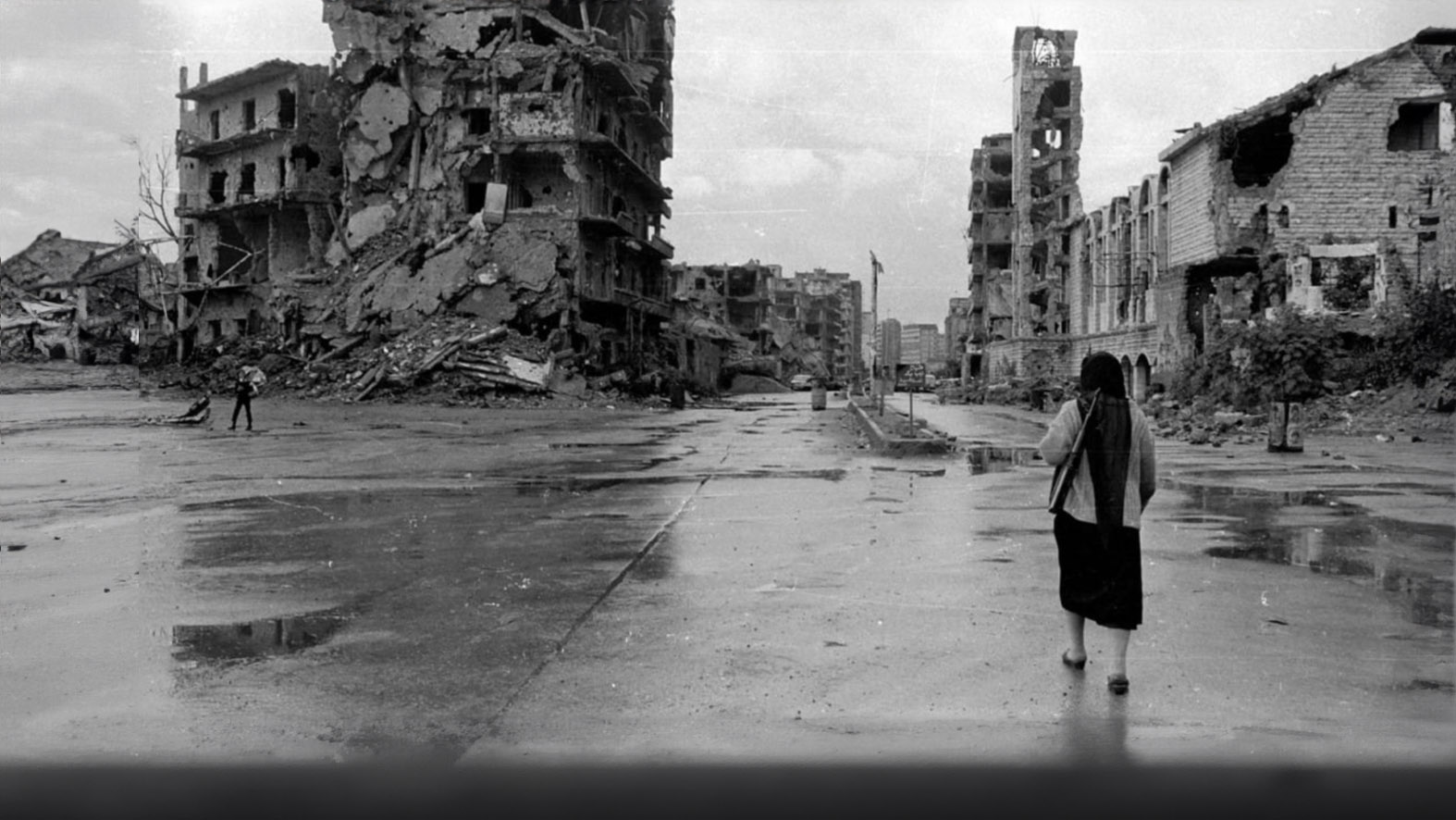
My aunt didn’t ask the dreaded question. She didn’t have to. In Lebanon, the specter of civil war is the specter of a cold February drizzle turning into a torrential downpour. It is the mood of a perennially nervous country, and as with all toxic political moods, you live half-expecting it to turn deadly.
We Lebanese are forever trapped in déjà vu. We are not fated to be so. We choose to, even though the burdens of it are truly unendurable. Because, like my aunt, most of us are so very tired of this existence, and yet we seem so utterly incapable of tending to its afflictions. At a loss, we have chosen to fool ourselves into believing that we will always overcome the worst of its moments: those we suffer because of incessant familial feuds, and those we sustain because we are so welcoming of competing foreign interests. We are like a family whose ill-bred children have cowed their mother into submission, running amok in a house with no doors or windows.
Now, we confront again the mad prospect of a civil war. We do so, however, in a context noticeably different from those that brought us fratricide in 1958, 1975, and all eruptions since, and in between. In The Age of the New Left, historian Fawwaz Traboulsi wrote of the 1975-1990 civil war:
Lebanese society split over the armed Palestinian presence along the same fault line that divided it over the internal conflict: support for the resistance fused with rejection of the sectarian system and demands for democratic, socio-economic transformation, while opposition to the Palestinian presence aligned with the defense of the status quo—an attachment to the sectarian order, its social underpinnings, and the free-market order.
There is no such Lebanese fault line today. The fight for social justice and democratic progress has no presence in the current argument. Politics itself, for the new generation of self-described activists, is akin to a four-letter word. What redress we pursue, we do so through a web of NGOs. The Palestinians of Lebanon are confined to their camps. And Hezbollah long ago came to appreciate the Lebanese system, exploiting its deformities as readily as any other sectarian party. In other words, the resistance stands with its sectarian sisters “in defense of the status quo.”
In fact, the ruling elites come to this latest quarrel in agreement over practically everything that matters for them: the weakness of the state; the sectarian system that draws strength from its feebleness; the oligarchic character of the political economy; its parasitic nature and endemic corruption. The one issue agitating these kindred spirits is Hezbollah’s conceit of scale beyond its place. Put simply, Hezbollah’s hegemonic reach and weapons are emasculating the other sects. The government, long suffering its own emasculation, openly joins them now. So do many Lebanese — earnest, unaligned citizens, like my aunt, who are so very tired of this existence.
We have, then, a convergence of constituencies and a divergence of reasons, the sinister among them mixing easily with the sincere. Hezbollah’s special status, in this very fragile country of a broken, exhausted people, has become intolerable. In defending its unique station and turf as an armed resistance movement, it stands alone against a predatory Israel that has fully operationalized its Gaza doctrine, and against a broad sweep of popular sentiment. Under a defenseless republic, the former lends it legitimacy; under the stark cost of war, the latter denies it latitude and cover. It is a brutal irony for both Hezbollah and the state, one in keeping with our brutal quandaries. And one over which neither has genuine control.
In this season of war and torment and fear, othering has begun. The Shiite sect is being paired with Hezbollah and jettisoned as culturally alien to this land; opponents of Hezbollah, whatever their identity, are being branded as traitors to it. Sectarian brokers are everywhere rhetorically preparing the ground. If not checked, we all know where this kind of chauvinism leads.
Toward the end of our conversation of lament and consolation, my aunt finally couldn’t resist and asked, “We have to live through another mseebeh?”
I couldn’t lie. “Most likely we do, but it doesn’t have a name yet.”
On Another Note
Omer Bartov is a leading scholar on genocide. He is also Israeli. He writes about the genocide in Gaza with clarity, passion, and authority. He writes about Israel with the sobriety of the heretic who was once a naïve believer. Bartov’s book, Israel, What Went Wrong?, is out. It’s already on my Kindle.
In a recent interview with The New Yorker, editor David Remnick asked him, “Is Zionism reformable?” His reply was as telling as it was simple: “No, Zionism is not reformable, but the state of Israel is.”
Have a listen because it is always worthwhile when the conversation is with Bartov.
Amal Ghandour’s biweekly column, “This Arab Life,” appears in The Markaz Review every other Friday, as well as in her Substack, and is syndicated in Arabic in Al Quds Al Arabi.
Opinions published in The Markaz Review reflect the perspective of their authors and do not necessarily represent TMR.