TMR columnist Amal Ghandour notes two concurrent spectacles, one comical, one promising — perhaps — as 2025 draws to a close.

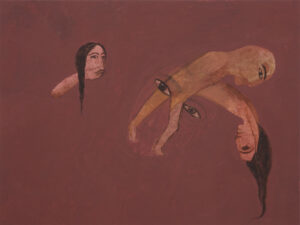
You’re looking at a publicity montage of Sah al-Nawm, Mohammad al-Maghout’s 1970s masterpiece of social and political satire. Listen to this column, recorded by Amal Ghandour.
Two recent spectacles cheer the heart. This heart, especially. One is inevitably Lebanese; the other reassuringly American.
The first features characters who do very nicely for themselves as members of Lebanon’s elite, yet could just as easily play the dupes in Sah al Nawm (closest translation is the sardonic Hello, Look Who’s Finally Awake!), the hilarious 1970s Syrian satire of Arab society and politics. For my young Arab readers who, to their great loss, have missed out on Sah al Nawm, YouTube is your savior. For my foreign readers, the story I am about to share will give you a sense of playwright Mohammad al-Maghout’s genius in capturing how Arab regime buffooneries crochet the burlesque into everyday Arab life. Syria’s Hafez Assad was known to crack a wide smile at Maghout’s brilliant parodies, apparently untroubled that the joke was on none other than his Baathist self.

Before I proceed, the shenanigans detailed in the tale I am about to narrate are alleged. Onward and forward.
So, a few years ago, Sharia’ Court Judge Khaldoun Oraymet saw profit in the absence of Saudi Arabia from the Lebanese arena. He devised a scheme to shake down millions from various luminaries of this sorry country, duping them into believing that he had a strong connection to an “Abu Omar,” a character he concocted as a chief adviser to Saudi Crown Prince Mohammad Bin Salman.
Before them he dangled what obsesses their waking hours and envelops their nightly reveries: high office. The inducements ranged from a parliamentary seat to a cabinet post to the premiership — or, in some cases, merely a direct line to power as favored acolytes and functionaries.
Abu Omar, of course, communicated strictly by phone with these seekers of Saudi favor through the good Sheikh himself. And at the end of every call, after issuing his orders or counsels or greetings from MBS, he would ask the Lebanese supplicant to “take care of Sheikh Oraymet.” After which the cash would flow into Oraymet’s pockets.
Are you with me so far? Because the story is about to take a turn into the realm of the truly outlandish. The man Oraymet groomed for the role of Abu Omar is Mustapha al-Hassyan, a dirt poor car painter from Akkar, the Sheikh’s hometown. Al-Hassyan was perfect for the part because he happened to hail from an Arab Bedouin tribe whose vernacular closely resembles the Saudi one.
To work around the Saudi embassy in Lebanon, the Sheikh assured his prey that Lebanese affairs fell strictly under Abu Omar’s remit. His was the real influence and authority in the Saudi royal court. The embassy, a mere sideshow, was to be ignored. Something along these lines, at any rate. Targeted Lebanese politicians, whose venality would reliably cancel out their few brain cells, followed the Sheikh’s counsel, directing all their sycophancy toward him and Abu Omar.
Wouldn’t you know it! There was one such episode in Sah al Nawm, when Ghawwar al Tosheh, the star of the series, and his brother-in-arms Abu ‘Antar, invent a similar swindle to Oraymet’s. They pretend they are rulers from a fabulously rich country called Twalistan (a play on tall in Arabic), wearing beneath their overflowing garments the highest-heeled qubqab (wooden clogs) you have ever seen. For the unfamiliar, the qubqab was Ghawwar’s signature footwear in Sah al Nawm and earlier in Hammam al-Hanna.


Just this month, Oraymet and al-Hassyan were finally caught in a sting operation carried out by Lebanese intelligence with the help of the Saudi embassy. As it happens, so was the sorry fate of Ghawwar and Abu ‘Antar, at the hands of Abu Kalabsha, the head shawish (policeman) of Haret Kil Min Ido Illo ( The Neighborhood of Every Man for Himself), Sah al Nawm’s universe.

Abu Omar and Oraymet were the talk of the town as Lebanon bade good riddance to 2025. Al-Hassyan, the car painter, is already in jail; the no-doubt-very-pious Sheikh so far remains free, though not at large. He spends his time holding press conferences and threatening news outlets. The mugs who fell for it are the butt of jokes –– about as good a comeuppance as we hapless Lebanese could hope for in a country loath to hold its worst offenders remotely accountable.
As for Lebanon itself, yet again it has demonstrated its remarkable knack for the tragicomic: a place where crooks and chumps converge to entertain and shock. A talent not unique to us, it must be said, but one that has clearly become the world’s envy, as even so-called great states descend, one after another, into absurdist theatre.
The real scandal, of course, is that Abu Omar’s tale is only the latest of countless ruses that have, generation after generation, exposed most of Lebanon’s pretend patricians as the shysters they truly are. Most scams unravel behind semi-closed doors; this one thankfully came undone for all to gape at and laugh over, much like a drunkard’s soiled trousers slipping loose as he clowns away at a party.
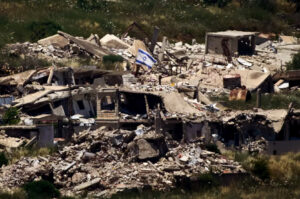
But this, too, is just frivolous vaudeville befitting the frivolity of the home country. The spectacle whose significance matched that of the United States itself was Turning Point USA’s AmericaFest Conference, held in December 2025. It was quite the sight watching its MAGA notables going to war over the singular issue for many of us on this side of the trench: Israel.
Tucker Carlson’s searing attack on evangelical ministries that support or justify Israel’s mass slaughter in Gaza best captured the shifting ground in this now epic fight.
If a man commits a crime, do we kill his kids? I don’t care if it’s in Minneapolis or Gaza City. No, we don’t. God is not on any country’s side … [God] doesn’t have a nationality.
What makes this precise argument so pivotal is that it is not ours but entirely theirs. It will most likely be won because it is being fought on their turf, for their own sake, not ours –– and most consequentially, not Israel’s. Of all the prospects announcing 2026, this one deserves all our patience and attention. 
On Another Note
I’d like to greet 2026 with Mahmoud Darwish’s On This Land. The reasons are as clear as the sun that shines above me this morning as I write:
On this land, is what makes life worth living:
the return of April, the smell of bread
at dawn, a woman’s opinions on men, the writings of Aeschylus, love’s
beginning, moss on stone, mothers standing on the string of a flute,
and the invaders’ fear of memories.
On this land, is what makes life worth living:
the end of September, a lady leaving
her forties full of apricots, the hour of sun in prison, clouds becoming
a swarm of creatures, the chants of a nation that faces its demise
smiling, and the tyrannies’ fear of songs.
On this land, is what makes life worth living:
on this land is the lady of the land, the mother
of beginnings and endings. She was named Palestine. Still
named Palestine….
Amal Ghandour’s biweekly column, “This Arab Life,” appears in The Markaz Review every other Friday, as well as in her Substack, and is syndicated in Arabic in Al Quds Al Arabi.
Opinions published in The Markaz Review reflect the perspective of their authors and do not necessarily represent TMR.