The Whispers Of Nadia Tueni and Maroun Baghdadi

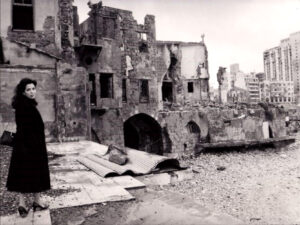
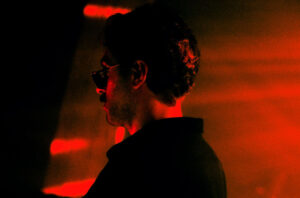
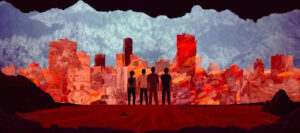
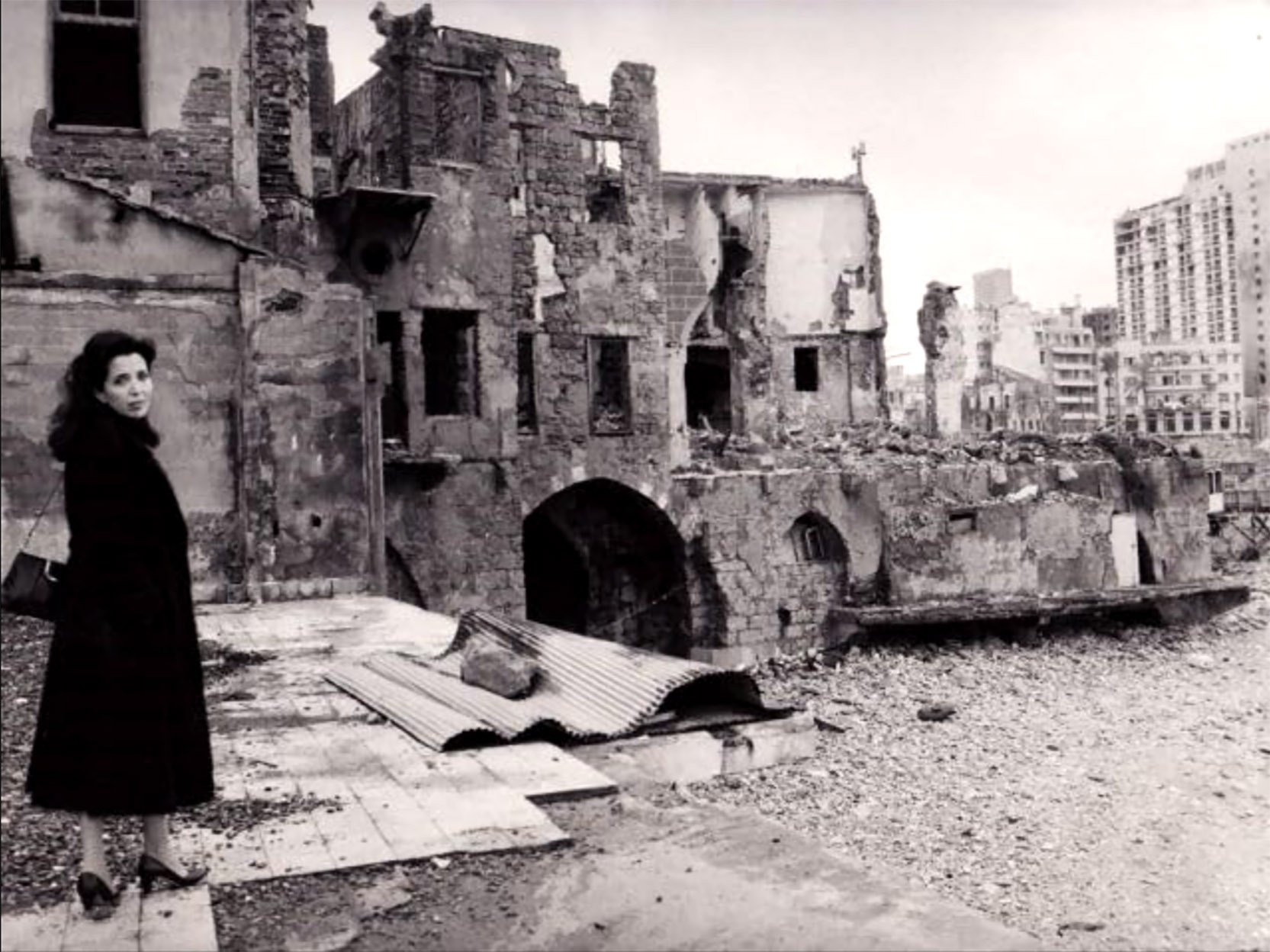
Poet Nadine Tueni in Maroun Baghdadi's "Whispers" (1980).

5 DECEMBER 2025 • By Amal Ghandour

In "This Arab Life," Amal Ghandour ruminates on the late Lebanse poet Nadine Tueni, featured in filmmaker Maroun Baghdadi's Whispers.

Listen to this column read by the author.


In front of Maroun Baghdadi’s lens — in his film Whispers, 45 years ago – the poet Nadia Tueni ruminated about a Lebanon in the throes of life and death. So was she. In 1983, after years of struggling with bone cancer, she finally succumbed. She was 45 years old; the state of Lebanon was 37.

In the opening scene, they’re a threesome: her delicate voice, the gentle crash of the waves, and the faint echoes of her footsteps. As she walked among the war’s carnage, her words were at once brutal and beseeching: “Beirut has become ruins, and ruins, with time, acquire beauty. But I cannot become accustomed to this… We used to say, again and again, that Beirut needed to be burned down. We talked and talked, endlessly. But now the reality is of another order. Beirut is my city — and someone destroyed it.”

Did Nadia choose Maroun for her visual requiem, or did he choose her for his? There are no clues in the public records, but it hardly matters. In the end, the prose could only be hers, and the camera’s eye his. Theirs was, in essence, a meditative duet on their beloved country’s torment.

Technically, the documentary hasn’t aged well. But in meaning, close to 50 years after its release, it has grown extraordinarily resonant and wise, even if mistaken in the glimmers of hope it chose to convey in parts. When the businessmen, industrialists, and bankers talk about their ingenuity and resilience, the effect is that of a press release. They still talk this nonsense today. But perhaps it was passably believable then, or a necessary moral boost in dire circumstances. Likely, it was also Maroun’s concession to Rafiq Hariri’s Bank Méditerranée (BankMed), which sponsored the documentary.

Poignantly, the passage of time has been much kinder to the authenticity of the film’s other characters. When the farmer and the fisherman are given the stage, the perennial yearning for the land and the sea is all there is. When Ziad Rahbani, musician and playwright, holds sway, he imparts the ugly truth, as if fulfilling the intellectual’s enduring true calling.

These juxtapositions may have gelled well in 1980; they certainly jar and shriek today.

As cruel irony would have it, on these Levantine landscapes of cruel ironies, exactly ten years after the poet’s death, the filmmaker went. At 43, he was almost her age when she passed. Baghdadi’s demise was, in its own way, even more tragic than Nadia’s: he fell to his death onto the inner bed of his building from high up on a dark night on a dark stairway with no balusters. They were two of the war’s lettered chroniclers. Fate would not permit either one of them to witness its true legacy in the supposed peace that followed in 1990.

I did not live the 15-year war. My family went into exile well before it erupted in 1975. Amman was my home. But I have spent my youth in the simmering Lebanese disquiet that ensued. Many have taken to calling this post-strife period a kind of peace. It has been, and remains, anything but.

For this reason, I watched Whispers for the first time last week. So it was with Tueni’s poetry. They read like an accompaniment to the documentary. Context to this moment: contemporary and not vaguely recalled or unconsciously imagined. It’s a habit of mine in times of acute unease to seek interior narratives that render vital and immediate what was once intimately familiar before the hours and the years did their worst.

And time has done its worst to us Lebanese; a gift to those who have been doing their worst to the country since its inception. We live through the present in a state of fugue, as if yesterday was lived by someone else; as if its traumas are not ours, its blunders are someone else’s. In Stopped Earth, Nadia evokes her own very personal story, but it should be ours as well had we had any sense in us:

I survive my own ashes,
And know from memory the future of my time

Towards the end of the documentary, she muses about the madness of this place:

Majnoun Lebnain,( mad, this Lebanon).
Maybe its madness is what sets it asunder… Maybe its madness might save it yet. This country that was condemned, still lives. This country that has turned half-empty, still lives. This country that has become walls and alleys, still lives.
Mad, this Lebanon, because it does not want to die, because it still knows how to laugh.
Majnoun, Lebnain! (my translation, from Arabic).

In 1980, the fratricide was only five years old. Israel hadn’t invaded yet. Hezbollah had not been born. The thousands who would perish during the month-long siege and bombardment of Beirut in 1982 were still alive then, and many of the city’s neighborhoods were still upright. The bloodletting between and within sects would continue for another ten years. But by 1980, Beirut, its epicenter, already had the mood, look, and feel of a wrenched realm: desolate, filthy, and ravaged in the harsh glare of the sun, gin-soaked and heedless in the kind shade of the moon; its lost youth dancing to Marcel Khalifeh’s oud in private sitting rooms and swinging to sappy love songs on AUB’s green fields.

I look at all those young faces now and recognize mine in them. This was my generation. Nadia watches them with a smile suggesting hope and faith. I recognize my face in her today as I look upon this new generation of youth, and wonder if my failure will be theirs as well.

I never met Nadia. Force of war and distance. But the close family friendship meant that I knew things: the devastation wrought from an eight-year old daughter’s loss to a sinister disease; the scars it left in those who survived her; the redemption found in the birth of a son; the unbearable delicacy and indomitable strength of this woman that, like an emotional braid, interweave.

I would have liked to say that, in so many ways, this is also Lebanon’s story. Sadly, I am not able to.

On Another Note

First, an excerpt from Tueni’s My Country:

My country, costumed in uniforms and mere gestures,
condemns a flower for being a flower.
My country has a look of holiness and doubt.
My country is where men die when they have time for it.
My country’s law is a toy soldier.
My country begs me, “Take me seriously,”
then turns and goes berserk as a wounded pigeon.
My country is difficult as a long poem.
My country is softer than a lover’s shoulder.
My country’s like a child’s storybook
where the theme awakens Sleeping Beauty.

 •

Equator, a new intellectual magazine, has just launched. Pankaj Mishra is one of its leading voices. That alone was enough for me to subscribe. Another compelling reason was Hisham Matar’s “Pity and Fear,” a masterful essay on Titian’s seven renderings of the myth of Actaeon and Diana, and what they echo in the more recent American horrors and humiliations in Iraq’s Abu Ghraib prison and Israeli genocide in Gaza:

“Everything is closed… We are fighting human animals and we are acting accordingly.” These words, spoken in 2023 by Israel’s then minister of defense, Yoav Gallant, were meant to justify his country’s actions in Gaza, as well as explain the terms on which his troops would proceed. Like Diana and Apollo, they see cruelty as ridicule and transformation. And like the Americans in Abu Ghraib, their appetite is unquenchable. It is unquenchable because they have misunderstood their situation.

Read the full essay here.


Amal Ghandour’s biweekly column, “This Arab Life,” appears in The Markaz Review every second Friday, as well as in her Substack, and is syndicated in Arabic in Al Quds Al Arabi.

Opinions published in The Markaz Review reflect the perspective of their authors and do not necessarily represent TMR.
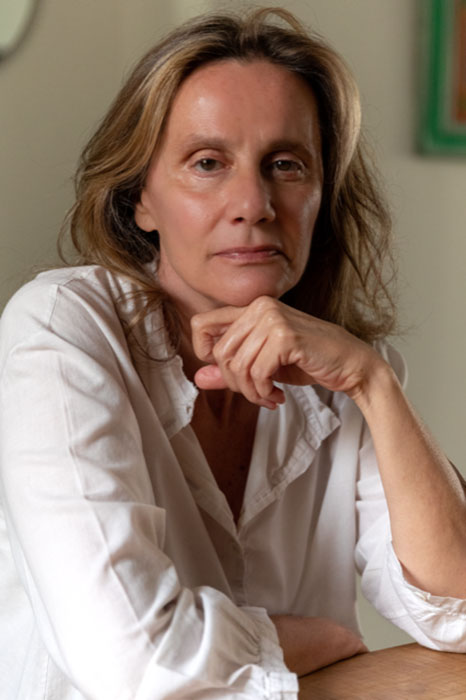
 

Amal Ghandour

Amal Ghandour ’s career spans more than three decades in the fields of research, communication, and community development. She is an author (About This Man Called Ali; This Arab Life, A Generation’s Journey Into Silence) and a blogger (This Arab Life on... Read more

Join Our Community

TMR exists thanks to its readers and supporters. By sharing our stories and celebrating cultural pluralism, we aim to counter racism, xenophobia, and exclusion with knowledge, empathy, and artistic expression.

Learn more

RELATED

Columns

The Whispers Of Nadia Tueni and Maroun Baghdadi

5 DECEMBER 2025 • By Amal Ghandour
The Whispers Of Nadia Tueni and Maroun Baghdadi
Columns

Dear Souseh: Stuck Between Families

24 OCTOBER 2025 • By Lina Mounzer
Dear Souseh: Stuck Between Families
Film

A Love Letter to the Ghosts of Armenian Cinema

17 OCTOBER 2025 • By Jim Quilty
A Love Letter to the Ghosts of Armenian Cinema
Film Reviews

New Documentaries from Palestine, Sudan, Afghanistan, and Iran

12 SEPTEMBER 2025 • By Yassin El-Moudden
New Documentaries from Palestine, Sudan, Afghanistan, and Iran
Editorial

Why Out of Our Minds?

5 SEPTEMBER 2025 • By Lina Mounzer
Why <em>Out of Our Minds</em>?
Centerpiece

Trauma After Gaza

5 SEPTEMBER 2025 • By Joelle Abi-Rached
Trauma After Gaza
Art & Photography

Ali Cherri’s show at Marseille’s [mac] Is Watching You

15 AUGUST 2025 • By Naima Morelli
Ali Cherri’s show at Marseille’s [mac] Is Watching You
Essays

Ziad Rahbani: The Making of a Lebanese Jazz Legend

8 AUGUST 2025 • By Diran Mardirian
Ziad Rahbani: The Making of a Lebanese Jazz Legend
Featured Artist

Syria and the Future of Art: an Intimate Portrait

4 JULY 2025 • By Arie Amaya-Akkermans
Syria and the Future of Art: an Intimate Portrait
Arabic

Jawdat Fakreddine Presents Three Poems

20 MAY 2025 • By Jawdat Fakhreddine, Huda J. Fakhreddine
Jawdat Fakreddine Presents Three Poems
Film Reviews

Contretemps, a Bold Film on Lebanon’s Crises

16 MAY 2025 • By Jim Quilty
Contretemps, a Bold Film on Lebanon’s Crises
Poetry

Three Poems by Najwan Darwish

22 APRIL 2025 • By Najwan Darwish
Three Poems by Najwan Darwish
Essays

Heartbreak and Commemoration in Beirut’s Southern Suburbs

7 MARCH 2025 • By Sabah Haider
Heartbreak and Commemoration in Beirut’s Southern Suburbs
Book Reviews

Maya Abu Al-Hayyat’s Defiant Exploration of Palestinian Life

20 DECEMBER 2024 • By Zahra Hankir
Maya Abu Al-Hayyat’s Defiant Exploration of Palestinian Life
Book Reviews

Barrack Zailaa Rima’s Beirut Resists Categorization

6 DECEMBER 2024 • By Katie Logan
Barrack Zailaa Rima’s <em>Beirut</em> Resists Categorization
Art

In Lebanon, Art is a Matter of Survival

22 NOVEMBER 2024 • By Nada Ghosn
In Lebanon, Art is a Matter of Survival
Film

The Haunting Reality of Beirut, My City

8 NOVEMBER 2024 • By Roger Assaf, Zeina Hashem Beck
The Haunting Reality of <em>Beirut, My City</em>
Essays

Between Two Sieges: Translating Roger Assaf in California

8 NOVEMBER 2024 • By Zeina Hashem Beck
Between Two Sieges: Translating Roger Assaf in California
Fiction

The Last Millefeuille in Beirut

4 OCTOBER 2024 • By MK Harb
The Last Millefeuille in Beirut
Film

Soudade Kaadan: Filmmaker Interview

30 AUGUST 2024 • By Jordan Elgrably
Soudade Kaadan: Filmmaker Interview
Book Reviews

Nabil Kanso: Lebanon and the Split of Life—a Review

2 AUGUST 2024 • By Sophie Kazan Makhlouf
Nabil Kanso: <em>Lebanon and the Split of Life</em>—a Review
Fiction

“We Danced”—a story by MK Harb

5 JULY 2024 • By MK Harb
“We Danced”—a story by MK Harb
Fiction

“Paris of the Middle East”—fiction by MK Harb

1 APRIL 2024 • By MK Harb
“Paris of the Middle East”—fiction by MK Harb
Poetry

“The Scent Censes” & “Elegy With Precious Oil” by Majda Gama

4 FEBRUARY 2024 • By Majda Gama
“The Scent Censes” & “Elegy With Precious Oil” by Majda Gama
Essays

“Double Apple”—a short story by MK Harb

4 FEBRUARY 2024 • By MK Harb
“Double Apple”—a short story by MK Harb
TMR 37 • Endings & Beginnings

“The Summer They Heard Music”—a short story by MK Harb

3 DECEMBER 2023 • By MK Harb
“The Summer They Heard Music”—a short story by MK Harb
Books

Huda Fakhreddine’s A Brief Time Under a Different Sun

3 DECEMBER 2023 • By Huda J. Fakhreddine, Rana Asfour
Huda Fakhreddine’s <em>A Brief Time Under a Different Sun</em>
Fiction

“The Followers”—a short story by Youssef Manessa

3 DECEMBER 2023 • By Youssef Manessa
“The Followers”—a short story by Youssef Manessa
Art & Photography

War and Art: A Lebanese Photographer and His Protégés

13 NOVEMBER 2023 • By Nicole Hamouche
War and Art: A Lebanese Photographer and His Protégés
Featured Artist

Mohamed Al Mufti, Architect and Painter of Our Time

5 NOVEMBER 2023 • By Nicole Hamouche
Mohamed Al Mufti, Architect and Painter of Our Time
Book Reviews

The Archaeology of War

23 OCTOBER 2023 • By Arie Amaya-Akkermans
The Archaeology of War
Art & Photography

Middle Eastern Artists and Galleries at Frieze London

23 OCTOBER 2023 • By Sophie Kazan Makhlouf
Middle Eastern Artists and Galleries at Frieze London
Theatre

Hartaqât: Heresies of a World with Policed Borders

9 OCTOBER 2023 • By Nada Ghosn
<em>Hartaqât</em>: Heresies of a World with Policed Borders
Theatre

Lebanese Thespian Aida Sabra Blossoms in International Career

9 OCTOBER 2023 • By Nada Ghosn
Lebanese Thespian Aida Sabra Blossoms in International Career
Books

Fairouz: The Peacemaker and Champion of Palestine

1 OCTOBER 2023 • By Dima Issa
Fairouz: The Peacemaker and Champion of Palestine
Fiction

“Kaleidoscope: In Pursuit of the Real in a Virtual World”—fiction from Dina Abou Salem

1 OCTOBER 2023 • By Dina Abou Salem
“Kaleidoscope: In Pursuit of the Real in a Virtual World”—fiction from Dina Abou Salem
Poetry

Allen C. Jones—Two Poems from Son of a Cult

12 SEPTEMBER 2023 • By Allen C Jones
Allen C. Jones—Two Poems from <em>Son of a Cult</em>
Books

“Sadness in My Heart”—a story by Hilal Chouman

3 SEPTEMBER 2023 • By Hilal Chouman, Nashwa Nasreldin
“Sadness in My Heart”—a story by Hilal Chouman
Film

The Soil and the Sea: The Revolutionary Act of Remembering

7 AUGUST 2023 • By Farah-Silvana Kanaan
<em>The Soil and the Sea</em>: The Revolutionary Act of Remembering
Beirut

“The City Within”—fiction from MK Harb

2 JULY 2023 • By MK Harb
“The City Within”—fiction from MK Harb
Cities

In Shahrazad’s Hammam—fiction by Ahmed Awadalla

2 JULY 2023 • By Ahmed Awadalla
In Shahrazad’s Hammam—fiction by Ahmed Awadalla
Arabic

Inside the Giant Fish—excerpt from Rawand Issa’s graphic novel

2 JULY 2023 • By Rawand Issa, Amy Chiniara
Inside the Giant Fish—excerpt from Rawand Issa’s graphic novel
Art & Photography

Newly Re-Opened, Beirut’s Sursock Museum is a Survivor

12 JUNE 2023 • By Arie Amaya-Akkermans
Newly Re-Opened, Beirut’s Sursock Museum is a Survivor
Beirut

Remembering the Armenian Genocide From Lebanon

17 APRIL 2023 • By Mireille Rebeiz
Remembering the Armenian Genocide From Lebanon
Beirut

War and the Absurd in Zein El-Amine’s Watermelon Stories

20 MARCH 2023 • By Rana Asfour
War and the Absurd in Zein El-Amine’s <em>Watermelon</em> Stories
Beirut

The Forced Disappearance of Street Vendors in Beirut

13 MARCH 2023 • By Ghida Ismail
The Forced Disappearance of Street Vendors in Beirut
Fiction

“Counter Strike”—a story by MK HARB

5 MARCH 2023 • By MK Harb
“Counter Strike”—a story by MK HARB
Fiction

“Mother Remembered”—Fiction by Samir El-Youssef

5 MARCH 2023 • By Samir El-Youssef
“Mother Remembered”—Fiction by Samir El-Youssef
Essays

More Photographs Taken From The Pocket of a Dead Arab

5 MARCH 2023 • By Saeed Taji Farouky
More Photographs Taken From The Pocket of a Dead Arab
Cities

The Odyssey That Forged a Stronger Athenian

5 MARCH 2023 • By Iason Athanasiadis
The Odyssey That Forged a Stronger Athenian
Beirut

The Curious Case of Middle Lebanon

13 FEBRUARY 2023 • By Amal Ghandour
The Curious Case of Middle Lebanon
Beirut

Arab Women’s War Stories, Oral Histories from Lebanon

13 FEBRUARY 2023 • By Evelyne Accad
Arab Women’s War Stories, Oral Histories from Lebanon
Book Reviews

Sabyl Ghoussoub Heads for Beirut in Search of Himself

23 JANUARY 2023 • By Adil Bouhelal
Sabyl Ghoussoub Heads for Beirut in Search of Himself
Art

On Lebanon and Lamia Joreige’s “Uncertain Times”

23 JANUARY 2023 • By Arie Amaya-Akkermans
On Lebanon and Lamia Joreige’s “Uncertain Times”
Fiction

Broken Glass, a short story

15 DECEMBER 2022 • By Sarah AlKahly-Mills
<em>Broken Glass</em>, a short story
Book Reviews

Fida Jiryis on Palestine in Stranger in My Own Land

28 NOVEMBER 2022 • By Diana Buttu
Fida Jiryis on Palestine in <em>Stranger in My Own Land</em>
Art & Photography

Our Shared Future: Marwa Arsanios’ “Reverse Shot”

28 NOVEMBER 2022 • By Mariam Elnozahy
Our Shared Future: Marwa Arsanios’ “Reverse Shot”
Columns

For Electronica Artist Hadi Zeidan, Dance Clubs are Analogous to Churches

24 OCTOBER 2022 • By Melissa Chemam
For Electronica Artist Hadi Zeidan, Dance Clubs are Analogous to Churches
Poetry

On a Poem by Imtiaz Dharker—From Poetry Unbound

15 OCTOBER 2022 • By Pádraig O. Tuama
On a Poem by Imtiaz Dharker—From <em>Poetry Unbound</em>
Film

Ziad Kalthoum: Trajectory of a Syrian Filmmaker

15 SEPTEMBER 2022 • By Viola Shafik
Ziad Kalthoum: Trajectory of a Syrian Filmmaker
Essays

Kairo Koshary, Berlin’s Egyptian Food Truck

15 SEPTEMBER 2022 • By Mohamed Radwan
Kairo Koshary, Berlin’s Egyptian Food Truck
Essays

Exile, Music, Hope & Nostalgia Among Berlin’s Arab Immigrants

15 SEPTEMBER 2022 • By Diana Abbani
Exile, Music, Hope & Nostalgia Among Berlin’s Arab Immigrants
Art & Photography

16 Formidable Lebanese Photographers in an Abbey

5 SEPTEMBER 2022 • By Nada Ghosn
16 Formidable Lebanese Photographers in an Abbey
Film

Two Syrian Brothers Find Themselves in “We Are From There”

22 AUGUST 2022 • By Angélique Crux
Two Syrian Brothers Find Themselves in “We Are From There”
Fiction

Where to Now, Ya Asfoura?—a story by Sarah AlKahly-Mills

15 JULY 2022 • By Sarah AlKahly-Mills
Where to Now, Ya Asfoura?—a story by Sarah AlKahly-Mills
Film

Lebanon in a Loop: A Retrospective of “Waves ’98”

15 JULY 2022 • By Youssef Manessa
Lebanon in a Loop: A Retrospective of “Waves ’98”
Columns

Why I left Lebanon and Became a Transitional Citizen

27 JUNE 2022 • By Myriam Dalal
Why I left Lebanon and Became a Transitional Citizen
Fiction

Rabih Alameddine: “Remembering Nasser”

15 JUNE 2022 • By Rabih Alameddine
Rabih Alameddine: “Remembering Nasser”
Film

Saeed Taji Farouky: “Strange Cities Are Familiar”

15 JUNE 2022 • By Saeed Taji Farouky
Saeed Taji Farouky: “Strange Cities Are Familiar”
Fiction

Dima Mikhayel Matta: “This Text Is a Very Lonely Document”

15 JUNE 2022 • By Dima Mikhayel Matta
Dima Mikhayel Matta: “This Text Is a Very Lonely Document”
Fiction

“The Salamander”—fiction from Sarah AlKahly-Mills

15 JUNE 2022 • By Sarah AlKahly-Mills
“The Salamander”—fiction from Sarah AlKahly-Mills
Art & Photography

Film Review: “Memory Box” on Lebanon Merges Art & Cinema

13 JUNE 2022 • By Arie Amaya-Akkermans
Film Review: “Memory Box” on Lebanon Merges Art & Cinema
Beirut

Fairouz is the Voice of Lebanon, Symbol of Hope in a Weary Land

25 APRIL 2022 • By Melissa Chemam
Fairouz is the Voice of Lebanon, Symbol of Hope in a Weary Land
Book Reviews

Joumana Haddad’s The Book of Queens: a Review

18 APRIL 2022 • By Laila Halaby
Joumana Haddad’s <em>The Book of Queens</em>: a Review
Art & Photography

Ghosts of Beirut: a Review of “displaced”

11 APRIL 2022 • By Karén Jallatyan
Ghosts of Beirut: a Review of “displaced”
Columns

Music in the Middle East: Bring Back Peace

21 MARCH 2022 • By Melissa Chemam
Music in the Middle East: Bring Back Peace
Poetry

Three Poems of Love and Desire by Nouri Al-Jarrah

15 MARCH 2022 • By Nouri Al-Jarrah
Three Poems of Love and Desire by Nouri Al-Jarrah
Fiction

Fiction from “Free Fall”: I fled the city as a murderer whose crime had just been uncovered

15 JANUARY 2022 • By Abeer Esber, Nouha Homad
Fiction from “Free Fall”: I fled the city as a murderer whose crime had just been uncovered
Columns

Sudden Journeys: From Munich with Love and Realpolitik

27 DECEMBER 2021 • By Jenine Abboushi
Sudden Journeys: From Munich with Love and Realpolitik
Comix

Lebanon at the Point of Drowning in Its Own…

15 DECEMBER 2021 • By Raja Abu Kasm, Rahil Mohsin
Lebanon at the Point of Drowning in Its Own…
Comix

How to Hide in Lebanon as a Western Foreigner

15 DECEMBER 2021 • By Nadiyah Abdullatif, Anam Zafar
How to Hide in Lebanon as a Western Foreigner
Columns

Sudden Journeys: The Villa Salameh Bequest

29 NOVEMBER 2021 • By Jenine Abboushi
Sudden Journeys: The Villa Salameh Bequest
Music Reviews

Electronic Music in Riyadh?

22 NOVEMBER 2021 • By Melissa Chemam
Electronic Music in Riyadh?
Art

Etel Adnan’s Sun and Sea: In Remembrance

19 NOVEMBER 2021 • By Arie Amaya-Akkermans
Etel Adnan’s Sun and Sea: In Remembrance
Book Reviews

Diary of the Collapse—Charif Majdalani on Lebanon’s Trials by Fire

15 NOVEMBER 2021 • By A.J. Naddaff
<em>Diary of the Collapse</em>—Charif Majdalani on Lebanon’s Trials by Fire
Interviews

The Anguish of Being Lebanese: Interview with Author Racha Mounaged

18 OCTOBER 2021 • By A.J. Naddaff
The Anguish of Being Lebanese: Interview with Author Racha Mounaged
Book Reviews

Racha Mounaged’s Debut Novel Captures Trauma of Lebanese Civil War

18 OCTOBER 2021 • By A.J. Naddaff
Racha Mounaged’s Debut Novel Captures Trauma of Lebanese Civil War
Featured excerpt

Memoirs of a Militant, My Years in the Khiam Women’s Prison

15 OCTOBER 2021 • By Nawal Qasim Baidoun
Memoirs of a Militant, My Years in the Khiam Women’s Prison
Art & Photography

Displaced: From Beirut to Los Angeles to Beirut

15 SEPTEMBER 2021 • By Ara Oshagan
Displaced: From Beirut to Los Angeles to Beirut
Columns

Beirut Drag Queens Lead the Way for Arab LGBTQ+ Visibility

8 AUGUST 2021 • By Anonymous
Beirut Drag Queens Lead the Way for Arab LGBTQ+ Visibility
Art & Photography

Gaza’s Shababek Gallery for Contemporary Art

14 JULY 2021 • By Yara Chaalan
Gaza’s Shababek Gallery for Contemporary Art
Columns

The Semantics of Gaza, War and Truth

14 JULY 2021 • By Mischa Geracoulis
The Semantics of Gaza, War and Truth
Columns

Lebanon’s Wasta Has Contributed to the Country’s Collapse

14 JUNE 2021 • By Samir El-Youssef
Lebanon’s Wasta Has Contributed to the Country’s Collapse
Columns

Lebanese Oppose Corruption with a Game of Wasta

14 JUNE 2021 • By Victoria Schneider
Lebanese Oppose Corruption with a Game of Wasta
Weekly

War Diary: The End of Innocence

23 MAY 2021 • By Arie Amaya-Akkermans
War Diary: The End of Innocence
Weekly

Beirut Brings a Fragmented Family Together in “The Arsonists’ City”

9 MAY 2021 • By Rana Asfour
Columns

Memory and the Assassination of Lokman Slim

14 MARCH 2021 • By Claire Launchbury
Memory and the Assassination of Lokman Slim
Weekly

Hanane Hajj Ali, Portrait of a Theatrical Trailblazer

14 FEBRUARY 2021 • By Nada Ghosn
Hanane Hajj Ali, Portrait of a Theatrical Trailblazer
TMR 6 • Revolutions

Revolution in Art, a review of “Reflections” at the British Museum

14 FEBRUARY 2021 • By Malu Halasa
Revolution in Art, a review of “Reflections” at the British Museum
TMR 3 • Racism & Identity

Find the Others: on Becoming an Arab Writer in English

15 NOVEMBER 2020 • By Rewa Zeinati
TMR 3 • Racism & Identity

I am the Hyphen

15 NOVEMBER 2020 • By Sarah AlKahly-Mills
I am the Hyphen
World Picks

World Art, Music & Zoom Beat the Pandemic Blues

28 SEPTEMBER 2020 • By Malu Halasa
World Art, Music & Zoom Beat the Pandemic Blues
Beirut

An Outsider’s Long Goodbye

15 SEPTEMBER 2020 • By Annia Ciezadlo
An Outsider’s Long Goodbye
Beirut

Wajdi Mouawad, Just the Playwright for Our Dystopian World

15 SEPTEMBER 2020 • By Melissa Chemam
Wajdi Mouawad, Just the Playwright for Our Dystopian World
Art

Beirut Comix Tell the Story

15 SEPTEMBER 2020 • By Lina Ghaibeh & George Khoury
Beirut Comix Tell the Story
Editorial

Beirut, Beirut

15 SEPTEMBER 2020 • By Jordan Elgrably
Beirut

It’s Time for a Public Forum on Lebanon

15 SEPTEMBER 2020 • By Wajdi Mouawad
It’s Time for a Public Forum on Lebanon
Book Reviews

Salvaging the shipwreck of humanity in Amin Maalouf’s Adrift

15 SEPTEMBER 2020 • By Sarah AlKahly-Mills
Salvaging the shipwreck of humanity in Amin Maalouf’s <em>Adrift</em>

Leave a Comment

Your email address will not be published. Required fields are marked *

11 − 10 =

Scroll to Top