An Impossible Task in <em>The President’s Cake</em>

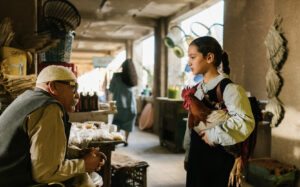
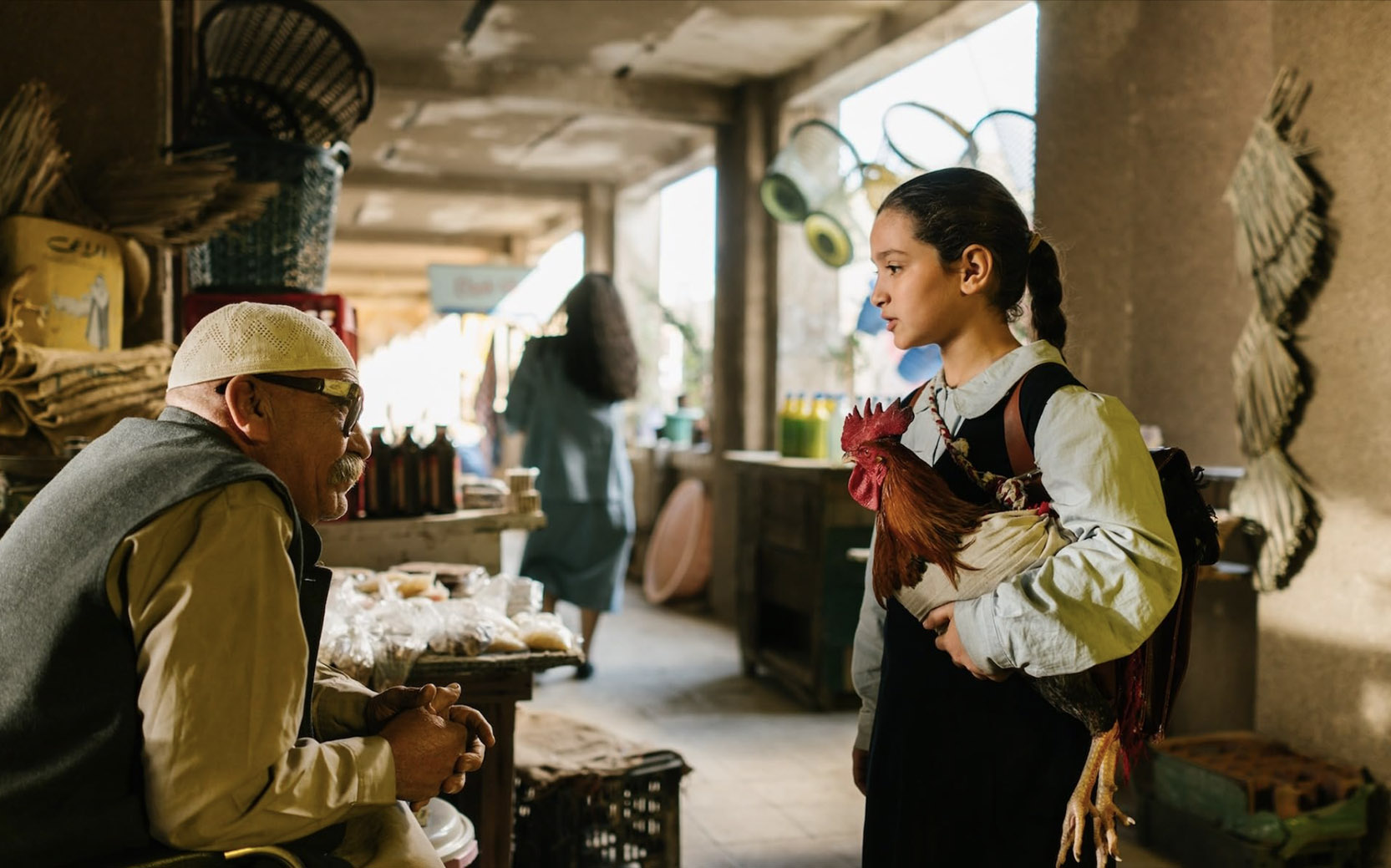
Baneen Ahmad Nayyef as Lamia in The President's Cake.

6 FEBRUARY 2026 • By Alex Demyanenko

Select Other Languages French.

In this Cannes-winning debut, writer/director Hasan Hadi filters authoritarian cruelty through childhood, revealing how power embeds itself in daily life.

The President’s Cake opens on an Iraq we’re not conditioned to recognize. Dusk reflects in water like something sacred. Marshes stretch toward the horizon, palm trees silhouetted against a sinking sun, meshoofs gliding quietly through reeds. It’s calm, it’s beautiful, it doesn’t resemble the Iraq of news footage or political shorthand. And that is precisely the point: Iraqi filmmaker Hasan Hadi’s stellar debut feature begins by reminding us that suffering doesn’t always announce itself. Sometimes it hides behind beauty, waiting for the moment when power makes its demands.


That moment arrives abruptly. The serenity of the marshes is shattered by the scorching roar of military jets streaming across the sky. The film understands that ugliness rarely looks the way we expect it to. Often, it intrudes suddenly, violently, into the everyday.

There is a particular kind of cruelty that only authoritarian systems perfect: the ability to turn the most innocent task into a test of loyalty, fear, and survival. The President’s Cake understands this instinctively. What begins as a child’s classroom assignment — to bake a cake in honor of Saddam Hussein’s birthday — slowly reveals itself as something far more insidious: a quiet, grinding lesson in how power reaches into every corner of daily life, and how the most vulnerable are so often the ones made to carry its weight.

The film follows nine-year-old Lamia (Baneen Ahmad Nayyef), a young girl living in southern Iraq in 1991, during the height of international sanctions against Saddam’s regime. In her classroom, children are randomly assigned tasks to honor the President Saddam Hussein’s upcoming birthday. One must bring flowers. Another fruit. Lamia is given the most impossible burden of all: she must bake a cake in a country where flour, eggs, sugar — even fresh water, medicine, and fuel — have become scarce.

This is not merely a logistical challenge; it is a loyalty test disguised as civic duty. The assignment is absurd, but the consequences of failure are not. The film understands how totalitarian systems weaponize the banal, turning obedience into ritual and ritual into fear.
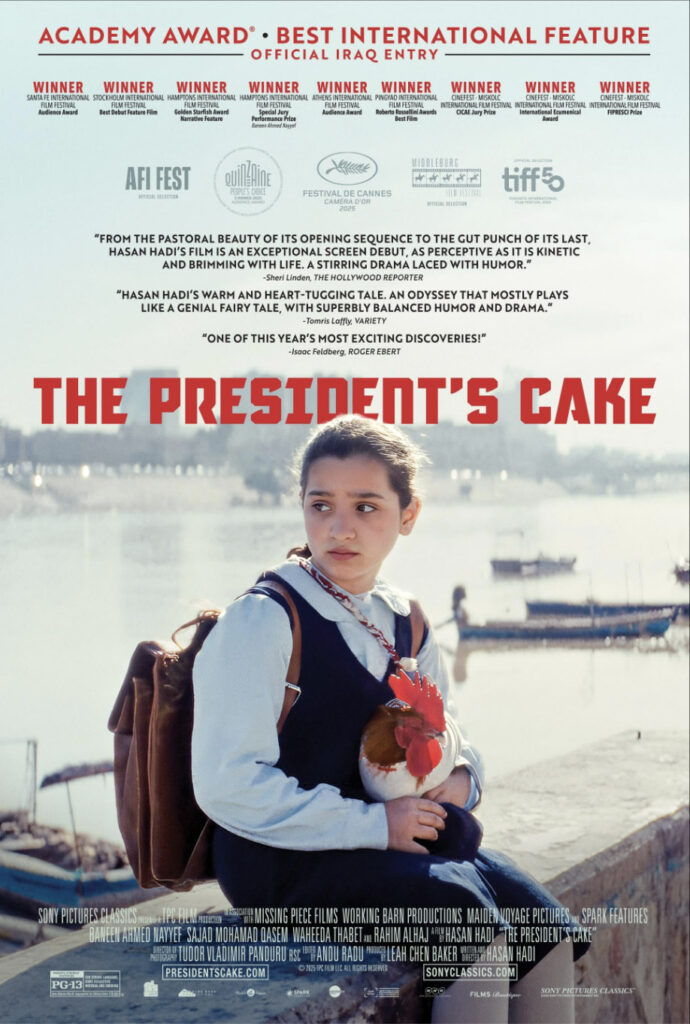
The President's Cake posterLamia does not begin her journey alone. She sets out with her Bibi (Waheed Thabet Khreibat), or grandmother, who is her caretaker, along with her beloved rooster, Hindi. The elderly woman is bent by age, visibly worn down by deprivation that clings to everything in this landscape. Soon, the journey becomes too much for her. Bibi, herself an embodied casualty of the sanctions, is slowly exhausted by scarcity and physical strain, leaving Lamia to continue on her quest.

Streaming in and out of Lamia’s serpentine mission are a diverse array of characters, including her mischievous classmate Saeed (Sajad Mohamad Qasem) and a charismatic taxi driver (played by Iraqi American musician Rahim AlHaj). What follows is an arduous, often absurd odyssey through villages, waterways, markets, and shadowed alleys as Lamia attempts to gather the ingredients she needs. The stress of the task far outweighs its logic. That imbalance is the point.

At moments when the weight becomes overwhelming, Lamia and Saeed retreat into a simple staring game — locking eyes, daring the other to blink. These exchanges are small but profound. They pull the children briefly into the present, offering a fleeting escape from a system determined to erase childhood altogether. It’s a quiet act of resistance: play as survival.

And looming over every step of this journey is Saddam Hussein himself. His image is omnipresent — staring down from posters, murals, billboards, paintings, and classroom walls that function as spaces of indoctrination. His face watches, judges, demands. Even the landscape bears his mark. The marshlands where the film is shot — lush, watery, and visually stunning — were systematically drained and destroyed by Saddam because they did not support his rule. The choice of location is not incidental. The land itself becomes a quiet rebuke.

The story is inspired by Hadi’s own childhood, when a male classmate was assigned to make Saddam’s cake. At a recent screening of the film, Hadi revealed that his choice to center the film instead on a young girl was both a creative and political decision. Hadi, who grew up surrounded by women, said he felt girls and women absorbed an inordinate share of the sanctions’ daily toll. While men were often away at war or work, women bore the weight of scarcity at home — managing survival with fewer resources.

Before he told Lamia’s tale, Hadi endured a journey of his own, shaped by a different system of power. Accepted to NYU’s film program, his dream was initially derailed when Iraq was placed on the U.S. travel ban list. Even after Iraq was removed, his visa applications were repeatedly denied. On what he was told was his final attempt, the visa was approved — but the uncertainty didn’t end there. Upon landing in the United States, he had to make it through U.S. Customs, which was no sure thing. He was taken aside into a room, where a customs officer noticed he was headed to film school and asked him if he liked Martin Scorsese (an NYU film grad). A nervous Hadi said he paused, wondering if it was a trick question, and then said yes. Only then was he waved through.

Hadi attended NYU and wrote the script for The President’s Cake during the pandemic. After graduating, he asked his classmate Leah Chen Baker to produce his debut feature. The film would go on to win the Caméra d’Or at the Cannes Film Festival — the first major international film award ever won by Iraq. It is also Iraq’s official submission for the 98th Academy Awards. The film is produced by Leah Chen Baker and Eric Roth (Forrest Gump), Marielle Heller (A Beautiful Day in the Neighborhood), and Chris Columbus (Home Alone).

Hadi’s film-school roots are visible throughout the film in subtle, affectionate nods to cinema history. A red balloon floats through the film — an unmistakable homage to Albert Lamorisse’s The Red Balloon. The stark realism, quest storyline, and authenticity of the acting recalls Vittorio De Sica’s neorealist classic Bicycle Thieves, which Hadi revealed was an influence. The film also carries a Chaplinesque absurdity that transforms bureaucracy into farce and survival into dark comedy. These references never feel academic. They’re woven into the fabric of the story, reinforcing the idea that cinema itself can be a form of resistance.

In the neorealist tradition, Hadi cast entirely non-actors, many of them children, whose performances feel unvarnished and immediate. Several are so magnetic and compelling they threaten to steal the film outright. At the center of it is Nayyef as Lamia, who is a revelation. Her face — resolute, expressive —carries every nuance of emotion, from delight to despair, fear to frustration, pain to quiet defiance.

Romanian cinematographer Tudor Vladimir Panduru (Graduation, R.M.N.) works wonders with limited resources. With only four meters of dolly track, the crew engineered shots through ingenuity rather than scale, even fabricating equipment when none was available. At night, boats glide magically down shimmering waterways. In cramped streets, the camera acts as both observer and participant. Flowing through the film is a spellbinding atmospheric soundscape incorporating traditional Iraqi music, credited to sound designer Tamás Zányi and musician AlHaj.

The film ends with archival video footage of Saddam Hussein celebrating his birthday — smiling, surrounded by abundance. Fiction collapses into reality. The cruelty of the system is no longer implied; it is documented. The contrast of the sycophantic party with Lamia’s struggle is both shocking and maddening.

But what gives The President’s Cake its power is restraint. It does not sermonize. It trusts the audience to connect the dots. In doing so, it dismantles stereotypes about Iraq while pulling no punches. It shows life as it was lived: complex, absurd, beautiful, and cruel all at once.

Set in 1991, the film resonates far beyond its historical moment. The mechanics of control it depicts — loyalty tests disguised as civic duty, scarcity weaponized against the vulnerable, obedience enforced through fear — are not relics of the past. Around the world today, authoritarianism tightens its grip not always through spectacle, but through the quiet erosion of choice and dignity.

By filtering tyranny through the eyes of a child, The President’s Cake reminds us how early these systems begin their work, and how deeply they rely on ordinary people being forced to comply with absurdity to survive. By the time Lamia’s cake is finished, nothing about it feels celebratory, only revealing. In an era when strongmen once again demand to be adored and obeyed, the film stands as both memory and warning. It asks us to recognize how easily cruelty is normalized — and how often it begins by asking something small, and seemingly harmless, from those most vulnerable and least able to refuse.
Alex Demyanenko

Alex Demyanenko is a journalist and television producer based in Los Angeles. He worked as a journalist/editor for ten years before moving into television, where he has spent more than 25 years producing documentaries and series. His feature gang documentary Bastards of... Read more
Join Our Community

TMR exists thanks to its readers and supporters. By sharing our stories and celebrating cultural pluralism, we aim to counter racism, xenophobia, and exclusion with knowledge, empathy, and artistic expression.

Learn more

RELATED

Film Reviews

An Impossible Task in The President’s Cake

6 FEBRUARY 2026 • By Alex Demyanenko
An Impossible Task in <em>The President’s Cake</em>
Theatre Reviews

Who Speaks for Iraq? A Review of Bengal Tiger at the Baghdad Zoo

23 JANUARY 2026 • By Nazli Tarzi
Who Speaks for Iraq? A Review of <em>Bengal Tiger at the Baghdad Zoo</em>
Book Reviews

Controlled Demolition: an Epistolary Review

16 JANUARY 2026 • By Lina Mounzer
<em>Controlled Demolition</em>: an Epistolary Review
Film Reviews

If You See Something—an Iraqi Film on Asylum

12 DECEMBER 2025 • By Alex Demyanenko
<em>If You See Something</em>—an Iraqi Film on Asylum
Book Reviews

Contemporary Kurdish Writers in the Diaspora

14 NOVEMBER 2025 • By Matt Broomfield
Contemporary Kurdish Writers in the Diaspora
Book Reviews

Myth and Migration in the Work of Dalia Al-Dujaili

6 NOVEMBER 2025 • By Noshin Bokth
Myth and Migration in the Work of Dalia Al-Dujaili
Book Reviews

Reading The Orchards of Basra

12 SEPTEMBER 2025 • By Jacob Wirtschafter
Reading <em>The Orchards of Basra</em>
Book Reviews

Hope Without Hope: Rojava and Revolutionary Commitment

11 JULY 2025 • By Arie Amaya-Akkermans
Hope Without Hope: Rojava and Revolutionary Commitment
Essays

Architecture and Political Memory

4 JULY 2025 • By Meriam Othman
Architecture and Political Memory
Essays

Israel is Today’s Sparta: Middle East Wars Viewed from Iraq

20 JUNE 2025 • By Hassan Abdulrazzak
Israel is Today’s Sparta: Middle East Wars Viewed from Iraq
Book Reviews

Hassan Blasim’s Sololand features Three Novellas on Iraq

25 APRIL 2025 • By Hassan Abdulrazzak
Hassan Blasim’s <em>Sololand</em> features Three Novellas on Iraq
Book Reviews

Frankenstein in Baghdad: A Novel for Our Present Dystopia

21 MARCH 2025 • By Deborah Williams
<em>Frankenstein in Baghdad</em>: A Novel for Our Present Dystopia
short story

Baxtyar Hamasur: “A Strand of Hair Shaped Like the Letter J”

7 FEBRUARY 2025 • By Baxtyar Hamasur, Jiyar Homer, Hannah Fox
Baxtyar Hamasur: “A Strand of Hair Shaped Like the Letter J”
Editorial

Animal Truths

1 NOVEMBER 2024 • By Malu Halasa
Animal Truths
Art & Photography

Lin May Saeed

1 NOVEMBER 2024 • By Arie Amaya-Akkermans
Lin May Saeed
Fiction

“Dear Sniper” — a short story by Ali Ramthan Hussein

6 SEPTEMBER 2024 • By Ali Ramthan Hussein, Essam M. Al-Jassim
“Dear Sniper” — a short story by Ali Ramthan Hussein
Essays

Beyond Rubble — Cultural Heritage and Healing After Disaster

23 AUGUST 2024 • By Arie Amaya-Akkermans
Beyond Rubble — Cultural Heritage and Healing After Disaster
Essays

SPECIAL KURDISH ISSUE: From Kurmanji to English, an Introduction to Selim Temo

9 AUGUST 2024 • By Zêdan Xelef
SPECIAL KURDISH ISSUE: From Kurmanji to English, an Introduction to Selim Temo
short story

“Ten-Armed Gods”—a short story by Odai Al Zoubi

5 JULY 2024 • By Odai Al Zoubi, Ziad Dallal
“Ten-Armed Gods”—a short story by Odai Al Zoubi
Fiction

“The Doll with the Purple Scarf”—flash fiction from Diaa Jubaili

5 JULY 2024 • By Diaa Jubaili, Chip Rossetti
“The Doll with the Purple Scarf”—flash fiction from Diaa Jubaili
Art

Demarcations of Identity: Rushdi Anwar

10 MAY 2024 • By Malu Halasa
Demarcations of Identity: Rushdi Anwar
Editorial

Why FORGETTING?

3 MAY 2024 • By Malu Halasa, Jordan Elgrably
Why FORGETTING?
Essays

Regarding the Photographs of Others—An Iraqi Journey Toward Remembering

3 MAY 2024 • By Nabil Salih
Regarding the Photographs of Others—An Iraqi Journey Toward Remembering
Fiction

“The Waiting Bones”—an essay by Maryam Haidari

3 DECEMBER 2023 • By Maryam Haidari, Salar Abdoh
“The Waiting Bones”—an essay by Maryam Haidari
Essays

“My Father’s Last Meal”—a Kurdish Tale

28 NOVEMBER 2023 • By Dilan Qadir
“My Father’s Last Meal”—a Kurdish Tale
Book Reviews

First Kurdish Sci-Fi Collection is Rooted in the Past

28 NOVEMBER 2023 • By Matt Broomfield
First Kurdish Sci-Fi Collection is Rooted in the Past
Opinion

Gaza vs. Mosul from a Medical and Humanitarian Standpoint

27 NOVEMBER 2023 • By Ahmed Twaij
Gaza vs. Mosul from a Medical and Humanitarian Standpoint
Art & Photography

Middle Eastern Artists and Galleries at Frieze London

23 OCTOBER 2023 • By Sophie Kazan Makhlouf
Middle Eastern Artists and Galleries at Frieze London
Fiction

“My Rebellious Feet”—a story by Diary Marif

23 OCTOBER 2023 • By Diary Marif
“My Rebellious Feet”—a story by Diary Marif
Poetry

Home: New Arabic Poems in Translation

11 OCTOBER 2023 • By Sarah Coolidge
<em>Home</em>: New Arabic Poems in Translation
Poetry

Albanian Poet Luljeta Lleshanaku

11 OCTOBER 2023 • By Luljeta Lleshanaku
Albanian Poet Luljeta Lleshanaku
Theatre

Hartaqât: Heresies of a World with Policed Borders

9 OCTOBER 2023 • By Nada Ghosn
<em>Hartaqât</em>: Heresies of a World with Policed Borders
Essays

September 11, 1973 and Ariel Dorfman’s The Suicide Museum

3 SEPTEMBER 2023 • By Francisco Letelier
September 11, 1973 and Ariel Dorfman’s <em>The Suicide Museum</em>
Book Reviews

On Museums and the Preservation of Cultural Heritage

21 AUGUST 2023 • By Arie Amaya-Akkermans
On Museums and the Preservation of Cultural Heritage
Book Reviews

Can the Kurdish Women’s Movement Transform the Middle East?

31 JULY 2023 • By Matt Broomfield
Can the Kurdish Women’s Movement Transform the Middle East?
Film Reviews

A Deaf Boy’s Quest to Find His Voice in a Hearing World

24 JULY 2023 • By Nazli Tarzi
A Deaf Boy’s Quest to Find His Voice in a Hearing World
Book Reviews

Why Isn’t Ghaith Abdul-Ahad a Household Name?

10 JULY 2023 • By Iason Athanasiadis
Why Isn’t Ghaith Abdul-Ahad a Household Name?
Fiction

“The Long Walk of the Martyr”—fiction from Salar Abdoh

2 JULY 2023 • By Salar Abdoh
“The Long Walk of the Martyr”—fiction from Salar Abdoh
Book Reviews

Wounded Tigris: A River Journey Through the Cradle of Civilisation

12 JUNE 2023 • By Nazli Tarzi
<em>Wounded Tigris: A River Journey Through the Cradle of Civilisation</em>
Islam

From Pawns to Global Powers: Middle East Nations Strike Back

29 MAY 2023 • By Chas Freeman, Jr.
From Pawns to Global Powers: Middle East Nations Strike Back
Book Reviews

The Yellow Birds Author Returns With Iraq War/Noir Mystery

29 MAY 2023 • By Hamilton Cain
<em>The Yellow Birds</em> Author Returns With Iraq War/Noir Mystery
Film

Hanging Gardens and the New Iraqi Cinema Scene

27 MARCH 2023 • By Laura Silvia Battaglia
<em>Hanging Gardens</em> and the New Iraqi Cinema Scene
Columns

Tiba al-Ali: A Death Foretold on Social Media

5 FEBRUARY 2023 • By Malu Halasa
Tiba al-Ali: A Death Foretold on Social Media
Featured excerpt

Fiction: Inaam Kachachi’s The Dispersal, or Tashari

5 FEBRUARY 2023 • By Inaam Kachachi
Fiction: Inaam Kachachi’s <em>The Dispersal</em>, or <em>Tashari</em>
Centerpiece

Iraqi Diaspora Playwrights Hassan Abdulrazzak & Jasmine Naziha Jones: Use Your Anger as Fuel

5 FEBRUARY 2023 • By Hassan Abdulrazzak, Jasmine Naziha Jones
Iraqi Diaspora Playwrights Hassan Abdulrazzak & Jasmine Naziha Jones: Use Your Anger as Fuel
Art

Lahib Jaddo—An Iraqi Artist in the Diaspora

5 FEBRUARY 2023 • By Mischa Geracoulis
Lahib Jaddo—An Iraqi Artist in the Diaspora
Interviews

Zahra Ali, Pioneer of Feminist Studies on Iraq

5 FEBRUARY 2023 • By Nada Ghosn
Zahra Ali, Pioneer of Feminist Studies on Iraq
Book Reviews

 The Watermelon Boys on Iraq, War, Colonization and Familial Love

5 FEBRUARY 2023 • By Rachel Campbell
<em> The Watermelon Boys</em> on Iraq, War, Colonization and Familial Love
Book Reviews

After Nine Years in Detention, an Iraqi is Finally Granted Asylum

22 AUGUST 2022 • By Rana Asfour
After Nine Years in Detention, an Iraqi is Finally Granted Asylum
Book Reviews

Questionable Thinking on the Syrian Revolution

1 AUGUST 2022 • By Fouad Mami
Questionable Thinking on the Syrian Revolution
Book Reviews

Leaving One’s Country in Mai Al-Nakib’s “An Unlasting Home”

27 JUNE 2022 • By Rana Asfour
Leaving One’s Country in Mai Al-Nakib’s “An Unlasting Home”
Columns

World Refugee Day — What We Owe Each Other

20 JUNE 2022 • By Jordan Elgrably
World Refugee Day — What We Owe Each Other
Fiction

Mai Al-Nakib: “Naaseha’s Counsel”

15 JUNE 2022 • By Mai Al-Nakib
Mai Al-Nakib: “Naaseha’s Counsel”
Featured excerpt

Hawra Al-Nadawi: “Tuesday and the Green Movement”

15 JUNE 2022 • By Hawra Al-Nadawi, Alice Guthrie
Hawra Al-Nadawi: “Tuesday and the Green Movement”
Interviews

Conversations on Food and Race with Andy Shallal

15 APRIL 2022 • By Jordan Elgrably
Conversations on Food and Race with Andy Shallal
Book Reviews

Abū Ḥamza’s Bread

15 APRIL 2022 • By Philip Grant
Abū Ḥamza’s Bread
Art

Artist Hayv Kahraman’s “Gut Feelings” Exhibition Reviewed

28 MARCH 2022 • By Melissa Chemam
Artist Hayv Kahraman’s “Gut Feelings” Exhibition Reviewed
Book Reviews

Nadia Murad Speaks on Behalf of Women Heroes of War

7 MARCH 2022 • By Maryam Zar
Nadia Murad Speaks on Behalf of Women Heroes of War
Columns

“There’s Nothing Worse Than War”

24 FEBRUARY 2022 • By Jordan Elgrably
“There’s Nothing Worse Than War”
Art

(G)Hosting the Past: On Michael Rakowitz’s “Reapparitions”

7 FEBRUARY 2022 • By Arie Amaya-Akkermans
(G)Hosting the Past: On Michael Rakowitz’s “Reapparitions”
Editorial

Refuge, or the Inherent Dignity of Every Human Being

15 JANUARY 2022 • By Jordan Elgrably
Refuge, or the Inherent Dignity of Every Human Being
Art & Photography

Children in Search of Refuge: a Photographic Essay

15 JANUARY 2022 • By Iason Athanasiadis
Children in Search of Refuge: a Photographic Essay
Columns

Getting to the Other Side: a Kurdish Migrant Story

15 JANUARY 2022 • By Iason Athanasiadis
Getting to the Other Side: a Kurdish Migrant Story
Film Reviews

“Europa,” Iraq’s Entry in the 94th annual Oscars, Frames Epic Refugee Struggle

15 JANUARY 2022 • By Thomas Dallal
“Europa,” Iraq’s Entry in the 94th annual Oscars, Frames Epic Refugee Struggle
Columns

An Arab and a Jew Walk into a Bar…

15 DECEMBER 2021 • By Hadani Ditmars
An Arab and a Jew Walk into a Bar…
Book Reviews

The Vanishing: Are Arab Christians an Endangered Minority?

15 NOVEMBER 2021 • By Hadani Ditmars
The Vanishing: Are Arab Christians an Endangered Minority?
Essays

A Street in Marrakesh Revisited

8 NOVEMBER 2021 • By Deborah Kapchan
A Street in Marrakesh Revisited
Art

Guantánamo—The World’s Most Infamous Prison

15 OCTOBER 2021 • By Sarah Mirk
<em>Guantánamo</em>—The World’s Most Infamous Prison
Essays

Why Resistance Is Foundational to Kurdish Literature

15 SEPTEMBER 2021 • By Ava Homa
Why Resistance Is Foundational to Kurdish Literature
Featured excerpt

The Harrowing Life of Kurdish Freedom Activist Kobra Banehi

15 SEPTEMBER 2021 • By Kobra Banehi, Jordan Elgrably
The Harrowing Life of Kurdish Freedom Activist Kobra Banehi
Columns

Afghanistan Falls to the Taliban

16 AUGUST 2021 • By Hadani Ditmars
Afghanistan Falls to the Taliban
Weekly

World Picks: August 2021

12 AUGUST 2021 • By Lawrence Joffe
World Picks: August 2021
Weekly

Summer of ‘21 Reading—Notes from the Editors

25 JULY 2021 • By TMR
Summer of ‘21 Reading—Notes from the Editors
Book Reviews

ISIS and the Absurdity of War in the Age of Twitter

4 JULY 2021 • By Jessica Proett
ISIS and the Absurdity of War in the Age of Twitter
Weekly

World Picks: July 2021

3 JULY 2021 • By TMR
World Picks: July 2021
TMR 7 • Truth?

Truth or Dare? Reinterpreting Al-Harīrī’s Arab Rogue

14 MARCH 2021 • By Farah Abdessamad
Truth or Dare? Reinterpreting Al-Harīrī’s Arab Rogue
TMR 7 • Truth?

Poetry Against the State

14 MARCH 2021 • By Gil Anidjar
Poetry Against the State
Columns

The Truth About Iraq: Memory, Trauma and the End of an Era

14 MARCH 2021 • By Hadani Ditmars
The Truth About Iraq: Memory, Trauma and the End of an Era
TMR 5 • Water

Watch Water Films & Donate to Water Organizations

16 JANUARY 2021 • By TMR
Watch Water Films & Donate to Water Organizations
TMR 5 • Water

Iraq and the Arab World on the Edge of the Abyss

14 JANUARY 2021 • By Osama Esber
Iraq and the Arab World on the Edge of the Abyss
Columns

On American Democracy and Empire, a Corrective

14 JANUARY 2021 • By I. Rida Mahmood
On American Democracy and Empire, a Corrective
TMR 4 • Small & Indie Presses

Hassan Blasim’s “God 99”

14 DECEMBER 2020 • By Hassan Blasim
Hassan Blasim’s “God 99”
Weekly

Kuwait’s Alanoud Alsharekh, Feminist Groundbreaker

6 DECEMBER 2020 • By Nada Ghosn
Kuwait’s Alanoud Alsharekh, Feminist Groundbreaker
World Picks

World Art, Music & Zoom Beat the Pandemic Blues

28 SEPTEMBER 2020 • By Malu Halasa
World Art, Music & Zoom Beat the Pandemic Blues
World Picks

Interlink Proposes 4 New Arab Novels

22 SEPTEMBER 2020 • By TMR
Interlink Proposes 4 New Arab Novels

Leave a Comment

Your email address will not be published. Required fields are marked *

four × two =

Scroll to Top