Select Other Languages Français.
In this Cannes-winning debut, writer/director Hasan Hadi filters authoritarian cruelty through childhood, revealing how power embeds itself in daily life.
The President’s Cake opens on an Iraq we’re not conditioned to recognize. Dusk reflects in water like something sacred. Marshes stretch toward the horizon, palm trees silhouetted against a sinking sun, meshoofs gliding quietly through reeds. It’s calm, it’s beautiful, it doesn’t resemble the Iraq of news footage or political shorthand. And that is precisely the point: Iraqi filmmaker Hasan Hadi’s stellar debut feature begins by reminding us that suffering doesn’t always announce itself. Sometimes it hides behind beauty, waiting for the moment when power makes its demands.
That moment arrives abruptly. The serenity of the marshes is shattered by the scorching roar of military jets streaming across the sky. The film understands that ugliness rarely looks the way we expect it to. Often, it intrudes suddenly, violently, into the everyday.
There is a particular kind of cruelty that only authoritarian systems perfect: the ability to turn the most innocent task into a test of loyalty, fear, and survival. The President’s Cake understands this instinctively. What begins as a child’s classroom assignment — to bake a cake in honor of Saddam Hussein’s birthday — slowly reveals itself as something far more insidious: a quiet, grinding lesson in how power reaches into every corner of daily life, and how the most vulnerable are so often the ones made to carry its weight.
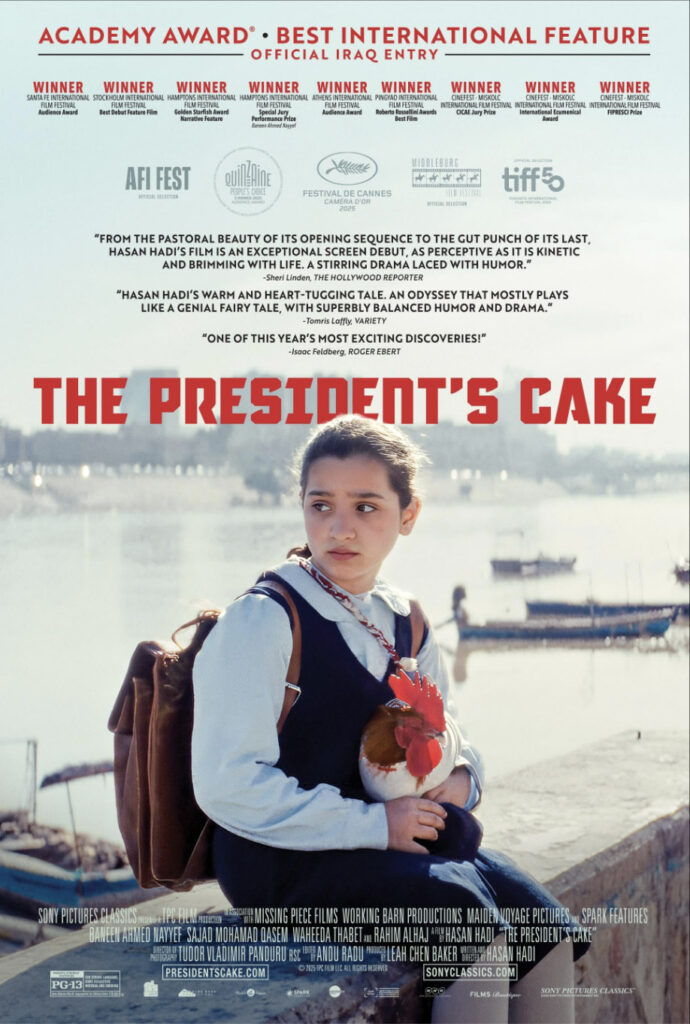
The film follows nine-year-old Lamia (Baneen Ahmad Nayyef), a young girl living in southern Iraq in 1991, during the height of international sanctions against Saddam’s regime. In her classroom, children are randomly assigned tasks to honor the President Saddam Hussein’s upcoming birthday. One must bring flowers. Another fruit. Lamia is given the most impossible burden of all: she must bake a cake in a country where flour, eggs, sugar — even fresh water, medicine, and fuel — have become scarce.
This is not merely a logistical challenge; it is a loyalty test disguised as civic duty. The assignment is absurd, but the consequences of failure are not. The film understands how totalitarian systems weaponize the banal, turning obedience into ritual and ritual into fear.
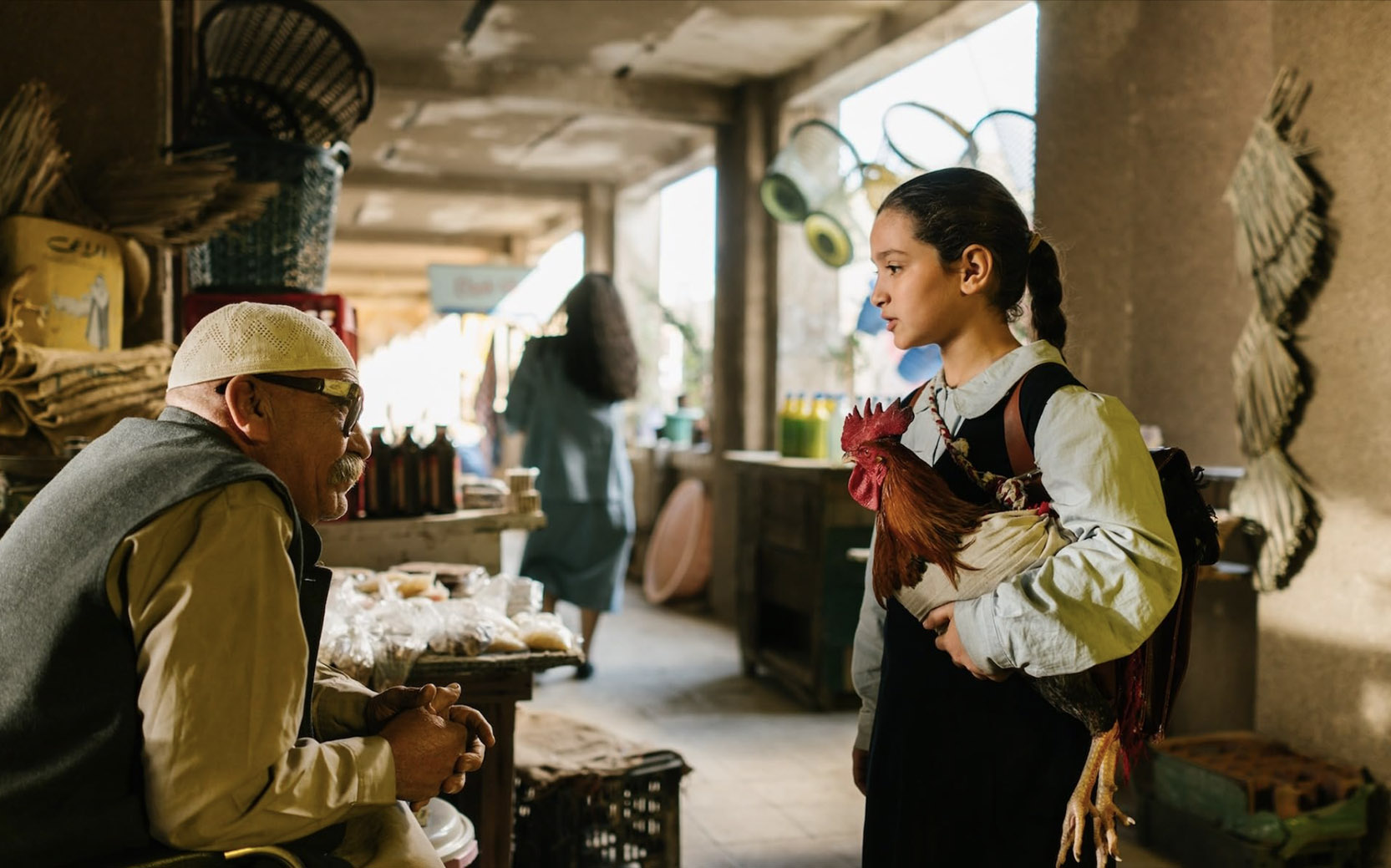
 Lamia does not begin her journey alone. She sets out with her Bibi (Waheed Thabet Khreibat), or grandmother, who is her caretaker, along with her beloved rooster, Hindi. The elderly woman is bent by age, visibly worn down by deprivation that clings to everything in this landscape. Soon, the journey becomes too much for her. Bibi, herself an embodied casualty of the sanctions, is slowly exhausted by scarcity and physical strain, leaving Lamia to continue on her quest.
Streaming in and out of Lamia’s serpentine mission are a diverse array of characters, including her mischievous classmate Saeed (Sajad Mohamad Qasem) and a charismatic taxi driver (played by Iraqi American musician Rahim AlHaj). What follows is an arduous, often absurd odyssey through villages, waterways, markets, and shadowed alleys as Lamia attempts to gather the ingredients she needs. The stress of the task far outweighs its logic. That imbalance is the point.
At moments when the weight becomes overwhelming, Lamia and Saeed retreat into a simple staring game — locking eyes, daring the other to blink. These exchanges are small but profound. They pull the children briefly into the present, offering a fleeting escape from a system determined to erase childhood altogether. It’s a quiet act of resistance: play as survival.
And looming over every step of this journey is Saddam Hussein himself. His image is omnipresent — staring down from posters, murals, billboards, paintings, and classroom walls that function as spaces of indoctrination. His face watches, judges, demands. Even the landscape bears his mark. The marshlands where the film is shot — lush, watery, and visually stunning — were systematically drained and destroyed by Saddam because they did not support his rule. The choice of location is not incidental. The land itself becomes a quiet rebuke.
The story is inspired by Hadi’s own childhood, when a male classmate was assigned to make Saddam’s cake. At a recent screening of the film, Hadi revealed that his choice to center the film instead on a young girl was both a creative and political decision. Hadi, who grew up surrounded by women, said he felt girls and women absorbed an inordinate share of the sanctions’ daily toll. While men were often away at war or work, women bore the weight of scarcity at home — managing survival with fewer resources.
Before he told Lamia’s tale, Hadi endured a journey of his own, shaped by a different system of power. Accepted to NYU’s film program, his dream was initially derailed when Iraq was placed on the U.S. travel ban list. Even after Iraq was removed, his visa applications were repeatedly denied. On what he was told was his final attempt, the visa was approved — but the uncertainty didn’t end there. Upon landing in the United States, he had to make it through U.S. Customs, which was no sure thing. He was taken aside into a room, where a customs officer noticed he was headed to film school and asked him if he liked Martin Scorsese (an NYU film grad). A nervous Hadi said he paused, wondering if it was a trick question, and then said yes. Only then was he waved through.
Hadi attended NYU and wrote the script for The President’s Cake during the pandemic. After graduating, he asked his classmate Leah Chen Baker to produce his debut feature. The film would go on to win the Caméra d’Or at the Cannes Film Festival — the first major international film award ever won by Iraq. It is also Iraq’s official submission for the 98th Academy Awards. The film is produced by Leah Chen Baker and Eric Roth (Forrest Gump), Marielle Heller (A Beautiful Day in the Neighborhood), and Chris Columbus (Home Alone).
Hadi’s film-school roots are visible throughout the film in subtle, affectionate nods to cinema history. A red balloon floats through the film — an unmistakable homage to Albert Lamorisse’s The Red Balloon. The stark realism, quest storyline, and authenticity of the acting recalls Vittorio De Sica’s neorealist classic Bicycle Thieves, which Hadi revealed was an influence. The film also carries a Chaplinesque absurdity that transforms bureaucracy into farce and survival into dark comedy. These references never feel academic. They’re woven into the fabric of the story, reinforcing the idea that cinema itself can be a form of resistance.
In the neorealist tradition, Hadi cast entirely non-actors, many of them children, whose performances feel unvarnished and immediate. Several are so magnetic and compelling they threaten to steal the film outright. At the center of it is Nayyef as Lamia, who is a revelation. Her face — resolute, expressive —carries every nuance of emotion, from delight to despair, fear to frustration, pain to quiet defiance.
Romanian cinematographer Tudor Vladimir Panduru (Graduation, R.M.N.) works wonders with limited resources. With only four meters of dolly track, the crew engineered shots through ingenuity rather than scale, even fabricating equipment when none was available. At night, boats glide magically down shimmering waterways. In cramped streets, the camera acts as both observer and participant. Flowing through the film is a spellbinding atmospheric soundscape incorporating traditional Iraqi music, credited to sound designer Tamás Zányi and musician AlHaj.
The film ends with archival video footage of Saddam Hussein celebrating his birthday — smiling, surrounded by abundance. Fiction collapses into reality. The cruelty of the system is no longer implied; it is documented. The contrast of the sycophantic party with Lamia’s struggle is both shocking and maddening.
But what gives The President’s Cake its power is restraint. It does not sermonize. It trusts the audience to connect the dots. In doing so, it dismantles stereotypes about Iraq while pulling no punches. It shows life as it was lived: complex, absurd, beautiful, and cruel all at once.
Set in 1991, the film resonates far beyond its historical moment. The mechanics of control it depicts — loyalty tests disguised as civic duty, scarcity weaponized against the vulnerable, obedience enforced through fear — are not relics of the past. Around the world today, authoritarianism tightens its grip not always through spectacle, but through the quiet erosion of choice and dignity.
By filtering tyranny through the eyes of a child, The President’s Cake reminds us how early these systems begin their work, and how deeply they rely on ordinary people being forced to comply with absurdity to survive. By the time Lamia’s cake is finished, nothing about it feels celebratory, only revealing. In an era when strongmen once again demand to be adored and obeyed, the film stands as both memory and warning. It asks us to recognize how easily cruelty is normalized — and how often it begins by asking something small, and seemingly harmless, from those most vulnerable and least able to refuse.
Select Other Languages Français.