Stricken by mysterious numbness on a trip to her homeland, a writer wonders: could an attempt at establishing an autonomous identity be the cause?
On a film scout in Istanbul, Turkey, one year ago, my body suddenly fell numb. Beginning in the lower back, the numbness spidered outward, creeping down my left leg and crawling all the way up to my left cheek. Left side. Left cheek. Was I, at that moment in the middle of Bebek, surrounded by seagulls dancing around balik ekmek sellers, having a stroke? The numbness however, was not persistent or debilitating. It instead struck at different intervals, cleverly avoiding a traceable pattern. Akin to a neurological enigma described in Oliver Sacks’ case studies, my rational mind sought causation; my fingers became vehicles of reassurance, perpetually touching my body all over, again and again, adamant to feel sensation for fear of losing it forever.
My stomach, chest, legs all suddenly felt foreign. It was as if my body had instilled a pristine layer of defense to shield me from an exterior enemy. A voice of reason diagnosed this left-sided numbness as no more than a symptom of fatigue from a month of traveling to European film festivals. A body broken and spent from trekking through the icy hills of Clermont-Ferrand and the mounds of snow sheathing the theaters at the Berlinale. My circulation was off. Too much alcohol, too many cigarettes pulsed through my veins. Who wouldn’t crash? Unfortunately, cold hard facts are not the determinate source of reasoning in my family tree. I come from a family who believes in nazar, in jinn, in forces in direct contrast to the rational mind. We are but mere puppets in a predetermined destiny set forth by Allah and his associates.
I couldn’t shake the suspicion that my numbness was tied to my trip to Istanbul. I was no stranger to the city, having spent years visiting my mother’s hometown, and specifically my grandmother’s fourth-floor apartment in Bostanci, overlooking the Anatolian side of the Bosphorus. But this trip was different from prior family vacations; I was there on covert business, that is, I was there to scout locations for a film. I didn’t tell my family: The lack of time, and more so the lack of emotional bandwidth, justified my decision to remain silent about my presence in their city. In my thirty-four years, I had never been to Turkey without my family. I had never stayed at an apartment that wasn’t theirs. I had never had an identity outside their auspices. Their Istanbul was my Istanbul.
Could my attempt at establishing an autonomous identity be the cause of my numbness? I thought of Rose’s mysterious paralysis in Deborah Levy’s novel, Hot Milk — rooted not in medical reasoning, but unprocessed familial trauma.
I am no stranger to physical ailments. My earliest childhood memories are not of sun-kissed family vacations or beloved anthropomorphized toys, but rather a scrapbook of hospital beds, ventilators, and flashes of my father carrying Hala Teyse like a baby to the washroom to change her colonoscopy bag. Hala, my grandfather’s eldest sister, lived in Ravenna, Ohio — a detail relevant only because of the distinct American landmarks nestled en route to their apartment: Sea World and Big Boy’s diner. My younger sister and I bargained for stopovers there once we were old enough to understand the value of giving up our coveted Saturdays. We got strawberry waffles topped with Cool Whip, with a side of Betty Boop’s heaving bust. An amuse bouche to Hala’s Teyse’s cable TV, a luxury in 1998 to us Nickelodeon addicts. Mr. Crabs flipped Crabby Patties as Hala Teyse sucked on her oxygen tube in the background, occasionally spouting confused lore in Turkish; a final grasp at an identity long lost.
Trapped in an American suburb, daytime soap operas drip-fed her English while she fed me Turkish.
I owe my American existence to Hala Teyse, the first to escape her once-Ottoman, now-Greek village on the island of Kos. Wooed by the promise of exchanging a rural life tending olive groves for a job at a Good Year Tire factory — labor that would later earn her American Dollar bills and a middle-class ranch-style home in Akron, Ohio — my grandfather and grandmother soon followed her across the ocean to build their own lives in this foreign land. How far the Mediterranean vines must have felt as Hala Teyse and my grandfather filled their lungs with factory debris and pined for the food from their homeland.
Years later, my father, an American-born Turk, would find himself split between two worlds — the drive-in hamburger joint and marching-band Midwest of his soul, vs. the romanticized terroir of his ancestors. He chose the latter, taking on the burden of the eldest son to carry on the family lineage, and married a woman from a country more distant than he realized.
As for my Istanbul-born mother: at nineteen, in an effort to free herself from a life dominated by the societal strictures of womanhood, she married my father and replaced one sort of confinement with another. Trapped in an American suburb, daytime soap operas like As the World Turns drip-fed her English while she fed me Turkish. My first language, my mother tongue. First born, I was my mother’s only companion during those early years of her isolation in suburban farmland while my father took our one family car for hours on end for work. Long distance phone calls were cost prohibitive in the early 1990s, so during her initial years of motherhood, it was just us. I absorbed her stories of a not-so-long-ago youth, inflected with sadness over the loss of her home and identity.
During my first few years, I was inundated with, and subsequently spoke in, a torrent of bilingualism. I spoke Turkish to my mother and English to my father. Then, one day, without warning, a choking stutter seized my words. I could no longer speak. Words bottlenecked in my larynx, resisting release. My body responded with mute panic — jaw widening like a Nutcracker, feet stomping, chest heaving — an amalgamation of desperate, unuttered cries for language.
Concerned at their formerly chatty daughter’s ominous ailment, my parents responded in accordance with their dispositions and cultures: my mother tying a nazar bracelet around my wrist, my father seeking medical advice. My speech pathologist’s office was located in a pocket of downtown Cleveland, defined by 1980s gray-brown office buildings built for stoic utility rather than charm. The only upside to those visits was the gyro cart outside. I swallowed my fries as determinedly as I did my words. The therapist suggested a prognosis of “linguistic confusion,” gravely warning of a permanent stutter if my parents didn’t “pick a language.” Out went Turkish. “We lived in America,” after all. What followed was a forced separation from my mother tongue, a strange purgatory that persists to this day. I understand Turkish fluently, but when I open my mouth to speak, the words cannot be summoned. Everything I know of Turkish is padded in warmth, in intimacy. Although it is only in English that I can express myself fluently, accurately, honestly, it is in Turkish that I express myself artistically and emotionally.
Any language is accompanied by a bespoke personality within it, and this feels especially true of Turkish and English. Turkish is a hyperbolized and funny language, less structured and formal than English. The very existence of the predominant mış tense — a tense of inference and hearsay — suggests a language constructed around gossip or rumor. Nothing that happens is entirely certain; everything is up for interpretation. And so the loss of my mother tongue and its replacement with English materially impacted my personality as a child, shaping the adult I would become. I became serious and brooding, inward-facing and secretive. Perhaps this was a way of attempting to preserve the Turkish self I had left, locking it away in a chest to prevent its total annihilation.
The practice of linguistic and therefore cultural repression is a distinct side effect of the Turkish republic: a nation molded by president Mustafa Kemal Atatürk in the aftermath of World War I. Fueled by his efforts to Westernize, or “modernize” the country — a country that in fact straddles two continents — the Turkish language itself came to reflect the State’s practices around silence and conformity. In her memoir of her time spent in Turkey, Notes on a Foreign Country: An American Abroad in a Post-American World, journalist Suzy Hansen describes the overnight eradication of Ottoman and Islamic influences. Men were banned from wearing fezes; hijab-wearing women precluded from attending schools. Traditional buildings were torn down in the capital city of Ankara and replaced with austere styles of the West. Overnight, a new language emerged; a reflection of the gaps and lacks imposed by the creation of an intended utopic nation. Modern Turkish reflects the Republic’s attempt to wash away Arabic influences and conform to a Latin-based patchwork of western tongues. Irrespective of the lack of western colonial rule, Turkish absorbed French words such as mersi “merci”; kuaför “coiffeur”; plaj “plage”; asansör “ascenseur”; kalite “qualité.” Through these governmental mechanisms of identity displacement and replacement, Turks were taught to forget and repress the wrongdoings of preceding and contemporary generations, irrespective of their scale.
The practice of linguistic and therefore cultural repression is a distinct side effect of the Turkish republic.
Everything is swept under the rug. But no matter how much you sweep, the debris remains, at risk of exposure. This entire dynamic seeps into familial settings, going beyond political agendas and creating a family life constructed around a duality of identity, separating the private from the public. Any intersection of the two is discouraged. Psychologist Carl Jung first described this duality in his theory around the shadow — the inner, unconscious self that is repressed when it is perceived to be at odds with the public-presenting self. And so, when a society is that invested in a separation between its modern public face and the intimate memories of what it once was… how does this manifest in the mental and physical well-being of its people?
In my mid-twenties, my mother suffered a mental breakdown of sorts. For weeks on end, she went through a succession of severe depressive spells. When she finally emerged from the fog, her hands trembled uncontrollably. She couldn’t regulate several of her motor movements, unable to zip zippers or twist doorknobs. Her left arm swung and twitched in rhythmic jolts. Her “condition” was diagnosed as early onset Parkinson’s — a neurological disorder linked to diminished dopamine production, the “mood” hormone. Though incurable, modern medicine has aided in regulating Parkinson’s symptoms through medication and the readjustment of dosage based on the level of dopamine secretion. I’ve found it notable that, during her day-to-day life in Cleveland, Ohio, my mother’s condition remains relatively stable. It is only when she returns to her motherland, to Istanbul, that the disease presents itself in full force, manipulating her limbs like a puppet master, swinging them from left to right as we stroll down the Bosphorus-adjacent boardwalk in Suadiye. The return to her homeland chokes her dopamine supply, and I can’t help but think of it as an unconscious response to the confrontation with a world no longer hers, or perhaps, with a self she sought to repress and bury.
My mother left Turkey so she could leave behind some of the constraints that held her back as a woman. In the U.S., her public-facing self could be free and open. But the cost of that was the burial of her intimate, familial, private self. Her shadow self had to be disappeared, only to begin coming out in these involuntary jerks of her body from time to time. A stutter of the body, not unlike my stutter of the tongue. Both our conditions could be response to a kind of cultural silencing.
The year I turned thirty coincided with the era of COVID-imposed stay-at-home orders. Restrained in my New York City apartment and isolated from cultural distraction, I was forced inward in more ways than one. I began to write. Prose and personal essays quickly evolved into film scripts and then films. Though my words flowed in English, their essence was rooted in Turkish. The bilingualism of my childhood began to seep back in as I unlocked my chest of memories, using what I found inside to build new worlds of my own. My characters and scenes were infused with stories from Hala Teyse, my grandparents, my mother. The Turkish side of me, listening in silence all these years, now wished to make itself heard. Gradually I found the text of my films naturally shifting: from solely English, then English and Turkish together.
Now, I write films solely in Turkish. This language, muted for so many years, began making up for lost time. Allowing myself the space to tap into these intimate pockets of my mind and soul resulted in an unexpected wave of early remembrances, and a reckoning with how they had molded my worldview. The length of time elapsed between the memory and its reflection gave me a startling sense of clarity that translated into a reimagined perspective. I began digging deeper into the link between mental and physical well-being, thinking about my mother and my extended family. Was it possible that a cultural ecosystem could be a causal force in illness? I took these learnings and transferred them into my art, gravitating towards themes of cultural trauma, particularly amongst Turkish women, and its mental, emotional, and physical impact on future generations.
For months after my scouting trip to Istanbul, the intermittent numbness on the left side of my body persisted. Reports from neurology EMGs and CAT scans proved inconclusive. Acupuncture, yoga, and meditation provided only temporary relief, often overruled by a nagging anxiety about my family’s history of ailments. Of course my time had come, I thought. Of course I was next in line on the chopping block. There was no dodging a predestined malady. All those hospital wards and curtain-drawn homes full of relatives too sick for their age, all pining in regret over past mistakes had taught me to expect the worst. Had I not been prepared for all this by Hala Teyse’s stories? No matter how far we journey, we cannot escape our ancestry. In Turkey, to exist is to feel a kind of heaviness. I thought of Tezer Özlü in her memoir, Cold Nights of Childhood, describing her forced confinement in mental hospitals and multiple rounds of electroshock therapy, a then-sanctioned antidote to her public revealing of her shadow. Her desire to speak her truth was quashed by a society too afraid to hear it. What will people say? You must be crazy.
Spurred on by my research, I resolved to marry the rational and emotional minds and engaged a Jungian therapist, Dr. W. She not only took seriously the link between the mental and physical, but also warned me of the risk of unresolved emotions and the physical damage they might do. The longer I repressed, ignored, rechanneled my anguish, the thicker the internal sludge would emulsify, gurgling from my subconscious, consuming the healthy parts of my physical being. Memories of my own past ailments resurfaced during our therapy; undiagnosed and unexplained physical manifestations from my mind that nevertheless mapped over significant material circumstances. Lower back pain that accompanied my year working in big law. Paralyzing vertigo commencing during COVID’s Omicron strain and reemerging each December thereafter. Migraine upon migraine upon migraine. A childhood stutter. Dr. W. debunked the theory of “linguistic confusion,” explaining that a stutter is not rooted in linguistics, but rather in anxiety. A mental suppression of speech. A combative persistence of a respective language suppressing the other. In the end, English won over Turkish, resulting in a form of “cultural suppression.”
What was the meaning behind these physical barriers to accessing my Turkish side? My childhood stutter and adult numbness — both mysterious physiological symptoms of attempts to inhabit an identity that proved resistant to my efforts. As children, our worldview is formulated by our parents through osmosis; their fears, joys, cautions become our own. To what extent were my ailments defenses against the melancholic tales of my family? Was this pining for a lost culture meant to serve as a warning to stay where I belonged, in America? After all, in America, to exist is to feel lightness.
I used my work to probe those old familial wounds. They had been carefully stitched, but not healed to extinction. The reintegration of Turkish into my work had been a gentle step forward, helping release the shadow so that I might encounter the person I’d once been. From the comfort of my New York City apartment, I’d been able to engage with the language on my terms; sprinkling phrases into my films but ultimately keeping it at arm’s length. My film scout to Istanbul, however, had represented a confrontation — a deliberate disobedience to the warnings of my ancestors. Like my mother’s dopamine suppression when she returns to Istanbul, I suspect the numbness was my body’s reaction to these unlocked emotions. Or perhaps a warning: Stay away from the land of sorrow.
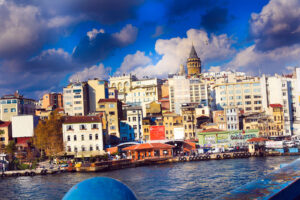
Eight months after the trip when the numbness had first appeared, lingering throughout that time, I found myself back in Istanbul, once again under artistic pretenses. This time, I stayed with my grandmother in her apartment by the Bosphorus and listened to her stories of the past. Was this why I found the trip so different? Or why I found myself so suddenly different? I experienced exceptional ease and confidence, both in the way I related to the city and to the language. I spent solitary days traversing Galata Bridge, riding back and forth on the Kadıköy ferry, and visiting various kıraathanes (backgammon houses), recording city sounds for a Turkish-language short film I had recently shot in Rome, Italy. Though at peace, I often felt sadness during those moments, a sadness I had known only through hearsay. Within the gray-blue skies and choppy waves edging toward the northern Black Sea, I saw the stories of a population with so much to say but without the vehicles to speak. This time, instead of shying away, or numbing myself to the pain of it, I leaned fully into the melancholy.
A few days after leaving Istanbul, I noticed the numbness had seemingly dissipated. Now, one year later, its presence has not returned. Another medical mystery archived, preparing me for what is to come. In a language driven by the mış tense, I have come to reconcile myself with the fact of the unknown.
Discover more art by Nevhiz.