Select Other Languages Français.
Singer-songwriter Amel Zen and the group Iwal choose to write and perform in Amazigh mother tongues, Dahri and Chaoui. These talented artists restore to Algeria its full cultural and linguistic diversity.
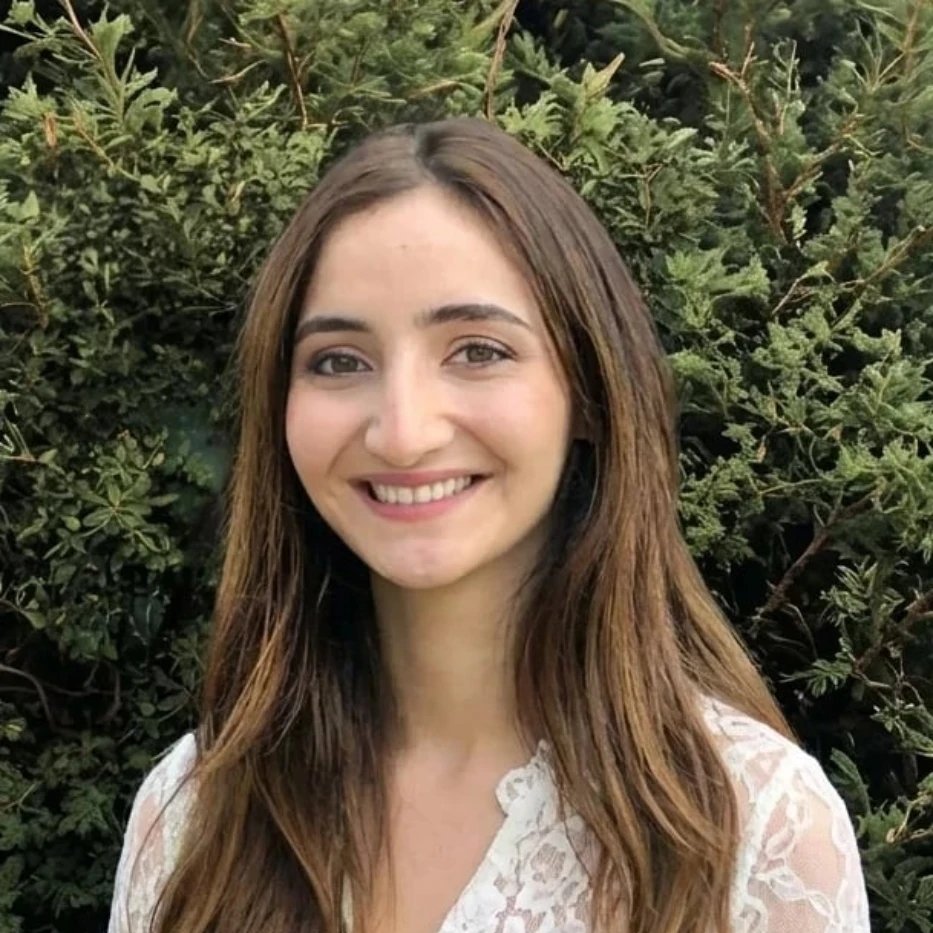
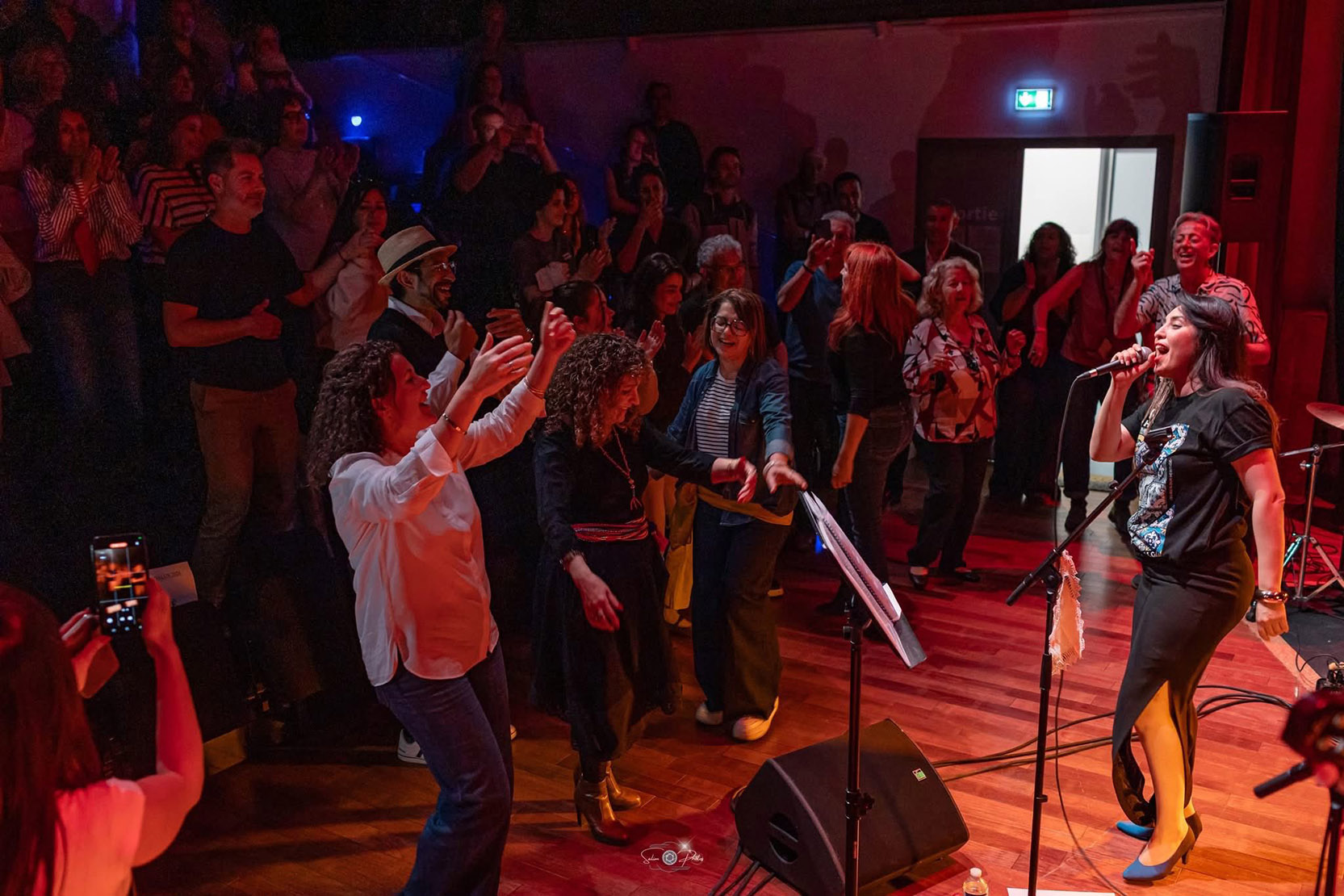
The pop-rock and world music artist singer-songwriter Amel Zen weaves her art across multiple languages, effortlessly traversing registers and fusing heritage with contemporary soundscapes. Her musical universe is both eclectic and universal, blending rock fusion, jazz, and the rich tones of North African and western musical traditions. Among the languages she nurtures, Dahri, a Tamazight variant spoken in the Dahra region, holds a profoundly intimate place. For Amel, singing in Dahri is not just a choice, it is a natural, instinctive expression of her inner self.
Far to the east, in the rugged landscapes of the Aurès, the group IWAL came into being. A duo, Nesrine and Fayssal share both life and stage, composing and performing primarily in Chaoui, Fayssal’s mother tongue. Their artistic endeavor, deeply personal, transforms language into a vessel for transmission, healing, and affirmation.
These young artists consciously give voice to languages often dismissed as “minority.” They persist in singing in Dahri or Chaoui, despite these idioms being little taught, seldom broadcast, and socially marginalized. For them, these tongues are far from peripheral relics — they are the primordial languages, the living threads that bind them to their roots, their history, and their cultural heritage.
Dahri: A Little-Known Language
Amel Zen’s earliest memories are inseparable from both a language and a place. As a child, every weekend she would leave Cherchell to spend time with her paternal grandmother, Nana, in Gouraya, on Algeria’s northern coast. There, Dahri was alive, natural, and tangible.
“My Nana didn’t speak a word of Darija or Arabic — only Dahri — and somehow, I understood her instinctively,” she recalls, describing a gentle, intimate transmission. “She spoke to my heart, to my soul, around the kanoun she lit every winter, telling me stories and enveloping me in her hugs.”

At Nana’s house, even the body seemed to regain freedom. “As soon as I arrived, I went barefoot,” Amel Zen remembers — a spontaneous gesture that connected her to the earth and to the neighborhood children. “The children I played with also spoke Dahri, and I learned the language alongside them.”
Over time, this intimate connection grew into a broader awareness. Dahri remains largely marginalized in dominant narratives. “I sing in a variant of Tamazight from the Dahra region, which I like to call Dahri,” she explains.
The naming of Dahri is deliberate: “Several names have been given to this variant — Tachanwit in Mount Chenoua, Taqvaylit in Gouraya and its surroundings. But the Dahra is much larger; it stretches from the heights of Blida, Tipaza, Cherchell, Gouraya, Ain Defla, Chlef, to Mostaganem. It was therefore necessary to include everyone under the geographic designation of Dahra, which excludes no one, just like Kabyle for Kabylie.”
For Amel Zen, Dahri is far more than a language to be sung. “It is my mother tongue, my heritage, a central part of my culture and of Algerian and North African history, still too little known.” In it, she finds foundational values, including “freedom and honor, a connection to the land, to family, to humanity.” Values she continues to carry and breathe life into through her art.
A Language Pushed to the Margins
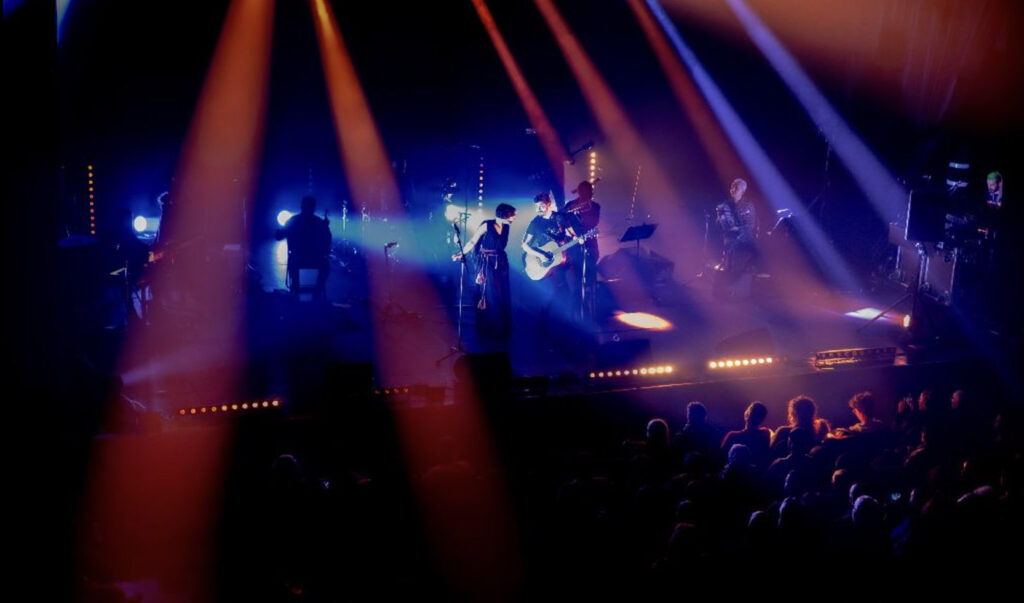
Like many Tamazight variants, Dahri has long been pushed to the margins. “Dahri remained far from dominant and official narratives. Admittedly, there hasn’t been much artistic production in this language, except in songs performed by the group Ichenwiyen in the 1970s and ‘80s, which left a mark and carried the language and style of Daynane. There was also Iyourayen in Gouraya, which enjoyed local success. Today, young artists continue to sing in Dahri, but they lack the resources and means to fully produce,” observes Amel Zen.
Public visibility is a recent phenomenon. It was only in 2009, with the creation of the national Amazigh channel (Channel 4), that Dahri appeared on television. Amel Zen witnessed this firsthand. “I hosted the very first musical program, Thimlilith, alongside the well-known presenter Riad Aberkane during the experimental phase.”
Yet recognition remains fragile. “Dahri is not sufficiently represented in national festivals as a distinct style, unlike Kabyle, Chaoui, or Targui.”
From an early age, Amel Zen understood that language carries political and identity weight. She recalls the disparaging narratives that marked her childhood. “I heard some city-dwellers denigrate Tamazight, claiming the Amazigh were uncivilized mountaineers, while only families descended from Turks were considered the city’s nobles.” She rejected this view immediately. “It made me furious, and I spoke out even more to prove them wrong. I found it unjust, unfounded, and discriminatory. Even as a child, I knew I had to excel in everything to show that being Amazigh means being free, strong, intelligent, and civilized.”
For her, Amazigh identity is synonymous with dignity and historical continuity: “We were here before the Romans, the Turks, and the Arabs. We are not the minority they want us to believe; we are a majority that has long been repressed and ignored.”
This history of repression is also a story of struggle and sacrifice. Amel Zen emphasizes: “It took tremendous sacrifices — like the Berber Spring on April 20, 1980, and the Black Spring in 2001, carried forward by Kabylie at the cost of blood and unwavering activism — for Tamazight to be recognized as a national language in 2002 and made official in 2016.”
Yet, she argues, this recognition remains largely symbolic. “It is not fully effective, as Amazigh is still not widely taught across the country, and production in this language remains insufficient.”
Faced with this reality, one choice became clear to her: “As I grew, I realized that carrying this language would be one of my essential missions — to create in it, for it, and to make it shine whenever the opportunity arises.”
Creating in Dahri: Healing and Transmitting
Producing in Dahri, for Amel Zen, is both an intimate alignment and a collective and individual commitment. “Producing in Dahri is first about being in tune with your innermost self,” she explains. This act extends beyond the personal sphere. “It’s also about protecting an ancestral Amazigh language, an integral part of Algerian and North African history and culture.”
Singing in Dahri expresses what the language carries and tells. “It is singing the land, love, freedom, history, and the culture of a people rooted in their origins and open to the world,” she affirms. Her songs have become fragments of memory and transmission.
Through “Yelis Iyourayen” (the little girl from Gouraya), as well as “Heqantarine,” “Dada,” or “Abendou,” Amel Zen places Dahri in the present. “I will continue to carry this language with pride, as a generational duty and for its perpetuation,” she confides.
Creating in this language is transmitting a living culture and championing the Amazigh cause until it finds its rightful place. For Amel Zen, such recognition is essential “for a real reconciliation with our history and identity, in an effective, not folkloric, way.”
This takes on particular significance when she performs Daynane, a largely unknown indigenous musical style. Traditionally associated with pivotal social moments like births, weddings, and mourning. Daynane is also a rare space for expressing intimacy, love, and desire.
By reclaiming it, Amel Zen revitalizes it. “Singing in Dahri and performing Daynane, being the first woman in the region to do so, is an honor and a pride for me,” she says. It is also a mission, “To give voice to women, guardians of the Amazigh temple, who keep this culture alive and transmit it in the shadows, often remaining invisible.”
Her work with archives, particularly in the Mirath project by the Goethe-Institut in Amman and Algeria, continues this effort. “This experience with sound archives involved taking an excerpt of Daynane from Ichenwiyen and making it dialogue with a contemporary female voice — mine.” She reinterpreted “Sajrat Ulili,” an iconic 1970s recording by Ichenwiyen, overlaying her voice onto those of her predecessors, adding electro-pop textures and contemporary instruments, creating an intergenerational dialogue.
Traditionally sung separately by men and women, Daynane takes a new form here. “The idea was to help break the taboo surrounding Daynane through mixed voices and revive it in a contemporary way. For me, heritage is not limited to the past: it is also what we create today and what will become tomorrow’s legacy.”
When she sings, Amel Zen does not choose her audience. “I address Algerians, North Africans, and the world. Both those who understand the language and those who simply feel its emotion. I translate my texts when I can. I carry the memory of a people and transmit it universally.”
“All the languages I speak are part of me. They coexist naturally within me,” Amel Zen sums up. Creativity, she adds, does not choose language strategically. “The language comes to me. I don’t go looking for it.” Navigating between languages, she lets emotion guide her choice. Every language tells a story, but Dahri carries a memory still too little heard. Singing in Amazigh, for her, means “fighting cultural erasure and linguistic uniformity,” and showing that music can be a powerful tool for preservation and reconciliation.
IWAL: Healing Internalized Memory
Just as Amel Zen revives Dahri, Nesrine, and Fayssal of IWAL restore Chaoui memory and explore what singing in their mother tongue means for their identity and community.
This fight for the mother tongue is not solitary. At IWAL, it is conducted in unison. For Nesrine and Fayssal, Chaoui is the backbone of a life project.
The struggle for the mother tongue is embedded in a family story — intimate, sometimes contradictory, marked by fragmented transmissions, protective silences, and late recoveries.
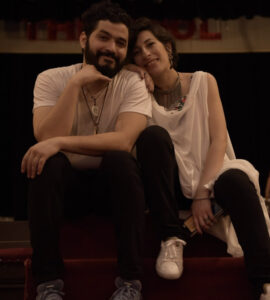
For Fayssal, Chaoui is primarily a language with a shifting geography. It is not the language of urban daily life but of return. Although his parents left the Aurès when he was one year old to settle in Biskra, Chaoui never disappeared from their home: it circulated between them as a discreet code. His parents spoke to him in Darija, a choice he now understands as protective. “To avoid feelings of inferiority, to better integrate into the city,” he explains.
Every weekend, this strategy unraveled. Returning to Tkout, his native village, meant the return of Chaoui. There, the language reclaimed its rights, carried by grandparents and aunts, true “guardians of the temple,” who demanded he speak it, teased him when he hesitated, and ensured the chain was never broken.
His earliest linguistic memories are also auditory: lullabies, tales, and ancestral melodies that still feed his musical imagination.
For Nesrine, the relationship to language is more turbulent. Of Kabyle origin, she grew up in a family where transmission had been largely interrupted. On her father’s side, neither language nor culture was preserved. Her mother introduced her to Kabyle through lullabies, but the language remained backgrounded, without status or importance — until university.
There, she met Fayssal. And through him, Chaoui. First through music, then through history. Gradually, she realized that this language she perceived as foreign carries an entire civilization. “A way of being and existing,” she says today. A full-fledged identity.
This awareness came with a critical reflection on her childhood. Nesrine recounts a harsh reality widely shared in the 1990s: internalized contempt. “I remember, as a naive child, we had neighbors who spoke Berber. Although my mother spoke Kabyle, my grandmother and paternal aunts mocked Berber speakers and instilled in us children this hatred of the other who was not ‘Arab.’” The line was clear: on one side, Berber speakers from the countryside, seen as ignorant; on the other, supposedly modern city dwellers. “I’m ashamed I was like that, even as a child,” she confides.
For Fayssal, the political consciousness of language came earlier — it is inherited. His paternal family has always been involved in the cultural and identity struggle of the Aurès. His uncle, founder of Tamussni (“Knowledge”) at Batna University, the first activist structure for Chaoui recognition, played a decisive role. From this association emerged the MCA movement, which united the region in the 1980s–1990s. Lyricist for several Chaoui singers, his uncle embodies the figure of the cultural transmitter. “My identity awareness is a direct product of this heritage,” he asserts.
Following this legacy, IWAL chooses to sing in Chaoui — not for aesthetic calculation, much less folklorism, but out of necessity. Music is a tool of transmission: it allows immersion in the language through emotion, mastering phonetics before even understanding meaning. Certain words, situations, and images can only be expressed in Chaoui, which becomes the sole language capable of conveying Chaoui culture from within. “A language carries a whole way of thinking, a history, a civilization. You cannot speak of Amazigh languages without speaking of the Amazigh people,” they explain. “Our ancestors had a full civilization: language, writing, beliefs, a social system… everything that makes a civilization. But they were not considered as such because they were peaceful and didn’t dream of conquest. They suffered numerous invasions and erasure attempts, yet Amazigh culture and languages are still here. Today, we continue to resist and assert our presence.”
Language choice is also political: the presence of Darija in Chaoui territory, for instance, stems from a violent colonial history. “Many don’t know, but the existence of Darija songs in Chaoui territory is due to historical reasons from French colonialism. To destroy Chaoui culture and language, Arab offices were created, imposing Arabic and combating pagan customs. Then punitive fines were used to silence Chaoui songs glorifying honor bandits, to break the imagination of resistance in the Aurès,” explains Faycal.
On stage, personal and artistic identity merge. IWAL is an extension of themselves. Singing in Chaoui honors history, memory, and those who resisted before them. Some songs crystallize this approach: “Hmed (Chacha),” an adaptation from the singer Markunda Aurès, is a collective madeleine, a childhood memory turned anthem. “Hamghart,” the eponymous track of their album, invokes the ancestor, a figure of land and history, questioning contemporary despair and cultural erasure.
Their relationship with the audience goes beyond the Chaoui community — they translate, narrate songs, and adapt some texts into French to include all listeners. Their goal is to free Chaoui culture from folkloric constraints and make it a living, contemporary entity.
For IWAL, song is an indestructible memory. You can censor, marginalize, or folklorize, but you cannot silence a language that sings. Like other indigenous languages worldwide, Chaoui has survived through music. As long as voices exist to carry it, it remains a living, untamed, irreducible force.
IWAL approaches the future of Chaoui with clarity and ambition. “Surely, in the media space, it will always have its place as a temporary folkloric exhibit. But to become a recognized language, a living material under serious consideration, that is not part of current policy — and this applies to most, if not all, Amazigh languages in our country,”
Looking ahead, IWAL expands this approach: “We are working on an album and a children’s show featuring songs in Chaoui, Darija, and French. Primarily original compositions that spontaneously came to us in all three languages… songs dedicated to our daughter, who inspired us,” shares Nesrine.
Mother Tongue: Refuge or Wound?
Through their journeys and creations, Amel Zen and IWAL remind us that Tamazight and its variants are not mere relics of the past or regional curiosities; they are living languages, carriers of history, memory, and identity.
As Amel Zen emphasizes, “Producing in Dahri is also protecting an ancestral Amazigh language, integral to Algerian and North African history and culture. Carrying Dahri is transmitting a culture and heritage to future generations. It is championing the Amazigh cause and continuing to claim it until it regains its true place in dominant narratives and policies, so there can be real reconciliation with our history and identity, effectively and not folklorically.”
For their part, Fayssal and Nesrine argue that, “Our commitment is a form of resistance, part of the continuity of a cultural and artistic awakening, a reclamation of identity awareness in the Aurès initiated by pioneers of modern Chaoui music, such as Dihya, Markunda, Les Berbères… By writing and singing in Chaoui, we feel pride first, but also a duty towards our past history and our future as Chaoui people.”
In a country where official recognition is still insufficient to ensure cultural and linguistic equality, singing in Amazigh becomes both a political act and a bridge between generations. Tamazight, in all its variants, continues to live because it is carried by voices that resist erasure and celebrate the richness of Algeria’s linguistic diversity. As long as these voices rise, they will resonate with the identity of a people and the beauty of their culture.
Select Other Languages Français.