Select Other Languages French.
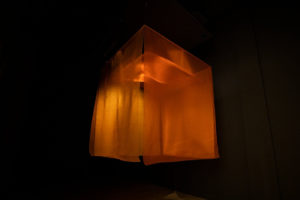
London resident Melis Aker meditates on the moral and aesthetic implications of light and darkness, and on the creative potentialities that exist in the shadows.
When I moved to London, the first thing I noticed was the absence of shadows in my living room. Most hours here pass — if you’ll forgive the Dickensian cliché — in a single, dim grey register without any sharp contrast at all. In the first few months, I began to miss the harshness of light: morning turning into midday, the piercing rays that would weave between my monstera, my cafetière, my hourglass teacup, my guitar, tracing time as they passed in and around my desk. Those shadows had been my measure of time, and this new reality was a bit like living inside a flat-lit monochrome film.
A single register, however, trains the eye to adapt and settle for a kind of stillness, and with stillness comes an odd, exacting attention to detail: a way of catching nuance across a softer spectrum of colors, noting the subtler shades of difference, the faintest change. If I looked closely, I could, in fact, spot those quieter shadows around me. They were alive and well, and unexpectedly, there were more of them than I thought. I found them everywhere: in areas of lower luminance, in gradual transitions between the less obvious outlines of people, places and things. Perhaps I didn’t need sharp brightness to make shadows visible at all. Perhaps I had it all wrong. Time was passing all around me; it was simply moving a little differently, slower, perhaps, and without much lure. And why, exactly, did I want time to move faster anyway? Did I need to mark time to feel like it was mine? Or to be sure I was inside it? Or to confirm I was keeping up with it?
Finding shadows in London became its own slow, deliberate practice. First came the understanding that brightness often arrives loud and dressed in color; how the more declarative the light, the less it lets me see any real variety around it at all. I realized that shadows cast by such bright lights are no kinder on the eye; that their darkness dominates, simplifies, and erases with the same blunt force as the glare that produces them. They form, in effect, an absolute binary of views. A deeper confrontation arrived on a rainless Tuesday at the V&A, where I stood before the dimly lit Ardabil Carpet display, set apart from its harshly lit neighboring galleries. It occurred to me that the West named its awakening Enlightenment for a reason; because it prizes that which is seen with utmost clarity and surgical precision. (The word bright is, after all, a synonym for a whole constellation of attributes the English-speaking world considers positive, and thus valuable: smart, lively, cheerful, optimistic, sunny.) The Ardabil Carpet is kept in a softer light to preserve the dyes and to let the indigo hues breathe and come to life. My mind drifted to the carpet-weavers from back home, how they are told to hide the most symbolic — and thus the most valuable — motif into the folds of the pattern, because where I come from, that which is unseen is considered the truest and most beautiful of all. It was here that I noticed the habits I had built around my own attention: how I often let brightness take the space it demanded, how I let it pass for verity, yes, but also for a kind of blind certainty. The very sensory palette that overwhelmed me as a playwright and screenwriter in New York had also convinced me that immediacy and bravado were the same thing as truth. Hadn’t I left New York precisely because its brightness often resulted in distress and outrage?

It was here that I began to understand the seemingly basic notion that when I can’t see clearly, I take my time, and that taking my time means delaying my certainty, and thus, slowing my judgement. That taking time might just be the moral argument for shadows in a world addicted to glare. In an age of velocity, spectacle, and instant conclusions, half-light creates the conditions for fine-tuned, purposeful attention. And attention, perhaps, is our only honest relationship to knowledge, and so, to truth. My move to London was quickly becoming a deep reckoning with a paradox I’d never quite been able to articulate before: we live in a fully chromatic world that still, somehow, insists on being read in black and white. I was in search of a different sort of variety; a richer, slower, interior kind, away from the reductive, shorthand qualifiers that defined and branded who and what I was, as a writer and beyond. The invisible shadows tucked in the corners of my beloved gray city were, in fact, becoming quiet invitations to another way of thinking.
I should mention that my appetite for shadows has a history. My love for them began as a child in Ankara, where they became the fabric from which I first learned to weave stories. I’d slip beneath the tablecloth of my grandmother’s table and watch my family’s shadows play across the linen. I would try to name each person by the way they moved, and from the shapes of their ankles, legs, hips, shoes. One afternoon, my father lifted the cloth and told me a story about shadows. About how his grandfather had been a shadow puppeteer.
Where I come from, that which is unseen is considered the truest and most beautiful of all.
My shadow-puppeteering great-grandfather was also among the first to bring the film projector for cinemas in Turkey. Apparently, Kenan Sübakan was a legend. According to my father, Kenan was a shadow puppeteer by night, and by day, the owner of a company he founded in the 1940s — Sinefon — where he would import and sell old Sinemakina film projectors. My dad recounts middle school summers he would spend in Istanbul in the early 1970s, earning a wage by waiting for the dial tone to drop for business calls and dusting the old projectors in Kenan’s store on Ağa Camii street in Beyoğlu. Apparently, Kenan had a small workshop across from his store, too, where he kept a coal rod lamp and a concave mirror that caught the beam and guided it through strips of film towards a lens. That lens would, in turn, throw the moving image onto a screen at a movie theatre. A carbon-arc projector. This process demanded enormous electricity, and to increase the voltage, Kenan built an inverter, about the size of a small refrigerator, packed with copper-wired coils. My father thought ghosts lived in that machine. But he stuck it out to be the first to see some of his favorite films in the cinema for free. And some of the first films threaded through my great grandfather’s projectors in Istanbul were American noir films. It was, simply put, the postwar cargo of moral disillusionment that fed, fueled, and strengthened the American Dream and with that, a feeling of hope for many Turks.
Inside his workshop, Kenan liked to work slowly, and in half-light. Apparently, too much light would wash the beam, and he couldn’t see the image clearly. He required dimness to see the gradations of shadows that excessive brightness hid, and I suppose this is what we do inside a movie theatre all the time.
When I think back on Kenan — one of the few members of the family with whom I share a creative kinship, if not a vocational aspiration in storytelling and film — I realize he lived in a time of great uncertainty for Turkey. The 1940s and 50s were a period of turmoil and rebuilding. The country was still reckoning with a new alphabet, a new government. The republic was young and restless, whose confidence was performed in loud patriotic marches and bronze statues. Most people, I’m told, were simply improvising in the dark. Kenan’s world was one of political volatility, censorship, rationed electricity, blackouts that could last for days. And yet, the stories I keep hearing about him are about invention. The man built radios in his attic, for no one in particular. He was, in my mind at least, making sense of the century in the only language he knew: half-light, shadows, and stories. He was also taking literal advantage of the dark to create, using dimness as a cover that allowed him to work freely in a country where certain people needed — and continue to need — the ubiquity of shadows and allegory to protect themselves.
Growing up in Turkey myself, I knew I was living inside a culture of heavy censorship, where stories had to be passed down using shadows: aurally and visually, mostly through unscripted, unarchivable means. I followed in Kenan’s footsteps and tried my hand in shadow puppetry first, using his puppets to concoct stories as a child. It was my way into becoming a storyteller. And as I took up performance and writing and moved to the U.S., and eventually the U.K., I was suddenly branded a “Middle Eastern” artist. I was Middle Eastern everywhere I went, except in Turkey, where I’m now considered “a foreigner.” Colleagues with similar narratives call our state the “Republic of the in-between:” those who belong nowhere, and everywhere at once. I’ve named the experience “cultural dysmorphia,” which is a theme that creeps up in my writing often. I’m a lifelong member of the Republic of the in-between, whether I like it or not.
I suppose cultural dysmorphia is a bit like inhabiting a “half-light” existence. I define the experience as the constant unease of seeing the shape of your self and life reflected back at you in distorted frames: recognizable, yet never quite accurate. Always resized, mistranslated, but never fully aligning with your inner reality. If shadows are a kind of negative space, I had learned to inhabit them well. Half insider, half outsider, forever splitting the difference of languages and selves through mimicry, through standing in opposition, in reflection, or just off key to a dominant, central culture. Shadows were always home. A quieter, perhaps more honest and introspective home that I now realize can multiply in half-light. It’s a difficult internal space to be inhabiting in the bright lights of the entertainment business, but I am grateful for it every passing day. I had moved to London to write with more depth, to recover the interiority that the speed and mindset of New York had scraped thin. But I’d grown used to a world of sharp contrasts and constant color after spending a decade in the Big Apple, and every so often I still find myself yearning for that bright distraction in London, too: wanting to scratch the itch of needing stimuli to drown out my anxious thoughts. I reach for it on my phone, in the constant light and color coming from my TV, in a scrollable world in my palms that promotes brightness through eye-catching, quick-to-judge brevity. Skits and clips and opinions, dressed in shiny colors, clamoring for my attention, and, as I slowly realize, eschewing nuance and the natural pace of existence.
I return to Kenan often these days, when I think about my own life, sitting in my grey London flat in this winter of 2025, when I am exhausted by an industry that has lost its sense of purpose entirely; burnt out from trying to negotiate the kinds of stories that are “producible,” from flattening my own imagination to fit the narrow slots of identity politics now being used to fend off growing censorship in the West; from reading anxious virtue-signaling statements designed to prove moral relevance that look good on brochures asking for donations; all inside a grueling global-political landscape that places no value on the arts. I begin to consider Kenan’s quiet inventions as a kind of resilience. When the nation swung between regimes and ideologies, he seemed to find comfort in continuity, in the making itself, and in taking time. I think of those American noir films on screens in Istanbul, arriving like coded messages from another uncertain world, becoming the beacon of a strange, unexpected kind of faith for locals. Kenan’s half-light shadows were not just an absence of bright light. They were a working condition, a strategy and shelter against a landscape that had its own version of truth.
Years before those noir reels crossed the Bosphorus to reach Sinefon, Junichiro Tanizaki wrote In Praise of Shadows, about the dignity of dimness, Japanese aesthetics, and how certain things only really come into themselves when removed from the spotlight. I wish I could have met Kenan so I could gift this book to him. Both built different types of light so shadows could move in their own obscure, uncertain little world. Uncertainty must not have unmoored Kenan, at least as legend has it. I’d like to believe that both Kenan and I have learned that our decisions are slower in half-light, and thus, sharper and truer.
In a post-truth world, certainty must be earned slowly, and the only way to achieve that is by taking time. We need more shadows. Shadows give us back our time, and this feels like the only cure to battle the attention economy of misinformation and disinformation distracting our eyes first before it settles into the restless corners of our minds.
So, each morning, I set myself up in front of my laptop the way I imagine Kenan might have done in front of his little inventions for no one in particular, living inside the joy of small rituals built by careful hands. I’ve come to believe strongly that in a time that floods us with color and demands attention and certainty, I would rather protect the conditions where shade can survive. I’m not sure brightness has ever told me the whole truth. Half-light just might.