Select Other Languages Français.
Palestinian American writer-director Cherien Dabis’s third feature film is a masterful saga that illustrates the Israel-Palestine narrative in human terms.
A little over 30 years ago, I was a film journalist in Los Angeles, invited to a press screening for a new picture about which I’d heard nothing. Screening on the Universal lot, the film turned out to be Steven Spielberg’s latest, a black and white picture entitled Schindler’s List. By the time the lights came up, I was gobsmacked, literally shaken. Like most Americans, I had been familiar with the details of the Holocaust, but seeing it up close — especially with Ralph Fiennes’ intense portrayal of the gruesome Amon Goeth — even as a hard-bitten journalist, I left the theatre unsteady on my feet.
Three decades later, I found myself thinking of that moment again as I walked out of writer-director Cherien Dabis’ third feature film, All That’s Left of You. By the time the lights came up, I felt destroyed.
All That’s Left of You captures the generational trauma of Palestinian uprooting and exile as no other feature film I’ve seen. With Dabis’ meticulous eye for detail, the story, which spans a timeline between 1948 and 2022, seamlessly brings the viewer into the lived reality of a Jaffa family forced to flee their home and orange grove, only to become refugees in Nablus, where the daily humiliations of Israel’s occupation forces bring into focus decades of persecution. Only the hardest heart would fail to feel the cruelty of the Palestinian fate and its people’s suffering at the hands of a settler-colonial army: first evicted from your home, then policed in your place of refuge, with no accountability for your oppressor, and no force of law to protect you from their whims, whether destruction of property, arrest, or murder.
The film had to be shot on locations in Jordan, Cyprus and Greece, since Israel made it impossible to shoot in Jaffa and Nablus. This is not a story the state wants told, for they have expended billions of dollars and produced decades of hasbara drilling false myths into American brains, starting with the heroic narrative that on May 15, 1948, vastly superior Arab armies mercilessly attacked the underdog Jews and their newly-declared state of Israel, and yet by some miracle, the underdog triumphed. The truth is that the settlers, many newly arrived from Europe, had begun preparing for this conflict years earlier. Despite the greater numbers of the Arab forces, militarily, the Zionist militias were better-equipped. They’d also devised Plan Dalet, a strategic plan for the conquest of Palestinian land that relied on various terror tactics to forcefully expel the indigenous population from their homes and villages. In short, ethnic cleansing.
Despite every attempt to erase historical memory through simplistic narratives, AI or misleading social media posts, there is a documented history of what happened in Palestine — we know where the proverbial, and literal, bodies are buried. Numerous historians including Rashid Khalidi, Nur Masalha, and Ilan Pappé and Avi Shlaim, two prominent British Israeli historians, have interviewed scores of 1948 war survivors, Israeli and Palestinian, and translated thousands of official state documents from Hebrew and Arabic, producing several dense history tomes, such that no inquisitive person need rely on Israel’s one-sided narrative. To sum up, as reported in Al Jazeera in 2022 (the year Palestinian American journalist Shireen Abu Akleh was assassinated by Israeli troops in Jenin, and the year that Cherien Dabis’ film All That’s Left of You ends), “Between 1947 and 1949, Zionist military forces attacked major Palestinian cities and destroyed some 530 villages. About 15,000 Palestinians were killed in a series of mass atrocities, including dozens of massacres.”
Note that these events began in 1947, prior to the end of the British Mandate in Palestine, and before Egypt, Iraq, Jordan, Lebanon, and Syria declared war on Israel.
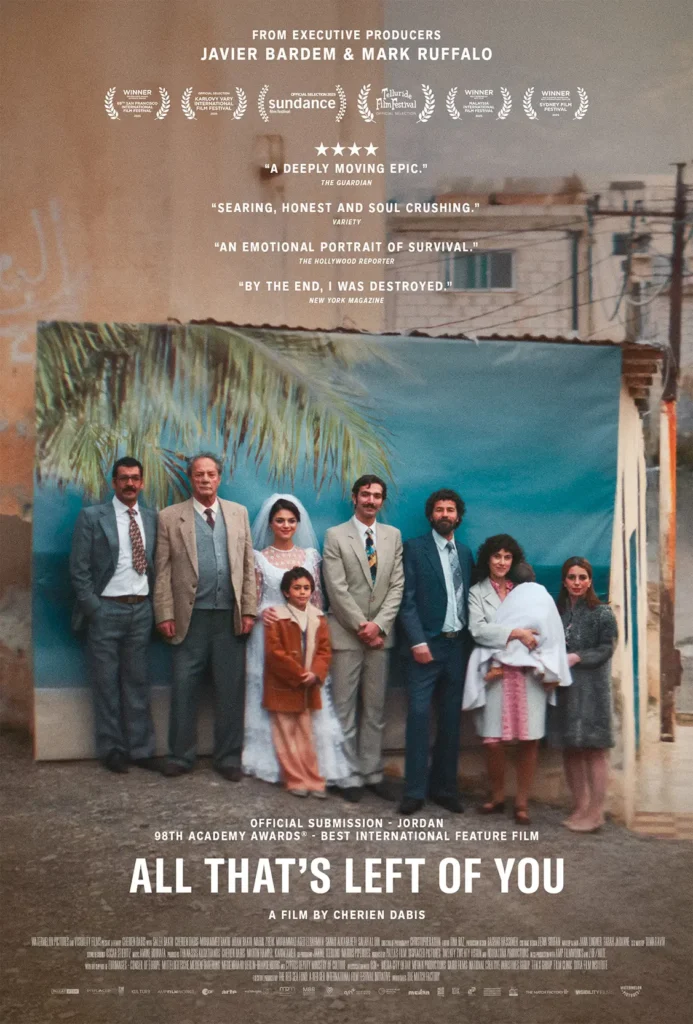
All That’s Left of You follows the fortunes of Sharif and Munira, a prosperous middle-class Jaffa family who, along with their small children, are driven out of their city by Zionist forces. After the 1948 expulsion, the story jumps ahead 30 years to 1978 and the West Bank. Munira has since passed away and Sharif is a broken-down grandfather, living with his youngest son Salim, his wife Hanan — played with tenderness and conviction by Dabis herself — and their three children in a modest concrete home, in the refugee slums of Nablus.
Hanan’s son Noor is the linchpin of the movie. A key scene finds the 8-year-old Noor walking home with his father, Salim, a local schoolteacher, when they are stopped at random by a group of four Israeli soldiers, cruising the hills of Nablus in an army jeep. Salim is ruthlessly humiliated in front of Noor, who will one day think of his father as a traitor to Palestinians, because he has succumbed to the occupation — Noor believes that Salim shows no signs of a willingness to resist Israeli oppression.
Although the main story is set and begins in Jaffa, before cutting away to 1948, All That’s Left of You opens with an energetic scene in Nablus, when two teenage friends are hanging out, and one of them, Malek, finds a spent bullet casing. Noor wants to see it, and a chase begins through the town. It’s 1988, during the First Intifada; the chase ends when a confrontation begins between a phalanx of aggravated Palestinians, who are fed up with the pressures of the occupation, and Israeli soldiers who fire teargas at protesters, then lethal ammunition.
There are clear indications of the Nakba’s effects throughout the film, the structure serving to create parallels between 1948 and various other points in Palestinian history. At the start, viewers who pay close attention will notice that Sharif and Munira’s children are out of school, because of the “hostilities”; it’s also a fact that Noor and his friend Malek are out of school due to the “hostilities” of the Intifada. One cannot help but think of the hundreds of thousands of children in Gaza, who went largely without schooling for two years after October 7. It’s a fact of life that Israel’s military occupation results in children missing school, just as checkpoints and occupation forces impede the Palestinian economy, hindering parents from getting to work. The cycles of scholasticide and economic recession have generational implications, and yet, Palestinians remain among the most educated Arab populations. According to AMP, “Defying occupation, poverty, and rampant fear of Israeli violence, Palestinians have a 99 percent literacy rate, the highest in the Arab world.”
Sumūd — that legendary steadfastness exhibited by Palestinians in the face of oppression and hardship — is evident in this film. While the men, Sharif and Salim, seem beaten down by decades of losses, Dabis’ character Hanan is the family backbone, a symbol of determination. She fights tenderly for her son Noor and her husband, despite his humiliation by young soldiers half his age in his own town.
All That’s Left of You is enhanced by the gritty presence of the Palestinian acting dynasty that consists of the late Mohammad Bakri (older Sharif), Saleh Bakri (Salim), and Adam Bakri (young Sharif). The film was executive produced by a number of people in Hollywood who insisted this story be told, among them Mark Ruffalo, Javier Bardem, and Eve Ensler (known today as “V”). It is Jordan’s official entry in this year’s Oscar competition (Cherien Dabis’ mother is from Salt, Jordan, and her father is a retired physician of Palestinian heritage), along with Annemarie Jacir’s Palestine 36, which was selected as the Palestinian entry for Best International Feature Film at the 98th Academy Awards. Both films are banned in Israel.
Like more than 700,000 Palestinians in 1948, Palestinians from Jaffa were faced with an impossible choice: flee to live, and lose everything; stay and possibly be killed, and lose everything. Sharif chooses to stay to defend his home and orange groves, while his wife Munira flees, ostensibly to stay two weeks with her brother in Nablus, believing she will return home with the children when the fighting subsides. After being brutally arrested on his property in 1948 by Zionist military forces and thrown into a prison camp, he later finds Munira at her brother’s home in Nablus, having survived harsh treatment, starvation, and a heart attack.
More than 100,000 people in Jaffa, 98% of the city’s Arab population, were expelled in 1948. As a result, Israel illegally acquired what remained — homes, businesses, cultural institutions, and untold hectares of land.
Decades later, with a weak heart and the early onset of dementia to contend with, the grandfather Sharif insists aloud: “We are from Jaffa, Palestine is our homeland.” Later, in another key scene, he warns his son Salim, “Mark my word. They won’t stop until they take all of Palestine.”
In September 2025, Netanyahu stated flatly, “This land is ours. There will be no Palestinian state to the west of the Jordan river.”
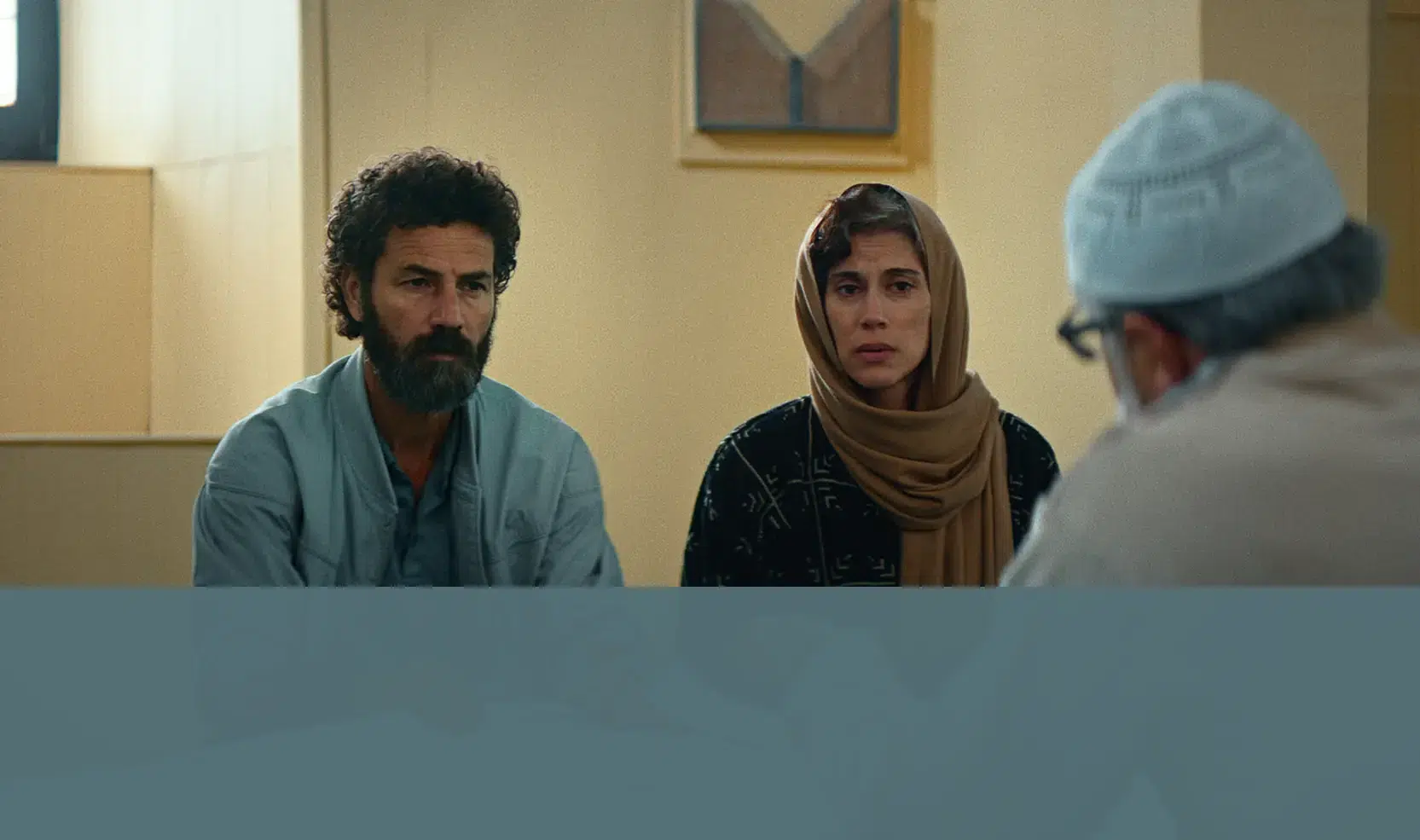
At the height of the First Intifada, confronted with a dramatic decision concerning their son Noor, Hanan and Salim consult with a local imam, who advises them, “Your humanity is also resistance. Don’t forget the power of your humanity.”
Salim says, “You do everything for your kids, why else are you alive?”
Near the film’s conclusion, Hanan speaks to an Israeli in a café-bookstore in Tel Aviv-Jaffa, who insists that Israelis, too, have their immense suffering to bear, to which Hanan responds, “We pay a price for what happened to your people. Until now we pay it.”
One of the film’s conclusions is that until today, in 2026, having lost so much, Palestinians continue to pay dearly for the Holocaust.

All That’s Left of You is now playing theatres.
Select Other Languages Français.