Pourquoi la NATIONALITÉ ?

NATIONALITY featured artist El Mehdi Largo.

7 NOVEMBER 2025 • By Jordan Elgrably, Malu Halasa

Select Other Languages English.

En matière de nationalité, nous sommes plus riches grâce à la diversité de nos identités, et plus pauvres à cause de nos divisions.

Zohran Mamdani, né en Ouganda, est le maire élu de la ville de New York. Il est marié à Rama Duwaji, une artiste syro-américaine. Il est musulman, il est immigrant, ses parents sont immigrants ; sous le régime de Trump, les immigrants ont été pourchassés et envoyés dans des prisons à l’étranger ; l’immigrant est l’Autre, il a été criminalisé. L’élection de Mamdani a inexorablement modifié les perceptions, ou du moins changé la teneur du débat sur les immigrants et l’identité nationale.

Nous nous souvenons que ce sont les immigrants qui ont construit les Amériques, du Canada à la pointe de l’Argentine. Les immigrants ont construit de nombreux pays ; ils ont certainement changé la façon dont le pays se perçoit. Il suffit de penser que les Arabes ont occupé la Sicile pendant deux cents ans ; la Sicile a été occupée par les Grecs, les Romains, les Vandales et les Vikings. Comment les Siciliens contemporains conçoivent-ils leur identité ?

Les Maures, bien sûr, ont occupé la péninsule ibérique, l’Espagne et le Portugal, pendant 800 ans, sous le règne d’Al-Andalus. Imaginez comment cela a influencé l’identité espagnole contemporaine (les Espagnols disent « ojalá », qui signifie « je l’espère », une douzaine de fois par jour, sans se souvenir que cela vient de l’expression arabe et islamique « inshallah » — si Dieu le veut).

Quand on pense à la nationalité, on ne peut s’empêcher de penser à la langue. N’oubliez pas que beaucoup d’entre nous ont été colonisés et ont appris à parler la langue du colonisateur. Il y a plus de mille ans, les Arabes ont colonisé les peuples indigènes d’Afrique du Nord, les Bédouins et les Amazighs ; il y a plus de 500 ans, les Européens ont colonisé les Amériques. On peut donc dire que l’arabe, tout comme l’anglais, l’espagnol et le français, sont des langues colonisatrices, responsables de l’oppression des langues indigènes, qui dans certains cas sont presque éteintes, et dans d’autres, connaissent un renouveau, comme le catalan dans le nord-est de l’Espagne. Mais les colonisés tirent également profit de la maîtrise de la langue du colonisateur : la conversation va dans les deux sens.

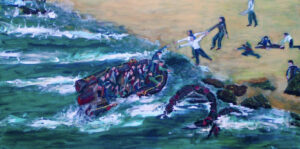
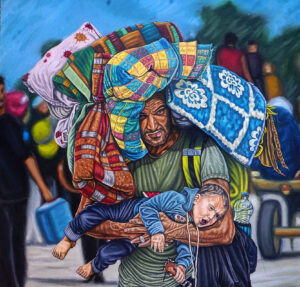
Qui est « des nôtres » et qui ne l’est pas ? La nationalité est une question brûlante. Les agents masqués de l’ICE aux États-Unis ratissent large, des Hispaniques américains et des migrants vénézuéliens sans papiers jusqu’aux touristes irlandais qui dépassent la durée de leur visa, et les envoient dans des centres de détention collectifs inhumains à travers le pays. En Europe aussi, la nationalité est une question déterminante. Les petits bateaux remplis de Kurdes, de Soudanais, d’Afghans et d’autres arrivent sur les côtes britanniques pendant un été marqué par des émeutes d’extrême droite devant les hôtels des demandeurs d’asile. L’origine et la nationalité des personnes sont devenues des questions déterminantes dans un monde en crise, où les personnes en déplacement refusent de cesser de fuir les conflits, la guerre civile, la sécheresse et la pauvreté.

Quand il s’agit de garantir l’égalité des droits pour tous les habitants d’un pays, le nationalisme est un échec cuisant, comme le suggère un poème de Mahmoud Darwish. Dans « Passeport », il écrit :

« Tous les cœurs des gens sont mon identité
Alors, confisquez mon passeport ! »

Plus de la moitié des Palestiniens dans le monde restent apatrides, et les citoyens palestiniens d’Israël ne jouissent pas des mêmes droits que leurs homologues juifs. Leur nationalisme est synonyme de discrimination inhérente et d’espérance de vie plus faible.
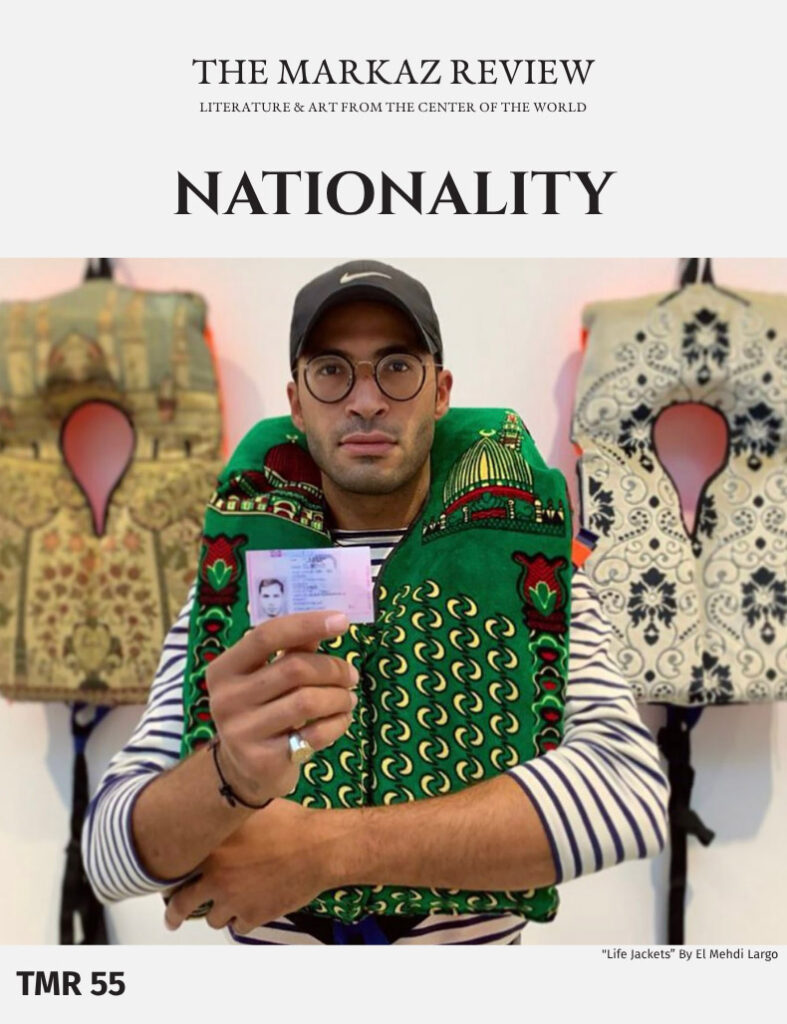

Artist El Mehdi Largo on the cover of TMR 55 • NATIONALITY
L’artiste El Mehdi Largo en première page de couverture de TMR 55 • NATIONALITY.

Selon le dictionnaire Merriam Webster, les quatre aspects du nationalisme comprennent le caractère national, la loyauté et le dévouement à une nation ; le statut national et l’appartenance à une nation particulière ; l’indépendance politique ou l’existence en tant que nation distincte ; et les personnes ayant une origine, une tradition et une langue communes et capables de former ou de constituer effectivement un État-nation ou un groupe ethnique, élément d’une unité plus grande. Cependant, les synonymes de nationalité élargissent et enrichissent les possibilités du mot : ethnicité, race, famille, clan et parenté, pour n’en citer que quelques-uns. À l’ère des réseaux sociaux, la nationalité ne se réfère plus strictement à un pays, elle peut désigner la religion, l’identité ou la simple culpabilité par association, comme le montre la campagne réussie de la théoricienne du complot de droite Laura Loomer pour empêcher les enfants de Gaza gravement blessés et affamés de recevoir des soins médicaux aux États-Unis.

Dans TMR 55 • NATIONALITÉ, notre essai central d’Adam Makary, « The Grammar of Power » (La grammaire du pouvoir), examine l’hypocrisie et le double standard du libéralisme occidental en ce qui concerne la vie des Palestiniens. Dans « We the Wanderers » (Nous, les nomades), notre artiste vedette El Mehdi Largo réfléchit à la façon dont il est passé de Marocain à Italien, avant de découvrir en France qu’il était finalement Arabe. Largo insiste sur le fait que « nous, immigrants, nomades, suivant le soleil couchant vers l’exil, sommes les chercheurs ultimes de sens ».

Dans « The Absent Homeland » (La patrie absente), Mayssa Alajjan accepte le fait que, bien qu’elle soit née et ait grandi au Liban, le pays refuse de lui accorder la nationalité, car son père était syrien. Dans « Home, a State of Restlessness » (Le chez-soi, un état sans repos), Neemah Ahamed, une Kenyane musulmane de troisième génération d’origine indienne vivant à Londres, aspire à une vie à Athènes, car elle compatit avec les Palestiniens de Gaza et de la diaspora. Elle écrit : « Peut-être que le paradoxe est de reconnaître que pour moi, la maison n’est pas un lieu, mais un état “sans repos”. » Dans la nouvelle « Paranoia » de Parand, la société afghane contemporaine est dépeinte à partir de perspectives opposées : des femmes qui perdent toute apparence de liberté, face aux talibans qui ont leurs propres idées rigides sur ce que signifie être Afghane. Et dans la nouvelle « Sultana to the Rescue », l’écrivain libanais MK Harb accueille une femme pauvre chez lui, réalisant sans le savoir que c’est elle qui le sauve.

Tous nos contributeurs de ce mois-ci, y compris Amy Omar qui écrit sur la nomade et romancière turque Ayşegül Savaş, Nohshin Bokth qui explore l’œuvre de l’écrivaine britannique irakienne Dalia Al-Dujaili, Gaar Adams qui critique deux livres explorant l’identité du Golfe ; et Lara Vergnaud, rédactrice en chef adjointe de TMR pour 2025-2026, qui interviewe le romancier franco-palestinien et libanais Jadd Hilal, s’efforcent de mettre en lumière ce que signifie appartenir à un peuple, à une culture, à une nationalité, voire à une tribu. En fin de compte, nous sommes plus riches grâce à la diversité de nos identités, et plus pauvres à cause de nos divisions.

Jordan Elgrably et Malu Halasa


Traduit de l’anglais par Maï Taffin

Jordan Elgrably

Jordan Elgrably is an American, French, and Moroccan writer and translator. His stories and creative nonfiction have appeared in many anthologies and reviews, including Apulée, Salmagundi, and the Paris Review. Editor-in-chief and founder of The Markaz Review, he is the cofounder and... Read more

Malu Halasa

Malu Halasa is the Literary Editor at The Markaz Review. A London-based writer, journalist, and editor with a focus on Palestine, Iran, and Syria. She is the curator of Art of the Palestinian Poster at the P21 Gallery, as part the Shubbak:... Read more

Join Our Community

TMR exists thanks to its readers and supporters. By sharing our stories and celebrating cultural pluralism, we aim to counter racism, xenophobia, and exclusion with knowledge, empathy, and artistic expression.

Learn more

RELATED

Book Reviews

Stolen Nation: An Argument for Palestinian Reparations

6 FEBRUARY 2026 • By Selma Dabbagh
<em>Stolen Nation</em>: An Argument for Palestinian Reparations
Interviews

Prison and the Writer: Interview with Palestinian Nasser Abu Srour

30 JANUARY 2026 • By Rebecca Ruth Gould
Prison and the Writer: Interview with Palestinian Nasser Abu Srour
Film Reviews

If You See Something—an Iraqi Film on Asylum

12 DECEMBER 2025 • By Alex Demyanenko
<em>If You See Something</em>—an Iraqi Film on Asylum
Editorial

Why NATIONALITY?

7 NOVEMBER 2025 • By Jordan Elgrably, Malu Halasa
Why NATIONALITY?
Essays

I Don’t Have Time For This Right Now

5 SEPTEMBER 2025 • By Re'al Bakhit
I Don’t Have Time For This Right Now
Book Reviews

Egyptian Novelist Skewers British Bureaucracy with Black Humor

15 AUGUST 2025 • By Valeria Berghinz
Egyptian Novelist Skewers British Bureaucracy with Black Humor
Film

From A World Not Ours to a Land Unknown

13 JUNE 2025 • By Jim Quilty
From A World Not Ours to a <em>Land Unknown</em>
Editorial

For Our 50th Issue, Writers Reflect on Going Home

2 MAY 2025 • By TMR
For Our 50th Issue, Writers Reflect on Going Home
Film

Exile and Hope: Sudanese creatives and the question of home

2 MAY 2025 • By Ati Metwaly
Exile and Hope: Sudanese creatives and the question of home
Book Reviews

An Immigrant in America: The Palace of Forty Pillars

18 APRIL 2025 • By Sean Casey
An Immigrant in America: <em>The Palace of Forty Pillars</em>
Art & Photography

Afghanistan’s Histories of Conflict, Resistance & Desires

7 MARCH 2025 • By Jelena Sofronijevic
Afghanistan’s Histories of Conflict, Resistance & Desires
Essays

Return to Damascus…the Long Road Home

13 DECEMBER 2024 • By Zaher Omareen, Rana Asfour
Return to Damascus…the Long Road Home
Featured Artist

Featured Artists: “Barred From Home”

6 SEPTEMBER 2024 • By Malu Halasa
Featured Artists: “Barred From Home”
Art & Photography

What Is Home?—Gazans Redefine Place Amid Displacement

31 MAY 2024 • By Nadine Aranki
What Is Home?—Gazans Redefine Place Amid Displacement
Poetry

Moheb Soliman presents two poems from HOMES

8 MAY 2024 • By Moheb Soliman
Moheb Soliman presents two poems from <em>HOMES</em>
Essays

Holding Back the Bobos: Portrait of Paris’ Belleville

1 APRIL 2024 • By Cole Stangler
Holding Back the Bobos: Portrait of Paris’ Belleville
Editorial

Shoot That Poison Arrow to My Heart: The LSD Editorial

4 FEBRUARY 2024 • By Malu Halasa
Shoot That Poison Arrow to My Heart: The LSD Editorial
Book Reviews

Love Across Borders—on Romance, Restrictions and Happy Endings

4 FEBRUARY 2024 • By Lina Mounzer
<em>Love Across Borders</em>—on Romance, Restrictions and Happy Endings
Art & Photography

Cyprus: Return to Petrofani with Ali Cherri & Vicky Pericleous

8 JANUARY 2024 • By Arie Amaya-Akkermans
Cyprus: Return to Petrofani with Ali Cherri & Vicky Pericleous
TMR 37 • Endings & Beginnings

“The Summer They Heard Music”—a short story by MK Harb

3 DECEMBER 2023 • By MK Harb
“The Summer They Heard Music”—a short story by MK Harb
Book Reviews

The Refugee Ocean—An Intriguing Premise

30 OCTOBER 2023 • By Natasha Tynes
<em>The Refugee Ocean</em>—An Intriguing Premise
Essays

Forging Peace for Artsakh—The Debacle of Nagorno Karabagh

16 OCTOBER 2023 • By Seta Kabranian-Melkonian
Forging Peace for Artsakh—The Debacle of Nagorno Karabagh
Theatre

Lebanese Thespian Aida Sabra Blossoms in International Career

9 OCTOBER 2023 • By Nada Ghosn
Lebanese Thespian Aida Sabra Blossoms in International Career
Essays

“My Mother is a Tree”—a story by Aliyeh Ataei

2 JULY 2023 • By Aliyeh Ataei
“My Mother is a Tree”—a story by Aliyeh Ataei
Fiction

“The Afghan and the Persian”—a short story by Jordan Elgrably

2 JULY 2023 • By Jordan Elgrably
“The Afghan and the Persian”—a short story by Jordan Elgrably
Fiction

The Ship No One Wanted—a story by Hassan Abdulrazak

2 JULY 2023 • By Hassan Abdulrazzak
The Ship No One Wanted—a story by Hassan Abdulrazak
Featured Artist

Artist at Work: Syrian Filmmaker Afraa Batous

26 JUNE 2023 • By Dima Hamdan
Artist at Work: Syrian Filmmaker Afraa Batous
Essays

Turkey’s Earthquake as a Generational Disaster

4 JUNE 2023 • By Sanem Su Avci
Turkey’s Earthquake as a Generational Disaster
Arabic

Arab Theatre Grapples With Climate Change, Borders, War & Love

4 JUNE 2023 • By Hassan Abdulrazzak
Arab Theatre Grapples With Climate Change, Borders, War & Love
Interviews

The Markaz Review Interview—Faïza Guène  

22 MAY 2023 • By Melissa Chemam
The Markaz Review Interview—Faïza Guène  
Essays

When a Country is not a Country—the Chimera of Borders

17 APRIL 2023 • By Ara Oshagan
When a Country is not a Country—the Chimera of Borders
Essays

Artsakh and the Truth About the Legend of Monte Melkonian

17 APRIL 2023 • By Seta Kabranian-Melkonian
Artsakh and the Truth About the Legend of Monte Melkonian
Beirut

Tel Aviv-Beirut, a Film on War, Love & Borders

20 MARCH 2023 • By Karim Goury
<em>Tel Aviv-Beirut</em>, a Film on War, Love & Borders
Beirut

Interview with Michale Boganim, Director of Tel Aviv-Beirut

20 MARCH 2023 • By Karim Goury
Interview with Michale Boganim, Director of <em>Tel Aviv-Beirut</em>
Cities

For Those Who Dwell in Tents, Home is Temporal—Or Is It?

5 MARCH 2023 • By Arie Amaya-Akkermans
For Those Who Dwell in Tents, Home is Temporal—Or Is It?
Cities

The Odyssey That Forged a Stronger Athenian

5 MARCH 2023 • By Iason Athanasiadis
The Odyssey That Forged a Stronger Athenian
Book Reviews

To Receive Asylum, You First Have to be Believed, and Accepted

5 MARCH 2023 • By Mischa Geracoulis
To Receive Asylum, You First Have to be Believed, and Accepted
Essays

Home Under Siege: a Palestine Photo Essay

5 MARCH 2023 • By Anam Raheem
Home Under Siege: a Palestine Photo Essay
Art

Displacement, Migration are at the Heart of Istanbul Exhibit

13 FEBRUARY 2023 • By Jennifer Hattam
Displacement, Migration are at the Heart of Istanbul Exhibit
Poetry Markaz

Poet Mihaela Moscaliuc—a “Permanent Immigrant”

5 FEBRUARY 2023 • By Mihaela Moscaliuc
Poet Mihaela Moscaliuc—a “Permanent Immigrant”
Featured excerpt

Fiction: Inaam Kachachi’s The Dispersal, or Tashari

5 FEBRUARY 2023 • By Inaam Kachachi
Fiction: Inaam Kachachi’s <em>The Dispersal</em>, or <em>Tashari</em>
Fiction

“The Truck to Berlin”—Fiction from Hassan Blasim

5 FEBRUARY 2023 • By Hassan Blasim
“The Truck to Berlin”—Fiction from Hassan Blasim
Film

The Story of Youssef Salem, Nominated for the Goncourt

16 JANUARY 2023 • By Laëtitia Soula
The Story of Youssef Salem, Nominated for the Goncourt
Film

The Swimmers and the Mardini Sisters: a True Liberation Tale

15 DECEMBER 2022 • By Rana Haddad
<em>The Swimmers</em> and the Mardini Sisters: a True Liberation Tale
Art

French-Algerian Artist Djamel Tatah’s Solitary Crowds

12 DECEMBER 2022 • By Laëtitia Soula
French-Algerian Artist Djamel Tatah’s Solitary Crowds
Film Reviews

Why Muslim Palestinian “Mo” Preferred Catholic Confession to Therapy

7 NOVEMBER 2022 • By Sarah Eltantawi
Why Muslim Palestinian “Mo” Preferred Catholic Confession to Therapy
Columns

Sudden Journeys: Israel’s Intimate Separations—Part 2

31 OCTOBER 2022 • By Jenine Abboushi
Sudden Journeys: Israel’s Intimate Separations—Part 2
Poetry

We Say Salt from To Speak in Salt

15 OCTOBER 2022 • By Becky Thompson
We Say Salt from <em>To Speak in Salt</em>
Columns

Sudden Journeys: Israel’s Intimate Separations—Part 1

26 SEPTEMBER 2022 • By Jenine Abboushi
Sudden Journeys: Israel’s Intimate Separations—Part 1
Fiction

“Another German”—a short story by Ahmed Awadalla

15 SEPTEMBER 2022 • By Ahmed Awadalla
“Another German”—a short story by Ahmed Awadalla
Essays

Phoneless in Filthy Berlin

15 SEPTEMBER 2022 • By Maisan Hamdan, Rana Asfour
Phoneless in Filthy Berlin
Film

Two Syrian Brothers Find Themselves in “We Are From There”

22 AUGUST 2022 • By Angélique Crux
Two Syrian Brothers Find Themselves in “We Are From There”
Music Reviews

Hot Summer Playlist: “Diaspora Dreams” Drops

8 AUGUST 2022 • By Mischa Geracoulis
Hot Summer Playlist: “Diaspora Dreams” Drops
Columns

Tunisia’s Imed Alibi Crosses Borders in new “Frigya” Electronica Album

18 JULY 2022 • By Melissa Chemam
Tunisia’s Imed Alibi Crosses Borders in new “Frigya” Electronica Album
Book Reviews

Leaving One’s Country in Mai Al-Nakib’s “An Unlasting Home”

27 JUNE 2022 • By Rana Asfour
Leaving One’s Country in Mai Al-Nakib’s “An Unlasting Home”
Columns

World Refugee Day — What We Owe Each Other

20 JUNE 2022 • By Jordan Elgrably
World Refugee Day — What We Owe Each Other
Fiction

“Godshow.com”—a short story by Ahmed Naji

15 JUNE 2022 • By Ahmed Naji, Rana Asfour
“Godshow.com”—a short story by Ahmed Naji
Art

Lisa Teasley: “Death is Beautiful”

15 JUNE 2022 • By Lisa Teasley
Lisa Teasley: “Death is Beautiful”
Fiction

“The Salamander”—fiction from Sarah AlKahly-Mills

15 JUNE 2022 • By Sarah AlKahly-Mills
“The Salamander”—fiction from Sarah AlKahly-Mills
Art

Book Review: “The Go-Between” by Osman Yousefzada

13 JUNE 2022 • By Hannah Fox
Book Review: “The Go-Between” by Osman Yousefzada
Film

Art Film Depicts the Landlocked Drama of Nagorno-Karabakh

2 MAY 2022 • By Taline Voskeritchian
Art Film Depicts the Landlocked Drama of Nagorno-Karabakh
Book Reviews

Joumana Haddad’s The Book of Queens: a Review

18 APRIL 2022 • By Laila Halaby
Joumana Haddad’s <em>The Book of Queens</em>: a Review
Columns

Music in the Middle East: Bring Back Peace

21 MARCH 2022 • By Melissa Chemam
Music in the Middle East: Bring Back Peace
Opinion

Ukraine War Reminds Refugees Some Are More Equal Than Others

7 MARCH 2022 • By Anna Lekas Miller
Ukraine War Reminds Refugees Some Are More Equal Than Others
Editorial

Refuge, or the Inherent Dignity of Every Human Being

15 JANUARY 2022 • By Jordan Elgrably
Refuge, or the Inherent Dignity of Every Human Being
Art & Photography

Children in Search of Refuge: a Photographic Essay

15 JANUARY 2022 • By Iason Athanasiadis
Children in Search of Refuge: a Photographic Essay
Film Reviews

“Europa,” Iraq’s Entry in the 94th annual Oscars, Frames Epic Refugee Struggle

15 JANUARY 2022 • By Thomas Dallal
“Europa,” Iraq’s Entry in the 94th annual Oscars, Frames Epic Refugee Struggle
Art & Photography

Refugees of Afghanistan in Iran: a Photo Essay by Peyman Hooshmandzadeh

15 JANUARY 2022 • By Peyman Hooshmandzadeh, Salar Abdoh
Refugees of Afghanistan in Iran: a Photo Essay by Peyman Hooshmandzadeh
Book Reviews

Meditations on The Ungrateful Refugee

15 JANUARY 2022 • By Rana Asfour
Meditations on <em>The Ungrateful Refugee</em>
Fiction

Fiction: Refugees in Serbia, an excerpt from “Silence is a Sense” by Layla AlAmmar

15 JANUARY 2022 • By Layla AlAmmar
Fiction: Refugees in Serbia, an excerpt from “Silence is a Sense” by Layla AlAmmar
Centerpiece

Climate Disasters Hasten the Advent of a World Refugee Crisis

15 NOVEMBER 2021 • By Omar El Akkad
Climate Disasters Hasten the Advent of a World Refugee Crisis
Columns

Refugees Detained in Thessonaliki’s Diavata Camp Await Asylum

1 NOVEMBER 2021 • By Iason Athanasiadis
Refugees Detained in Thessonaliki’s Diavata Camp Await Asylum
Interviews

Interview With Prisoner X, Accused by the Bashar Al-Assad Regime of Terrorism

15 OCTOBER 2021 • By Jordan Elgrably
Interview With Prisoner X, Accused by the Bashar Al-Assad Regime of Terrorism
Essays

Voyage of Lost Keys, an Armenian art installation

15 SEPTEMBER 2021 • By Aimée Papazian
Voyage of Lost Keys, an Armenian art installation
Weekly

Summer of ‘21 Reading—Notes from the Editors

25 JULY 2021 • By TMR
Summer of ‘21 Reading—Notes from the Editors
Latest Reviews

No Exit

14 JULY 2021 • By Allam Zedan
No Exit
Editorial

Why WALLS?

14 MAY 2021 • By Jordan Elgrably
Why WALLS?
Fiction

A Home Across the Azure Sea

14 MAY 2021 • By Aida Y. Haddad
A Home Across the Azure Sea
Essays

From Damascus to Birmingham, a Selected Glossary

14 MAY 2021 • By Frances Zaid
From Damascus to Birmingham, a Selected Glossary
TMR 7 • Truth?

Allah and the American Dream

14 MARCH 2021 • By Rayyan Al-Shawaf
Allah and the American Dream
Essays

A Permanent Temporariness

14 FEBRUARY 2021 • By Alia Mossallam
A Permanent Temporariness
TMR 4 • Small & Indie Presses

Hassan Blasim’s “God 99”

14 DECEMBER 2020 • By Hassan Blasim
Hassan Blasim’s “God 99”

Leave a Comment

Your email address will not be published. Required fields are marked *

four × five =

Scroll to Top