Select Other Languages Français.
Over a decade after its Broadway debut, Bengal Tiger at the Baghdad Zoo comes to London, but does it say anything new — or true — about Iraq?
As audience members trickle into the auditorium of the Young Vic, my eyes scan the room for familiar faces. I spot one: a visage of Saddam Hussein painted on a blast wall, grinning at me mockingly.
The clock has turned back 22 years. Debris-strewn streets. Green spaces repurposed into military bases set the stage of the play. The year is 2003. Baghdad, once the seat of the Abbasid caliphate, resembles a desolate wasteland. Putting stagecraft aside — including the mastery of the stage lighting used to authentically revive these scenes — the depiction of Iraq that unfolds over the next 150 minutes would feel stereotyped, Americanized, unimaginative, and lacking in contemporary relevance.
The twin themes of American exceptionalism and Iraqi suffering, even when told through comic inversion, merge into a superficial retelling of 2003: a frozen image of Iraq which still inhibits alternative stories. This portrayal of a broken country under foreign rule — ingrained in the western imaginary — leads me to ask once again: Who speaks for Iraq? And why?
My quest for answers has me seated in the crowd, pen in hand, as the play kicks off with a familiar night raid and an exaggerated flurry of gunfire. The stage lights rake across the space to reveal a hooded, handcuffed, cross-legged Iraqi, calming his wife as clamoring Americans encircle him. The scene evokes Jean-Marc Bouju’s world-renowned photograph of the Iraqi prisoner cradling his terrified son. My mind wonders — does the reference resonate with others in the audience? Is it even intentional?
Written by 2010 Pulitzer finalist Rajiv Joseph, the production reimagines the classic zoo-escape formula. Following a devastating air strike on Baghdad Zoo, a pride of lions set themselves free only to be hunted and killed by occupying forces. A nonchalant, somewhat jaded Bengal tiger — played by the superb Kathryn Hunter — is left behind, and in a final act of defiance, bites off the hand of an American soldier and is killed in retribution. The tiger, both the main protagonist and narrator, has the last laugh: maintaining her primacy even after death to exact a campaign of revenge against her American executioner.
The death of the Tiger, or rather its resurrection as a ghost, sets Palestinian-Italian playwright Omar Elerian’s absurdist dramatization of the Iraq War in motion — macabre at times, lackluster at others, and marred by cheap thrills. Excessive sexual innuendos and swearing — hallmarks of Elerian’s satirical style — may be applauded as edgy or artistically brave but strike me as culturally insensitive. The irony-based humor, from “pimp this” and “pussy that” jokes to sexually explicit satire layered on thickly, undermine the gravitas of Iraqi suffering.
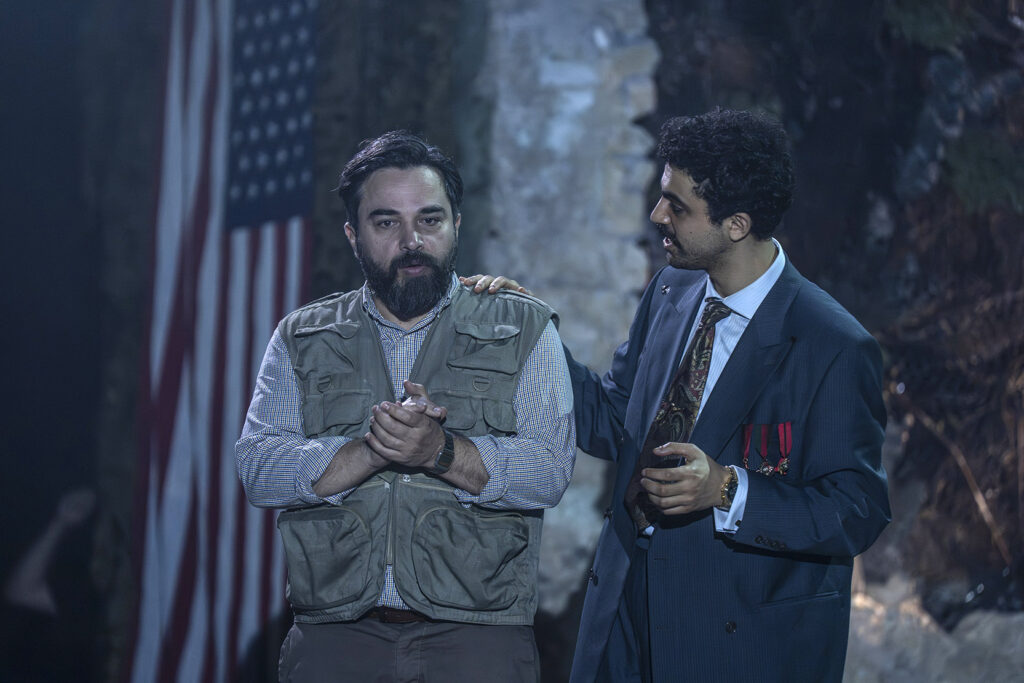
Inspired by true events, the plot distills the tragic events of 2003 into a parable about occupational violence, using the carceral space of the zoo as an analogy to depict the broader confinement and brutality which befell Baghdad and its animal kingdom. This is largely achieved through a gaggle of ghosts who haunt Iraq in life and in death, underscoring a trauma that extends beyond 2003. These phantoms capture the hallucinations of the mind in times of war, and in the Shakespearian sense, the desire for revenge or justice. The most ostentatious is Saddam’s son, Uday (Sayyid Aki). His one-dimensional, caricatured portrayal is hinged on Uday’s megalomaniacal sex-obsessed persona and relentless pursuit of young girls, while dispensing patronage. The depiction of Qusay, Saddam’s second son, as a severed head carried in a plastic bag by Uday is beyond words especially when the play fails to mention the 2004 battle in Mosul which resulted in the killing of both men, including Qusay’s minor son who fought against occupiers.
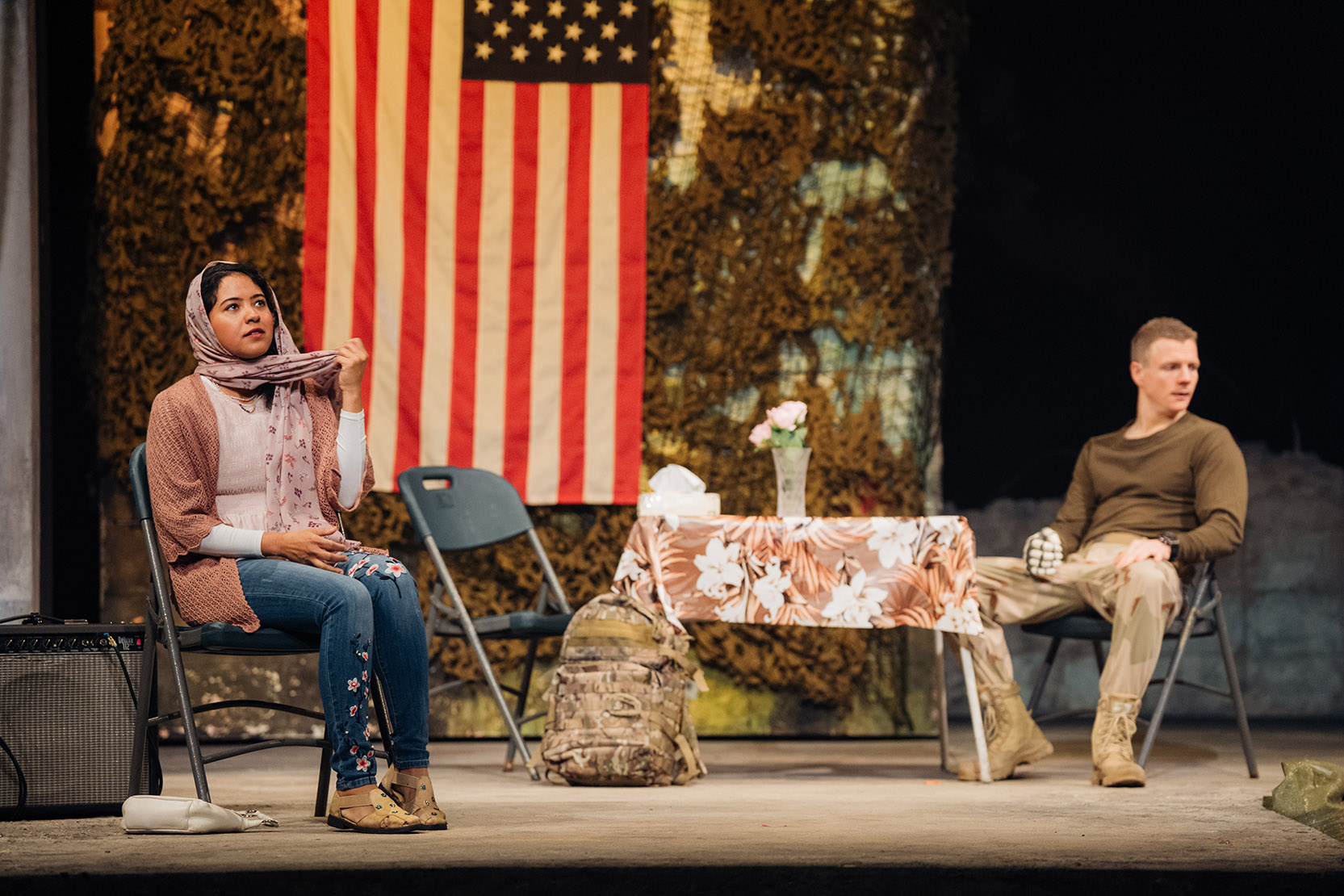
There is also U.S. Marine Kev (Arinzé Kene), who, in a psychotic episode, severs his hand to exorcise the guilt he feels for shooting the Bengal tiger. Unlike his Iraqi counterparts, Kev is offered a chance at redemption, giving his character a level of nuance and emotional complexity absent from the Iraqis. In the spirit world, Kev learns to speak Arabic and to add insult to injury, he even atones for his sins in a dramatic desert scene by reciting a Quranic verse about redemption.
In contrast, the stories of Iraqis orbit around the parasitic character of Uday Hussein — arguably, anything Saddam-branded sells. Hadia (Sara Masry), the sister of Musa (Ammar Haj Ahmad), a gardener-turned-translator, is a deceased child whom Uday reportedly pursued, and whose death is never properly explained. As for Musa, his former boss, you guessed it, Uday relentlessly torments him for selling out to the Americans.
Musa’s redemption takes the form of murder. He kills U.S. Marine Tom (Patrick Gibson) for duping him. Tom agrees to sell Musa weapons in exchange for a golden toilet and pistol belonging to Uday but reneges on his promise. The play closes with an Iraqi lullaby sung by a leper (Hala Omran), which hits the right notes albeit with the exception of the Iraqi dialect.
The Iraq “story” as told by writers and directors in the west recognizably distorts and fictionalizes the historical record.
While Kev’s narrative arc — from guilt to redemption — contrasts with the portrayal of Iraqis, the tweedle dee tweedle dum duo of Kev and Tom provides moments of comic relief, but the lowbrow humor peppered throughout feels unearned in the context of unforgivable U.S. violence against thousands of innocent people.
Overall, the play’s depictions of Iraq and its people — villains and innocents — feels prosaic and facile. Absurdist humor is undoubtedly a celebrated artistic device that unveils the depth of the human psyche, and yet in this context it distracts from the true human cost of the Anglo-American invasion.
The humanization of American soldiers, at the expense of native subjects, who the play caricatures, fulfills a predictable schema of Iraq as a hotbed of conflict and pitiful suffering. Setting aside Joseph’s literary mastery, I find myself asking: How close to the truth is the story it narrates about wartime Baghdad? And how many more productions are needed for the world to move beyond 2003? Notwithstanding the muscular performances and the magic touch of the play’s scenography, Bengal Tiger at the Baghdad Zoo remains an American play that is about Iraq, one which ultimately does not — and cannot — speak for its people.
No rule dictates that only Iraqis should be narrating their own history. Yet, the Iraq “story” as told by writers and directors in the west recognizably distorts and fictionalizes the historical record. They build narratives around cherry-picked soundbites, palatable to western audiences, and treat culture like the pennies fed into gum machines in exchange for plastic goods. Needless to say, trauma is embedded within Iraqis’ psychological DNA and cannot be tidily squeezed out of an icing piping bag for decorative show.
Cutting through the noise of militarized portrayals of Iraq is Insane Asylum Seekers, a play written by British-Iraqi playwright and filmmaker Laith al-Zubaidi, which concluded in June 2025. Laith, the protagonist of the show and played by Tommy Sim’aan, is a love-stricken young man, born to Iraqi parents who fled multiple wars, and grappling with obsessive compulsive disorder (OCD).
The autobiographical plot features no trigger-happy, redemptive soldiers, nor does it repackage memories of the “better Iraq” the first generation lived. Instead, it peels back the multiple layers of the Iraqi diaspora experience, centering trauma, identity, and mental health concerns scarcely discussed within the community. Using humor to blunt the sharp edge of the Iraqi refugee experience in the UK and the lifelong consequences of leaving “home,” the one-actor play is ultimately about trauma, how it accompanies us at the dining table, slinks into our bedrooms, and breeds second-generational wounds. Laith reminds us that the body keeps the score.
In the same vein, the play Baghdaddy by British-Iraqi playwright Jasmine Naziha Jones amplifies the voices of ordinary Iraqis, capturing the intergenerational tensions that fuel their love-hate and at times obsessive relationship with their motherland. The play tells the deeply personal story of Naziha’s loving but fraught relationship with her war-hardened father while growing up in London. Using surrealism and absurdism, the play brings to life the fragmented and contradictory thoughts of Iraqis, torn between the scars of past trauma, four decades of war, the weight of a distant homeland for which they painfully yearn, and the demands of parenthood and modern life. As Naziha remarked at the time, audiences are “invited to consider an unseen perspective on a recent piece of history,” without claiming to speak for or on behalf of any one segment of Iraqi society.
Iraqi spectators who attended both plays, like I did, likely felt the shrapnel of their experiences — the jagged remnants of trauma they know too well — resurfacing. Both artists reach deep into their own psyches, activating collective memories both painful and bittersweet, but ultimately writing ordinary Iraqis back into the historical record. Their unvarnished emotions, true to their own lives and shared by millions, are broadcast to the British public, no matter how unpalatable, prickly, or raw. Neither play glosses over the political despotism Iraqis endured for decades nor the role of the West in Iraq’s plunder. The success of these subject-centered plays lies in their ability to narrate a collective struggle and grief, encouraging other Iraqis to pierce through the veil of silence that so many of us have obediently worn for decades.
Select Other Languages Français.