A novel that tells the story of the end of socialism in Algeria almost one year before the fall of the Berlin Wall.
The End of the Sahara, a novel by Saïd Khatibi
Translated by Alexander E. Elinson
Bitter Lemon Press 2026
ISBN 9781916725225
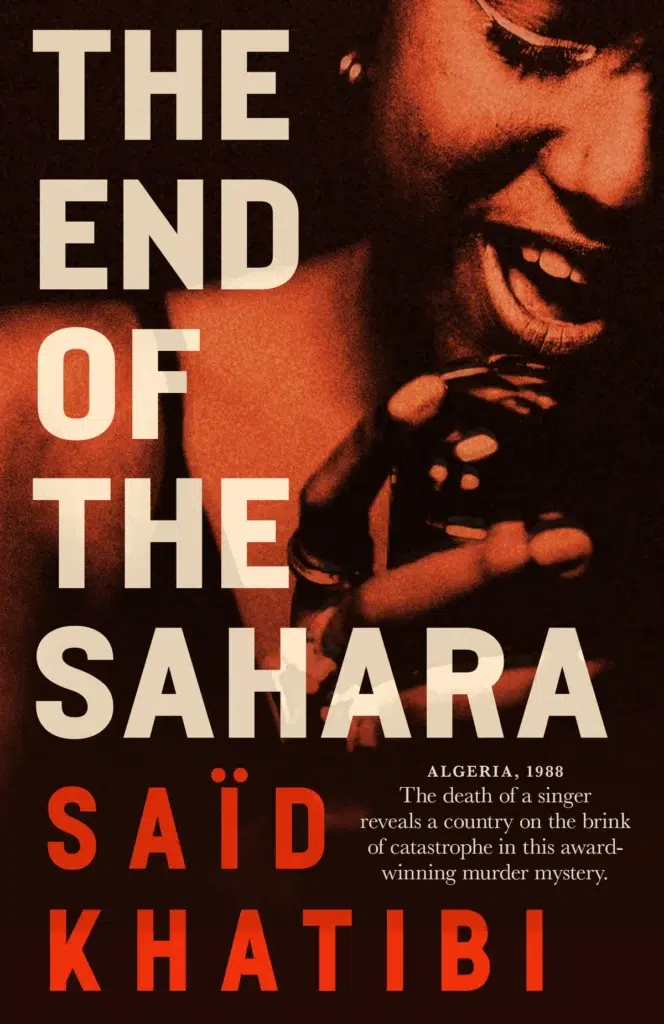
Author’s Note: This novel tells the story of the end of socialism in Algeria almost one year before the fall of the Berlin Wall. The novel’s events culminate on October 5, 1988, when scores of young Algerians took to the streets to protest the country’s single-party system that had been in place since the country’s independence from France in 1962. A state-led massacre followed, along with the violent emergence of Islamism and the beginning of the civil war that left hundreds of thousands dead. In a country on the verge of collapse, much of the action is centered in and around the Sahara Hotel, where people from all over the country, rich and poor, come together. The hotel stands in for Algeria, and Algeria for all countries that cultivate historical amnesia and indifference to others. The End of the Sahara is narrated by many, allowing the characters to tell their own stories in their own voices. It is a tribute to the more than five hundred people who died fighting for freedom on October 5, 1988, and to women who fought on this day and every day, resisting a violent patriarchal system that aims to control them. This is a novel about the end of one era and the bloody beginning of another. It speaks of the silences of a country we rarely see and recounts the crime of forgetting that we all are prone to commit.
IBRAHIM
SEPTEMBER 9
They called me Ibrahim, or Brihoum, or Briha. Names aren’t important in this place.
That’s what I was thinking about when the shouts of a cookware peddler woke me that morning. “May God give you canker sores,” I cursed him. He’d kept me from sleeping in after I’d spent the night previewing new movies and hadn’t closed my eyes until dawn. Two Westerns, an Indian movie, and three adult films. I wrapped the videotapes in sheets of newspaper and made my way to the kitchen.
“We’re out of coffee?!” I grumbled to my mother.
“Go drink some poison!” she shot back as she hung the laundry to dry in the house’s interior courtyard. Whenever the pain in her molar came back, she spoke with a sharper edge.
My head felt heavier than usual, so I left the house, slamming the door behind me, indifferent to her abuse. She isn’t happy with the job I’ve been doing for two years now, after scrimping and saving to open a shop that rents out videotapes and VCRs. This was the business that yielded the most in return for the least effort, especially since the city had converted its only movie theater into an administrative building.
The more she complained, the more I reminded her that getting a government job required me to complete my compulsory military service, and I wasn’t keen on spending twenty-four months in some far-flung army barracks. Once, my uncle had suggested I go with him to the Rubber & Plastic Co. and take a temporary job there, but I said no. “A young man like me? A university graduate? Working with morons?” That company hires people who, unlike me, haven’t com-pleted their education. I would rather starve to death than go work there. “You like doing business with haram things?” my mother often chided me. She had heard from our neighbors that, contrary to Islamic religious practice, all movies show women smoking or kissing men, and she avoided these movies whenever they were shown on TV. I preferred to bite my tongue rather than fight with her. Or I might press some coins into the palm of her hand, which she would then stuff into her bra. “What’s forbidden is what comes out of the mouth, not what goes into it,” I’d tell her. I once heard someone say this and have hurled it at her many times since. I walked for fifteen minutes, passing the Christian cemetery, then the vegetable market, before reaching the Khayma Café. Pictures of soccer players covered its walls, just to please its customers. The café was at the edge of a traffic circle known as the Pitcher Roundabout, so named for the jug-shaped stone fountain in its center that hadn’t flowed with water since its ceremonial unveiling. As the caffeine coursed through my veins and I regained my equilibrium, I muttered to the waiter who, like everyone else, called me Brihoum rather than Ibrahim: “Where do you buy your coffee?” He snapped his fingers and quipped: “We grow it.” Even though it’s not available in stores, you can get strong coffee in cafés which tastes as if it’s been mixed with ground-up garbanzo or fava beans. “A country with no head nor foundation,” I mumbled as I got up and headed downtown, nearly two miles straight down Fifth of July Street. I counted the potholes as I walked, then turned right down an empty side street, where my shop, the Desert Rose, was tucked away. On Fridays, people didn’t roll out of bed until after prayer.
After lighting some incense, I arranged the new movie jackets, hiding the adult films under a wooden table at the entrance that I’d made into something resembling a welcome desk. I wiped the front window with a rag and checked on the back of the store, which was hidden behind a curtain. The space was mostly occupied by an iron bed where I sometimes laid down for a nap, practiced guitar, or enjoyed a passing fling. I was twenty-seven, and sappy love stories no longer did it for me. Instead, I contented myself with sexual adventures that had a lifespan shorter than a butterfly’s. I felt pretty confident I could remake the hit song “Salma ya Salama.” I’d send it to Talents on Radio Algiers, it would get played on-air, and if I got the most listeners’ votes, I’d win a cash prize.
From under the bed, I pulled out the novel I’d bought as a gift to myself from a sidewalk vendor who also sold fabric and spices. No one else had remembered my birthday. I looked at the title, The Sheik, and the name of the author, Edith Maude Hull. I had seen the movie and smiled at the municipal library stamp on the first page. In the markets, I often came across items that had once been government property. Perhaps a day will come when they’ll sell the employees too! A warm feeling had drawn me into The Sheik from the very first sentence: “Are you coming in to watch the dancing?” I enjoyed the love story of a tomboyish girl and an Arab sheik from the Sahara. I was engrossed in its last pages when a man with a receding hairline walked in. He wanted to rent a VCR to watch his brother’s wedding party.
“Come back tomorrow,” I told him. A young woman with wavy tufts of hair peeking out from under her veil had rented it the other day. Rather than hand over her own ID card for me to hold onto as was normally done, which would have given me her name and address, she’d left her fiancé’s. I went back to my reading, taking advantage of the street’s calm as it approached midday on September 9, 1988, not realizing then that that book would be the cause of the worst days of my life.

ACHOUR
If I hadn’t plunged the knife into my cousin’s shoulder, I wouldn’t have been saved from death and lived to tell my tale, which began that morning when the heat started to scorch my bald spot and I became angry at the people who had made me leave the village. I was startled by what was before me. I frowned and staggered over to a juniper tree. I banged the ground with my staff to block my sheep’s path. I counted them off from one to six, then drove them home, where I saw my daughter, Louisa, who was not yet twelve. She leaned her pencil-thin body against the door as she played with her brother, who had just learned to walk. Except for a green shirt that stopped at his belly button, he was naked. I shouted at her to put the sheep in the pen. My staff landed on the ground in front of her, where I had thrown it like a javelin. She straightened up to carry out my order. When she called out to ask, “Where’re you going, Papa?” I was already gone, leaving dust behind me.
I went back to where the body had been dumped on its back, legs spread, on the sloping ground among the wormwood plants. Dear Lord, I thought. I stroked my chin, which I hadn’t shaved for a week, then raised my right palm to my temple, horrified at the sight of drying blood running from her nose to her left shoulder. I turned my eyes to the opening of her beige shirt, where a gold necklace peeked out. “God forgive her.” I felt a sharp pain in my stomach.
Her long black hair ended in half-twisted tufts. Her eyes were brown, and she had black kohl on her eyelashes. Her round nose looked like a grape dusted with bits of dirt. As I imagined her family’s anguish upon hearing the news, I noticed a scar on her lower jaw. She looked like she was in her twenties. She was thinner than my wife and had softer skin, and I guessed she was a nurse or a teacher. I was baffled. How had she got here? No woman in her right mind would venture alone into this wild meadow, full of poisonous and medicinal plants, that was attached to the city’s edge like an appendix (something a municipal employee once said to me). The only people here were the poor souls who crowded into informal dwellings they built out of tin, cane, and straw, hoping that one day the world would look kindly on them and they could move into houses with running water and electricity.
I wanted to place my hand on her forehead and recite some verses from the Qur’an (“My Lord’s words heal the dead”), but I couldn’t bring myself to touch her. I was still shy around women, something drummed into me by my mother when I was young. When a woman I don’t know crosses my path, I still lower my eyes and blush until she disappears from view. The dead woman wore a pearl earring, and I realized that my daughter had never worn jewelry. I took two steps back, scared that someone might see me and accuse me of a crime I had not committed. There was a watch sparkling on her right wrist and pink polish on her long nails. I wondered what might be in the handbag lying between her legs. Money? Gold jewelry?
There’s a security barrier located on the road opposite the meadow, where they check vehicle documentation and issue speeding tickets. It’s set up every day from seven in the morning to eight at night – two patrols alternate shifts. I rushed over and saluted the policemen stationed there, my jaw trembling, then added some broken sentences: “Dead… saw her… lying there…” I pointed in the direction of the body. One of the policemen craned his neck toward me and said, “You’re sick!” as he scratched his right calf. “Come… look… look for yourselves.” The two policemen exchanged puzzled looks. Then I got into their car with them and pointed the way.
We followed a dirt road dotted with stones and lined with dried-up streams. The sound of the Qur’an being recited came from a loudspeaker at one of the nearby mosques, calling people to Friday prayer. I was terrified they would accuse me of something I hadn’t done.
One of the policemen put a glove on and felt the woman’s neck for a pulse. “Oh my God!” he said, then spat on the ground to his left. Slowly, he looked up before addressing his colleague: “She’s been struck on the back of the head.”
He got on his wireless radio (I had learned the word “wireless” from the imam) and specified his location. We waited less than twenty minutes for the ambulance to arrive, passing the time in silence as we watched the hopping locusts that had invaded the city months ago and that no one paid any attention to anymore. A doctor came forward to examine the dead body, which took no more than a couple of minutes. Then another police car arrived. Two men got out. They marked off the area with yellow tape. One took pictures of the victim, and the other grabbed her handbag without looking at what was inside. Then they left. “These sons of bitches,” the ambulance driver whispered to the doctor, and gestured with his head toward my neighbors, who had started to emerge from their dwellings to take a look, not one of them daring to come close. Louisa stood in the distance in front of our door, her arms around her brother. Then, two paramedics picked up the body after covering it with a white sheet. A policeman asked me for my name.
“Achour Hadeeri.”
As he pulled the glove off his hand, the other officer barked: “Come with us!”
Fear gripped me. I remembered that I hadn’t finished grazing my flock yet. I usually drive them for three hours or more so they can gobble down the wormwood that quenches their thirst, or I might give them some leafy carob branches to fatten them up. I thought about asking the two policemen for permission to give the sheep some of the dry bread my daughter collects from the neighborhoods downtown or to ask my wife to do it instead, but I was afraid of what they might say. Their frowns told me they knew who the victim was.
As soon as we got to the police station, the first policeman disappeared, while the second one spoke to a colleague standing behind the front desk: “Has The Boss arrived yet?”
“He has.”
I went with the policeman to the first floor.
He sat me down on a wooden chair in a smoke-filled waiting area. He went into an office, the door creaking as he opened it. As soon as he came back out, he ordered me in. My face went pale as I thought about what I had done over the past few days. Maybe God was punishing me for a sin I’d committed. I couldn’t think of anything of note. Mine is the life of the hardworking stiff. I wake up in the morning a little before or after seven. I perform my prayers, then listlessly sip my tea. I fill the metal basins with water from the well next to the mosque. I pasture my sheep, then gather up some wood for the cookfire. After negotiating the price, I might buy some simple items from a store or a sidewalk vendor, after which I return home to inspect the animals’ pen before lying down on my straw mat. I gnaw on something to warm my stomach and wait for nightfall before getting into bed. Every Thursday, I head to the cattle market, where I watch the rise and fall of prices, waiting for the best time to buy a head or sell another to keep my business going. From time to time, I get a day of work on a construction site; the wages help me make ends meet.
My mind was drifting when the police inspector suggested I sit. I was embarrassed by my appearance. I wore a crimson-red shirt with only the bottom two buttons remaining, dusty black trousers, and white plastic sandals with my big toe sticking out.
“Are you married?”
“I am.”
“Any children?”
“Two.”
The inspector, who they called The Boss, wrote in a green-covered notebook that I was born in 1955. He guessed I was no taller than five seven. He didn’t think me guilty because I spoke directly, had reported the dead woman and had agreed to come to the station; as he put it, all the evidence exonerated me. Another policeman sitting next to him typed what I said on a typewriter whose clacking sound could be heard several yards away.
The inspector, whose name was Hamid, told his colleague that the forensic police on the scene had found only a white silk handkerchief, some nail polish, a bottle of perfume, and a wad of cash in the dead woman’s handbag. There were no documents that might point to her identity. “We’ll await the missing persons’ report to identify her.”
I sat still in my chair, which had arms and was quite comfortable. I only spoke when spoken to. How did I spend my days? The names and occupations of my neighbors? An image of my son popped into my head. He’s my firstborn son. I’m closer to him than I am to my daughter. Sitting in that spacious, almost empty office with its electric ceiling fan and the smell of deodorant – that’s right, deodorant, not perfume; I know the difference, even though I don’t use either one – made me miss him.
“Over the last few days, have you noticed any strangers wandering around the meadow?”
“No.”
While I was there, I thought I should lodge a complaint against my neighbor, Sheikh Lahmar, who dyes his beard red with henna. Women line up daily in front of his door for amulets, their screams ringing in my ears as he rids them of the spirits that inhabit them. Before I could say a word about that, though, a policeman entered the office carrying just-developed photos of the victim. The Inspector gasped as he grabbed his head, his lower jaw trembling: “No… I must be dreaming!” he yelled, then ran out of the room. It made me regret ever reporting the body.