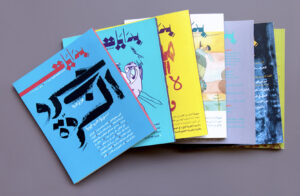
Through collective writing, this hybrid work offers counter-narratives to dismantle the disaster narrative mapped onto Afghan lives.
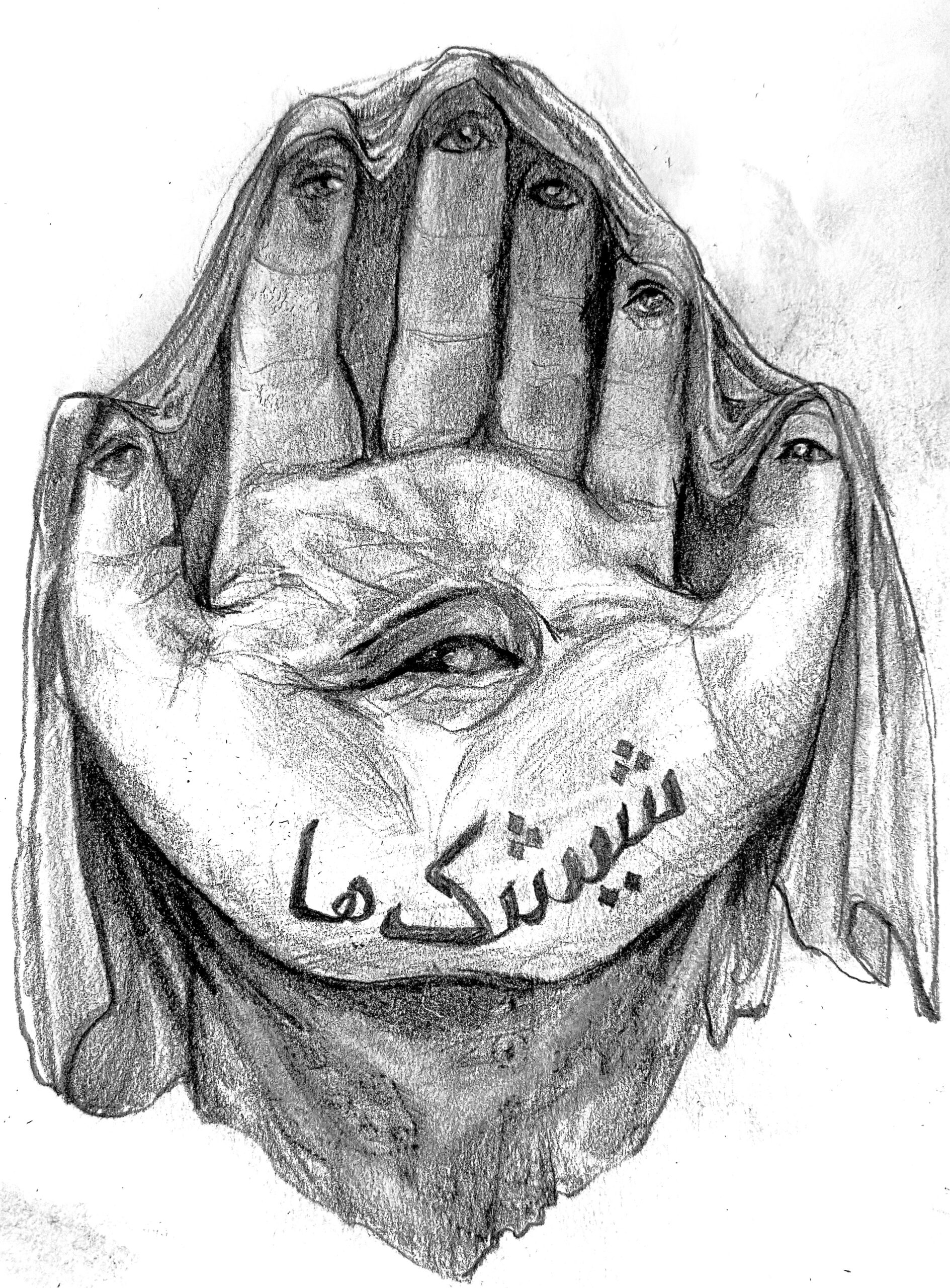
Sheeshaka, the Farsi word for “witches,” is a collective of seven Afghan American women working across lyric essay, fiction, poetry, and visual art. Their work emerges from varied professional, geographical, and generational contexts, yet is bound by shared histories of migration, linguistic fracture, and survival. The pieces below feature Farsi and Pashto.
۱
small like khurtarak
like itty bitty teeny tiny
not in size
in soul
not the bottom of the foot
but the inner most part of my jaw
my jaan
cavities of sugar
burn holes
in the filament of your sweetness
mama jaanemaa,
you, my body
i confide
i feel small
in the criss-cross of
interpretation
wires wound
around a thin inflection
orphanage for tones
and tongues
each betrayal
a guttural invasion
nauseating sound of
morphing zaban
splitting generations
one sil/sila at a time
so i interpolate.
a false polish on
a two-way mirror
i am not offended
when called du-rui-a
a constellation
called gemini
grants me this
a sky grey
is still a sky
the grey is just
a filter
god made to tease
coastal folk
amaw,
i know nothing of this
my land is locked
like my zaban
when i speak
it sounds like
the wrong pick
in a thief’s
attempt to liberate
an impotent fortune
flaccid is the mystery
of capital
Letters, signifiers of
power
quasi-qualifiers
the grammar of appearance
an apparent fence
arranging tense postures
jaanemaa…
my, mine, or yours
in the end
we are under each others
nerves
we are all
one-body
one
Jaan
Notes:
khurtarak: really small
jaan: soul, life, or body
jaanemaa: my soul, life, or body, term of endearment like darling
zaban: language / tongue
sil/sila: chain of succession, lineage, sequence
du-rui-a: two-faced
amaw: but, however
۲
What have you done to survive, and how did the earth hold you?
I climbed apple trees, read in the garden, let my hair be free,
the wind breaking through my mane as I cycled
up and down
a small American town
its doors unlocked
a moment of free fall, of letting go
a moment in which being out of control was ok.
I straddled an old bike
made anew by my father’s proud hand
branded by turquoise brushstrokes,
unlike the glossy bikes I’d seen.
My cheeks flushed pink with embarrassment,
shame besharm!
for not sharing in my father’s excitement
I swallowed my tongue.
I picked cherries, pitted them
sticky, sweet, and sour.
Pitter jammed.
Cherry jam.
I still love my mother’s cherry jam and cherry stew.
“Cherry stoo-oo-oo?!”
oo’s ride up and down like a roller coaster on a foreign tongue.
What is that?”
so many ask
faces twisted, noses scrunched.
It is
h the other
the unknown.
The melding of sweet, sour, and savory.
My mother’s love.
Her want to fit in
please
to be a splendid cook, dutiful mother.
It is the hunger of the youngest child
to be seen and celebrated in the shadow of three sisters.
One mother becomes three
And the tree’s boughs
bow from the baar of scattered roots.
It is eagerness
sweetness
and surprise pits for those who have been bad, too hasty,
impatient.
It is sweet revenge
crowning piles of fluffy white chalow
atop a platter so large
it must be held
by two careful hands.
A ceremony unto itself, room is quickly made to accommodate such an important guest.
A guest meant to impress, pacify, feed
h the hunger,
h the emptiness
of not being enough.
But the real guest is my father,
even though he sits here every day
without a word
he serves himself
with a large flat spoon
pregnant with expectation.
Much hangs upon a single grain of rice.
Does it stand apart on its own?
Is it sticky, or
crumbling
onto itself and others?
We wait quietly, eyes darting.
h aalaabaaloo!
h allah o akbar!
The stew has arrived
a trojan horse
dressed in reds and browns.
Gluttony prevails.
Stones against bones
collapsed cherries
The pit resists
tongues twist
The table is in balance.
The corners of my mouth are sticky
The distarkhan is decorated with white grains of rice
a blueprint of silent stories amongst cherry stains.
Notes:
sharm: shame, besharm: shame on you
baar: weight or load
chalow: cooked white rice
aalaabaaloo: the type of tart cherry used in this stew
distarkhan: tablecloth
۳
The cartographers of my education enrolled me in ESL
as if I was imprisoned by my Pashto, an uncontrolled
variable. Yet the accident of my zip code fires me
across the gun deck of America, a loose cannon.
It is no accident that I now lack an accent,
traces of my mother tongue pledged out of me.
Is this my inheritance? What little syllables
are left to me? I am target practice, a control,
a receptacle shipped from my mother’s withered
dreams to New York City. Do you ever wonder
how I weathered the cannon?
۴
My father required that I speak 100% Persian. If I used a single English word, he would shake his head and shout, “No English! Farsi!” Over the years, the shouting stopped, eventually. Instead, any English off my tongue, he’d simply pretend not to hear. My words illegible. My native tongue, English, invisible. His native tongue, Persian, a test I had to pass. Persian, his language for another land.
His friends called him Injineer. A random nickname, I assumed as a kid, one from his past in that place called Kabul that I saw marked with a star on maps—until it hit me years later: Injineer was Persian for engineer, used out of respect, an Afghan practice. His job became his name, his place in the world, his social title.
But he had wanted to be a diplomat, not an engineer. An ambassador traveling the world, representing Afghanistan as it ascended the world stage. Soviets loved Afghanistan. Americans loved Afghanistan. Money was pouring in, the nation modernizing. The US and the USSR were building highways, canals, airports, dams, pipelines, bridges.
My father was trained by American teachers at the Afghan Institute of Technology in Kabul, and then by American professors at Kabul University. The US needed boys like him to grow up to manage all the new infrastructure being built—Cold War gifts, downpayments for Afghan allegiance. His name became his profession, his assigned role in empire, his identity, his socially engineered culture.
My American mother understood Farsi but didn’t speak it. If I spoke English, my father wouldn’t hear. If I spoke Persian, my mother stopped talking. Family dinners were impossible. We had family dinner every night.
I spoke Persian. I seemed fluent.
On the news, Dan Rather updated Americans about the Afghan “guerillas.” I didn’t understand why this newsman cared so much about primates in trees. Gorillas eating bananas and hanging from branches? Why so concerned? I didn’t understand why in the world my father wanted the US to send Afghan gorillas more weapons.
The word empire was not in my father’s vocabulary. It was not in mine either. There was no need for the term. The US was generous. It was helping Afghans kick out the communists. The US was sending more and more weapons.
At Slovak wedding receptions, the polka bands played, the tubas honked, and the accordions bellowed. My mom held my hands and polkaed so fast around old aunts and uncles that my feet lifted. I floated, brown hair spinning. “One-two-three, one-two-three, you can do it.” Maybe I was used to Afghan drums, Eastern rhythms I couldn’t untangle, songs made with Persian poetry I couldn’t decipher. This music was too peppy. “C’mon, c’mon, move your feet, you can do it!” I couldn’t do it.
When my half-sister from my father’s first marriage arrived in the US from Afghanistan, she went to the high school in our tiny white town in rural New York State. Her hair was long, black, silky-shiny. Every other girl––I’ve seen the yearbooks––had permed, hairsprayed, and highlighted hair––like my mother’s. The jocks, the same kind as those who ruled the hallways when I graduated to that same high school years later, yelled in her face, demanding she repeat after them: Fawkyu. Es-hole. Sunova-beach. She told me they ran off laughing and left her there, back against the lockers.
She had a beautiful accent. She could speak five languages. One day she would work as a translator for the US military after it sent all those weapons to the mujahideen, after the US abandoned what happened to Afghanistan next, after the implosion of two very tall buildings in Manhattan, after the US finally invaded. But that is twenty-five years in the future.
On Sundays, my father drove every Afghan kid in the Rochester metro area to the mosque for Sunday School. Ten or twelve kids in the VW van. He yelled “Farsi! No English!” My brother traded NFL cards with boys in the back of the van. They Persian-ified football vocabulary. Shesh interception daasht! Quarterback besyar khub ast! No, Chicago Bears behtereen team ast!
My mother loved the Oprah Winfrey Show. She loved Gloria Steinem. She subscribed to Ms. Magazine. She loved the National Organization for Women. From Oprah she learned the term domestic violence. She learned patriarchy. “I think your father’s sexist, he doesn’t believe in equal rights for women,” she told me.
Before dinner many nights, my mother would encourage me to speak to my father in Persian while we ate. She wanted to keep him happy. She wanted me to help her with keeping him happy. She’d hand me a salad bowl, “Take this to the table, and don’t forget to speak only Persian to your father, don’t worry about me, you can talk to me later.”
My father taught us Persian lessons at the kitchen table. My little brother and sister would practice reading from a copy of a grade-school primer. I had to translate newspaper articles. Sometimes I tested his opinions. I translated an article on women’s rights. I couldn’t find the word for rights in my Persian dictionary. He filled it in with red ink. Haquq-i zanaan.
In college, my copy of Karl Marx’s Communist Manifesto was illustrated with an image of a protest on the cover. One sign was in Persian. Dist-i imperialism kotah. That’s when I learned how to say imperialism in Persian.
One steamy day, I was working in the kitchen with the women preparing a meal for an Afghan mehmani. My mother, in capri pants, sleeves rolled up to her shoulders, bandana tied around her blond hair, ran her eyes down my aunt Ammeh jan’s long shirt and pants, her loose white headscarf. My mom asked my cousin, “Can you ask your mom, is she hot?” My cousin translated. My aunt shook her head. My mother insisted, “You must be so hot. Does she want me to point the fan at her?” My cousin again translated, and my aunt again shook her head, responding in Persian, “No, no, thank you, aadat.”
My cousin looked at me. “I don’t know how to translate aadat,” and I said, “I don’t know either.”
My father also taught me another kind of translation. How to look past news headlines about “conflicts,” how to compare the armies with bulldozers and machine guns with the people with no way to resist except for throwing stones. He taught me, and my mother taught me too, although neither of them realized the depth of their lessons, what superpowers do to powerless people, what parents can do to children, how narratives fabricated in think tanks, board rooms, white houses, kitchens, and living rooms warp what we believe, how we live, what we see.
Aadat is a habit, a pattern. A practiced custom, a tradition inseparable from the body. It’s a way of being in the world. The word originated in Arabic, then made its way into Persian, moving in, residing where it didn’t start out, like so many Arabic terms now at home in Persian. The plural form became singular. An everyday routine, holding places and people and languages from near and far at once, bordering on ritual. It is like saying I’ve been doing this so long I no longer know where it started and where I end.
۵
Empire robbed me of my mother’s tongue.
Severed me, from knowing, wielding, the tongue of my ancestors.
Deprived me from inhabiting the same linguistic world, conscious plane,
as my parents, my aunts and uncles, my kin, my native world;
from knowing the words of our writers and thinkers.
Barred me from learning and understanding myself through the lens
of the poetic, romantic, feeling-rich language that shaped generations before me,
instead crushed and reduced by the penetrating, violent, sterile, unfeeling language of Empire.
Relegated to the woefully limited tongue, imagination, of Empire,
I was taught to label and hyphenate myself; stripped from believing that
I am whole,
and not two halves.
Empire wants to atomize us, to separate us from each other,
and ourselves.
Wants us to believe that love is a word that you say, not a way of being.
Wants us to ignore our senses, and each other.
Wants us to exalt words as the ultimate truth,
even when proven meaningless and deceptive.
The white, Empire-born and bred, ignorantly pitying me,
assuming my mother, with her non-fluency in Empire,
doesn’t understand me, “the real me.”
Thinking of us as not understood, and my mother as voiceless,
themselves, knowing only the language of lies. Of domination. Of depravity.
While they ask “what’s wrong,”
my mother leaves a box of tissues at my door, delivers a bowl of cut fruit to me.
They say “I love you, thinking of you”
while she whispers prayers for me in cupped hands,
kneeling at her worn prayer rug, asking our creator five times daily to bless me.
Bey zubaan, without a tongue—the Farsi word my mother uses to describe our cats and all animals,
a word commonly used to imply a disability: an inability to speak, to communicate.
As if respect, consideration, love for the other were not a shared, universal language.
Linguistic barriers foster consideration, love,
because without a shared fluency in a man-made verbal code,
each must consider what the other is trying to communicate, to say;
to consider what the other might need or want.
To see them, to really hear them.
We frequently refer to women in Afghanistan and elsewhere, as “voiceless,”
bey zubaan.
As if our indifference to hearing them, to considering them, renders them voiceless.
We deem them as such, to evade the truth of our carelessness.
To love is to consider.
Despite years of acquiescing to Empire’s subterfuge, believing I was disinherited from belonging
—that I was more them than me—
I know now that I have not been severed from my mother tongue.
My mother tongue is my inherited language;
not an alphabet, but a culture, an entire system of being and interacting.
My mother tongue is love, respect, consideration.
Collective care, interdependence, dignity, integrity.
Empire still tries to rob this from me.
Tries to force me into withholding expression, to make me bey zubaan, to abandon myself;
vilifying my language, my faith, my culture, my very being,
trying ceaselessly to reverse their beauty, their meaning,
to shame us into abandoning our tongue so that we could be susceptible to theirs,
their flowery lies, their shameless doublespeak.
Empire wants to mute, censor, silence us,
bey zubaan.
Being unheard is a reflection of the one not hearing;
there is no such thing as voicelessness, the way that there exists heartlessness.
Carelessness. Recklessness. Lovelessness.
۶
I visited Minneapolis just a week after Renée Good was killed by the State. I stayed with a friend in her home five blocks from the memorial site, the bedroom windows looking out directly on George Floyd Square. For months, we had planned this coming together of a few of us ‘ajeebha. Even then, we had already been in a state of emergency.
This friend supports newly-arrived Afghans, helps them put down roots and grow gardens in the soft belly of the beast that’s devoured them. For the past year she’s been warning me, telling me the war is coming, that things are getting dire. Days before this visit, she had an unplanned surgery and for the duration of the weekend, was forced to rest and slow. Sleep, even. But she insisted we maintain our plans.
It was easy to step in and mother her; to care for the person who cares for our people.
This past year, I’ve watched my friends outlive a mothering age. I’ve watched my friends lose their bodies, go under the knife. My friends have holes in their abdomens and their breasts and clavicles. Abscesses have grown there, the budding growths subsequently removed. I’ve watched my friends fade away from their mothers, then find their mothers again, yell at their mothers, pray to their mothers, forward me family photos on WhatsApp from their mothers, sit with their mothers in front of the television in silence. I’ve seen their bellies grow and their blood hemorrhage. Seen them survive it. I’ve held their hands and touched their hair and made them tea.
As the calendar turned and the snow blanketed a frigid Minnesotan January, my friend — a northern wild flower, hardy and untamed in her beauty — lay reclined, propped up on toshak in front of the fireplace, mother to all of us. She called on us to fight, to bare our teeth, but also to dance and drum and flirt; her means of production never residing in the ovary that had been ripped out, but rather in her hands, her heart, her tongue.
I can be quieter outside of English, less sure. But I also listen more studiously. Certain rhythms find me easier. With the right company, the words spill out instinctively: bismillah and mashallah often, bakhair always, jayet khali only when I mean it.
My mother was white. Was a real do-gooder. My mother had a green thumb. She was known for her herbs and her roses. My mother was sick, supposedly unable to conceive a child. My mother birthed me. She had an affair with a brown man, my brown father, and made me — a secret nestled in her soft white belly. My mother gave birth to me near a flat river, in a tornado, under a jaundice-yellow sky. The next week, German troops took chisels to the Wall.
Sixteen years later, my mother died.
My mother died not of the cancer, but of the treatment. The brute-force radiation ate away at the walls of her heart, over years and years, and she told no one.
Renée was white. Was a mother and a poet. She won an award, once, for a poem about science and belief and the big eternal questions.The piece also addressed the body — the piddly brook between pancreas and intestine, the meeting of ovum and sperm — and the quotidian minutiae of living — birthing, rearing, raising:
now i can’t believe—
that the bible and qur’an and bhagavad gita are
sliding long hairs behind my ear like mom used to &
exhaling from their mouths “make room for wonder”—
My friends and I mother one another, broken and incomplete and divine. There are no secrets held from shame, no daughter who is not our own.
We meet with many tongues and there, empire dies.
۷
The tree of eyes is laughing,
it told me: laughter is the salt of life.
But I’ve found salt that tastes like gold,
and it tastes the same straight off the knife.
You can’t outrun a song unsung.
That’s why I wake, muttering an old tongue.
He’s here,
he’s gone.
It wasn’t long.
When he and I were young, that cat sat in my palm.
He loved the garden right up until;
He knows, he knew, he always will.
I realize now I’ve been a fool,
tongueless,
distracted by the leaves until this.
I didn’t see that cat was all just smokeless fire,
and that he still is.
Of course no one sees the chasm till you’re tripping on the wire,
and even fools know this.
The tree of eyes is made of salt,
it laughs and melts.
It’s no one’s fault.
h
h
A collection by SHEESHAKA
۱ Hawa Amin-Arsala
DARI SHMARI JAAN
۲ Gazelle Samizay
What have you done to survive, and how did the earth hold you?
۳ Seelai Karzai
Losing Pashto
۴ Leila C. Nadir
Glossary of Missed Translations
۵ Samera Yousuf
on tongues
۶ Alexandra Millatmal
bey zabaan, bedoon-e nam
۷ Elina Ansary
Old Tongue