Montpellier celebrates the 19th Arab arts encounter organized by Festival Arabesques, held from September 10 to 22, 2024.
An annual series of encounters that is “a hymn to cultural diversity” in the south of France, for nearly 20 years, Arabesques has been a much-anticipated regional highlight, full of joy, surprises and creativity, in a city that supports the arts. The organizers ensure that Arabesques is a breath of fresh air with acts from both France and abroad, showcasing a wide range of artistic expression.

Cultural Cross-Pollination
This year the spotlight will be on cultural exchange and cross-fertilization, in sometimes surprising melodic combinations. For example, discover the Shamstep movement led by the Gaza group 47SOUL. This Palestinian music collective blends the sounds of “dabke” (meaning “kick”), a traditional folk dance, with other chaâbi music from the Levant region, as well as hip-hop, electro and R&B.
Imparting a contagious energy and a generous mix that makes you want to dance. 47SOUL calls for recognition of “the common humanity of all peoples.”
The Interzone duo features guitarist Serge Teyssot-Gay, former member of Noir Désir, and Khaled Aljaramani, Syrian oud player with the group Bab Assalam. In their album 5ème Jour, they intermix their respective cultures, between Europe and the Middle East, with electric, acoustic and poetic music. On this, their fifth album, they continue their collaboration, blending classical Arab music with rock, oud with guitar. The musical universe that emerges is absolutely intoxicating.
Other musical explorations will turn your heart upside down, including the Terrae Incognitae show. Provocative, exalted and insolent, it brings together singer and oudist Kamilya Jubran, instrumentalist Floy Krouchi, who accompanies her transformed electric bass, and Lebanese oudist Youmna Saba. Born in Israel of Palestinian parents, Kamilya Jubran, who encourages freedom of expression for young artists in the Arab world, has initiated this ambitious project to enable “the blossoming of new sound units.” This is an exceptional opportunity to meet these three adventurous improvisers.
Franco-Moroccan DJ Aziz Konkrite will take you on a whirlwind tour of the Siba Sawt-System, an anarchistic sound system combining traditional and popular music with funk, soul and hip-hop accents.
As for Sami Galbi, he’ll deliver an energizing electro clubbing raï. Revealed at the Trans Musicales de Rennes festival, this Swiss-Moroccan artist, with his stunning charm, plays with the codes of popular and traditional music, infusing Algerian chaâbi and melhoun with highly convincing electro-pop vibes. Her music is sunny and addictive, and you can’t help but dance along.
Raï and fusion will also be in the spotlight with the Algerian group Raïna Raï, led by the famous Lotfi Attar. Blending tradition and rock with derbouka, gasba (reed flute), guitar and drums, the group has become legendary for its freedom.
With the Benzine duo, you’ll discover Bedouin poetry in an electro-raï sauce, accompanied by Farid Belayat and Samir Mohellebi, winners of the Prix des Musiques d’Ici 2023.
Hope and light
In Montpellier, the Constantinople musical ensemble and Belgian-Tunisian singer Ghalia Benali celebrate the poet Rûmi (1207-1273), considered a spiritual master. Mystical and luminous, his texts come down to us eight centuries after they were written.
Kiya Tabassian, who is musical director of Constantinople and plays the sêtar (an Iranian instrument), explains: “I’ve been reading Rûmi’s verses in Persian since I was a child. His poems have often inspired me, and I’ve been setting them to music for many years now.” In Ghalia Benali, he claims to have found “the ideal voice” to sing such poems. They have chosen to highlight little-known poems in particular.
Depth, linguistic refinement, rhythm… Kiya Tabassian underlines the “contagious ardor” of Rûmi, who nine centuries ago claimed to be “intoxicated by the cup of Love.”
I was dead, I became alive,
I went from crying to laughing.
The reign of love has come,
and my kingdom became eternal.
(Rûmi, Ghazal)
Hope and light also lie in the blending of influences, as Ghalia Benali has picked up along the way, from Arabo-Andalusian, Indian, jazz and many other inspirations.
Or in the lyrics of Moroccan singer Oum, who will be presenting Dakchi, her fifth album created in Marrakech. Propelled into an international career, Oum covers her past hits as well as previously unreleased tracks, in a joyful, peppy folk-soul vein.
Because Oum knows that “life is short” and that you have to seize the day, she carries a message of struggle in a world where nothing can be taken for granted, and where it’s all about doing what’s best and being responsible.
Arabesques also welcomes the great Tuareg rock band Tinariwen. Formed in 1979, they have blended traditional Arab and West African musical styles with other horizons, from blues to folk. The result is a “desert blues” that we never tire of, where we can follow in the footsteps of the Tuareg people. With Amatssou, which means “fear,” they present their ninth album, with a touch of country. It’s an odyssey in the form of resistance to the rising tide of fear in northern Mali, which is plagued by terrorism and war. A jolt of hope to prevent the Tuareg culture from disappearing, and to reaffirm the dignity of its people.
Refinement
The diversity of cultural heritage is also in the spotlight with the Atine group. “Atine” is a Persian word that can mean both “reunited” and “new.” This is the name of this group of five musicians who will present Yâri, a concert based on Persian poetry. Aïda Nosrat, Sogol Mirzaei, Christine Zayed, Marie-Suzanne de Loye and Saghar Khadem will be performing new compositions, in a voluptuous ode to friendship. The melodic richness of the târ, qanûn, viola da gamba and daf will take you on a gentle, refined journey, blending traditional Iranian, Arabic, flamenco, jazz and baroque musical styles. The five of them offer an elegant glimpse of what it means to be Persian, in the context of their multifarious heritage.
Eclecticism will also be on the agenda, with Palestinian-American Tareq Abboushi lulling us with the melodic motifs of Arab maqâms, with sounds blending jazz, funk and electronica — creations that strike a balance between tradition and modernity for this artist, who gives lectures on Arabic music at prestigious venues in New York.
A part of humanity’s intangible cultural heritage, maqâm is part of the art music tradition, driven by the virtuoso improvisation of the singer, who demonstrates refined rhythmic prowess. A champion of the oral tradition, Tareq Abboushi is renowned as an exceptional buzuq player.
“The more I delve into my Palestinian heritage, the more impressed I am by the beauty and power of a music and poetry that have been shaped by hundreds of years of celebration and ritual.” Fighting against the “appropriation and erasure” of this Palestinian heritage thus becomes one of the driving forces behind his creation.
A wind of revolt
If the Constantinople Ensemble and Ghalia Benali have come to sing the poetry of Rûmi, it is perhaps because he refused to be labeled. His words resonate with us:
I am neither Christian, nor Jewish, nor Parsi, nor even Muslim.
I am neither of the East nor of the West, neither of the land nor of the sea.
I have abdicated duality, I have seen that the two worlds are one.
(Rûmi, Mystical Odes)
Why choose, if the blending of all our cultures can bring a new openness to the world? Why choose, if the meeting of peoples and imaginations gives rise to a dynamic and brilliant wealth? Through her career, artist Ghalia Benali also teaches us that it’s possible to refuse labels and happily mix genres and identities. It’s worth noting that the woman sometimes dubbed “Carthage’s Aretha Franklin” or “Oum Kalthoum’s granddaughter” works as a singer, songwriter, composer, dancer, visual artist, painter and actress. Why choose?
Arabesques also features Palestinian artist Bashar Murad. Exiled in Europe, this UFO who is not afraid to shake up conventions is considered a veritable “pop phenomenon.” Through his songs, he gives a voice to young people living in occupied territory, thwarting social norms and patriarchy, and tackling themes such as gender equality and diversity.
Dressed in extravagant outfits, sometimes grotesque, sometimes sexy, he appears on stage in make-up and disguises, conveying messages of struggle to free Palestine and denounce the genocide taking place there. We saw him, for example, cover John Lennon’s “Imagine” in a Palestinian version… A fine performance!
In particular, he made his mark by collaborating with Icelandic techno-punk band Hatari, who waved the Palestinian flag at the 2019 Eurovision final in Tel Aviv.
Music and politics are one and the same for this artist, who openly assumes his homosexuality, which sometimes causes incidents at his concerts, as was the case in the West Bank in 2022.
Another artist from Palestine proposes to defy genres by opting for a resolutely underground register: multi-instrumentalist Rasha Nahas will take you into a singular musical universe imbued with melancholy and vulnerability. Born in Haifa, the young woman exiled in Europe sings in all sincerity of exile and broken love, in a poetic, indie rock where the power of the lyrics takes precedence. Her second album, Amrat, released in 2023, was recorded in the heights of the occupied Golan Heights.
The faces I knew
Are fragmented in the distance
The city is gradually changing
With time
People ask
Why have you changed like this?
What did you find
What did you go looking for?
(Rasha Nahas, Khotwi – Step )
Saving, electrifying, powerful: there’s more to come from the group Sarãb, which means “mirage” in Arabic. Led by French-Syrian singer Climène Zarkan and guitarist Baptiste Ferrandis, Sarãb blends traditional Arab music, jazz, rock, funk and electro samples. An explosive and furious mix, for this six-piece band, who titled one of their albums Arwāh Hurra (The Free Souls). Feminism, xenophobia, defending the planet, love… The sextet also set to music a text by French writer Alain Damasio:
There’s a mistake in the word foreign.
It’s not a noun, stranger, it’s not an adjective.
Stranger is a verb.
An action verb, transitive, that we use
to distance those who are nevertheless like us.
(Alain Damasio, “Stranger is a Verb”)
A committed and liberated woman, the great Souad Massi will be performing at Arabesques this year. Unwavering in her denunciation of the dangers of dictatorial regimes, racism and the tragedies of immigration, at a time when sea rescues are not preventing the deaths of thousands of migrants in the Mediterranean, she delivers an ode to freedom and a cry of revolt. In her latest opus, she also pays tribute to the sunshine of her childhood, where “light and gentleness” cradled her.
Generous and poetic, she spoke about her work and inspirations in an interview with The Markaz Review in 2023. Caribbean music, rock… The Franco-Algerian artist blends different influences on her tenth album Sequana. One of the songs on the album is entitled “L’Espoir” (Hope), and in Celtic mythology, Sequana is the Gallic goddess of healing: a fine symbol.
There’s always
something surprising around the corner of life
A smile, an oversight
Something good waiting for you
There’s always a desire, a dream
Something important
Beneath the bark, the sap
Something waiting for you.
(Souad Massi, “L’Espoir”)
We find fusion, again, and revolt, with the Moroccan-French group Bab L’Bluz. Gnawa trance, Hassani songs from the Sahara, chaâbi polyrhythms and psychedelic rock… Bab L’Bluz introduces you to the guembri (electric version), the plucked string instrument of the Gnawoui, whose musical production is part of humanity’s intangible cultural heritage.
Psychedelic Gnawa rock, led by Doukkalia singer Yousra Mansour, calls for a revolution in attitudes. Bab L’Bluz is part of the Moroccan youth movement Nayda (the title of their first album), a word describing the new wave of committed artists drawing on local heritage to sing lyrics of freedom. And “Nayda” means “awakening” or “standing up” in the Darija dialect.
To close the 19th edition of Arabesques, festival organizers have decided to program Toulouse’s Mouss & Hakim. The two brothers, former members of the group Zebda, are an integral part of Tactikollectif’s Origines Contrôlées festival. They deliver a vibrant tribute to Algerian immigration, touching on the universality of all humanities and the richness they bring in their suitcases (get ready to dance).
Eclectic
The Festival Arabesques a truly eclectic occasion, showcasing a wide range of artistic expression, because it knows no borders. You can, for example, get carried away by storytelling with Contes d’Arabesques, featuring Lebanese artist Jihad Darwiche. An adept at poetic jousting and fabulous stories, he will unveil some of the traditional tales of the Orient that are his secret. In these marvelous tales, the quest for happiness can be found at every turn…
You’ll cross paths with Amine Radi, who will present his show L’expert humoriste (The Expert Standup), in which he retraces his career, from his childhood in Morocco to his arrival in France and his rise on the Internet (over 6 million followers on social networks). If you’re a fan of standup, you’ll also find French artist Akim Omiri. In his show Contexte, he recounts his life and struggles, having moved from Le Havre to Paris. In his sketches, Omri tackles subjects such as racism, sexism, war and freedom of expression. His bittersweet criticism of society, which he ridicules both in its minor foibles and its major tragedies, is a real tongue-in-cheek rant, as he points out: “If making people laugh is starting to be banned, maybe it’s changing things…”
Last but not least, French humorist Djamil le Shlag will be presenting his new show Exode(s). The former France Inter radio commentator will talk to you with humor and no complexes about his trajectory, between Vichy and Paris, within a society of which he reveals himself to be a keen observer…We remember his stunning resignation live from the public radio channel a few months ago, to protest against the suspension of Guillaume Meurice, who was fired “for serious misconduct” following a joke about Israeli Prime Minister Benyamin Netanyahu. Against immobility and withdrawal, Djamil le Shlag invites us to travel and meet. A breath of hope in a world of bullies…
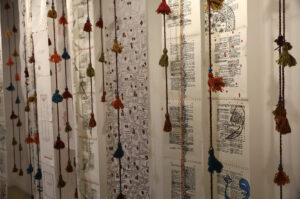
With concerts and other events scattered throughout Montpellier, Arabesques will take over various emblematic venues such as the Domaine d’O, the Opéra Comédie and the Halle Tropisme. The icing on the cake is the program of other events, including screenings at the Diagonal movie house near Place de la Comédie, in partnership with Cinémed, exhibitions at L’Arbre Blanc and Montpellier airport, and free events (Médina, DJ sets at the Kasbah, strolls)…

Meet writers Coline Houssais on Sept 21st and Rachida Belkacem & Karim Kattan on Sept 22nd
Together with The Markaz Review, Arabesques presents two literary events, the first of which features Coline Houssais, who specializes in the cultures of the Arab world. Trained at the Institute of Arab Studies in Damascus and at the Middle East-Mediterranean campus of Sciences Po, where she now teaches, she is also a translator, journalist and independent researcher. Houssais will present her book Paris en lettres arabes (Actes Sud 2024) which builds bridges between the culture of Paris and various Arab writers over time. The conversation will be moderated by Sarah Naili from The Markaz Review. More info.
On Sunday September 22, 2024 at 3 p.m. at Domaine d’O, a literary conversation organized by The Markaz Review for Arabesques will bring together Palestinian writer Karim Kattan and French Moroccan poet Rachida Belkacem. Kattan will present his new novel from Elyzad Editions, L’Éden à l’aube (Eden at Dawn), around the love story of Isaac and Gabriel, in Jerusalem, where it is about jinns and checkpoints, at the heart Palestine. Former radio columnist and member of literary prize juries, Rachida Belkacem is very involved in the cultural life of France and Morocco. In 2023, she published a collection of poetry entitled Phronésis (Mindset Éditions), a work of prose about light, freedom and optimism. In the collective work Maroc de quoi avons-nous peur (Morocco, What Are We Afraid Of), released in 2020, she analyzes the condition of Moroccan women: “The evolution of women’s conditions, so that they are part of morals and mentalities, can only be the fruit of inclusive action involving men.” Rachida Belkacem will present her latest book of poetry, L’Odyssée des possibles (The Odyssey of Possibilities).
The conversation will be moderated by Jordan Elgrably, editor-in-chief of The Markaz Review, who will ask the writers to talk about their work, and what it means to be an Arab writer during a time when Arab journalists and writers have been killed in large numbers in Gaza, by Israel’s war on Hamas and the Palestinians. More info.
So why Arabesques?
Perhaps because these 10 days in September remind us of the unbreakable bonds and shared cultures between the Middle East/North Africa and the Mediterranean, France and indeed Africa and the west. Between sound and word, dance and film, during Arabesques one has a rich opportunity to discover arts from the center of the world.

Giveaway: Enter for a chance to win 2 tickets for Oum’s concert on September 13th
Dreaming of seeing Moroccan artist Oum live? In partnership with Festival Arabesques, we are giving away 2 tickets for her September 13, 2024 concert in Montpellier.
Enter for a chance to win now: https://bit.ly/3Z4c9sW
The giveaway is open until September 11, 2024 until 11:59pm. The winner will be announced on September 12, 2024.
Practical info
Arabesques Festival, 19th Rencontres des Arts du Monde Arabe, September 10-22, 2024 in Montpellier. Further information on the festival website or on 04 99 77 00 17. Online ticketing.