Tunisians On the Couch in “Arab Blues”

Arab Blues or Un divan à Tunis is available on VOD.

15 JULY 2022 • By Mischa Geracoulis

Mischa Geracoulis reviews the film in which a Paris-trained shrink analyzes fellow Tunisians suffering from mental maladies.
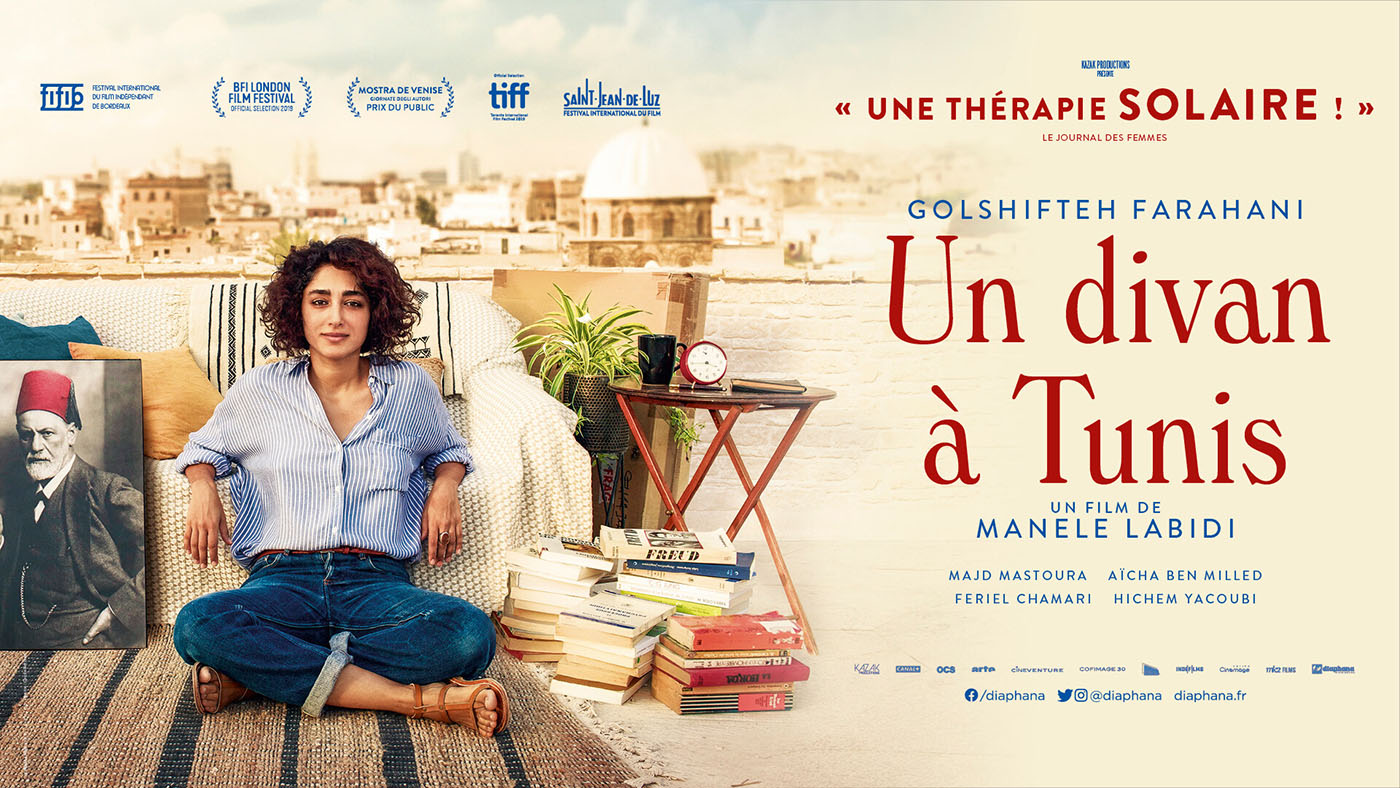
Arab Blues or Un divan à Tunis starring Golshifteh Farahani is available on VOD.


Arab Blues (Un divan à Tunis) 2019
comedy, drama, French and Arabic, with English subtitles
Directed by Manele Labidi
Running time 1 hour 28 minutes


In Arab Blues, nearly ten years have passed since the self-immolation of Mohamed Bouazizi that fueled Tunisia’s Jasmine Revolution, and deposed the country’s longtime dictator, Ben Ali.  While life in the burgeoning democratic Tunisia is still fragile, Selma, a Tunisian-born French citizen, is returning to Tunis at long last. Suspicious of her solo return to Tunis, her uncle, aunt, and cousins wonder if Selma is on drugs, on the run, a Mossad agent, or maybe pregnant. And, why, they grill her, isn’t she married yet? Why does she “dress like a guy,” have piercings, tattoos, and unruly hair?

Scenes of the city depict crowds, confusion, graffitied buildings with revolutionary slogans and the rather ubiquitous Tunisie libre (“free Tunisia”). Selma’s family can’t fathom her trading Paris for Tunis, the very place that they wanted to leave. Looking every bit the Parisian intellectual, Golshifteh Farahani plays the self-possessed and serious Selma, who, much to her family’s disapproval, is intent on opening a psychoanalysis practice in Tunis. Against the family’s objections, she moves herself into their apartment complex, and sets up shop in the rooftop flat.


Selma insists that people in Tunis need to talk. “We have God…we don’t need this bullshit!” rants her uncle. In Paris, rationalizes Selma, there were two other psychoanalysts in her building, and another ten on the same block. Thus, Tunis is where she can be of more service. There are obstacles though, and among them is the need to secure a medical license and business permit for her new practice. Selma’s mostly ineffectual journey within the bureaucracy of the Ministry of Health is both frustrating and funny. When she asks a secretary there if her application is in order, the response is a heavenward glance, punctuated by “inshallah.”

Meanwhile, Selma goes to the hair salon to offer psychoanalysis to the women there. As she describes a journey to oneself, through an inner door that opens to happiness and peace, she’s met with sarcasm and blank stares. But when she adds that she can be flexible with payments, suddenly everyone wants her business card. Despite an initial show of disdain and distrust, patients line up to see her, and the practice takes off. Selma’s treatment room displays an array of diplomas, and a picture of Freud in a fez whom few recognize. She imposes strict rules of conduct and boundaries, and insists on usage of the formal vous, altogether earning her a reputation as a “post-colonial snob.” And yet the patients keep coming back.

After the police learn that Selma is practicing without a license, which almost lands her in jail if not for her uncle’s bail payment, her uncle orders her to go back to Paris! Daily calls from her father in Paris beg her to come home. Instead, Selma pleads her case anew to the secretary at the Ministry of Health, who, unmoved, flatly implores God’s protection unto Selma.


The Tunisians in the film are fraught with post-revolutionary disillusionment, suffering from joblessness and socioeconomic struggles, loneliness, addictions, PTSD and paranoia, interpersonal discord, and internal angst. Their dramas and traumas are revealed by quirky, unexpected twists, such as when one male patient drops his pants. Misunderstanding Selma’s services, his defense is that he’d heard about “the French woman with a sofa.” To this point, the English film title, Arab Blues, is not nearly as fitting as the literal translation from French — “a sofa in Tunis.” One patient muses that the horizonal position offered by the sofa lends to the psyche’s desire to open up. And another male patient takes comfort in confessing his sexual dreams about dictators: Al-Assad, Mohammed VI, Saddam Hussein, and the name now on everyone’s lips, Putin. But, he says, “If I dream about that bastard Bush, I’ll throw myself out of a window!”

As much as the film’s characters moan about feeling stuck, scared, or wanting to leave Tunisia, Selma digs in and wants to stay. A cousin alludes to Selma’s father’s exile from Tunisia and her mother’s heartbreak, and when the stoic Selma eventually has an emotional meltdown, it’s plausible that Golshifteh Farahani’s onscreen sobs come from personal grief associated with her banishment from Iran. In 2012, Farahani appeared in a short, French film in which each actor involved makes a statement (corps et âmes) about their art by removing a piece of clothing of their choice. For her bit, Farahani discreetly flashes a breast. Since then, death threats from the Islamic Republic have rendered safe return to Iran impossible.

For Farahani, France is now home. From an article in The Guardian in 2012 by Fiachra Gibbons, the actress is quoted as saying, “For the first time in my life I appreciated being a woman. Paris is a city that liberates you as a woman from all your sins that you think you are guilty of, it washes away all of that, and you are free.” Farahani’s Selma conveys that sense of personal liberation; she is unapologetic and beholden to no one, for which other female characters in the film are envious.

Just as the next phase of Tunisia is unclear, so too is the film’s outcome. While Arab Blues doesn’t pretend to answer the questions that necessarily spring from a country still in transition, it doesn’t evade them either.  The multilayered, multicultural storyline is thoughtful and engaging, and the soundtrack that includes Italian music from the 1960s adds a perfect touch to the not-quite-Tunisian, not-quite-French, but decidedly Mediterranean vibe.

 

MADNESS MADNESS
Mischa Geracoulis

Mischa Geracoulis is the Managing Editor at Project Censored and The Censored Press, contributor to Project Censored’s State of the Free Press yearbook series, and a Project Judge. Her experience as a journalist and editor has long focused on human rights and civil... Read more

Join Our Community

TMR exists thanks to its readers and supporters. By sharing our stories and celebrating cultural pluralism, we aim to counter racism, xenophobia, and exclusion with knowledge, empathy, and artistic expression.

Learn more

RELATED

Fiction

The Intersection

5 SEPTEMBER 2025 • By Ayça Çubukçu
The Intersection
Profile

The Markaz Review Welcomes New Fellow, Lara Vergnaud

29 AUGUST 2025 • By TMR
The Markaz Review Welcomes New Fellow, Lara Vergnaud
Fiction

“The Last Third of the Night”—a story by Dia Barghouti

7 FEBRUARY 2025 • By Dia Barghouti
“The Last Third of the Night”—a story by Dia Barghouti
Book Reviews

Eyeliner: A Cultural History by Zahra Hankir—A Review

19 FEBRUARY 2024 • By Nazli Tarzi
<em>Eyeliner: A Cultural History</em> by Zahra Hankir—A Review
Essays

A Treatise on Love

4 FEBRUARY 2024 • By Maryam Haidari, Salar Abdoh
A Treatise on Love
Essays

Days of Oranges—Libya’s Thawra

3 DECEMBER 2023 • By Yesmine Abida
Days of Oranges—Libya’s Thawra
Book Reviews

The Maghreb Generation—North African Creatives for a Postcolonial Future

30 OCTOBER 2023 • By Tugrul Mende
The Maghreb Generation—North African Creatives for a Postcolonial Future
Poetry

Home: New Arabic Poems in Translation

11 OCTOBER 2023 • By Sarah Coolidge
<em>Home</em>: New Arabic Poems in Translation
Books

Edward Said: Writing in the Service of Life 

9 OCTOBER 2023 • By Layla AlAmmar
Edward Said: Writing in the Service of Life 
Amazigh

World Picks: Festival Arabesques in Montpellier

4 SEPTEMBER 2023 • By TMR
World Picks: Festival Arabesques in Montpellier
A Day in the Life

A Day in the Life: Cairo

24 JULY 2023 • By Sarah Eltantawi
A Day in the Life: Cairo
Interviews

Musical Artists at Work: Naïssam Jalal, Fazil Say & Azu Tiwaline

17 JULY 2023 • By Jordan Elgrably
Musical Artists at Work: Naïssam Jalal, Fazil Say & Azu Tiwaline
Art & Photography

Garden of Africa: Interview with Rachid Koraïchi

4 JUNE 2023 • By Rose Issa
Garden of Africa: Interview with Rachid Koraïchi
Columns

Sudden Journeys: Paris Arabe

27 MARCH 2023 • By Jenine Abboushi
Sudden Journeys: Paris Arabe
Arabic

Meet Ghoula—Arabic Music Remixed Via Tunisia

20 MARCH 2023 • By Melissa Chemam
Meet Ghoula—Arabic Music Remixed Via Tunisia
Fiction

“Raise Your Head High”—new fiction from Leila Aboulela

5 MARCH 2023 • By Leila Aboulela
“Raise Your Head High”—new fiction from Leila Aboulela
Cities

Nabeul, Mon Amour

5 MARCH 2023 • By Yesmine Abida
Nabeul, Mon Amour
Featured Artist

Benjemy : The unclassifiable Tunisian DJ

16 JANUARY 2023 • By Sarah Ben Hamadi
Benjemy : The unclassifiable Tunisian DJ
Essays

End of an Era: Al Saqi Bookshop in London Closes

16 JANUARY 2023 • By Malu Halasa
End of an Era: Al Saqi Bookshop in London Closes
Essays

Sexploitation or Cinematic Art? The Case of Abdellatif Kechiche

15 DECEMBER 2022 • By Viola Shafik
Sexploitation or Cinematic Art? The Case of Abdellatif Kechiche
Featured article

Thousands of Tunisians Are Attempting the “Harga”

31 OCTOBER 2022 • By Sarah Ben Hamadi
Thousands of Tunisians Are Attempting the “Harga”
Essays

Celebrating Mawlid An-Nabaoui with Stambeli Trance in Tunis

31 OCTOBER 2022 • By Shreya Parikh
Celebrating Mawlid An-Nabaoui with Stambeli Trance in Tunis
Film Reviews

44th CINEMED fest to Fête Simone Bitton & Abdellatif Kéchiche

5 OCTOBER 2022 • By Jordan Elgrably
44th CINEMED fest to Fête Simone Bitton & Abdellatif Kéchiche
Art & Photography

In Tunis, Art Reinvents and Liberates the City

29 AUGUST 2022 • By Sarah Ben Hamadi
In Tunis, Art Reinvents and Liberates the City
Poetry

Poem for Tunisia: “Court of Nothing”

1 AUGUST 2022 • By Farah Abdessamad
Poem for Tunisia: “Court of Nothing”
Columns

Tunisia’s Imed Alibi Crosses Borders in new “Frigya” Electronica Album

18 JULY 2022 • By Melissa Chemam
Tunisia’s Imed Alibi Crosses Borders in new “Frigya” Electronica Album
Film

Tunisians On the Couch in “Arab Blues”

15 JULY 2022 • By Mischa Geracoulis
Tunisians On the Couch in “Arab Blues”
Art

“A Tunisian Revolt” — the Rebel Power of Arab Comics

21 FEBRUARY 2022 • By Nada Ghosn
“A Tunisian Revolt” — the Rebel Power of Arab Comics
Book Reviews

From Jerusalem to a Kingdom by the Sea

29 NOVEMBER 2021 • By Rana Asfour
From Jerusalem to a Kingdom by the Sea
Editorial

Why COMIX? An Emerging Medium of Writing the Middle East and North Africa

15 AUGUST 2021 • By Aomar Boum
Why COMIX? An Emerging Medium of Writing the Middle East and North Africa
Latest Reviews

Rebellion Resurrected: The Will of Youth Against History

15 AUGUST 2021 • By George Jad Khoury
Rebellion Resurrected: The Will of Youth Against History
Art & Photography

Walls, Graffiti and Youth Culture in Egypt, Libya & Tunisia

14 MAY 2021 • By Claudia Wiens
Walls, Graffiti and Youth Culture in Egypt, Libya & Tunisia
Book Reviews

Being Jewish and Muslim Together: Remembering Our Legacy

28 MARCH 2021 • By Joyce Zonana
Being Jewish and Muslim Together: Remembering Our Legacy
Weekly

Francofeminism: a Postcolonial History

14 FEBRUARY 2021 • By TMR
Francofeminism: a Postcolonial History
TMR 6 • Revolutions

The Revolution Sees its Shadow 10 Years Later

14 FEBRUARY 2021 • By Mischa Geracoulis
The Revolution Sees its Shadow 10 Years Later
TMR 6 • Revolutions

Ten Years of Hope and Blood

14 FEBRUARY 2021 • By Robert Solé
Ten Years of Hope and Blood
TMR 3 • Racism & Identity

Systemic Racism in Tunisia Hasn’t Gone Away

15 NOVEMBER 2020 • By TMR
Systemic Racism in Tunisia Hasn’t Gone Away
World Picks

World Art, Music & Zoom Beat the Pandemic Blues

28 SEPTEMBER 2020 • By Malu Halasa
World Art, Music & Zoom Beat the Pandemic Blues
Music

Emel Mathlouthi Returns with The Tunis Diaries

22 SEPTEMBER 2020 • By TMR
Emel Mathlouthi Returns with The Tunis Diaries
Book Reviews

Poetic Exploration of Illness Conveys Trauma

14 SEPTEMBER 2020 • By India Hixon Radfar
Poetic Exploration of Illness Conveys Trauma

Leave a Comment

Your email address will not be published. Required fields are marked *

one × 3 =

Scroll to Top