Leyla Çağlı: A Turkish Poet’s Enduring Voice

Nihal Elmas Kaya, "Kaybolus."

1 MAY 2026 • By Leyla Çağlı, Mustafa Ziyalan Translated by Mustafa Ziyalan

A trio of poems by a late Turkish poet travel through time and across magical seas.

Leyla Çağlı (1970-2022) belongs to that quiet but vital lineage of poets whose work does not seek to announce itself loudly, yet leaves behind a distinct emotional and verbal atmosphere. Born in Karakoçan, Elazığ, educated as a teacher, and for many years based in Antalya, she lived not at the center of literary publicity but within the deeper, more intimate circuits of Turkish poetry: little magazines, serious readers, the slow and exacting fellowship of poems. Over the years, her work appeared in a range of literary journals, and she published the books Saksıda Deniz (The Sea in a Flowerpot) and Ağzımda Sustu Şehrazat (Scheherazade Fell Silent in My Mouth).

What endures in her poetry is a language of inward pressure: compressed, alert, wounded, and often resistant to paraphrase. Her poems do not open themselves all at once. They deepen as they proceed, moving by fracture, image, and tonal tension rather than by explanation. Even at their most intimate, they preserve a kind of mystery. They seem to arise from places where silence has not been overcome so much as made to speak. That is part of their force. They ask not merely to be read, but to be re-entered.

To bring Leyla Çağlı into English is therefore more than an act of literary introduction. It is also an act of carrying across a voice marked by vulnerability, intensity, and formal inwardness, a voice that deserves a wider hearing than it has yet received. The poems gathered here offer English-language readers an entry into that singular voice: grave, restless, tensile, and quietly luminous.

— Mustafa Ziyalan
Translator


Magic and Woman

Oh, the mouth—tired of repeating:
speak, and wake!
Words lie passed out
in lavender sacks beneath your tongue.

The halo of the chosen
was welcomed by melodies
of harps and cimbaloms.
You were always here.
With hearts of fired pots,
all male offspring of the mob—
more gossip
than wormwood’s whisper:
“Almighty Pan is dead!
Almighty Pan is dead!”

Herb-cures, polyphonic joy
of the pan flute.
Unidentified rain of stones,
volcanic ash,
fear and pan/ic.

Moses crossed another sea
without wetting even his feet—
what awesome miracle,
what believable myth.
Warm-up routine
of fins in pools for show.
Ask the water—
why did the baptism end early,
where you received the first gospel?

You awakened the dry appetite
of arsonist saints
marveling at their tamed lust.
There must be a punishment for that.

What surpasses its shadow
when struck by light at the right angle?
If chance favors
the rakish knife’s good aim,
it will rip the heart out.
Your hands, your feet in a vice—
you’ll burn
with what remains of your bones.

Wine of the warden,
feast of the judge,
rope of the executioner—
like wood, like tar.
All the expenses of death
slapped in cracks of time’s steps,
like a leer
across the face of holy books.

Did you say, “Do not let the witches live!”
Or did they only think you did?

—How long have you been absent, God?—

A rhymed curse across centuries:
state and assassinate.
In ears too small for screams,
what wailing in the temple of fire
has lasted this long?

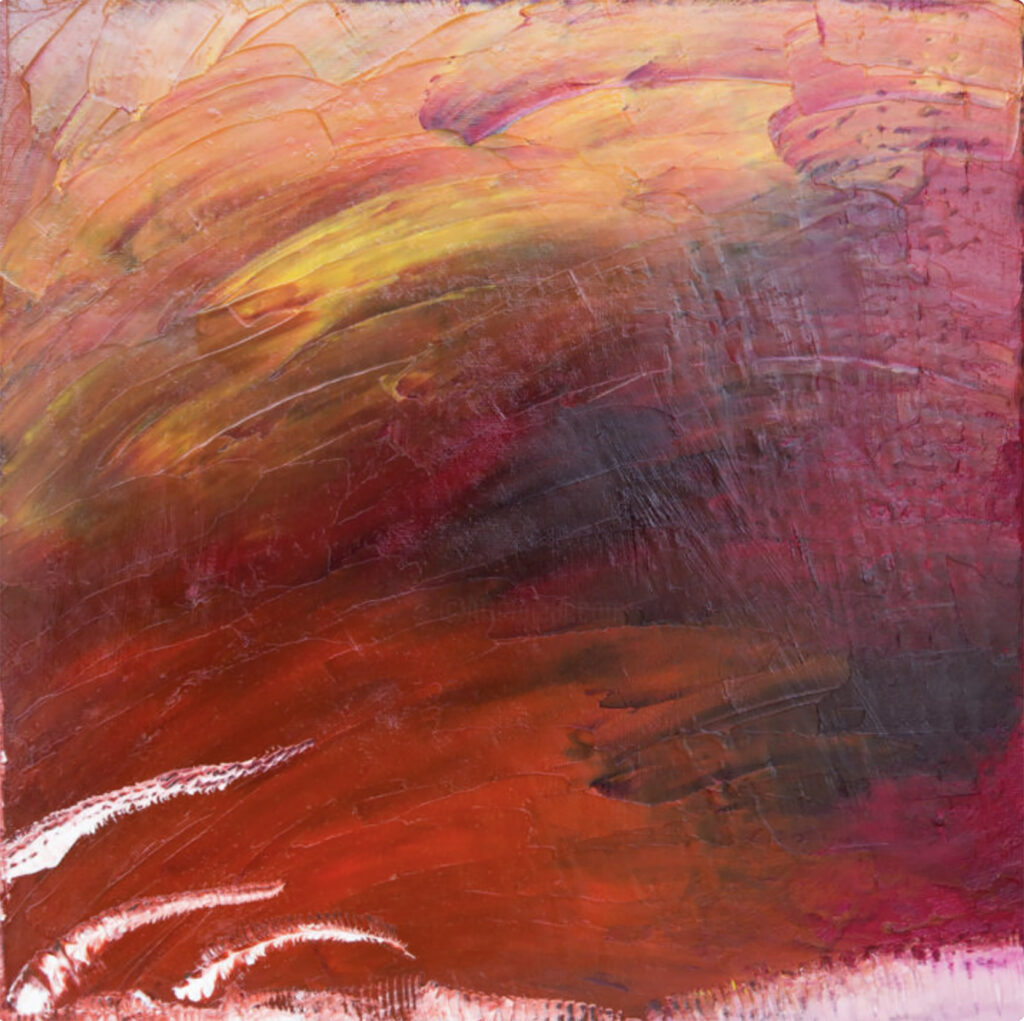
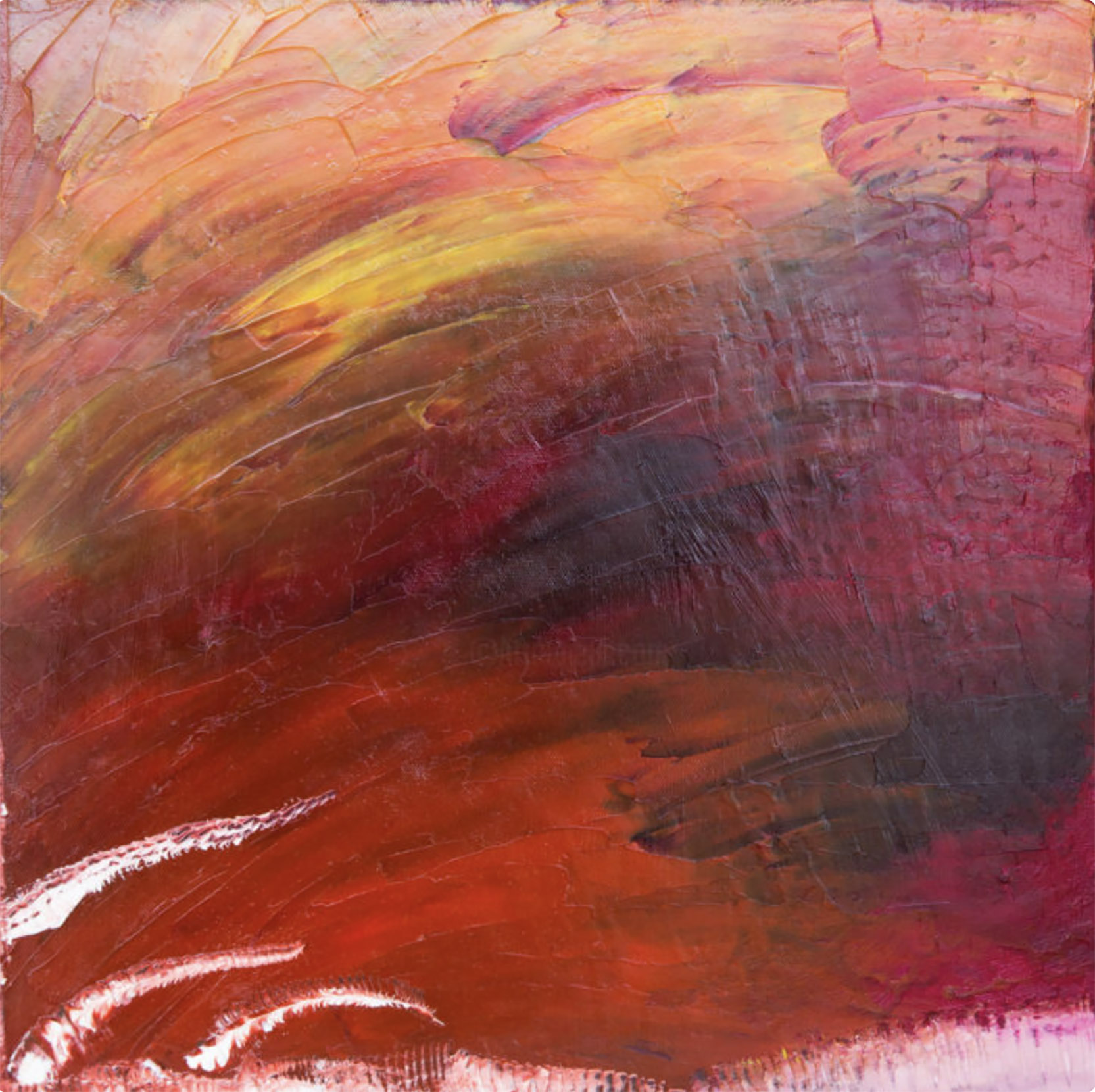
Nihal Elmas Kaya - Kaybolus acrylic on canvas 40x40cm 2013 courtesy Art Majeur
Nihal Elmas Kaya, “Kaybolus,” acrylic on canvas, 40x40cm, 2013 (courtesy Art Majeur).

Either / Or

Sweet, juicy fruit.
A broken harness, an epidemic of pleasure.
Omelas—all the links of the chain
tied to only one, only that one.
In the tainted smile of people,
common sense breaks out of its corset.

Your pathetic resignation—
it would not clot
even in the smallest pores of time.
Human: if not a child’s argument,
it meets itself
in the underpasses of its soul.

Either you become the boy-toy of men
whose balls have been seeded and sown,
or the toothmarks of the departed
on the neck of Karantina.1

Wouldn’t there be a short hesitation
at the mouth of the road, elongating—
our ways part
the moment we are about
to be pushed into the sea.

Either to Break the Present,
or to lock from the inside
all gates of the city.
My love, my thick pus—
how hard it is, sometimes, to stay.

If you don’t have a better option:
on the lush green meadow, a fistful of weed,
or to become the cool shadow
of the magnificent tree in the garden.
All your ambition is this.

Either to Break the Present 2
or to tie the sleeves
of people behind their backs.

Love has three syllables:
one is open, another closed.
The third—“all rights reserved.”
Going alone,
that one says.

Every Love Passes Its Own Stone

It was exactly three thousand years ago,
a night like this—
my umbilical, my first threat.

How I turned from the brink,
from the weight of abysses
leaping over me.

I took names,
jumping their fences,
from courts of love
I ran away from.

I peeked, in secret,
through the illusion—
its shame, whose tracks
too narrow for its splinter,
shrinking across the face of the earth.

Holy loves with righteous wars,
boundless,
in a jealous field of tobacco,
slippery, taking no side.

The pleasure of words,
their abundant allusions—
a daydream,
a chorus of expired voices,
favored by a few apostles.


1 An island located in Urla district of İzmir, Türkiye. The island, which was used in the fight against infectious disease during the Ottoman Empire, was named after the French quarantine facilities in 1865.

2 “Break the Present” by Hüseyin Çiftçi.
 

Leyla Çağlı

Leyla Çağlı (1970-2022) was a poet, writer, and educator. Born in Karakoçan, Elazığ, and later based in Antalya, where she worked as a teacher, she published in a number of Turkish literary journals and brought out the books Saksıda Deniz and Ağzımda... Read more

Mustafa Ziyalan

Mustafa Ziyalan was born on Turkey’s Black Sea coast and now lives in New York, where he practices psychiatry. His poetry, short fiction, essays, and translations have appeared in numerous literary journals and anthologies, including New European Poets, as well as in... Read more

Join Our Community

TMR exists thanks to its readers and supporters. By sharing our stories and celebrating cultural pluralism, we aim to counter racism, xenophobia, and exclusion with knowledge, empathy, and artistic expression.

Learn more

RELATED

TMR 59 • MEDITERRANEANS

Leyla Çağlı: A Turkish Poet’s Enduring Voice

1 MAY 2026 • By Leyla Çağlı, Mustafa Ziyalan
Leyla Çağlı: A Turkish Poet’s Enduring Voice
TMR 59 • MEDITERRANEANS

“Last Glance at the Bosphorus”—a short story

1 MAY 2026 • By Nektaria Anastasiadou
“Last Glance at the Bosphorus”—a short story
Essays

The Friend of the Fallen: James Baldwin in Istanbul

19 DECEMBER 2025 • By Öykü Tekten
The Friend of the Fallen: James Baldwin in Istanbul
Art

The Three-Legged Cat—Istanbul’s 18th Biennale

14 NOVEMBER 2025 • By Nat Muller
<em>The Three-Legged Cat</em>—Istanbul’s 18th Biennale
Essays

I Don’t Have Time For This Right Now

5 SEPTEMBER 2025 • By Re'al Bakhit
I Don’t Have Time For This Right Now
Art

Repression and Resistance in the Work of Artist Ateş Alpar

27 JUNE 2025 • By Jennifer Hattam
Repression and Resistance in the Work of Artist Ateş Alpar
Book Reviews

Djinns Unveils Silence in the Home

9 MAY 2025 • By Elena Pare
<em>Djinns</em> Unveils Silence in the Home
History

Ahlat Reimagined—Birthplace of Turkish Rule in Anatolia

29 NOVEMBER 2024 • By William Gourlay
Ahlat Reimagined—Birthplace of Turkish Rule in Anatolia
Books

On The Anthropologists—an interview with Aysegül Savas

26 JULY 2024 • By Amy Omar
On <em>The Anthropologists</em>—an interview with Aysegül Savas
Book Reviews

Life Along Istanbul’s Byzantine Walls, a Review

28 JUNE 2024 • By Arie Amaya-Akkermans
Life Along Istanbul’s Byzantine Walls, a Review
Books

A Bicentennial Remembrance of Lord Byron, Among Greeks & Turks

7 JUNE 2024 • By William Gourlay
A Bicentennial Remembrance of Lord Byron, Among Greeks & Turks
Featured excerpt

“The Forgotten”—a short story by Oğuz Atay

3 MAY 2024 • By Ralph Hubbell
“The Forgotten”—a short story by Oğuz Atay
Book Reviews

Inci Atrek’s Intercultural Novel—Holiday Country

29 JANUARY 2024 • By Amy Omar
Inci Atrek’s Intercultural Novel—<em>Holiday Country</em>
Poetry

Two Poems by Efe Duyan

22 DECEMBER 2023 • By Efe Duyan, Aron Aji
Two Poems by Efe Duyan
Essays

Rebuilding After the Quake: a Walk Down Memory Lane in Southeast Anatolia

5 NOVEMBER 2023 • By Sevinç Ünal
Rebuilding After the Quake: a Walk Down Memory Lane in Southeast Anatolia
Essays

In and Between Languages: Writing on the Fault Line

1 OCTOBER 2023 • By Nektaria Anastasiadou
In and Between Languages: Writing on the Fault Line
Art

Memory Art: Water and Islands in the Work of Hera Büyüktaşçıyan

18 SEPTEMBER 2023 • By Arie Amaya-Akkermans
Memory Art: Water and Islands in the Work of Hera Büyüktaşçıyan
Art

Anatolian Journey: a Writer Travels to Sultan Han to Witness a Postmodern Installation

18 SEPTEMBER 2023 • By Matt Hanson
Anatolian Journey: a Writer Travels to Sultan Han to Witness a Postmodern Installation
Art & Photography

The Ghost of Gezi Park—Turkey 10 Years On

19 JUNE 2023 • By Arie Amaya-Akkermans
The Ghost of Gezi Park—Turkey 10 Years On
Art & Photography

Deniz Goran’s New Novel Contrasts Art and the Gezi Park Protests

19 JUNE 2023 • By Arie Amaya-Akkermans
Deniz Goran’s New Novel Contrasts Art and the Gezi Park Protests
Essays

Turkey’s Earthquake as a Generational Disaster

4 JUNE 2023 • By Sanem Su Avci
Turkey’s Earthquake as a Generational Disaster
Essays

Beautiful Ghosts, or We’ll Always Have Istanbul

27 MARCH 2023 • By Alicia Kismet Eler
Beautiful Ghosts, or We’ll Always Have Istanbul
Columns

Letter From Turkey—Solidarity, Grief, Anger and Fear

27 FEBRUARY 2023 • By Jennifer Hattam
Letter From Turkey—Solidarity, Grief, Anger and Fear
Art

Displacement, Migration are at the Heart of Istanbul Exhibit

13 FEBRUARY 2023 • By Jennifer Hattam
Displacement, Migration are at the Heart of Istanbul Exhibit
Columns

Tiba al-Ali: A Death Foretold on Social Media

5 FEBRUARY 2023 • By Malu Halasa
Tiba al-Ali: A Death Foretold on Social Media
Fiction

“The Truck to Berlin”—Fiction from Hassan Blasim

5 FEBRUARY 2023 • By Hassan Blasim
“The Truck to Berlin”—Fiction from Hassan Blasim
Fiction

Nektaria Anastasiadou: “Gold in Taksim Square”

15 JUNE 2022 • By Nektaria Anastasiadou
Nektaria Anastasiadou: “Gold in Taksim Square”
Film Reviews

2022 Webby Honoree Documents Queer Turkish Icon

23 MAY 2022 • By Ilker Hepkaner
2022 Webby Honoree Documents Queer Turkish Icon
Art

Silver Stories from Artist Micaela Amateau Amato

15 FEBRUARY 2022 • By Micaela Amateau Amato
Silver Stories from Artist Micaela Amateau Amato
Art

(G)Hosting the Past: On Michael Rakowitz’s “Reapparitions”

7 FEBRUARY 2022 • By Arie Amaya-Akkermans
(G)Hosting the Past: On Michael Rakowitz’s “Reapparitions”
Fiction

“The Location of the Soul According to Benyamin Alhadeff”—a story by Nektaria Anastasiadou

15 SEPTEMBER 2021 • By Nektaria Anastasiadou
“The Location of the Soul According to Benyamin Alhadeff”—a story by Nektaria Anastasiadou
Art

Malak Mattar — Gaza Artist and Survivor

14 JULY 2021 • By Jordan Elgrably
Malak Mattar — Gaza Artist and Survivor
Interviews

The Hidden World of Istanbul’s Rums

21 FEBRUARY 2021 • By Rana Haddad
The Hidden World of Istanbul’s Rums
TMR 5 • Water

The Sea That Binds and Divides: Our Mediterranean

14 JANUARY 2021 • By Iason Athanasiadis
The Sea That Binds and Divides: Our Mediterranean
Book Reviews

An American in Istanbul Between Muslim and Christian Worlds

15 NOVEMBER 2020 • By Anne-Marie O'Connor
An American in Istanbul Between Muslim and Christian Worlds

Leave a Comment

Your email address will not be published. Required fields are marked *

two + eight =

Scroll to Top